The latest in an occasionally-regular series exploring books and other items selected from our vast collections. In this entry Librarian Antony Ramm looks at a language phrase book from the 18th-century and, in particular, one intriguing handwritten note…
This week’s entry in the Chimney Corner series is what appears to be an 18th-century Latin-to-French phrasebook, authored by Claude Charles Thiboust and entitled Les nouveaux rudimens de la langue latine, reduits en nouvel ordre (which seems to roughly translate as ‘The new rudiments of the Latin language’. (The spine title of the box the book is kept in reads just La Langue Latine)
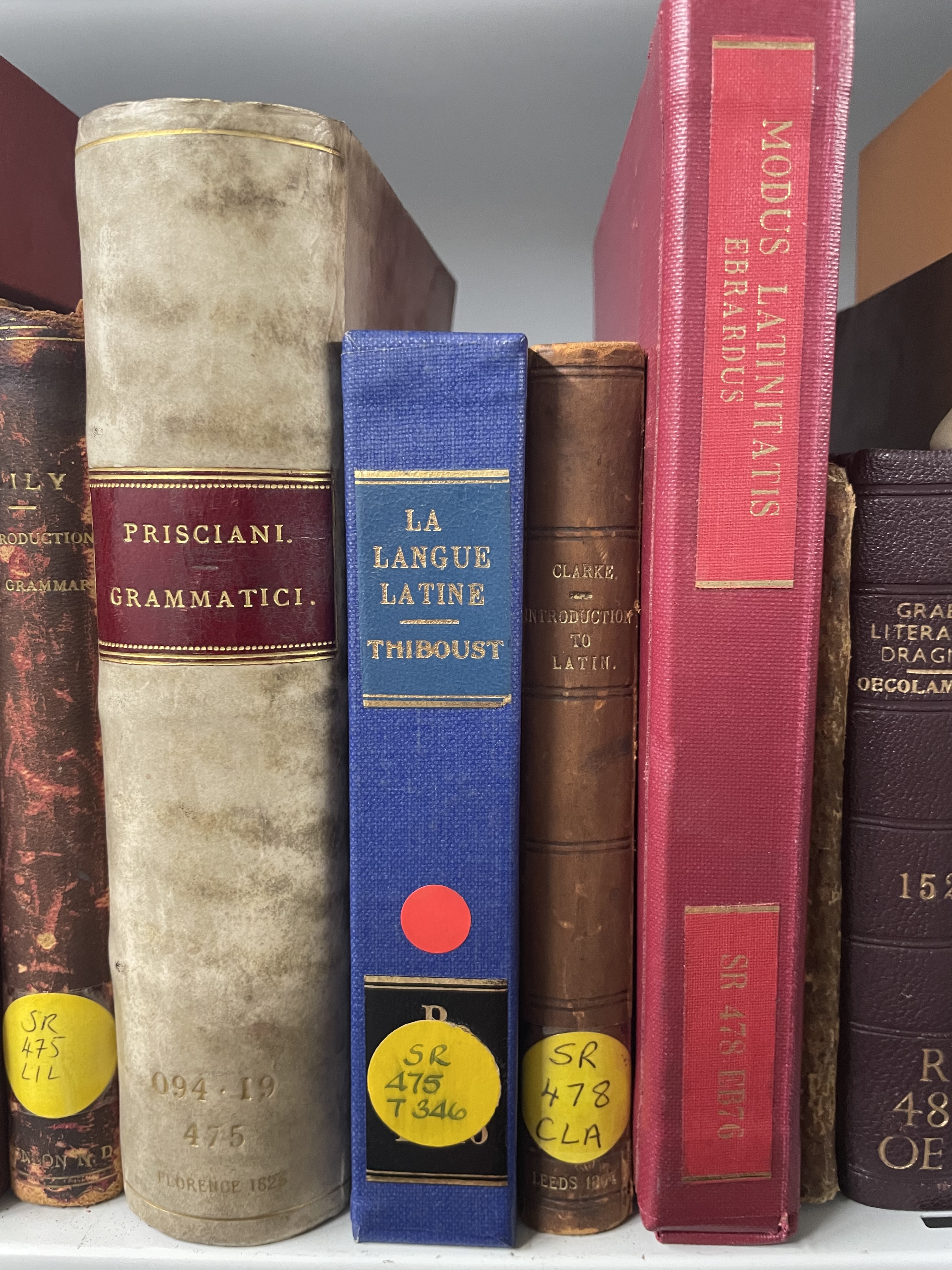
Little can be said about either the book itself. Our records attached to the book itself give only a very general publication century of 17–, though other catalogue details suggest more specific dates of 1702 or 1750.
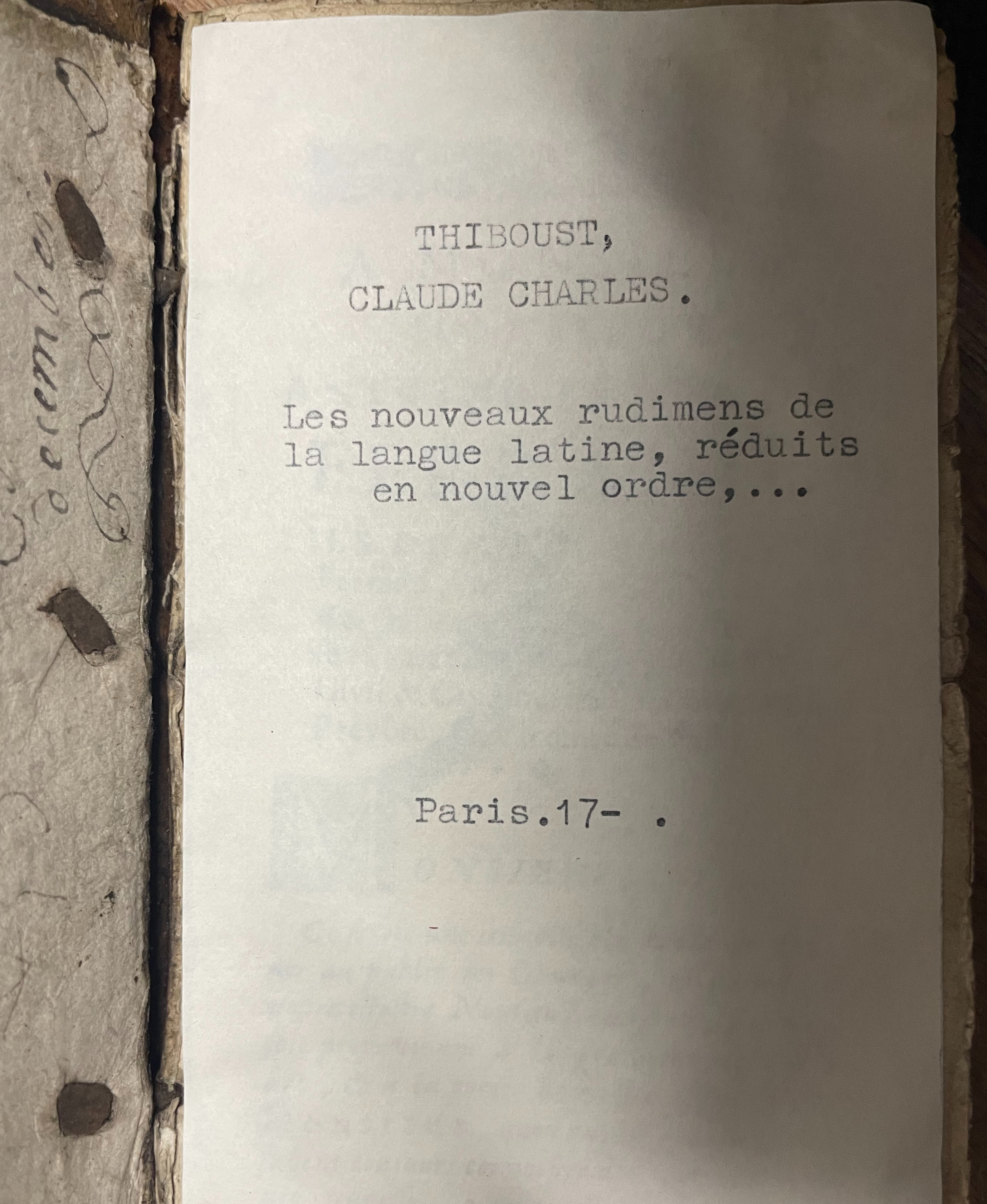
We don’t have any other works by Claude Charles Thiboust in our Library collections. However, some useful biographical details can be found in Volume 3 (T-Z) of Edward Clements Bigmore’s A Bibliography of Printing (1886). There, on pages 8-9, we find that Thiboust hailed from a family of legendary renown in the French printing and publishing world, with a lineage stretching back to Guillaume Thiboust, a printer of the 16th-century.
Claude Charles’ father – Charles Thiboust – added his own considerable achievements to that inheritance, being not only a printer of good quality editions of the classics, but also himself a Latin and Greek scholar and author of a Latin-language poem. On his death in 1737 he was succeeded by his son, who maintained the high reputation of the family in printing and publishing, translating his father’s poem and being described by Bigmore as “in reputation his [Charles’] rival.” Claude Charles died in 1757.
It seems likely, then, that our volume is part of the Thiboust tradition of Latin-language texts, likely being intended for French-speaking gentlemen to better enjoy the works of Greek and Latin authors such as Horace (on a translation of who Claude Charles was engaged when he died).
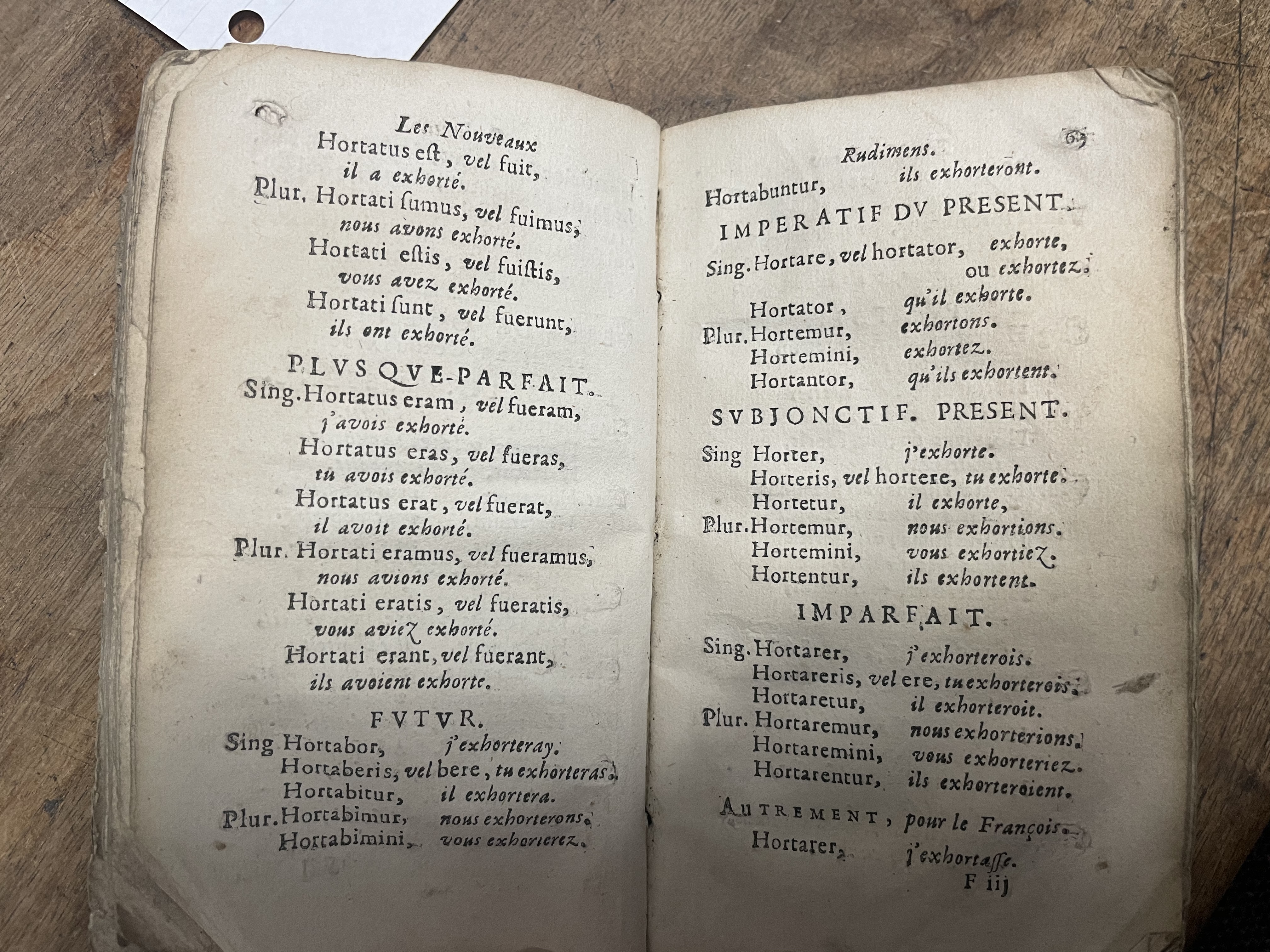
It’s entirely possible, however, that Thiboust was only the printer and not the author of this work: Worldcat entries for other copies of the same title appear to indicate the book was written by a Pierre Esclassan. And interestingly, the introduction to the book shows a very brief reference to someone sharing those same initials – and a quick google translate shows us that Pierre Esclassan was, in fact, apprenticed to Claude Thiboust and then, later, his business companion and partner.
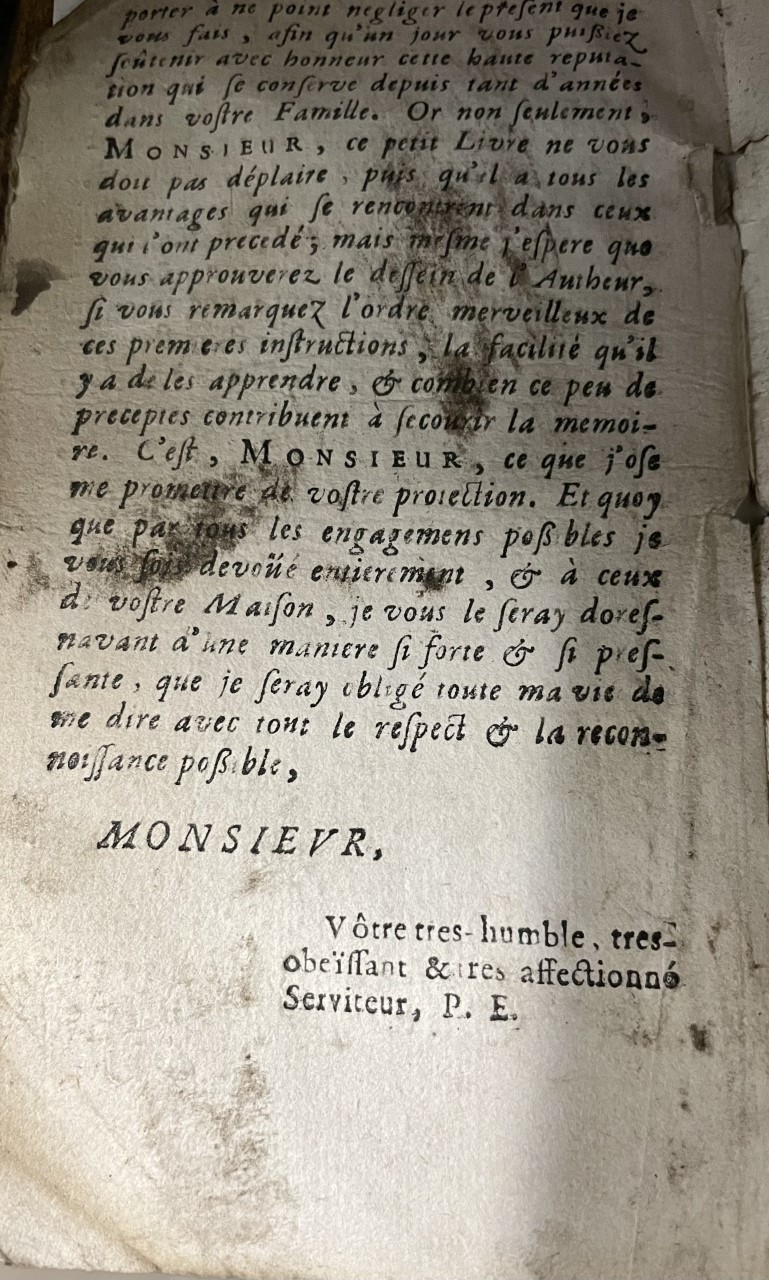
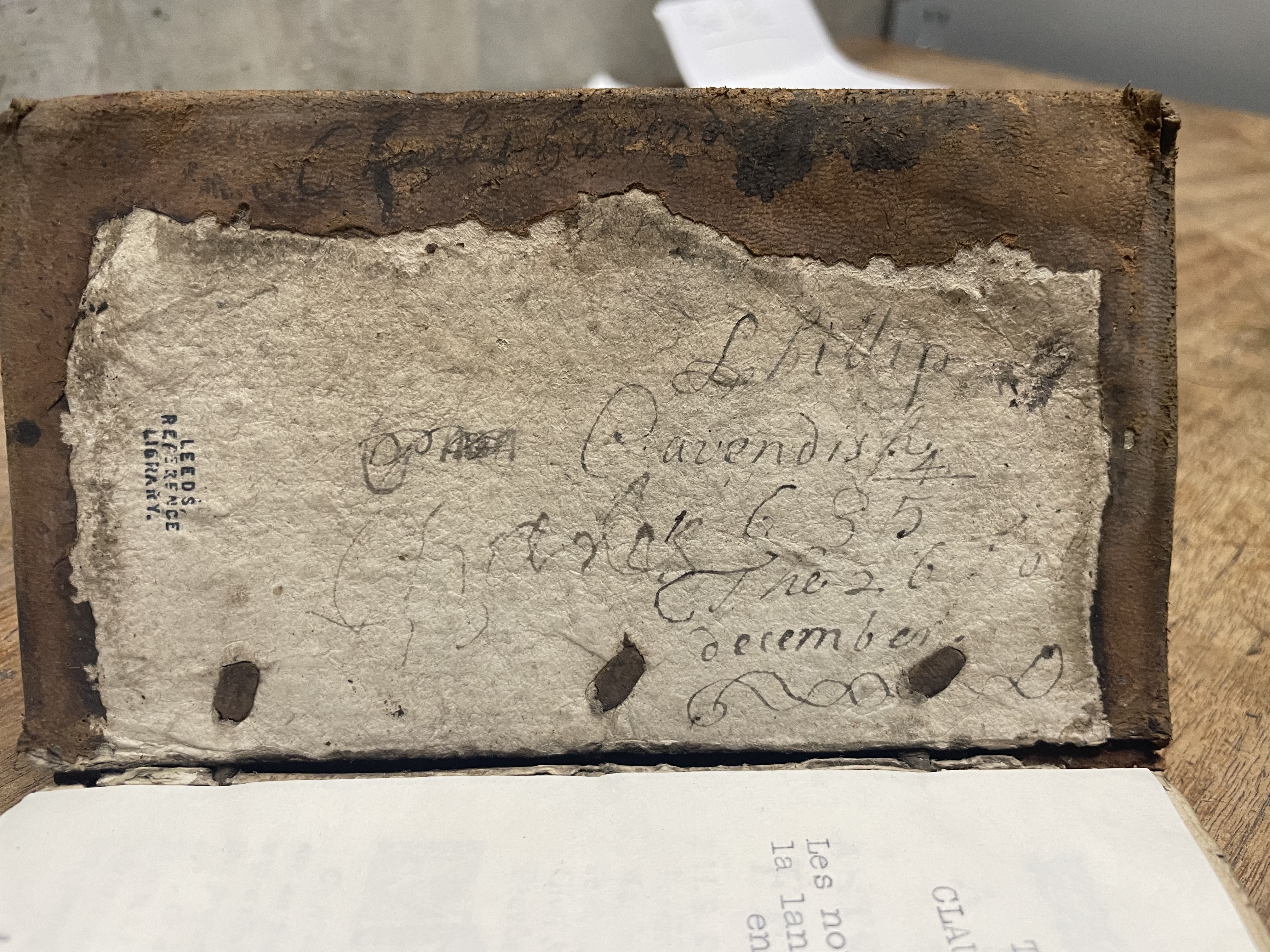
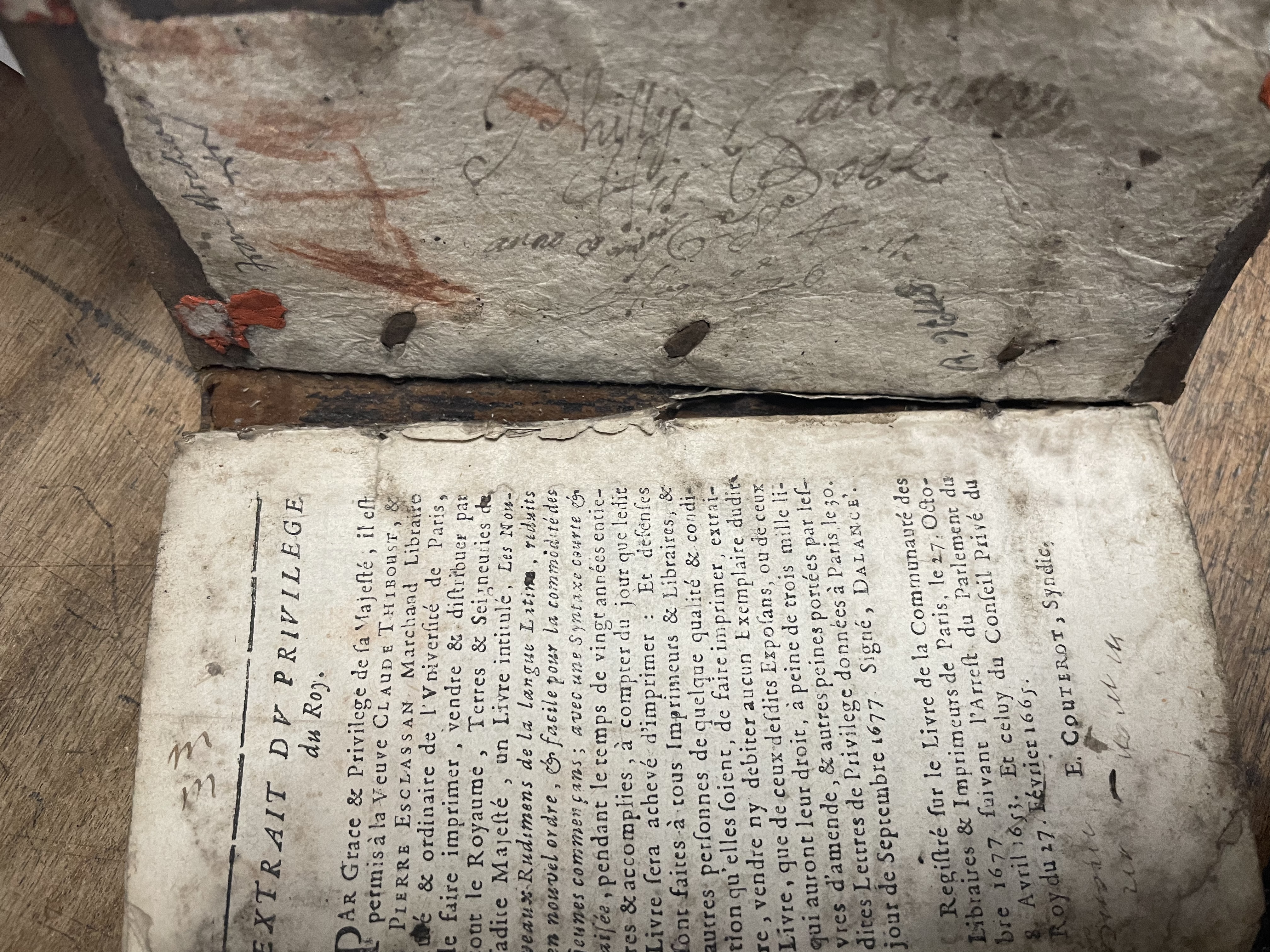
That minor authorial quibble aside, our particular copy of this title is most notable, not for the text itself, but for its material condition. As the images of the book’s binding and inside covers below/above show, this particular copy has been very well-used by a previous owner – hence our copy being preserved by us in a rather sturdy box.
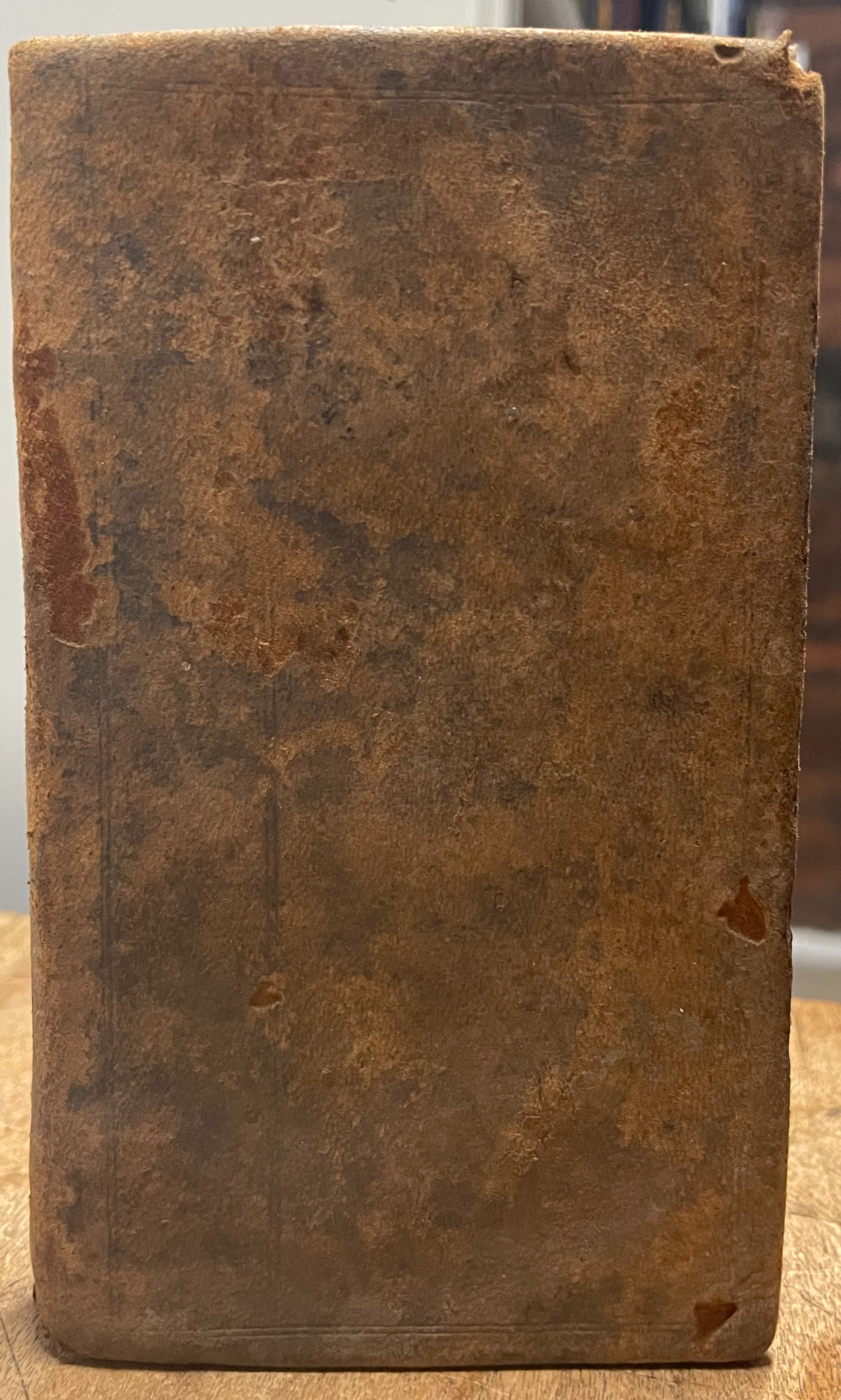
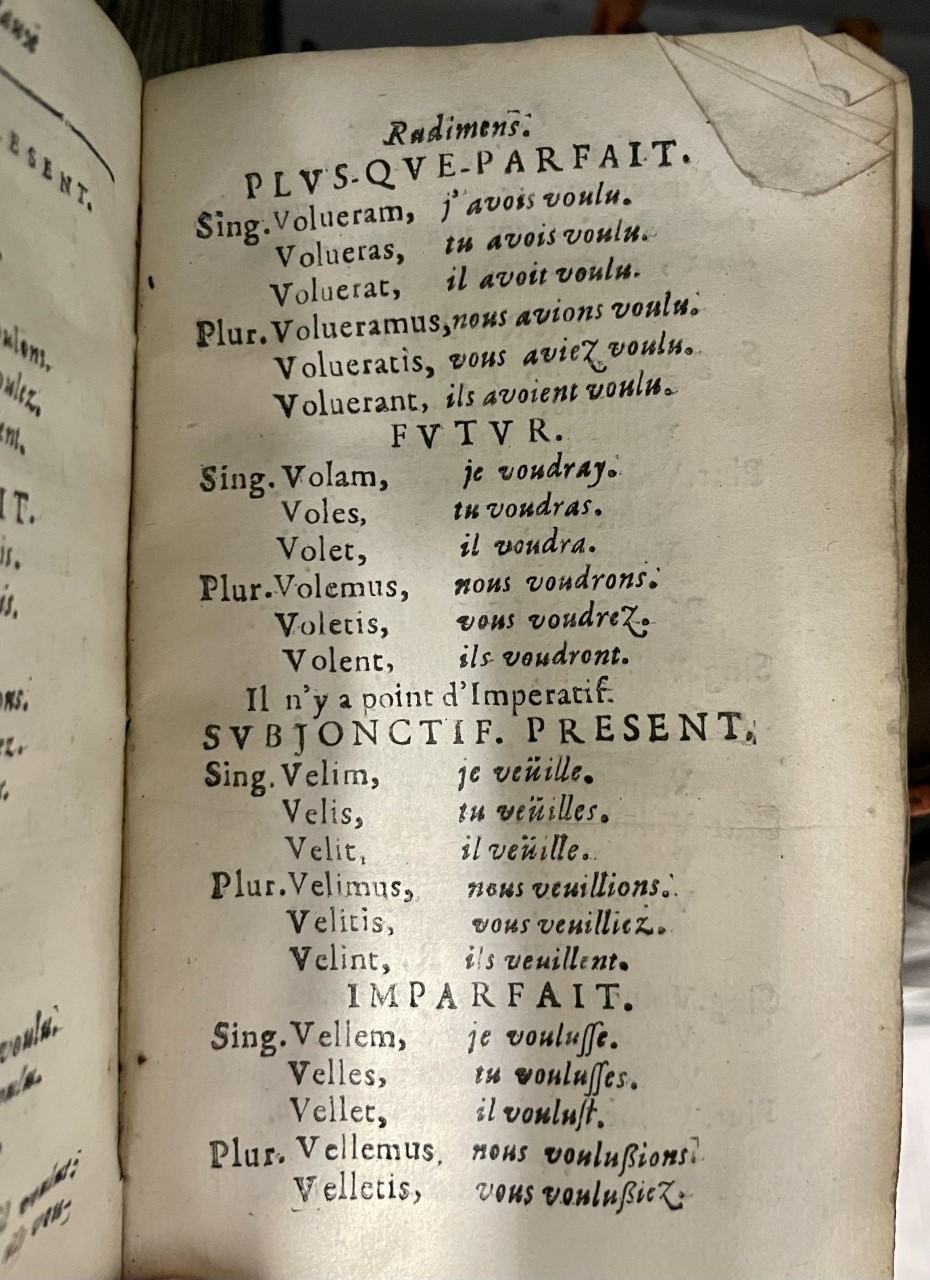
Further evidence, perhaps, of the same can be seen in the fact some of the page corners have been turned down – that’s either something that has happened during storage or handling by previous owners or Librarians; or, I’d like to think, particular pages being bookmarked by a reader-owner who spent significant periods of time with our volume.
And we find on those front and inside covers, a clue to who (at least one of) that previous owner may have been, with a quite visible handwritten note saying what reads like ‘Philip Cavendish’ on both pages. (Other jottings are also visible, but harder to read clearly).
So, who was this Philip Cavendish? That’s a hard question to answer. We can find no evidence that he was a Leeds man, which would probably be the most obvious explanation for Leeds Libraries owning this particular copy of this particular book.
In fact, the only person matching that name who might be a likely match is Admiral Philip Cavendish, who was active in the first half of the 18th-century and who died in 1743. It’s possible this Philip Cavendish owned and then autographed his copy of this book. It’s equally possible, of course, that this Philip Cavendish was (to use a rather ugly phrase) an ‘ordinary person’ and unrelated to the Admiral of the same name.
None of that explains why we hold this copy here at the Central Library in Leeds; sadly, a search of our Annual Reports returns no mention of this book, why and when it was purchased by us or donated to us. (Nor does a search of local newspaper records)
Do any readers have any ideas? Leave a comment below!
*****
At the time of writing this book is not available through our online catalogue, but you can request to see it by calling us on 0113 37 85005 or emailing LibraryEnquiries@leeds.gov.uk
The book can be found at shelfmark SR 475 T346
 The Secret Library | Leeds Libraries Heritage Blog