This week we hear from Jeanette B of the Friends of Beckett Street Cemetery group about the life and achievements of an inspiring Leeds woman…
Whilst researching and reading on the Friends of Beckett Street Cemetery website I was very interested to find a gentleman buried in the Cemetery who was known as the ‘Blind Botanist’. My curiosity was piqued, particularly because he grew up in the shadow of St. Saviour Church where generations of my family were baptised and married so I had to find out more.
It has been fascinating to read about the things he learned to do and what he achieved, so much so that I met with Clare Brown the Curator of Natural Science at the Leeds Museum Discovery Centre. I had an informative visit and was actually able to look at documents and some of his many books of specimens in the Herbarium held in their archives. (Many of the images in this article are of items in the Discovery Centre and are copyright of Leeds Museums and Galleries)
His cuttings have inspired me to do more research and even paint a watercolour painting of one of them which I thoroughly enjoyed!


Following my visit I read through the documents I had been given and it became apparent that whilst society at that time often focused on the achievements of the men, this particular man had a devoted, wonderful, supportive, and very proud mother who encouraged and helped him throughout his life.
Theodosia was born on 30 December 1831 and was the first-born daughter of John Grimshaw and Anne Pearson (who was illiterate and unable to even sign her marriage certificate). They had married in St. Wilfred’s, Calverley on 9 November 1830. At the time of her birth they lived in Wortley, Leeds. Theodosia was christened at the South Parade Baptist Church in Headingley. There were several Baptists in the family and her grandparents on her paternal side were Quakers. On the 1841 Census the family lived on Charley Street off St. Peter’s Street, Leeds. Her father was a Porter and her mother a Binder. In 1851 Theodosia was working as a General Servant and living in Leeds Infirmary at 19 years old.

She married George Wilkinson who was a Grocer and Shopkeeper in 1854. Their son John was born to them on 6 January 1856 and was their only child. Searching on Ancestry and GRO has not revealed any other records for possible siblings.
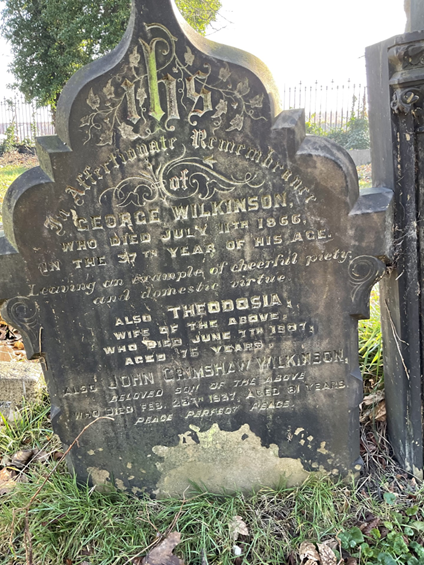
George died 11 July 1866 aged 36 at 30 Lower Bachelor Street in the Richmond Hill area of Leeds when John was just 10 years old. This area of Leeds was also known as ‘The Bank’ where generations of my family had also lived and where I was born. According to the Leeds House of Recovery Records there was an epidemic of Typhus Fever in Leeds during that time. Without seeing George’s death certificate, I can only wonder as to his cause of death at such a young age and if he succumbed to this illness, though life expectancy was much lower back then. George was the first of his family to be buried in plot 26307 in Beckett Street Cemetery.

Theodosia married Thomas Crookshank (10 years her junior), also a Grocer, in 1867 and on the 1871 Census they live as a family at 31 and 32 Bachelor Street, Leeds. John was working as a Grocers Assistant. As well as working, John’s hobby was water-colour painting (he was self-taught like me). By the time he had reached 20 he was painting beautiful pictures including one of his most successful done at Temple Newsam in which he showed great artistic promise. The whereabouts of this painting seems to be unknown if indeed it is still in existence. Artistic talent runs in the family.
By the 1881 Census Theodosia and her son John are living at 8 Ashworth Place but Thomas is no longer with them, he is living as a border with someone else.

John is listed on the Census as ‘Blind not from birth’ and ‘Son of former husband’ and they are both listed as ‘Retired Grocers’. John is 25 by this time.
John became blind at the age of just 22 after suffering from a serious illness with Rheumatic Fever. I imagine this would have been a very difficult time for his family and might explain the changes in family dynamics.
Thomas is always listed as ‘married’ on subsequent Census Records, but Theodosia returns to her previous married name of Theodosia Wilkinson and is recorded as a ‘Widow’ on the 1891 Census living at 5 Carberry Terrace, Burley Lodge Road, Headingley where John is listed as ‘Head of the House’. No children from her marriage to Thomas that I am aware of after checks on Ancestry, GRO and other records available.

No divorce records can be found online so I assume the marriage broke down and they lived separate lives from then on. In the articles I have read John does not make mention of this.
John continued to remain heavily dependent upon his mother to be his single-parent caregiver and support. We understand the concept of that in our modern-day society, but it was also true of women back then. Even in modern times caring for someone with any sort of disability can put a great strain on marriages and families. Fortunately they had sufficient means to ensure they were not living in poverty as many in Leeds did during that time.
Several members of the Grimshaw family, by all accounts, excelled in the fields of Art, Science, Botany, Music and Literature. Theodosia obviously had an education, as evidenced by the level of support she gave to her son John.
An article in a Special to The Yorkshire Evening Post dated 14 August 1906 entitled “The Blind Botanist – A Wonderful Leeds Scientist” begins with a quote from his mother Theodosia who stated “I don’t think they are blind when they are like him.” The author (a Yorkshire Evening Post representative not listed) writes (quote) “It was the aged mother of Mr John Grimshaw Wilkinson, the sightless President of the Leeds Naturalist Club and Scientific Association who spoke. And she cast upon her fifty-year-old son such a glance of motherly pride and affection that conveyed a volume of meaning”.
At the time of writing this article the writer had previously (quote) had a “chat with the Superintendent of the Leeds Blind Institution….I had asked the Superintendent ‘who is the most wonderful of the four hundred blind people in Leeds?’ promptly he replied ‘Mr. Wilkinson the well-known botanist. He is one of the most wonderful blind men in the country”. Thanks, in my opinion, in large measure due to his wonderful mother.
After he lost his sight he determined to find some method of developing his other senses once he realised he could still tell the trees that he had included in his paintings by their touch.
Part of this determination came from the fact that (quote from John in Leeds People, Great Thoughts, pg 116)
“my own family had long been noted throughout the North of England especially, but even farther too, for their artistic skill and work in various ways. Atkinson Grimshaw, the famous Yorkshire painter was a second cousin of mine; Arthur Grimshaw, the clever musician and organist…was another relative (I discovered he was the first Organist and Master of the Choristers of the Leeds Cathedral where he remained in post for 30 years and one of the first conductors of the Leeds Symphony Society – now the Leeds Symphony Orchestra), also Percy Grimshaw, the popular scientist at the Edinburgh Museum is another….whilst Arthur Hubbard of the Ordnance Department, Southampton is still another. So you see I had every incentive to rouse up and do something worthy of such a family.”
Of course, these were also Theodosia’s cousins and relatives. Theodosia’s Father John Grimshaw was the brother of David Grimshaw (father of the Artist John Atkinson Grimshaw). John and David were both children of Jonathan Grimshaw and Sarah Pickersgill.
The writer of the article goes on (quote)
“He lost no time in ordering a set of the best standard authorities on botany. Hour after hour, day after day, year after year, his mother read to him their contents and he soon became so familiar with the construction and peculiarities of various trees and plants that in a very short time he could go into the fields with his mother as guide, and by touching and tasting could discriminate, not only between a Beech and Elm, but between the most minute of plants”.
So that he did not have to make (quote) “too great a draw upon the time and energy of his mother” John compiled dozens of volumes of books of summarised plant information in braille type.
Another section of this same article pays further tribute to Theodosia and states (quote)
“His mother, now almost an octogenarian, mounts his botanical specimens and in every way possible aids him in his research work. Surely no tribute was more fully merited than that which The Leeds Naturalists’ Club and Scientific Society have conferred upon her by unanimously electing her an honorary member of the society”.
Theodosia had actually handled, pressed and mounted many of his botanical specimens. Her honorary membership was given around 1906 or prior when John was the President of the Society.
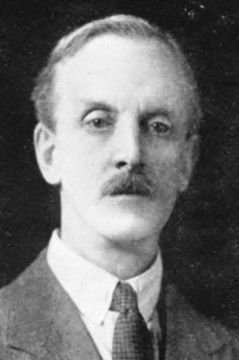
His cousin Percy Grimshaw also assisted with this work, as shown in the following picture:

Theodosia died 7 June 1907 and was laid to rest in Beckett Street Cemetery plot 26307 with her first husband George Wilkinson. She continued to use her previous married surname and was listed as a Widow (even though her estranged husband Thomas was still alive at the time of her death).


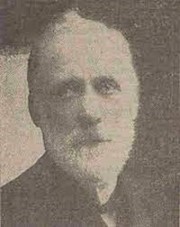
Her son was even mentioned in the Scrapbook of the famous Helen Keller:

Theodosia was obviously a caring mother and champion of her talented son. She helped him to achieve many successes during his lifetime in spite of his blindness, which led to the eventual award from the University of Leeds of an Honorary Degree of M.Sc in 1915. Sadly, she was not alive to see him receive this honour.
John passed away 28 February 1937 and is also laid to rest at Beckett Street Cemetery in plot 26307 with his parents.

His cousin Percy H Grimshaw wrote an obituary in The Journal of Botany page 142 and said (quote)
“The writer of this notice walked some hundreds of miles with him on botanical excursions between the years 1881 and 1893, and during that time, with a keen mutual interest in the British flora, enjoyed many a happy day, picking up specimens as they attracted his eye and handing them over to Wilkinson who examined them carefully with the tip of his tongue. On these occasions he also utilised to good purpose the associated senses of taste and smell.”
Percy also made mention of Theodosia and stated (quote)
“He had a wonderful memory, storing up a vast amount of knowledge gained not only from rambles in the country, but also from standard text-books (such as those of Sachs and Prantl and Vines) read to him for many years by his most devoted mother”.
If you are ever visiting any of the public parks of Leeds, in particular Roundhay Park, you might actually see many of the trees that he undertook to advise the Corporation of Leeds to plant and label for our benefit and enjoyment today and remember that she too had been there and made her own unique contribution to this.
Theodosia, who is laid to rest in the historical Beckett Street Cemetery, is a great inspiration and example to other women and caregivers who stay strong through adversity.
Jeanette B
(Friend of Beckett Street Cemetery and History Lover)
 The Secret Library | Leeds Libraries Heritage Blog
Ref Beckett Street cemetery
I have many family members buried here. Most in the Guinea grave area. Alun Pugh from the Friends of the cemetery helped me to locate them. Well worth a visit. Thanks again Alun.