Number #8 in an occasional series, this week we hear from Librarian Antony Ramm about a criminally little-known autobiography by a notorious member of the French underworld…
We’ve praised the Public Domain Review website before on the Secret Library Leeds blog – if you’re not already a reader, we strongly recommend you sign up to their mailing list and delve into their archive.
Those of you who are already subscribers will have seen or read a recent article about Eugène François Vidocq, the 19th-century pioneer of French criminology and likely source for many of the archetypes of detective fiction. There’s little point repeating the fascinating biographical contents of that article (we simply recommend you read it), but it’s worth drawing attention to the fact that a large part of that article concerned Vidocq’s memoirs.
Praised for its readability, Vidocq’s account of his own larger-than-life-life certainly sounds like the stuff of Hollywood. Now long out of copyright, the memoirs are easily findable in cheap, online e-editions. More interesting for our purposes, however, are physical copies of the book.
And, on that point, a quick search of our online catalogue reveals our Central Library holds an 1828 first (English-language) edition of Memoirs of Vidocq, principal agent of the French police until 1827 : and now proprietor of the paper manufactory at St. Mandé. Here it is –
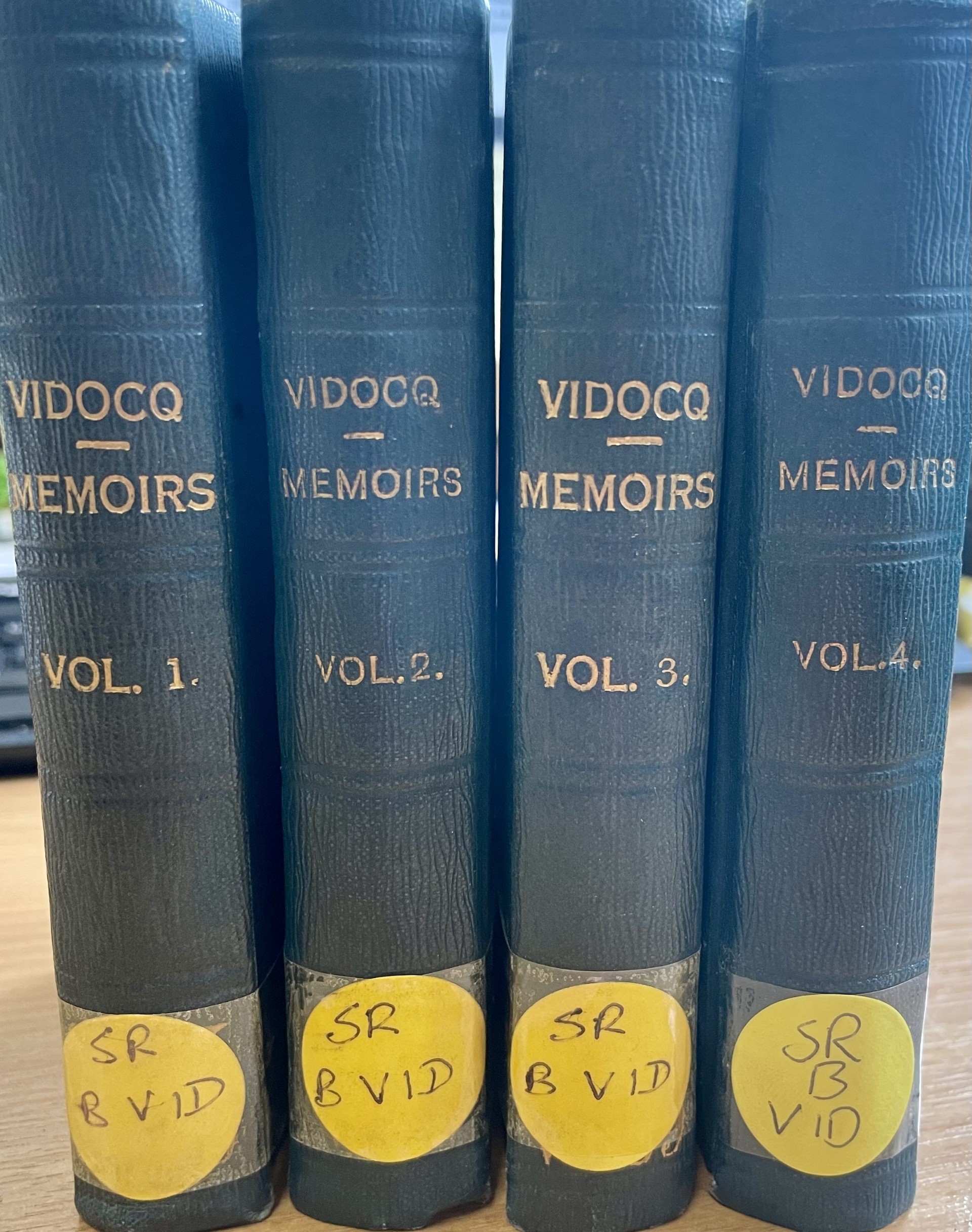
Even though we have a complete, four volume set of the Memoirs, it barely takes up any space at all, each volume being perfectly pocket-sized:
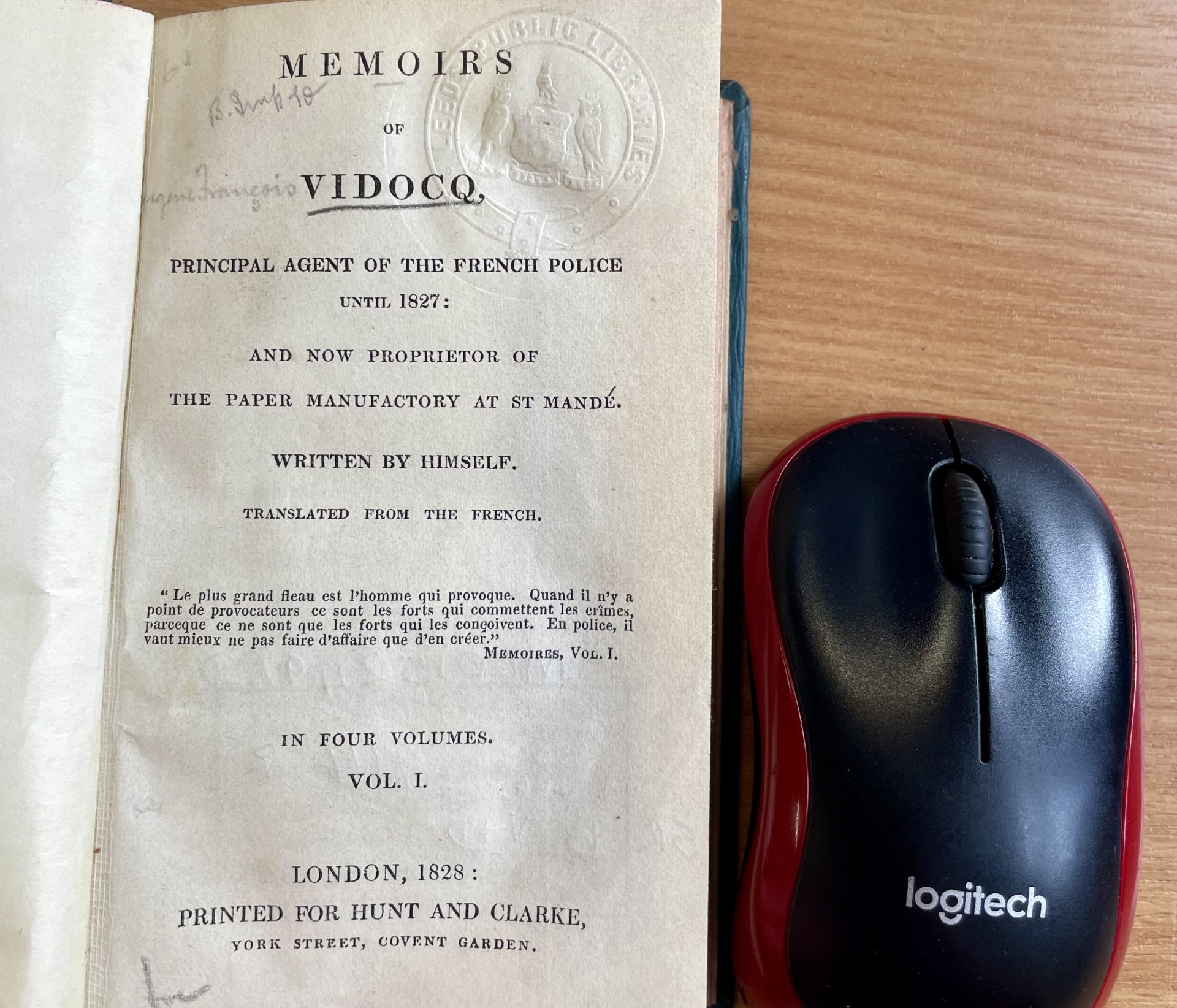
An edition such as this is not, it won’t be a surprise to hear, available for library customers to take home and actually read: the point here is to preserve this particular edition for future generations.
So, anyone interested in Vidocq’s amazing life and times is directed to Philip John Stead’s 1953 biography, which certainly is available to take home and read – and, at a modest 263 pages, surely won’t take too long to digest. Pages 122 – 125 of Stead’s book look at the life and afterlife of Vidocq’s memoirs and the impact of the English-language edition in particular.
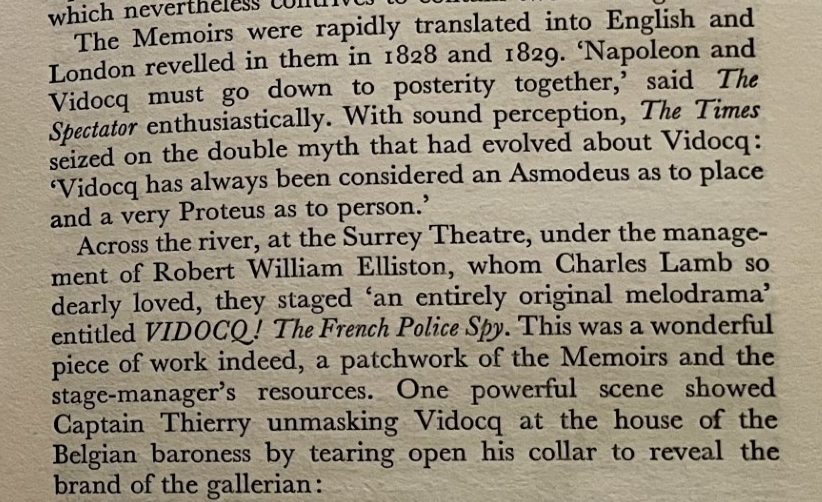
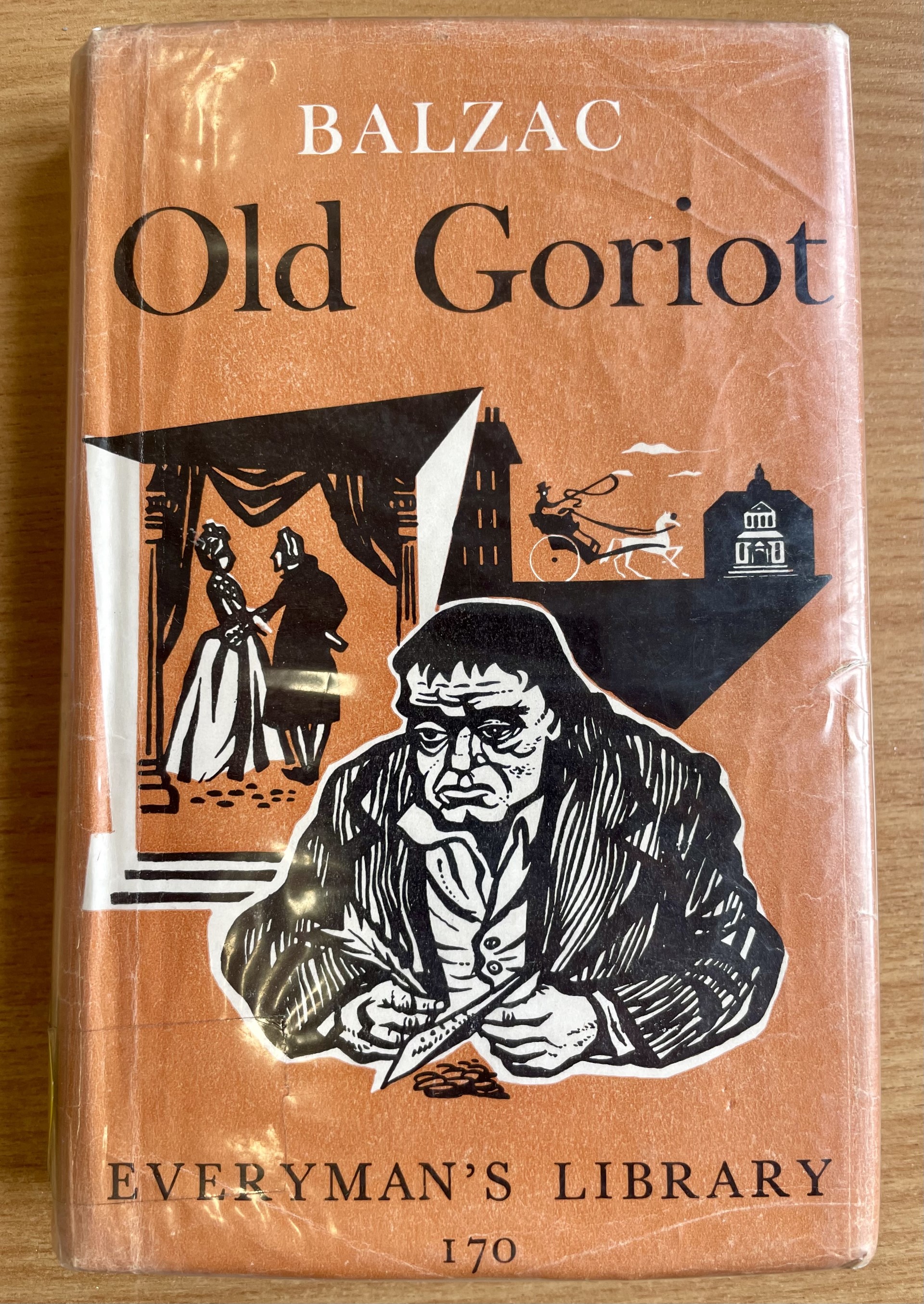
Stead writes with the flair of a novelist, complete with engaging but presumably invented dialogue between historical figures; indeed, his biography of Vidocq can be said to be, to quote a recent and utterly unrelated book review, “based on real events, but [with] the feel of fiction.” Fittingly so, as Vidocq himself was the basis for the character of Vautrin in Balzac’s Père Goriot (aka Old Goriot).
An aside: Stead was born in Swinton in 1914, then part of the old West Riding, interestingly enough (and Swinton has a broader connection to Leeds via the Rockingham and Leeds Pottery companies respectively). As such we’ve got other works by the author in our library collections, including a translated memoir of another 19th-century French criminal with literary influence, Pierre François Lacenaire, and a history of British policing. Stead was clearly a man of wide-ranging interests, as we also hold a copy of the book Songs of the Restoration Theatre, which he edited. Stead seems now be largely a forgotten figure, but someone who probably deserves greater renown. (As does Vidocq himself, in truth)

You can contact our Information and Research department to access any of the titles mentioned above. Email or phone us via the Local and Family History team at localandfamilyhistory@leeds.gov.uk or on 0113 37 86982
 The Secret Library | Leeds Libraries Heritage Blog