This week we welcome back Jeanette B from the Friends of Beckett Street Cemetery group, this time for a brief history of the Chapels at Beckett Street Cemetery – and a request for reader assistance…
More information : Public cemetery covering an area of 6.5 hectares. It was established in 1845 and was one of the earliest publicly funded cemeteries in England.
HISTORIC DEVELOPMENT
In 1842 the Leeds Burial Act allowed Leeds Corporation to levy rates for the interment of the dead, a pioneering venture in England at this time (Burt & Grady 1994).
Disposal of the dead had become an urgent issue as the population of Leeds almost trebled in the first half of the nineteenth century.
Two new cemeteries were to be provided in the most rapidly expanding areas: Burmantofts or Beckett Street Cemetery (qv), for the township of Leeds, and Woodhouse Hill Cemetery, for the township of Hunslet (White 1857-8).
OS MAPS BELOW SHOWING AN EARLY POSSIBLE DESIGN OF THE MORTUARY CHAPELS
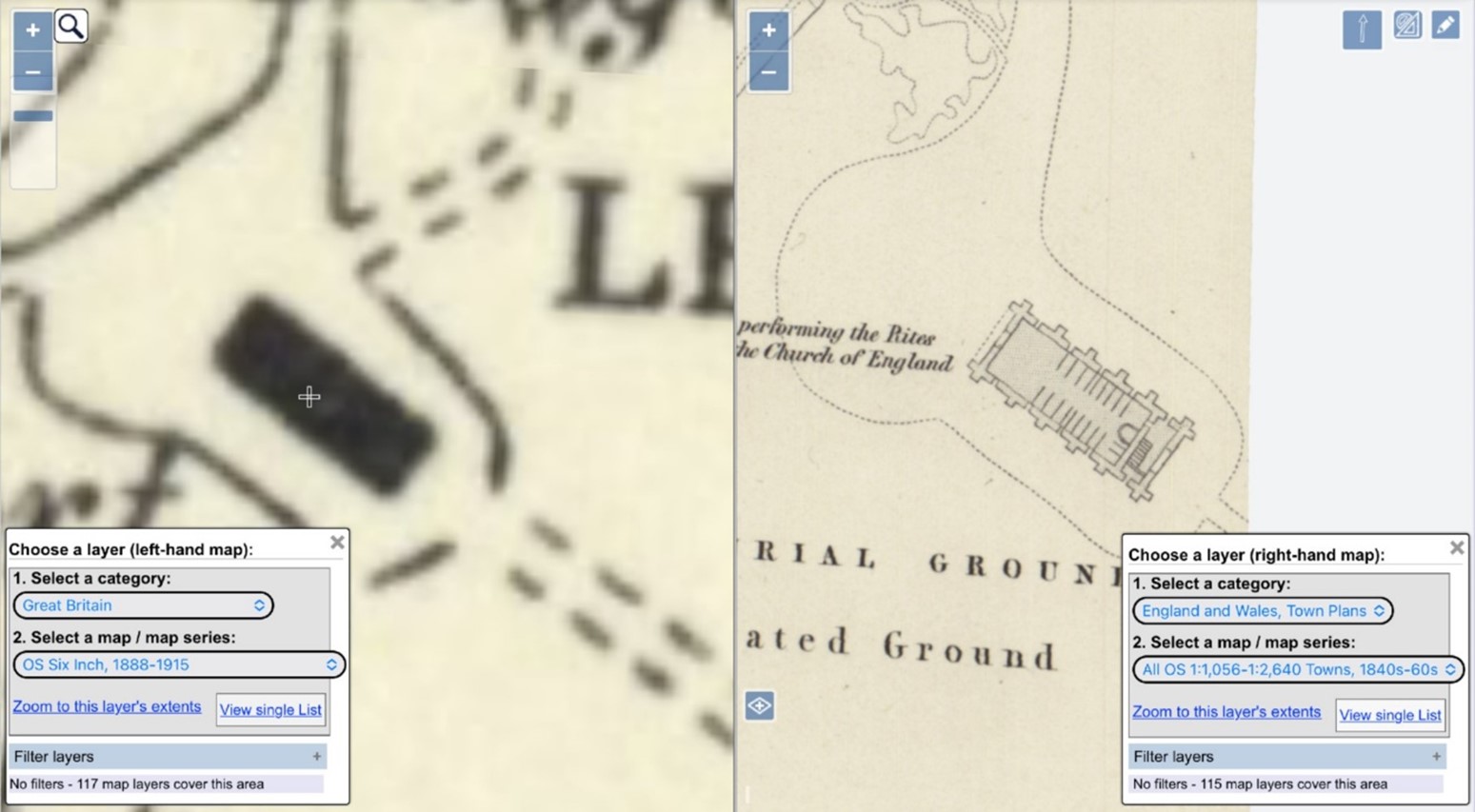

It might be possible that the creator (unknown to me) of this drawing on the map was able to go into so much detail because they were privy to the plans and drawings which had been created and existed at the time of establishing the cemetery (opened 1845) to allow the Corporation to allocate the funding for the necessary building works. It is interesting to see the level of detail internally including what appears to be the pews and the pulpit and internal steps leading to the roof space.
In her book To Prove I’m Not Forgot Sylvia Barnard, the founder of the Friends of Beckett Street Cemetery group, provides additional information about the chapels when in Chapter One (page 14) she refers to what was known as the Dissenter’s chapel (Nonconformists) and describes it as ‘simple, heavy and buttressed, twin to the Anglican Chapel…’ and goes on to explain that these buildings ‘caused headaches for the Councillors of the Burial Grounds Committee. Both chapels…. suffered severely from damp. In a letter considered on 29 April 1881 the Revd Kennedy threatened the Committee quite rudely…: “is nothing to be done for our Chapel? If not, I shall be obliged to ask the Bishop to close it for necessary repair. It is reeking with damp and the stench at times in intolerable”.
‘The chapels were patched up with Roman Cement, wood cladding and ventilators’ (page 29)
In the 1890s Frederick Temple took the job as Head Gardener at the Cemetery where he lived in the North Lodge with his wife Clara and their six children (Ernest, Mary, Arthur, Cissie, Stanley and Ruth). Details, possibly from information contained in the diaries of Frederick Temple, give further insight into the interior of the Anglican chapel stating that ‘the coffin would lie in the mortuary separated from the congregation but visible through a large plate-glass window’. ‘Mrs Temple, too, was involved in his work. Young Stanley would be set to dust the cream-coloured pews while his mother scrubbed and scoured with calloused hands the stone floor of the chapel. By the time Mr Temple was buried (1945) in the shadow of the chapel his wife had kept so well….Beckett Street was within a few months of its centenary’. (To Prove I’m Not Forgot, pages 32/34)
On later OS maps the chapel outline is drawn as a rectangle block with a smaller square entrance, as shown on the Ordinance Survey Map of 1908 which refers to the Cemetery as Leeds Corporation Cemetery.
ON ORD.SURV MAPS 1908


In April 1844 Robert D Chantrell (1793-1872) and Thomas Shaw, local architects (Linstrum 1978), were commissioned to design the walls and buildings for Hunslet Cemetery: two lodges and a large building incorporating two mortuary chapels, a Nonconformist chapel to the north and an Anglican chapel to the south (Barnard Notes 2003). Woodhouse Hill Cemetery (as originally named) opened on 19th June 1845, with roughly ten acres of ground provided at a cost of about £6000 (White 1894).
Hunslet Cemetery Chapels
Inspiration for the artist impression paintings has been taken from Hunslet Cemetery Chapels which are still standing and designed by same Architects.
Information following from Historic England as Hunslet Old Cemetery is Grade II Listed (Image from Geograph Britain and Ireland – available for reuse under relevant licence)
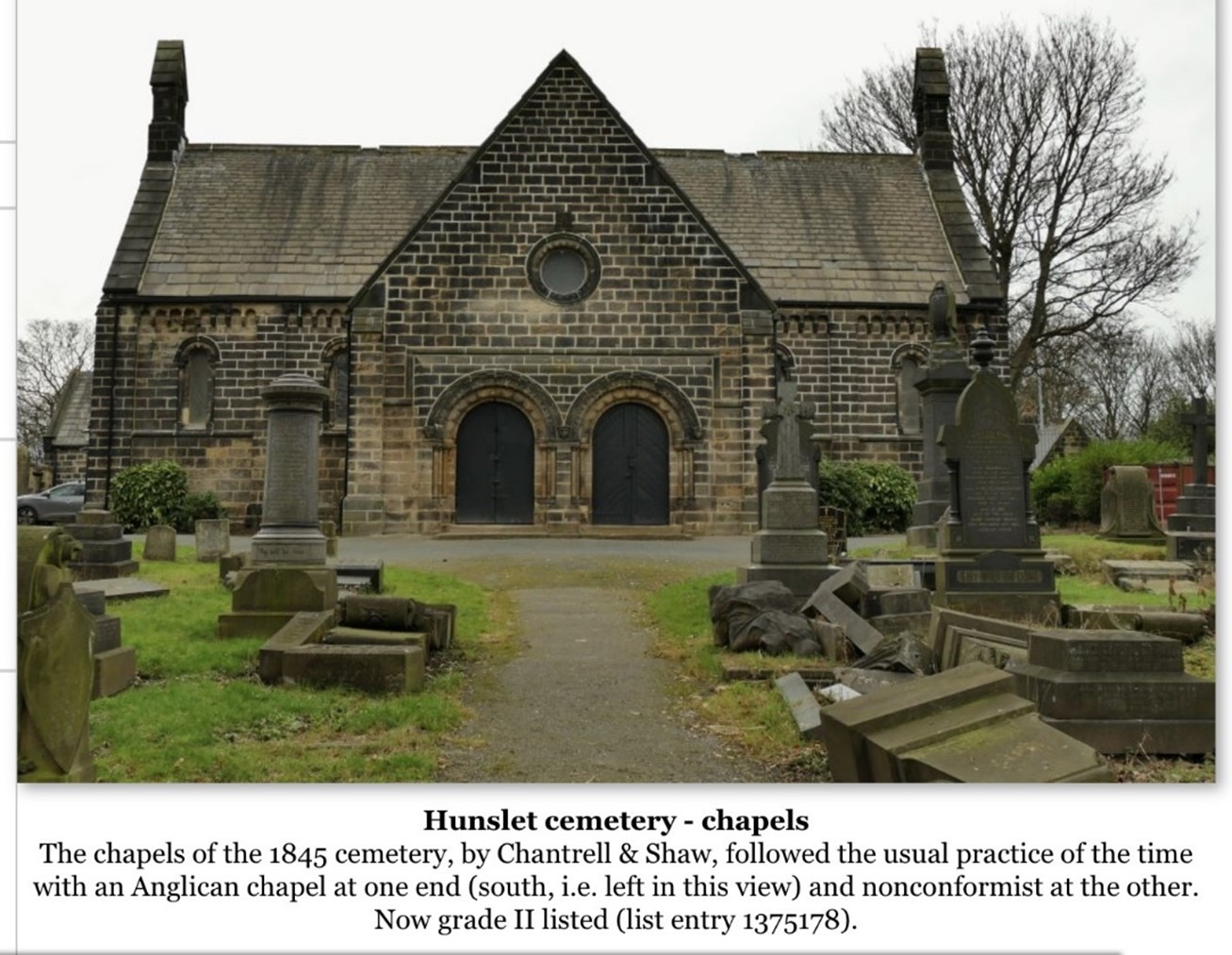
The cemetery has one building split into two chapels, with two separate entrances one for Anglicans and the other for nonconformists.

Side view photo I took and used as inspiration for what one of our Mortuary Chapels might have looked like in the 1900s. It is possible to see in places how light in colour the original stone may have been when the building was first erected.

This chapel building does appear to be ‘simple, heavy and buttressed’ with vertical stone columns in the form of simple piers placed at regular intervals along the walls and at the corners of the building where two load-bearing walls meet.
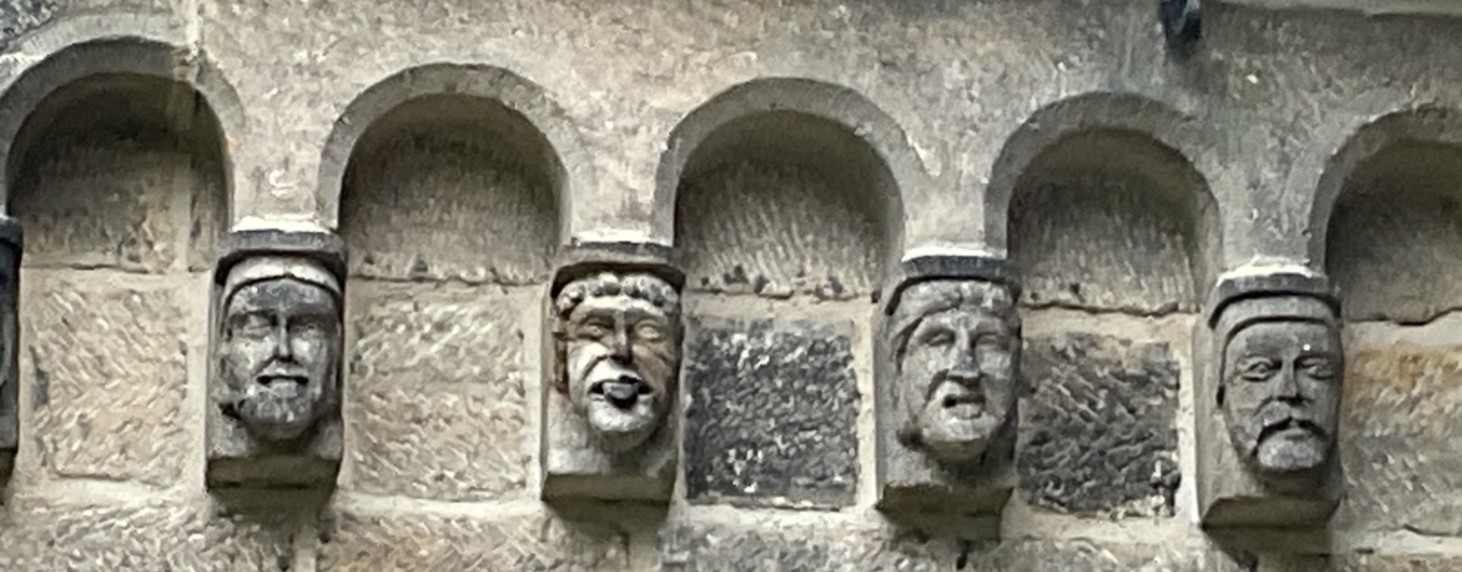
The carved faces on the corbels around the building are called Grotesques (usually a word used to describe something that is hideous, ugly and disgusting) and some were thought to have been used for the purpose of teaching biblical lessons at a time when many people did not read, or to ward off evil spirits and protect the people inside the building. The ones on this building look more humorous and friendly than fearsome! I am assuming that our chapels had similar decorative elements.
INTERIOR OF HUNSLET CEMETERY CHAPEL

Picture kindly sent by Park Ranger Heather. We do not know if Beckett Street chapels would have been so well decorated but perhaps they were whitewashed inside when they were first built and it gives us an idea.
More information
The cemetery’s two chapels were demolished in the late 1960s and by 1984 the cemetery was under threat of clearance by the City Council.
The West Yorkshire Archive has kindly looked over their catalogues but sadly cannot find much about the mortuary chapels at Beckett Street Cemetery. Unfortunately, they pre-date the building control scheme which is often the easiest way to find plans of buildings.
I have had no success to date in finding information from Historic England, Leeds Libraries, YEP archives, Leodis, Aerial Photography sites, Burmantofts History Facebook photographic pages, Thoresby archives and various other helpful contacts and sites viewed in the past 12 months.
It may be that the chapels were not considered interesting enough to be of historical significance and that the documents relating to them from so long ago are lost, but following its opening in 1845 ‘Burmantofts Cemetery (as it was commonly called) was performing an extremely important function in the growing city of Leeds’ (To Prove I’m Not Forgot, page 29).
If anyone has any memories of either of the chapels, recalls attending a funeral there or has a photograph we would like to hear from them as it might help us to solve this final ‘history mystery’ relating to the on-site cemetery chapels. You may, like me, have ancestors laid to rest in Beckett Street Cemetery whose funeral services might well have been conducted in those chapels.


Jeanette, Friends of Beckett Street Cemetery
February 2025
If you have any information to help Jeanette, please get in touch with the Local and Family History department at our Central Library on 0113 37 86982 or via localandfamilyhistory@leeds.gov.uk and we can pass a message on.
You can find the newly-updated Friends of Beckett Street Cemetery website at this link: https://www.beckettstreetcemetery.org.uk/research/index.php
 The Secret Library | Leeds Libraries Heritage Blog
The idea has a mischievous appeal to me. You may have been ignored, slighted and ill treated in your life, but your final memorial is an immutable statement of enduring presence.