This week we welcome back guest author Pete Slater. Pete is one of a small team of volunteers working with us for the joint Leeds Libraries/British Libraries Voice of the Fans exhibition celebrating football fanzines and football fan culture. One of Pete’s roles has been research using our microfilmed local newspaper collection – this article has developed from that research.
You can read more of Pete’s articles on football fanzine culture on his own blog site. Subscribe for notifications of new articles: https://footballfanzineculture.blog
Another story from the microfilm archives at Leeds Central Library, researching the story of professional football and football supporting in the city as background for the 2025 exhibition on Fanzine culture.
One of the most enduring legends about Leeds United is about the origin of the white strip. Ask almost any Leeds fan and they will immediately answer that Don Revie introduced it to make the team more like Real Madrid. That’s a fact, right? Well, not quite.

It is true that Don Revie was the manager when the strip was officially adopted but articles discovered in 1960 editions of the Yorkshire Evening Post (YEP) reveal that this wasn’t decided during Revie’s reign as manager at all and that a rather more practical reason was the driver.
Small changes in the strip had persisted in the decades that followed United’s formation but blue and gold (From the city crest) became the main template from 1934 until the 1960s. We’ll talk about the mystery years of 1919 to 1934 in another blog.
First Time
It has been documented that Leeds played in an all-white strip on the 17th September 1960 for a game vs Middlesbrough[1] (We’ll return to a Middlesbrough connection later). Jack Taylor was the manager and in fact this game was to mark the beginning of the end for Revie as a player.
The fact is that Revie sensationally dropped himself on the eve of the game where the all-white strip seems to appear as a first team kit for the first time, claiming his self-confidence had gone. Based on some letters found in the YEP sports mailbag on the Thursday of that week, I’m not surprised. What is also extremely interesting in this mailbag was a call from a fan to move to the all-white strip. It was clearly being discussed across the fan base at the time as well.

Strangely, not much was made of the white strip in YEP match reports on the 17th . This brief mention in a paragraph also mentioning the captaincy change is it. Perhaps not surprising as the game ended in a breathless 4-4 draw.

HOWEVER, the YEP were starting to use photography much more by now so we can present here what we think is the first ever action shot of Leeds United playing in an all-white strip at Elland Road. Unfortunately, it shows Brian Clough scoring for Middlesbrough. Thankfully we can balance out with this smaller photo of a Leeds goal that day as well.[2]

A brief note is made of the changed strip in a report about the 2-5 defeat to Ipswich on October 1st but there was next to nothing said in the press at the time.

Nearly a month later the change was mentioned in a Yorkshire Evening Post (YEP) sports mailbag letter by fan J A G Morley in the Yorkshire Evening Post (YEP) sports mailbag on Thursday the 12th October 1960. Mr Morley bemoans the change feeling the new strip is “not very colourful” and thinks blue and gold shirts with black shorts would “give distinction to the team”. Interestingly he thinks the change came because too many visiting teams were having to play in changed strip at Elland Road because of clashes with the blue gold and white strip.

By the late fifties and early sixties football was “modernising” as many grounds were starting to use the huge technical advance that was…floodlights. Correspondent Phil Brown explains that the new kit allows “Both for smartness and for easy sighting of each other on the field and the blue kit is “disliked under floodlights by the players” Taylor adds, “We are not officially changing our colours this season. Approval for the all-white strip is sought every time we use it “BUT WE ARE CONSIDERING WHETHER TO CHANGE OFFICIALLY TO ALL WHITE FOR NEXT SEASON, OUR PLAYERS DEFINITELY PREFER IT.”
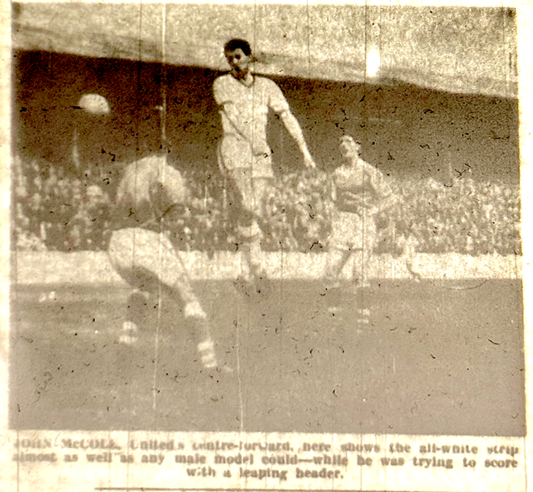
The article was accompanied by a photo of John McColl showing the all-white strip “almost as well as any male model could”..
In fact, on the 27th of September Revie would hand the captaincy to Freddie Goodwin believing himself to be an unlucky captain, he would appear in the all-white strip as captain just once. This alone should be enough to cast doubt on the Madrid story as it’s clear that the strip was used before Revie became manager, but we didn’t know why until now. Taylor wouldn’t last as manager until the next season, but he is clearly the one who instigated the white kit (perhaps at the player’s request) and as with most changes we can see the response from some fans was mixed at the outset.
The Times They Are A-Changin’
In fact, floodlights made white kits very popular in the late 50s and 60s as they stood out particularly well under the lights. Coventry started the trend in 1959[3] and during the following decade Tranmere, Bradford PA, Crystal Palace, Scunthorpe, Walsall, Doncaster and Port Vale all adopted white kits with Exeter, York and Brighton also briefly experimenting[4]
Amazingly the issue of not being able to see colleagues had in fact been raised well before Taylor was manger as well. In 1948 Leeds’ ‘eccentric’ manager Major Frank Buckley arranged a trial game[5] which led to Leeds changing its strip from gold and blue halves to gold shirts with blue sleeves and collars and white shorts as he “proved” that the players would recognise each other better than in the old strip and subsequently, Leeds played in a predominantly gold kit from 1948 to 1956.
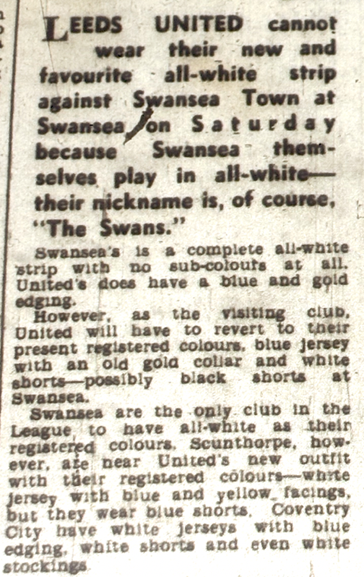
Leeds continued with the white strip when they could that season but had not officially registered this strip at the start of the season so when kit clashes with clubs like Swansea came up, they had to revert to blue and gold as this YEP article from Tuesday 17th November 1960 mentions. However, it’s clear that the decision to change to all white had been made well before Don Revie was manager.
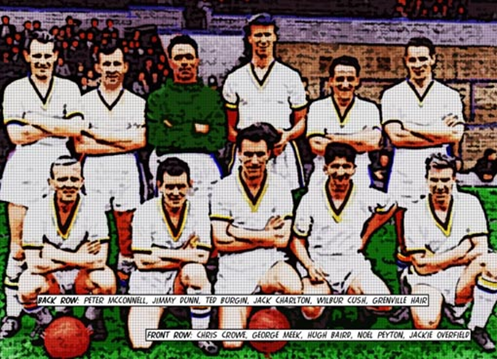
There is a very good reason for not much being made of the “official” kit change under Jack Taylor, it had been used before. There are photos of Leeds during a pre-season tour of Scotland in1958 using a white kit (A young Jack Charlton appears in this photo) and in fact the all-white strip was used as the change kit during the 1958-59 season.[6] [7]
Hala Madrid
So where does the Madrid element of this story come from? There were a few Real Madrid rumours and stories linked to Leeds before Revie became team manager. On the 10th of September 1959 it was reported in the YEP that United were trying to attract Real to the city for a friendly for which Madrid were asking approximately £7,000, an incredible sum at the time. Two directors had travelled to Madrid in 1959 apparently on holiday and were reported to be “following up with a phone call”. Quite a story, I wonder who paid their expenses!

Though the Revie “Madrid” idea is mentioned in many sources we haven’t been able to track down any officially attributed quotes directly to Revie himself. Instead, it all seems to be wrapped up with other events of the time and hyperbole applied to the Revie era in the media. It’s true he changed many things, reshaped the history of the club, changed attitudes, and employed psychological gimmicks to do this. It’s undeniable what a great manager he was and when something like this happens myths and legends are born but in truth not only was the white strip not Revie’s decision but the decision was down to a very simple, practical reason.
The truth has been hiding in plain sight for some time[8], Jack Charlton is quoted saying
This was the gear Real Madrid played in and the initial reaction from the local press was that Revie was aping the Spaniards. Not so, explained Don. In his opinion, white is the easiest colour to identify on a pitch. When you have only a split second to make a pass before the tackle comes in, you’re more likely to pick up the right man if he’s wearing not red or blue or green but white.
Jack Charlton subsequently adopted the idea when he became Middlesbrough manager, adding a broad white hoop to the Teessiders’ red shirts.
As an example of how this has been largely ignored as the myth grew is shown in an article that appeared in the press[9] when Charlton died in 2020. It repeats the Madrid myth whilst immediately carrying a quote from Charlton that contradicts it:
We brought in the white band to help the players identify each other better on the pitch. That had been a big thing with Don Revie when he went to Leeds. He didn’t want the players to blend into the background. It helps the players if they can look up and instantly see a team-mate. What I say to people is, if Alan Foggon is running forward and the defence is trying to push up and catch him off-side, having a big bold white band visible from behind gives his team-mate a better chance of instantly picking him out.
The Final Whistle
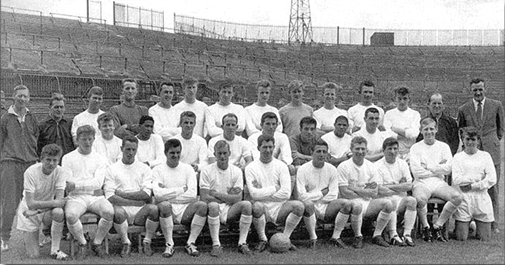
Leeds under Don Revie’s leadership did officially adopt all-white from the start of the 1961-62 season as Jack Taylor had indicated they would. The microfilm search revealed a remarkable photo that appeared in the YEP on Saturday 22nd July 1961.

A cleaner version of this important photo is included here and it is an important piece of history in many ways;
- We believe this is the oldest team photo available of Leeds United first team in the official all-new white strip.
- The photo is one of few that we have with Gerry Francis and Alfred Johanneson together and on April 15th 1961 in a 0-0 draw away at Stoke City Leeds United under Don Revie had become the first British team to field 2 black foreign players.
- The foundations of the great Revie Leeds team are on display in this photo, the spine of Sprake, Charlton, Hunter and Bremner already in place with the Don now installed in manager.
Post-Match
Don Revie changed Leeds United for ever and is quite rightly still revered by fans but let’s give credit where it is due. Revie was captain at the time Leeds started wearing white but only just. He may well have been studying Real Madrid for lessons when he became manager, no manager in their right mind wouldn’t be but the story behind the white kit is very different from the myth that has grown. The story and the manager who introduced it, Jack Taylor, have been lost in time until now.
References
[1] ‘Leeds United: A Complete Record, 1919-89’ Jarred and MacDonald
[2] https://www.ozwhitelufc.net.au/17-09-1960%20LUFC%20v%20Middlesbrough.htm
[3] https://www.historicalkits.co.uk/Coventry_City/Coventry_City.htm
[4] http://www.historicalkits.co.uk/Articles/History/part-6.html
[5] https://www.ozwhitelufc.net.au/1947-1949.php
[6] Robert Endeacott; The Leeds United collection : a history of the club’s kits
[7] https://www.ozwhitelufc.net.au/1957-1963.php
[8] Andrew Mourant, The Essential History of Leeds FC
[9] https://www.gazettelive.co.uk/sport/football/football-news/middlesbrough-legend-jack-charlton-reveals-18580022
 The Secret Library | Leeds Libraries Heritage Blog