This week we welcome Claire Warwick and John Boocock for some hidden history drawn from the annals of Leeds United fan culture. Claire and John will be speaking about the same subject at a talk on Monday July 7 – tickets are still available so please come along if you want to hear more.
The talk is Part of Voice of the Fans, an exhibition co-produced by the British Library and Leeds Libraries, which explores over 60 years of fan-made media from their collections that has defined the beautiful game. At Leeds Central Library from 9 May to 10 August, with a smaller display touring to Leeds branch libraries throughout autumn/winter 2025.
The history of the internet goes back several decades with significant technological developments enabling early electronic communication and discussion. Ironically, thanks to this very internet we can read all about these very developments and the culture it sprang from, often in great detail.[i] Given the way in which social media has developed into today’s all-pervasive monster it seems hard to imagine that a group of Leeds United fans would buck that trend and do so for over thirty years! A short history of how the Leeds List came about and how this sits within on-line communication and discussion shines a new light on football fans and the internet age.
Asked to describe a reliable and efficient way to connect with other users over the internet, most people would suggest the likes of Tik Tok, Facebook, WhatsApp, Instagram or even email. It is unlikely that people would think of, never mind have come across, such delights as IRC, MUT or alt.rec. soccer. One group of Leeds United fans however were well ahead of the game by the early 1990s.
Access to computers and the internet four decades ago, unlike today, was mainly restricted to technical people, academics and government officials. Some of these people were football fans, and especially Leeds United fans. By July 1993 these fans who had been holding discussions via earlier channels had progressed to an all-singing, all-dancing mailing list: ‘The Unofficial Leeds United Email List’.[ii]
Known to users as the ‘Leeds List’, this mailing list was initially hosted on a server at the University of Oxford and managed by ‘list-owner’, Gav Burnage. From July 1993 until today the Leeds List has run continuously, albeit hosted on several different servers over the years and with several different list-owners.
The mailing list software allows members of an email list to post messages via email to a list server which would then be sent to all the other list members who in turn can respond with their own words of wisdom. For over three decades the Leeds List has always been a sophisticated mix of moderation (via a list guide and its various owners) and a genuine camaraderie amongst its members.
The Leeds List has had several highpoints over the years. When Leeds United reached the League Cup final in 1996 a grand meet up was planned in London before the match. Described as ‘The Mother of All List Meets’ or the MOALM (there was always a short title to save bandwidth in the days of dial up computing!) it was the first time many list members had met each other in person. We enjoyed it so much that we carried on meeting in the pub before every Leeds game from then onwards. This helped us feel a sense of belonging which was relatively rare in the purely virtual communities of the time.
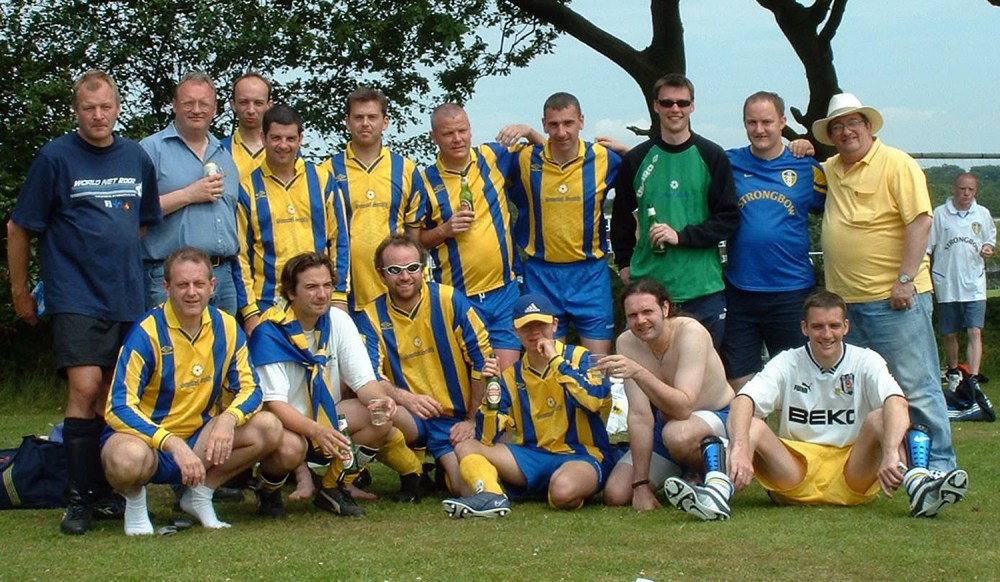
The Leeds List not only had its own football team, The Leeds Lards, but it played and won the first ever football match between two football email lists. Named after the great Leeds ‘Dripping Riot’, or possibly the portly appearance of many of the players.[iii] The Lards beat the Internet Spurs at a match played in neutral Nottingham on the 30th of July 1995 which they won 6-3 in front of an attendance of 12. Out of this was born the Internet Football Association which for two decades held its annual tournament, World Net, at Leeds University’s Boddington Hall.[iv]
As a community, the Leeds list not only had its own extensive netiquette but also produced a list glossary of all the terms used by its members. This glossary also included a number of pen pictures of prominent listers. A tension had always existed between listers as football fans and the club with its (in the list’s view) stodgy rules and procedures, especially when obtaining match day tickets (one lister invented an ingenious way of ordering tickets by fax).
A list jargon was quickly developed, some of the most memorable mnemonics used to save precious bandwidth included: MNES, SOTG, JOTL, BOTL. Please leave your suggestions for what you think these refer to in a comment!
Alongside those attending games providing post-match reports, the list ran a score predictions league, a separate matchday score flash list, and generated a host of other non-football related trivia. A regular non-football item would be discussion about the best curry or the best pre-match fish and chips in Leeds. (Do you have scraps on them or as some Philistine once suggested ‘bits’?)
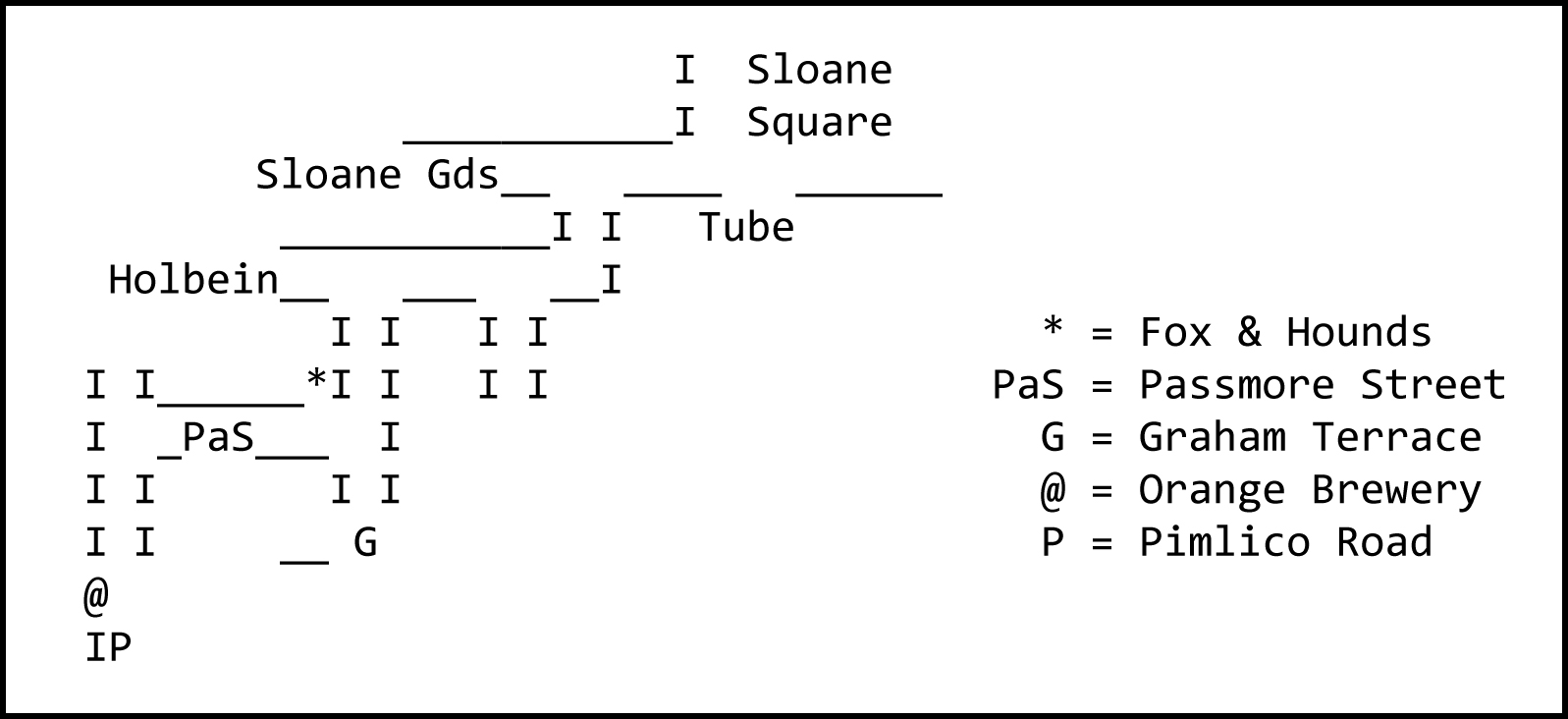
One of the list’s most useful features was the arranging of pre-match meet ups for those going to matches (and meet ups on match days for those members living in far off climes, especially Australia and the USA). In the days before the graphics heavy world of today’s internet, ascii maps were an important part of finding your way to the designated pub for a pre match list meet.
Perhaps one of the most significant developments for the List and an example of its attitude towards football, particularly in the 1990s, was its involvement in ‘Leeds United Against Racism’ (LUAR). In 1998 members of the list co-operated in the production (by the club) of a leaflet used on match days to promote anti-racism and created a LUAR website alongside the club’s efforts.[v]
To belong to the List community means many things to different people especially in terms of the many long-lasting friendships that have been created over three decades. Currently the List also operates a WhatsApp group and a Facebook group. These mainly provide line -up information, score flashes, final results and relevant match information from the club (as well as anything funny, weird or off the wall which enters people’s heads at the time.[vi]
Unlike the growth of message boards which developed with the expansion of internet use in the late 90s and early 2000’s the list has retained its adherence to the list server model. Perhaps this is one of the reasons why it has avoided so much of the dark side of social media. Or is it that we are all just nerds?
[i] An extensive description of the history of the ‘net’ is available in Henry Hardy’s MA Thesis, written in 1993 but relating to a history which begins in the 1960s. It goes into depth about many aspects of early internet culture. https://w2.eff.org/Net_culture/net.history.txt There are also details of the very early discussion type as developed for the internet here: https://www.livinginternet.com
[ii] The List can be found in its current incarnation her https://mailman.gn.apc.org/mailman/listinfo/leedslist
[iii] The story of the dripping riot is covered here in this Secret Library piece https://secretlibraryleeds.net/2019/09/13/the-dripping-riot-of-1865/
[iv] The Internet Football Association continues to bring football fans together, find out more here https://www.theifa.uk/about-the-ifa/
[v] Gav Burnage’s original LUAR web pages https://web.archive.org/web/19981205003159/https://canto.mml.cam.ac.uk/leedslist/luar.html
[vi] Find the Leeds List on Facebook at https://www.facebook.com/groups/leedslist
 The Secret Library | Leeds Libraries Heritage Blog
One Comment Add yours