Today’s article, by Becky Bavill, forms part of a series of posts inspired by Unearthed: The Power of Gardening – an exhibition in partnership with the British Library’s Living Knowledge Network, at Leeds Central Library from 10 September – 29 October 2025.
Gardening is not only transformative, but also a power for social change. Here is a story of a Leeds woman who saw gardening as a way to be in control of her own career and life.
Horticulture was not necessarily a career choice for women until the 1900s in the UK. There is an excellent book on the subject, An Almost Impossible Thing by Fiona Davison. Several chapters of this book refer to the Studley College of Agriculture, set up for women by Daisy, or Frances Evelyn the Countess of Warwick. You can find out more about the college here.
Studley closed in 1969, but during the years it was open it hosted many women from all around the world. Davison mentions one person who might be of interest to us – Marjorie Dodgshun of Leeds, who was cited as having graduated Studley in 1911 and appeared as a student of the college on the 1911 census. Did Marjorie spring from a gardening family? Did she go on to make her career in horticulture? Let’s use the resources of the Local and Family History Library to find out!
Marjorie Irene Dodgshun (or Irene Marjorie – she was registered with Irene as her first name, but seems to alternate fairly freely) was born 11th August 1890, her birth registered in Leeds. Her mother was Annie Frankland (as was) and her father Charles Clay Dodgshun. Marjorie had a sister, Gladys Frankland, who was two years older. There were no other siblings for Marjorie and Gladys.
Marjorie’s next brush with officialdom came with the 1891 census. The family were living at 22 Springfield Mount, and her father’s occupation was recorded as woollen merchant. By 1901 the family were at 27 Hyde Terrace. The next mention of Marjorie comes from the magazine of the Leeds Girls’ High School. Now amalgamated with the Grammar School at Leeds, Leeds Girls High School was based on Woodhouse Lane and then Headingley until 2006. The library has solid holdings of their magazine, dating from 1898, which you can find at L376.63 – although you’ll have to ask one of us to climb the ladder to get them down for you! It’s a lovely title, chatty and informative and offers a real insight into what it might have been like to attend the school, the activities that were undertaken including reviews of amateur dramatics and school trips. Particularly interesting are the accounts sent in by old girls of what their lives look like after leaving – missionaries in India, teachers in China and undergraduates at Cambridge and Oxford. There is certainly a feeling that there is literally nothing that a girl can’t do if she only gets her head down and applies herself. This includes one M Dodgshun of Form IIa who appeared on the prize list of Autumn 1902; Marjorie would have been 12 years old. By autumn 1903 she was winning prizes in Form IIIb. Alas, this prizewinning streak was not to continue – the exam results published in August 1908 show that Marjorie passed, but without distinction. In her defence, it had been a pretty traumatic few years for the family – in 1906 her father had dissolved his partnership with his brother and walked away from the family business of Isaac Dodgshun and Co – it does not appear to have been a friendly situation and the details were splashed liberally around the Leeds papers many of which branded her father a failure and he was declared bankrupt.
Isaac Dodgshun and Co. had been founded by Marjorie’s grandfather, Isaac. The Dodgshun family are well documented in Leeds for several generations associated with the woollen trade as weavers, merchants and manufacturers. A whole branch shipped out to Australia in the early 19th century as Dodgshun and Dickinson, securing an advantageous supply of wool for Leeds. The family all seem to be non-conformists; specifically, Congregationalists, not just worshipping at various chapels, but actively involved as leaders. Dodgshun causes include the London Missionary Society, the Lifeboat Institution, the Leeds Workpeople’s Hospital Fund, adult education, protestation against the billing of religious education as part of the Poor rate in 1905 and interestingly, a Mrs Dodgshun who is described as ‘one of the oldest women’s suffrage workers’ by the Leeds Mercury in February 1907. I haven’t been able to ascertain exactly which Mrs Dodgshun this is, but if it is Marjorie’s mother, it’s nice to think that her example inspired her daughters.
Returning to Marjorie, in the same run of the Leeds Girls’ High School magazine for 1910 is an account by her of what it is like to be a student at Studley – described here as a horticultural college. Marjorie’s description is of a varied, detailed curriculum, and her days are long but satisfying. Towards the end of her account we get a hint of what her intended future looks like – ‘There is nothing so lovely, I think, as to feel “on one’s own,” and to be able to make experiments.’
She was still at Studley in 1911, where she appears on the census, as well as being mentioned as performing in an amateur dramatics performance staged for a visit to Studley by the British Medical Association (Redditch Indicator 05/08/1911, p2).

It’s not clear when Marjorie graduated from Studley, but the next reference to her in the official records relates to her service in the Great War. Both Dodgshun girls signed up to ‘do their bit’; Gladys was a member of the Elsie Inglis Unit, a group of volunteer medics who saw service on the continent, particularly Serbia. You can find out more about them, and the Scottish Women’s Hospital Units in a great book available from the library: Fighting on the Home Front: The Legacy of Women in World War One by Kate Adie.
Marjorie also saw service abroad, but in France. The 1914-1920 Medal Roll shows that she served with the YMCA in Etaples, March-September 1918, receiving the British War Medal and The Victory Medal. Her home address was supplied as 25 Shaw Lane, Headingley. I might have tried to find her on the electoral register around these dates – but Marjorie would not have qualified to vote until 1918, and only then if she met the property qualification. Her parents are there though, from at least 1918 to Autumn 1920. I think that the work of the YMCA probably deserves an entirely separate article, but there is a nice article here that provides some information about what Marjorie might have been doing in France.
On the 1921 census the Dodgshuns were having what looks like a holiday at the Wells House Hydro at Ilkley. Marjorie is listed as a horticulturalist and also an employer. Her address is given as West Dene, Caversham, Reading. Electoral registers put Marjorie at this address on multiple occasions between 1921 and 1926 – however, she is never alone there. I hunted down the census entry for her housemates, and they had included her on their return! Given that Ancestry thinks that her name is Jodgshern it would have been pretty hard to find otherwise.
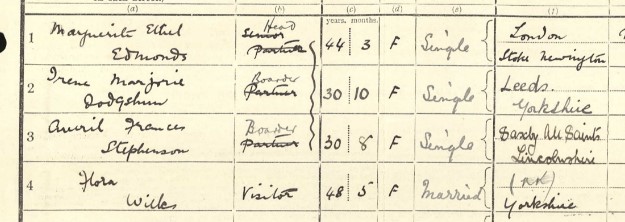
This is extremely interesting because it looks like an enumerator has corrected this entry which has distorted the household composition. Originally, the three women have described themselves as partners, with Marguerite Ethel Edmonds as the senior partner. Marguerite is a market gardener, Marjorie a market gardener/chauffeuse and Averil Frances Stephenson a herdswoman. This very much looks to me like they are living the Studley dream, an all-female agricultural co-operative. Their home is described as having a total of 7 rooms and on the 1921 census they have a visitor from Yorkshire, a Mrs Flora Wilkes or Willes. The enumerator has changed Marjorie and Averil to boarders, which isn’t a true representation at all.
Using Ancestry’s collection, I managed to find the Reading trade directory for 1914. This is too early for the ladies but not too early for me to use the entry to try and find them on a map. As best as I can tell, there are two candidates for their home on this map.
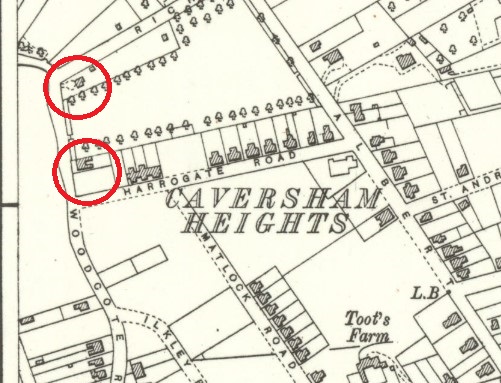
The top one with its ancillary buildings looks more likely to me, and the enclosed space adjacent would have perfect for a smallholding. They must have met at college, certainly Marguerite appears on the 1911 census as a student in 1911 at the same time as Marjorie. Averil is not there, and I cannot see a Flora either.
Marjorie may have moved south, but that doesn’t mean that there was a distance between her and her family. In June 1922 her sister Gladys married William Campbell in Ilkley – Marjorie was her bridesmaid.
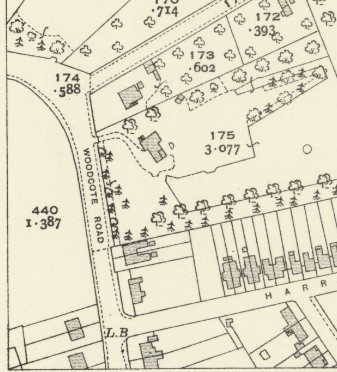
Marjorie stayed at West Dene cottage until at least 1926. Averil left in 1923 to get married. It’s hard to say when or why they moved, but this clipping from a 1932 map of the area shows a very changed landscape.
I lost her a little then, but she resurfaced at Garden Cottage, Orchard Leigh in Buckinghamshire in 1931, living with a Mifanwy Jones. Orchard Leigh is barely a hamlet, close to the village of Latimer. A 1922 map shows a large house set amongst woodland – orchards? Several other houses are nearby, and the Garden Cottage must be one of them. In the same year, her cousin, Maude Mary Frankland married from this address, again showing the importance of family connections. In 1932, Marjorie’s mother, Annie died at North Hill House in Headingley, Leeds, an address she and Charles had lived at since 1925. The year after, in November 1933, Charles and Marjorie went on a big trip aboard the Umvoti. They disembarked at Cape Town with the ship’s records suggesting that they would be staying for at least a year. That they can both be found on the electoral register in the UK for this period, suggests not. There’s some information here about the ship, Umvoti (2) including that it would have taken 25 days to complete its journey from London.
Marjorie was resident at Garden Cottage until 1934, after which she and Mifanwy both disappear from the electoral register there. In 1935, Marjorie is registered for the first time at Mimbridge Nurseries in Surrey.
As far as I can tell, the site is still dedicated to horticulture, it’s a nice garden centre called Longacres these days. Looking at maps of the area at the time Marjorie was there, there are a lot of nurseries in the area – however only one that is right in centre of Mimbridge. Like at West Dene, Marjorie shared her home and possibly her business with others – Margaret Hammond Lancaster and Doris Page are both on the electoral register at the same address more than once. By the time of the 1939 Register there are three people living at Mimbridge Nurseries – Marjorie, a market gardener, Doris Page, her assistant, Marg E Edmonds, a retired gardener; and Reginald Patrick, a radio officer in the ‘merchant marine.’ We’ve met Marg. E Edmonds before, the senior partner at West Dene. Neither Marguerite nor Doris are on the 1911 register at Studley, and Doris proved very hard to track. Reginald Patrick is a little more traceable – born in Lincolnshire in 1888, Reginald saw active service in the Great War as a radio operator, a profession he continued with after the conflict, with electoral registers linking him to HMS President, a shore establishment at Tower Hamlets. It’s not known from the records how he came to be at Mimbridge Nurseries, but he and Marjorie married in July 1941. The happy occasion was reported in the local paper.
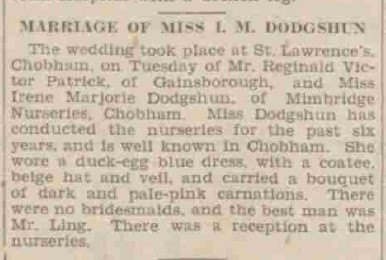
Although I have to admit being a tiny bit disappointed that the best a nurserywoman could do for her bridal bouquet in July was some carnations. This article firmly centres Marjorie as part of her community, describing her as ‘well known’.
Sadly, less than 5 years later, Marjorie had died. Her obituary states that she had been ill for two years, and died at home on Christmas Day 1943. By September 1945, the nursery was up for sale.
Gardening was one of the cornerstones of Marjorie’s life, enabling her to fulfil the dream she expressed back in 1910. However what is also interesting is that despite her stated desire to be ‘on one’s own’, Marjorie very rarely was. She was usually living and working with other women, women who when we examine their lives, turn out to be every bit as independent minded as she was. Averil Stephenson had studied at the Rotherham College of Art before becoming part of the operation at West Dene. Marguerite Edmonds was a land girl during WW2 despite being of retirement age; and had been part of the Settlement Movement in the 1930s, living in an intellectual community known as the Talbot settlement in London. Margaret Hammond Lancaster was a gardener at Southlands College in Wimbledon, run for women by (mostly) women.
When the term ‘new woman’ started to be used to describe independent minded women, Marjorie was just a child. She would have been expected to learn the basics, marry young, and have children. Instead she became part of a rather radical community of women, using gardening to transform not just their own lives but to help others.
 The Secret Library | Leeds Libraries Heritage Blog
Fantastic research and Marjorie really comes alive. Gre