We welcome back Heritage Volunteer Andy Armstrong this week, for the fifth in his series of blog articles exploring the rich archives of Leeds City Council papers and records available in our Local and Family History department. As usual, Andy’s research is accompanied by a research guide and a comprehensive spreadsheet of all our stock holdings on the subject of this blog…
Hi. My name’s Andy Armstrong and I have taken on the task of sifting through 200 years of Leeds CC papers held by the library to bring some structure to them and to produce research guides on subjects such as transport and housing.
Leeds Corporation, the precursor to the City Council, was reformed in 1835, Corporation had few powers to affect the development of Leeds, and little money with which to deal with the booming metropolis. Planning was not the specialist area that we know today, and building was undertaken by private developers, aiming to meet immediate needs. With Leeds’ population increasing from around 40,000 in 1800 to 430,000 in 1900, this led to many issues that could only be dealt with by being able to impose a more strategic framework for development.
Throughout this period, many Acts passed by Parliament led to the Corporation gaining the necessary powers to tackle many of the issues.
Health issues dominated the 19th century. For example, the cholera outbreaks in the 1830s eventually led to the building of sewers by the Corporation across Leeds, which was enabled by the powers granted in the 1842 Leeds Improvement Act. Cheap overcrowded housing, with poor sanitation, built to house the burgeoning population, soon became slums and caused many health problems. It wasn’t until the 1890 Housing of the Working Classes Act that the Corporation was able to address this by gaining the powers to buy, demolish and rebuild the stock.
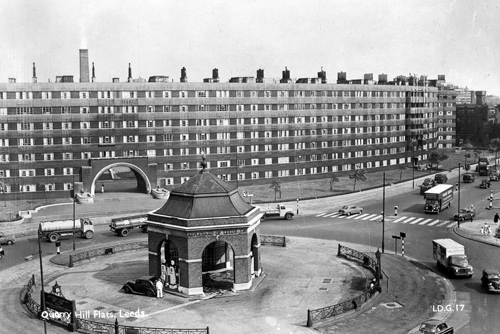
Other areas where the Corporation took control of development included the purchase of the Tram network in 1893, the supply of water in 1852 and the control of the supply of gas in 1869 and electricity in 1898.
It was the 1909 Town and Country Planning Act that created planning as we know it nowadays. This led to national standards being applied, like the ban on building back to back houses. Of course, Leeds Corporation found a way to carry on building such for another 30 years! Strategic Development Plans for the whole area were introduced, and these remain the framework for development today.
We can all see around us the development that has been made across Leeds and continues as highlighted by all the cranes seen across the skyline today.
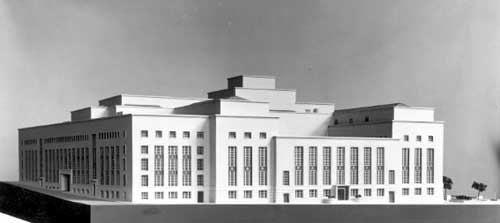
It’s also interesting to see the developments that never materialised. Such as the new Municipal Building to replace the Library and Art Gallery, first approved in 1939, and the Kearney Tube System which was to move the tram network in Central Leeds underground to reduce congestion in 1948. Sadly, both schemes were shelved due to post World War Two austerity.
 The Secret Library | Leeds Libraries Heritage Blog
People often criticise the state for infringing on people’s lives, for costly operations on other’s behalf which they don’t want. But the housing of the Working Classes Act 1890, whilst quaintly named, shows that sometimes other people, other individuals, can’t be trusted to have the interests of others, apart from themselves at heart – and more drastic measures are needed.