Earlier this year a new Red Plaque was unveiled in honour of James Potter Schofield, former fireman in the Liverpool & London & Globe Brigade. Schofield was killed on duty tackling the 1892 Leeds New Station fire. The plaque has been installed at the Dark Arches entrance to the station, off Neville Street, on behalf of West Yorkshire Fire and Rescue Service (WYFRS), Leeds Beckett University and the Fire Brigades Union. This week’s blog looks in detail at the life and death of Schofield.
James Potter Schofield was born 9th April 1849 to James and Mary Ann Schofield and was baptised in St Peter’s Church on 29th April 1849. His father was a bricklayer by trade and the family lived in Crown Street in Leeds city centre.
By the time of the 1871 census the family are still in Crown Street at no. 2. Schofield is now 21 and following in his father’s footsteps as a bricklayer. His siblings still living at home included John, Samuel, Mary Ann and Lucy. His younger brother, William Stubbs Scofield, 19, was also still living at home and also working as a bricklayer.
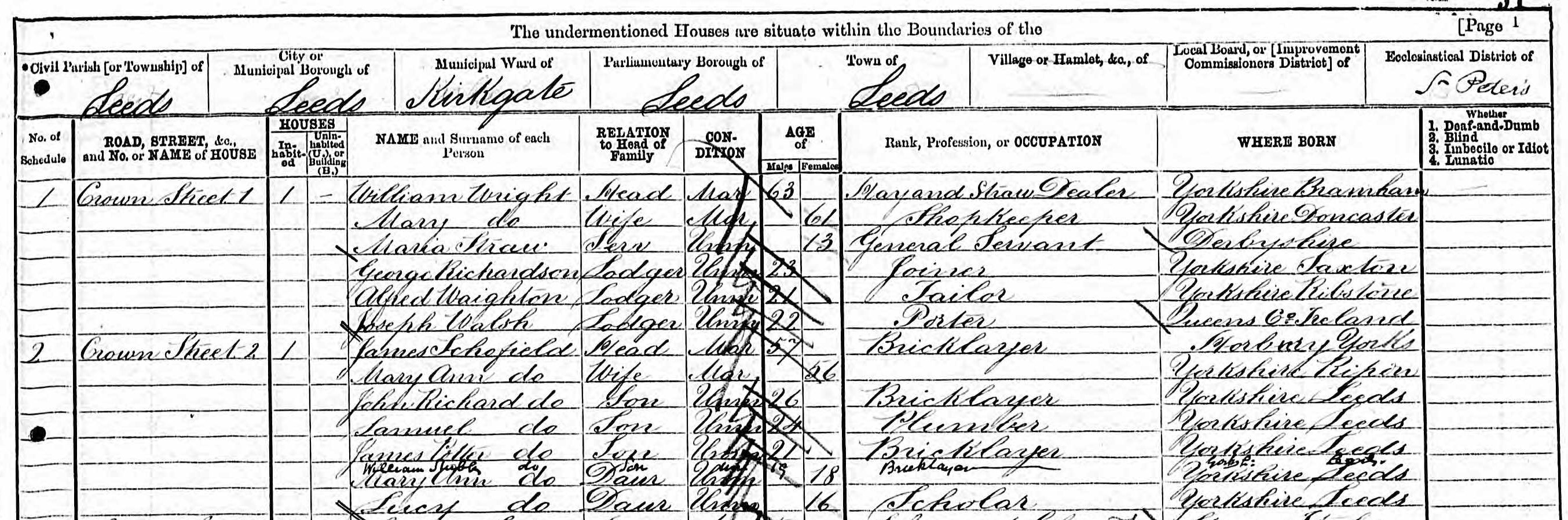
The 1881 census sees the family at 6 Haye’s Court. Schofield was still at home and unmarried. An older brother, John, and younger sisters Lucy and Mary Ann were all still living with their parents. Schofield is still listed as a bricklayer.
The 1891 census sees James Potter Schofield living alone at 17 Black Bull Yard, still unmarried. By 1892 and the time of the fire that would kill him, he was living at 8 Beehive Yard and still working as a bricklayer.
Both James and his younger brother William served as firemen. At the time of Schofield’s death they had both served with the Liverpool & London & Globe Fire Brigade for almost 20 years. Both of them were working together on the day of the station fire.
The fire began on Wednesday 13th January in the arches under the Leeds New Station in the premises of Messrs. Joseph Watson and Sons, soap manufacturers. Vast quantities of resin, oil and other inflammable materials used in the production of soap created the perfect conditions for the devastating fire. The fire burned for a full 24 hours before the various fire brigades could subdue it. Superintendent Baker, of Leeds Corporation Brigade, called it the most destructive fire that Leeds had ever seen and estimated that an acre was on fire before the brigades reached the site. There was a huge amount of damage to the arches and businesses and goods stored in them. The railway track became mangled and twisted – as seen in these images.


Both Schofield brothers were working at the far end of the Midland Railway platforms pouring water through the manholes that ventilate the arches below. James had been sent to replace William and only 2 minutes after handing over the hose, the platform gave way and James fell through to the furnace beneath and was not seen again. His remains were found the next day.
15th January 1892 saw the inquest into his death at Leeds Town Hall before the Borough Coroner, Mr J.C. Malcolm. It heard testimonies from various parties involved in fighting the fire including William Schofield. William explained that he had no inkling that the platform would fall in. He didn’t see James fall but heard his cry of alarm. He could only identify him from a key and buttons on his uniform. His last words were ‘I have relieved thee, Bill’.
Another member of the brigade testified that the area of the platform that fell was around five yards square. Schofield’s charred remains were found some 20 yards from the place he fell so death was not instantaneous.
The jury had earlier that day views Schofield’s remains at the mortuary and after hearing witness testimonies, asked to view the place of the accident. The Chief Constable explained that the area had greatly changed since the accident and the Coroner suggested that a visit would be unnecessary. The jury agreed and gave a verdict of accidental death with no negligence assigned to anyone. The cause of death was given as asphyxia.
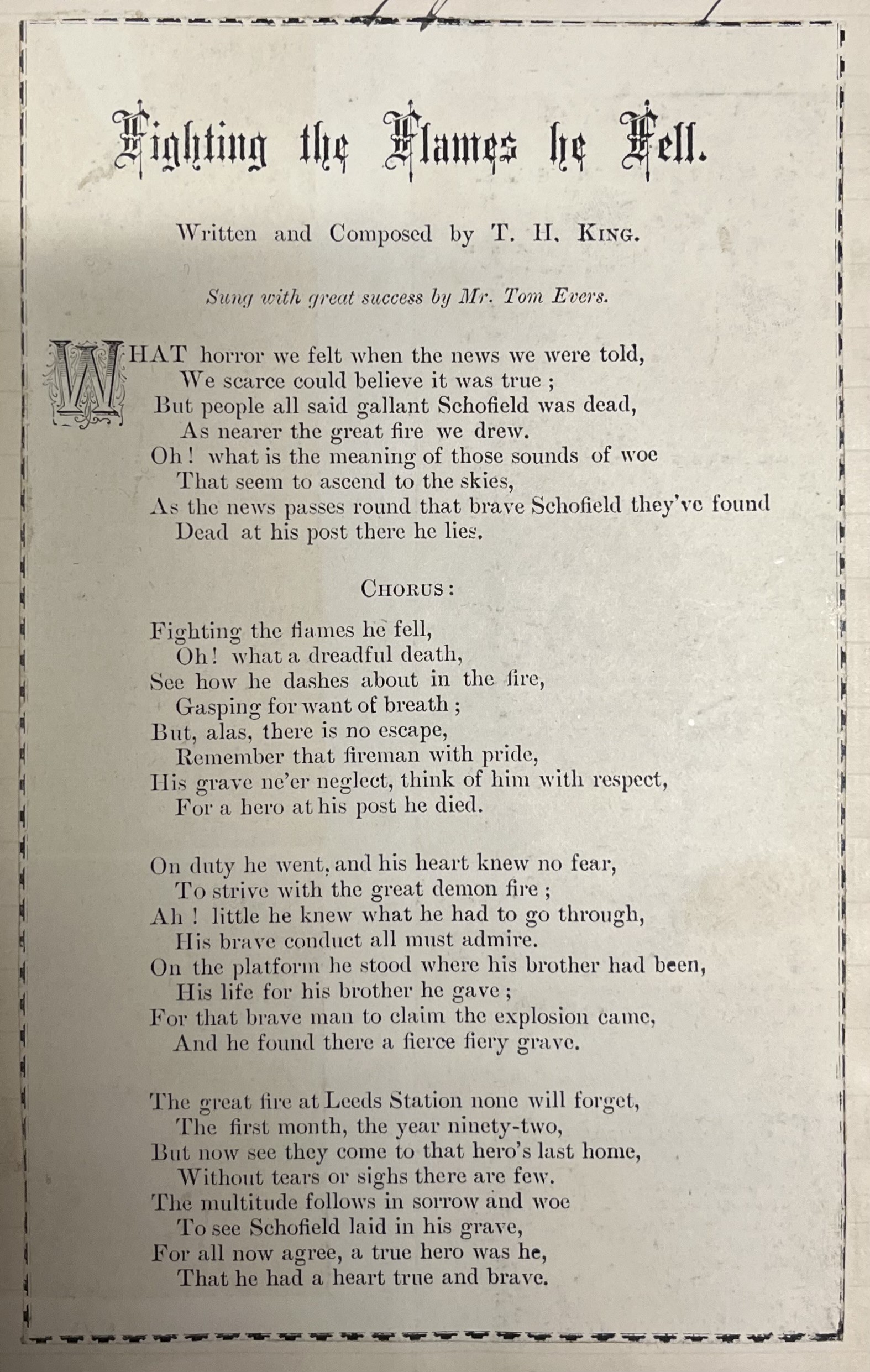
Schofield was interred at Beckett Street Cemetery on Sunday 17th January 1892. 317 members of Yorkshire Fire Brigades were in attendance, all wearing uniform. The coffin was carried by a manual engine of the Liverpool & London & Globe Brigade. The remains of Schofield’s helmet sat atop the coffin. It took an hour and a half to convey Schofield from his home to the cemetery with 42 carriages in procession. It was estimated that 100,000 people lined the route. Among the procession were members of the Company of Volunteer Engineers and of the Mountain Flower Lodge of the Grand United Order of Oddfellows, both of whom counted Schofield as members. Members of the Grand Theatre chorus sang at the burial service.
As early as the 22nd January 1892, a scheme was begun to create some kind of memorial to Schofield. A monument now stands in St George’s Fields on the University of Leeds grounds. It pays tribute the Schofield and other firemen who died in service.
 The Secret Library | Leeds Libraries Heritage Blog