Part two of Joey Talbot’s trilogy of articles on the mysteries and wonders of Morley Museum. Part one was published last week – we recommend reading before starting part two…
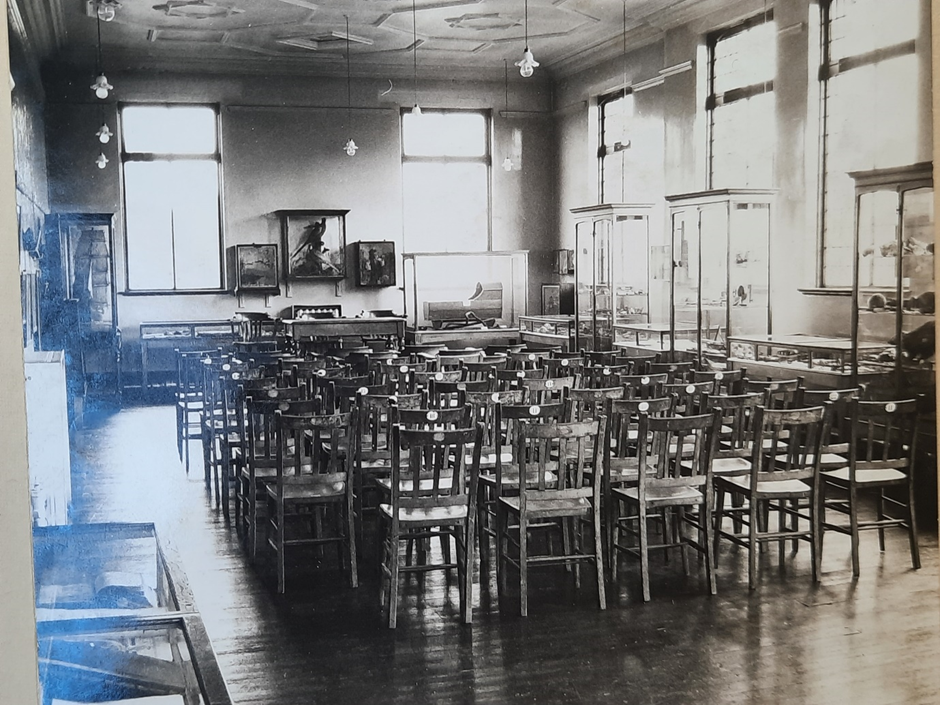
In a spacious room on the first floor of the Morley Library building there was once a museum. In the previous article, I introduced this museum and had a peek at some of the collection items as revealed through the museum’s acquisitions book. Having investigated this book, we were left with the question of what happened to the collection when the museum closed.
Clive McManus of Morley Community Archives provided the starting point for this investigation, by identifying a Morley Observer article from May 1966. First off, this gave a rough date for the museum closure. According to the article, which sadly describes the museum as “doomed to die through lack of interest”, the distribution of the former museum collection was organised by the Yorkshire Service for Museums and Art Galleries, with first refusal being given to Batley Museum, i.e. the Bagshaw Museum in Batley’s Wilton Park.
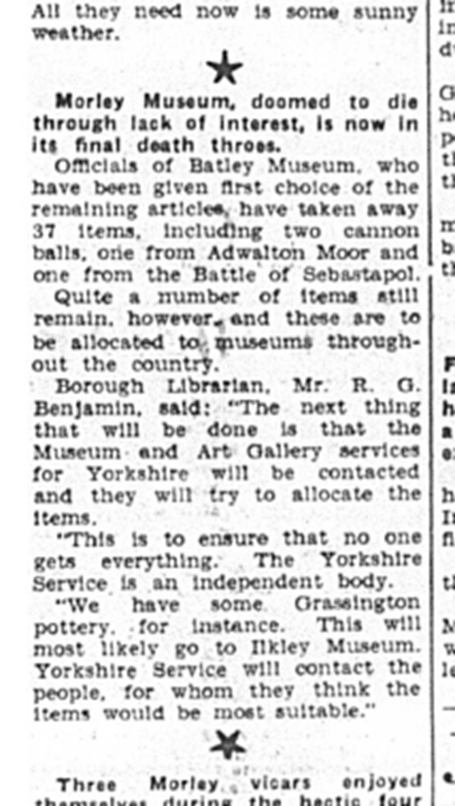
So I contacted Kirklees Museum service and got the first breakthrough when they were able to provide a spreadsheet containing a list of items received in June 1966 from the Morley Museum, including descriptions and some information on their provenance. Comparing this spreadsheet to the acquisitions book showed that nearly all the items could be matched with acquisitions book entries. Here was the first proof that at least part of the Morley Museum collection is still in public ownership!
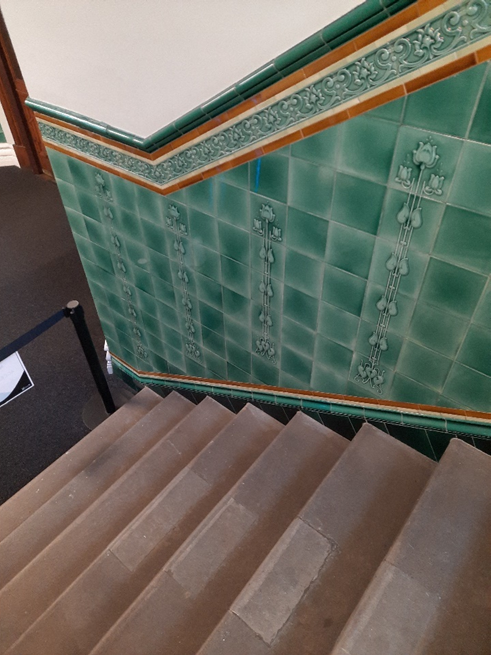
For example, we have the two cannonballs mentioned in the Morley Observer article. One of these was an English Civil War relic from the Battle of Adwalton Moor, just a couple of miles outside Morley; the other was from the Battle of Sebastopol in the Crimean War. When these cannonballs were removed from the museum, they came loose and bounced down the steps causing damage to several stairs along the way. The repair work from this incident is still visible in the Morley Library building today.
Several more items discussed in the previous article were also passed into the care of Kirklees Museums. These include the Town Crier’s bell, the stone quern, the mummy’s hand, the ball of slag used as a cricket ball against Oliver Scatcherd, the Chinese money swords, and the mystery skull. The mummy’s hand is now on display at the Bagshaw Museum, but the town crier’s bell has sadly been sold at auction.
One of the more intriguing objects we encountered was a nameless skull. This turns out to be a human skull with the top removed, originally donated by Mr W. H. Botham of Morley. Although not entirely certain, it seems likely that the top of the skull was removed for scientific purposes as a kind of medical demonstration specimen.
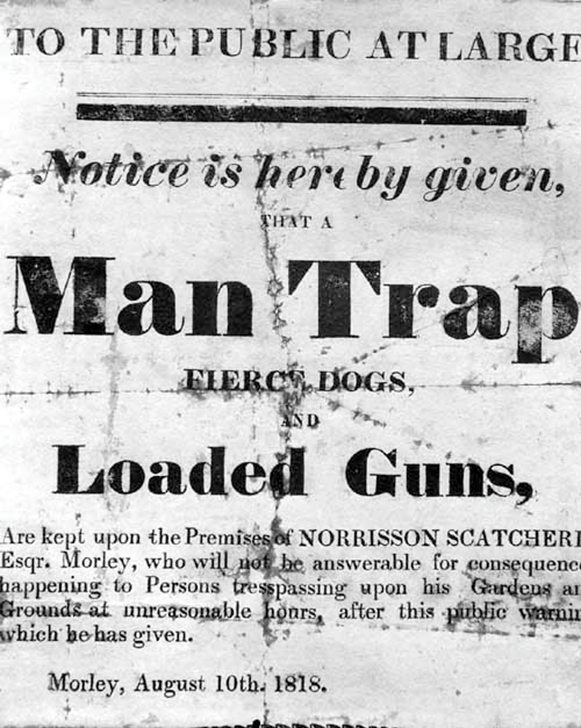
Also acquired by Batley was a man-trap owned by Morley antiquarian Norrisson Scatcherd, renowned author of The History of Morley, together with a warning notice as seen in this photo from the Leodis archive.
Another object donated was a painting of the Earl of Newcastle, a key Royalist figure from the English Civil War who commanded the victorious troops at the Battle of Adwalton Moor. A rapidly rising personage, William Cavendish began the war as Earl of Newcastle, then rose to Marquess following his Adwalton Moor victory. He went into exile after the defeat at Marston Moor, before being promoted again to Duke in 1665. During the Battle of Adwalton Moor, he used Howley Hall near Morley as his base of operations. The painting can now be viewed at Oakwell Hall. And now on display at Bagshaw is a scale model of the since-demolished Howley Hall.
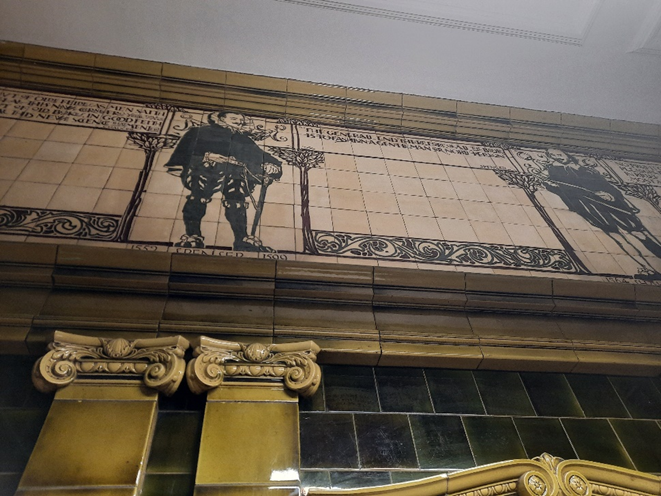
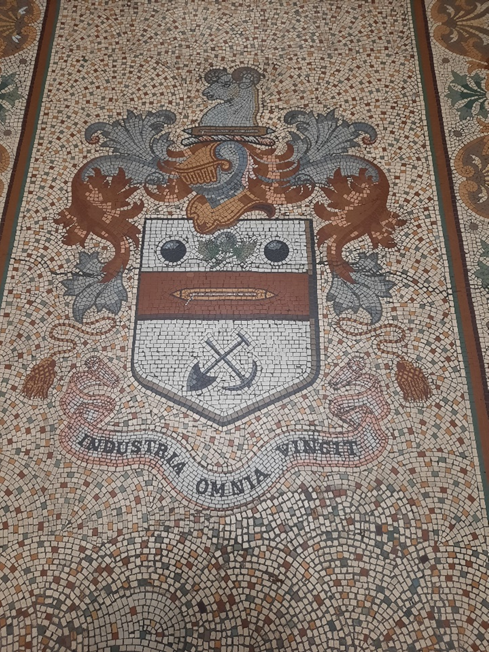
Meanwhile, to learn more about the fate of Morley’s Museum collection, I visited Morley Library to meet with Librarian Trudi Foster and members of Morley Community Archives. If you haven’t been to Morley, it’s a wonderful building, opened in 1906 as a Carnegie Library resplendent with tiled pillars and mosaics created by T.K. Yeates of Leeds, stained glass, and an entrance hall guarded by a posse of classic authors.
Now came the real breakthrough. In the cupboards upstairs lay an incredible stash of documents hailing from the period when the museum closed. These letters and papers told the story of the museum closure as it happened in real time!
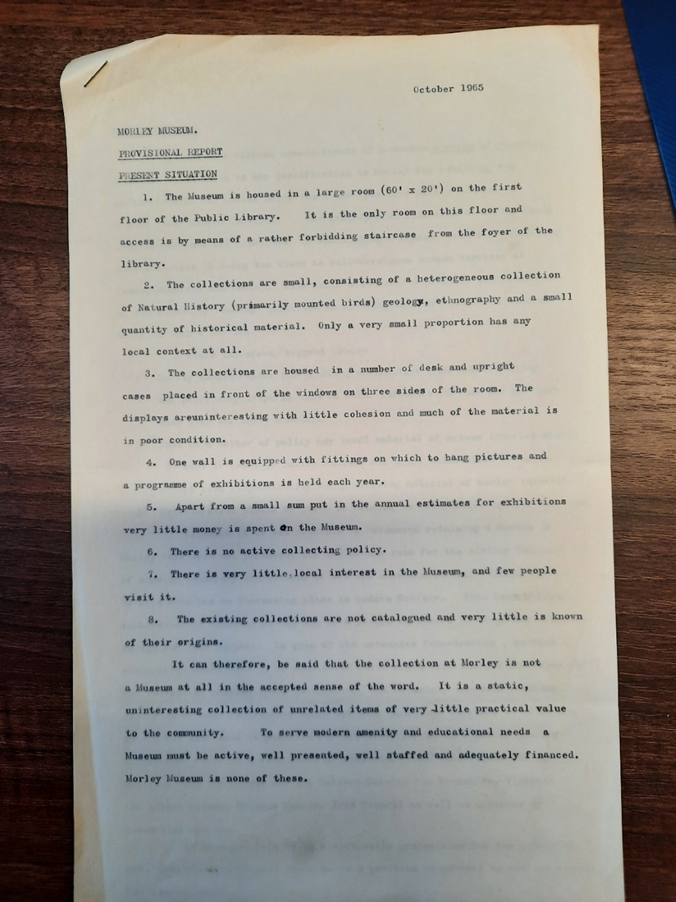
The story starts in October 1965, with a provisional report recommending the closure of the museum and the investigation of alternative uses for the room it occupied. This decision was confirmed at a council meeting on 2nd December 1965.
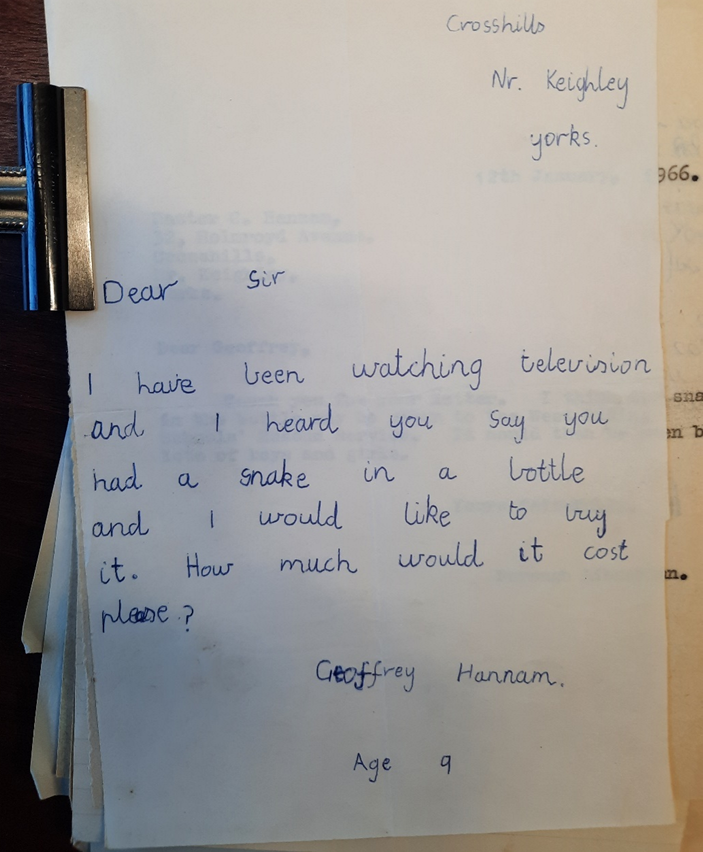
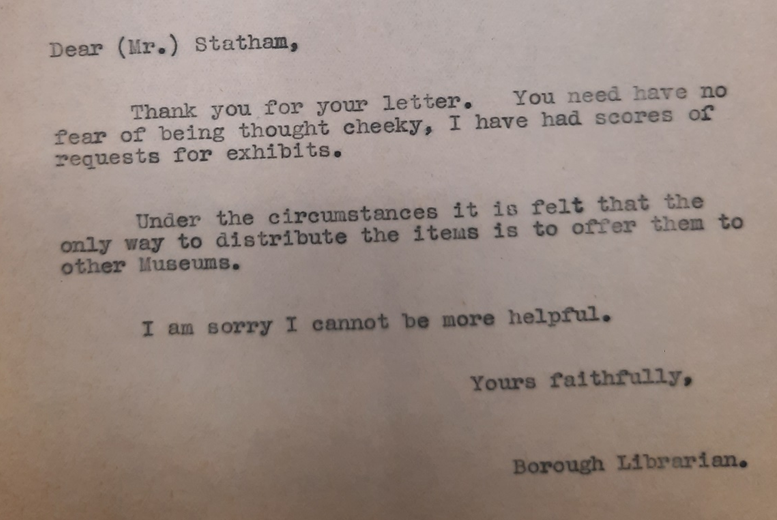
Initially, it was agreed that the museum collection should be offered to the public. On 10th January 1966, a Granada TV appeal was made on “Scene at 6-30”, calling on the public to rehouse museum collection items. The response was overwhelming. A flood of letters came in from collectors, schoolteachers, a holiday park, a zoo, Leeds College of Art, a member of the Society of Archer-Antiquaries, and large numbers of enthusiastic children, such as this one from nine-year-old Geoffrey Hannam of Crosshills nr. Keighley, who writes “Dear Sir, I have been watching television and I heard you say you had a snake in a bottle and I would like to buy it. How much would it cost please?”
Sadly for Geoffrey and all the other budding herpetologists, Borough Librarian Mr RG Benjamin rapidly came to the conclusion that dispersing the museum collection to all and sundry would be unworkable. Nevertheless, Mr Benjamin individually replied to each correspondent, explaining to them that the collection items would now be offered solely to local museums and schools. This seems to have been quite a considerable task.
One person who disapproved of the scattering of the collection was N. C. Haslegrave, Hon. Secretary of the Museum and Art Gallery Service for Yorkshire. In a letter to the Morley Town Clerk dated 10th February 1966, he formally requested that the collections should instead be transferred to other museums in the area. The upshot of this was that the Museum and Art Gallery Service for Yorkshire became responsible for the dispersal of the museum collection.
As we’ve already seen, first refusal was given to the Batley Museum service, being Morley’s neighbouring town. A letter from the Borough Librarian to G. Teasdill, Curator of the Bagshaw Museum, shows that the transport of the cannonballs and other items from Morley to Batley took place on Thursday 5th May 1966.
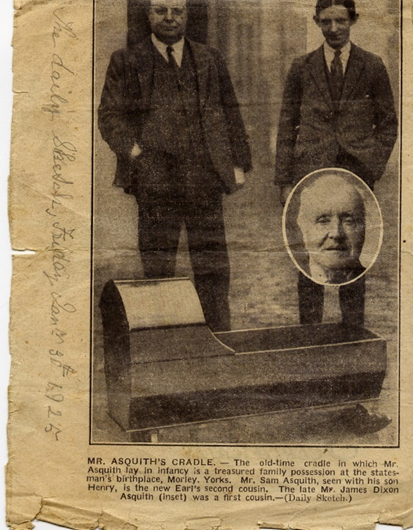
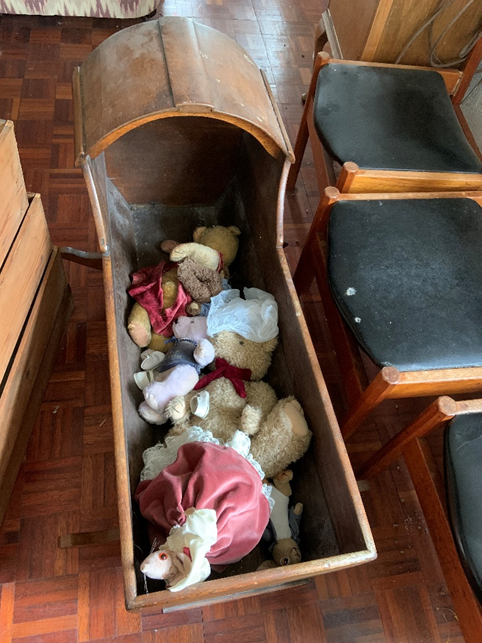
However, even before this, items were offered for return to their original donors or the donors’ families. Among those that were reclaimed in this way is Asquith’s cradle. Luckily we can bring the story right up to date. The cradle was returned to James Henry Asquith and his wife Anne. James Henry, as seen here with his father Samuel, was the grandson of Herbert Asquith’s cousin, James Dixon Asquith. He was the owner of J Asquith & Son Ltd, Textile Engineering and machine makers of Albion Works, Marshall Street, Morley, who made stainless steel dyeing machinery, rubber rollered scouring machines, milling machines, and fibre glass trucks. From him the cradle passed down through the family, and this photo shows the cradle as it was last year, before it was sold at auction.
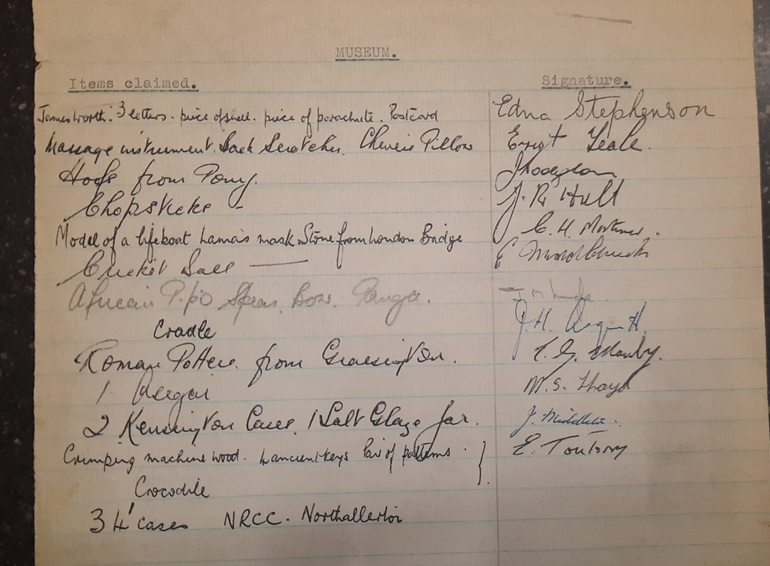
The list of items claimed by their donor’s families can also help us to answer a question posed in my previous blog. In 1908, former Morley Mayor William Middlebrook loaned a cricket ball to the museum. Did he ever get his ball back? Well, the document shows that a cricket ball was indeed returned, beside a signature that possibly reads as E Middlebrook. So it took almost sixty years, and must have skipped a generation or two, but yes, the Middlebrooks did indeed get their ball back. It was sadly too late for William to play any matches with it though.
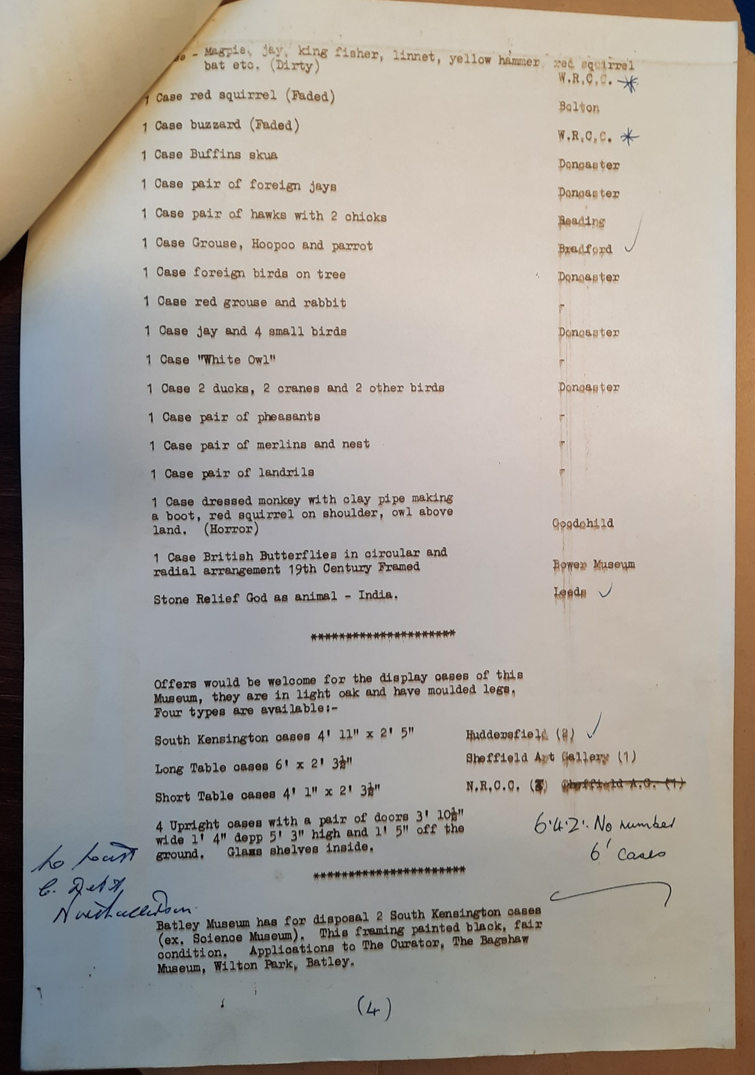
Finally, the collection items not claimed by their donors or by Batley Museums were offered to other cultural institutions. Managed by the Museum and Art Gallery service for Yorkshire, this process involved the creation of a four-page document listing the remaining items and their condition. A later version of this document included information on which institution each item was destined for. Most went to local museums, a few to museums further afield and some (especially stuffed animals and birds) to the West Riding School Museums Service, which distributed the materials among Yorkshire schools. The museum display cases were also sold or distributed in a similar manner.
In search of some of these items, I arranged a trip to the Bagshaw Museum and Oakwell Hall in Birstall, to see what I could find there. The results will be revealed in the next post!
 The Secret Library | Leeds Libraries Heritage Blog
Again totally wonderful and really admire the detective work tracking the history down with such fine detail. Makes me want to visit Morley Library!
>
Hi Lucy, I’m so glad you enjoyed the article. Please visit Morley Library and check out the spears on the wall!