This is the second part of a four part series. Read part one here.
The purpose of this series of articles is to demonstrate how you can use the resources of the Local and Family History department to conduct a fact checking exercise. Family historians will frequently encounter assertions, facts and descriptions that seem completely reasonable, but turn out to be totally incorrect. Sometimes you will never know the answer. But sometimes with a bit of digging and pulling at threads you can get to the facts behind a story.
This isn’t meant to be a definitive methodology. Finding your own research methods and establishing your own systems is one of the joys of family history research. However, I’m going to share some of my methods and tactics here so that you can see how you might approach a similar puzzle. To find out where our puzzle came from you can click here.
In this example, we have two sources of contradictory facts, supplied by four different secondary contributors (see here for a useful definition of primary and secondary sources).
The first thing to do was to compare the sources and break down the facts. In some cases they corroborated each other, in others they were very contradictory. Using the resources we now have at our fingertips, some of these facts will be very easy to establish.

Peachey family
The Peachey family seemed like a good place to start. Although there were no dates supplied the same names were mentioned in both sources – but there were differences in how they might relate to each other. Based on Bygone Middleton, their family tree should look like this:
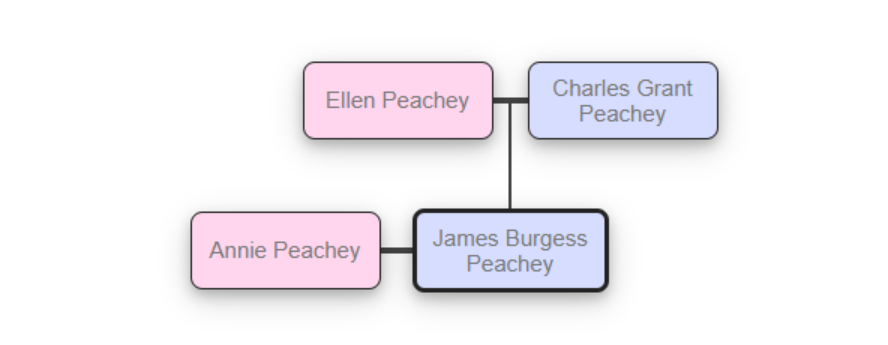
A search for James Burgess Peachey of Middleton on Ancestry proved immediately enlightening.
According to the 1911 census, James Burgess Peachey and his wife, Eliza were both born in Norfolk; and had married some time in 1892. This document showed them living at Town Street, Middleton with 3 of their children – including another familiar name, Charles Gant(Grant?) Peachey. So James is NOT married to Annie and NOT the son of Charles, in fact, he is the FATHER of Charles. Turning to the Leodis comments, there was an assertion that James was the father of Annie, corroborating Annie as a schoolteacher. Because the 1911 census tells us how many children have been born in a marriage we can see that James and Eliza had 3 children, with 3 still living as of 1911. Could one of them be Annie?
A quick hop backwards into the 1901 census via Ancestry’s ‘suggested records’ shows that yes, one of them was Annie. These suggestions can be both a blessing and a curse, being varied in their accuracy. In this case, they are a blessing; the digital mistranscription of the family name as ‘Beachery’ would have made it very hard to find otherwise. Thankfully, there are enough points of similarity for me to be able to say with confidence that the 1901 Beachery family of Town Street, Middleton are the same as the 1911 Peachey family of Town Street Middleton. The street address is the same; the names, ages, and places of birth of the 4 common entries all match; and James’s occupation is similar enough for it to be him.
There is one more family member mentioned in the secondary sources – Charles’ wife, Ellen. I could start a new search on Ancestry using the verified facts that I now have about Charles – his parents’ names, his place of birth, his estimated year of birth. Before I do that though, I can take a chance on something I can do a little bit more quickly.
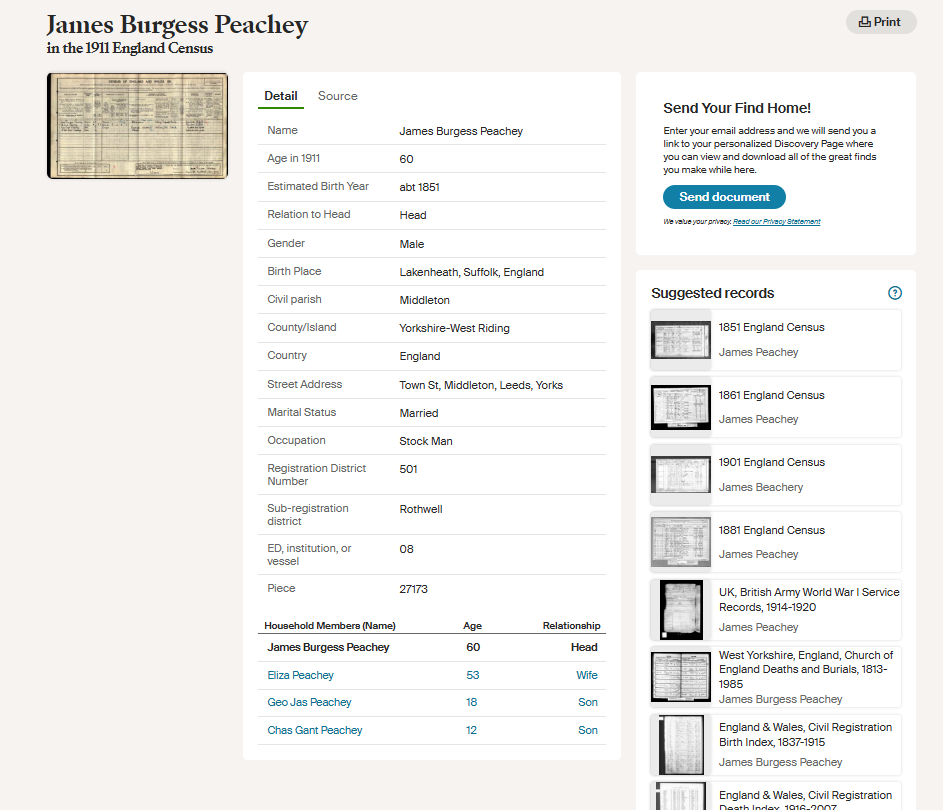
This screenshot shows the Ancestry page for James Burgess Peachey on the 1911 census. At the bottom of the page it lists other people in the record who appear as clickable links. This is like switching a slide in a microscope and changing your focus, which will also change the focus of all your ‘suggested records’ to the selected person as well. When I focus on ‘Chas Gant Peachey’, Ancestry suggests a 1921 census record for ‘Charles Gaut Peachey’; as well as a 1901 census record for ‘Charles Beachery’ which I have already seen and verified.

This record shows a Charles Gant Peachey of the right age and birthplace, living with his parents in law and his wife – Ellen. For further corroboration I could start searching for a marriage record, but for now I am happy to accept this. The Peachey family tree has changed dramatically from this:
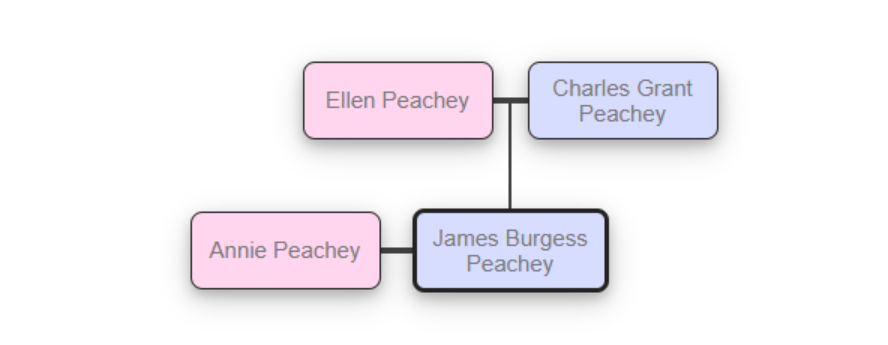
to this:
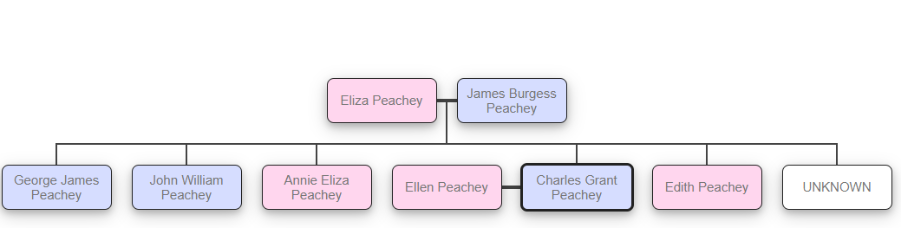
There are still a few remaining facts to check from the list, the first couple relating to Annie.
First, the assertion that she attended ‘the old school’. Annie is missing from the 1901 census where her parents are recorded, despite being around 14 years old. I found her on a different census entirely – listed as a boarder at St John’s Square Wakefield. The head of the household was Gertrude McCroben, known to have been the headmistress of Wakefield Girls School. This was a fee-paying school. The reference to ‘the old school’ may be a reference to St Mary’s CE Primary which used to be on Town Street in Middleton. It’s likely that all the Peachey children would have attended that school. There is a nice snippet of information about the school on this blog here: A Walk round Middleton
Secondly, both sources describe Annie as a teacher, one at Middleton Secondary Modern School, the other at Middleton Girls School.
The known biographical information about Annie led me to the 1921 census where she lived at Town Street with her mother. She was described as an elementary school teacher at East Ardsley Council School. To verify at which school, I could take a trip to the West Yorkshire Archives to view the records of the Leeds John Blenkinsop Middle School (LC/EDD133); where I could also look for the records of the primary school. Today I am happy to verify that Annie was a teacher, I am less concerned about where.
The final Peachey fact to check is that James Burgess Peachey was a coachman at the hall. We’ve already found the 1901 and 1911 censuses for James and neither of them offer his occupation as ‘coachman’; rather he appears as a stockman working for the colliery proprietor(1911) and ‘cattle cow man domestic’ on the 1901. Going further back in time, James is mostly described as an agricultural labourer where he appears on censuses in Suffolk. On his first Yorkshire census in 1891 he is described as a ‘horse feeder groom’. It’s still nowhere near a coachman so I think we can strike off this fact.
During the course of this exercise I found a great deal of other material on the Peachey family including the correct form of an important name to them – Charles is Charles Gaut Peachey; Gaut being his mother’s maiden name.
Read part three in this four part series
 The Secret Library | Leeds Libraries Heritage Blog
3 Comments Add yours