In today’s article Jan Pinder takes us on a journey across Leeds through the eyes of renowned artist John Atkinson Grimshaw with modern comparable images of the city today.
John Atkinson Grimshaw was one of the most significant artists of the late Victorian era, with a distinct style inspired partly by his fascination with the different effects of night light. His career coincided with the growth of towns and cities and the emergence of Great Britain as the world’s leading industrial nation. Leeds rapidly became a major manufacturing centre, and it is estimated that its population grew from approximately 30,000 in 1800 to around 180,000 a century later. This led to it becoming the fourth largest town in Victorian England. Grimshaw enjoyed capturing the new urban centres in his work and painted scenes in many large towns and cities, including London, Glasgow, Liverpool and of course his native Leeds. Although many feel that Grimshaw’s most creative and formative years were the 1860s and 1870s, the 1880s saw a big increase in his output and in new subjects such as these urban scenes, in addition to a greater output of dock scenes. This post will focus on Grimshaw’s atmospheric works of the centre of Leeds painted around 1880 and takes its inspiration from a Wellbeing Walk run by Leeds Art Gallery last year.
The first location of these works is a short walk from the Art Gallery, on Park Row. Painted in 1882 Park Row, Leeds was commissioned by the directors of Becketts Bank, which can be seen on the right of the painting.
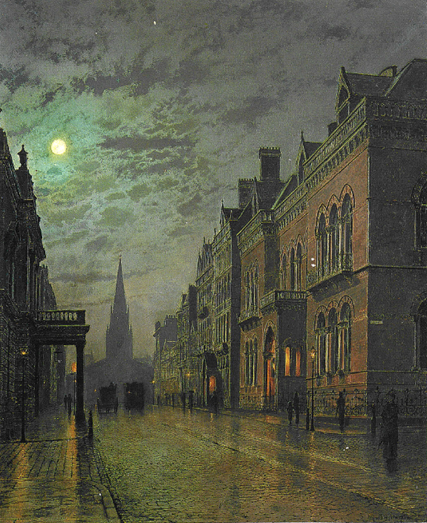
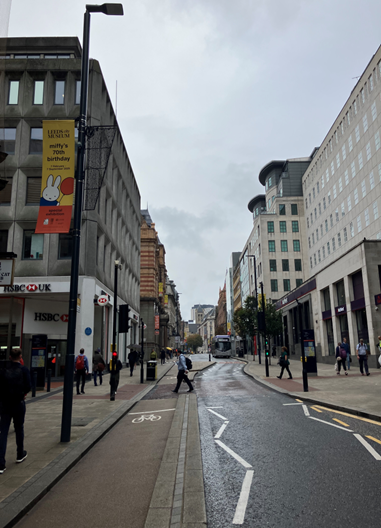
Park Row, Leeds 1882 by Atkinson Grimshaw The same location 2025 by Jan Pinder
Grimshaw’s work captures the modern feel of the new commercial buildings in Leeds centre, whilst giving them a more timeless quality in seeing them by moonlight. Alexander Robertson in Atkinson Grimshaw ( c1988 ) L Q B GRI describes this work as, “Grimshaw at his finest in conveying the mysteries of night-time in the town.” He notes that the Leeds Mercury found in it, “the same wonderful effects, the same grand gradations of tone, the same close attention to minuteness of detail, which most of his previous productions have displayed.” Despite a different theme to the suburban scenes there is the same air of moonlit mystery and atmospheric beauty common to much of Grimshaw’s work.
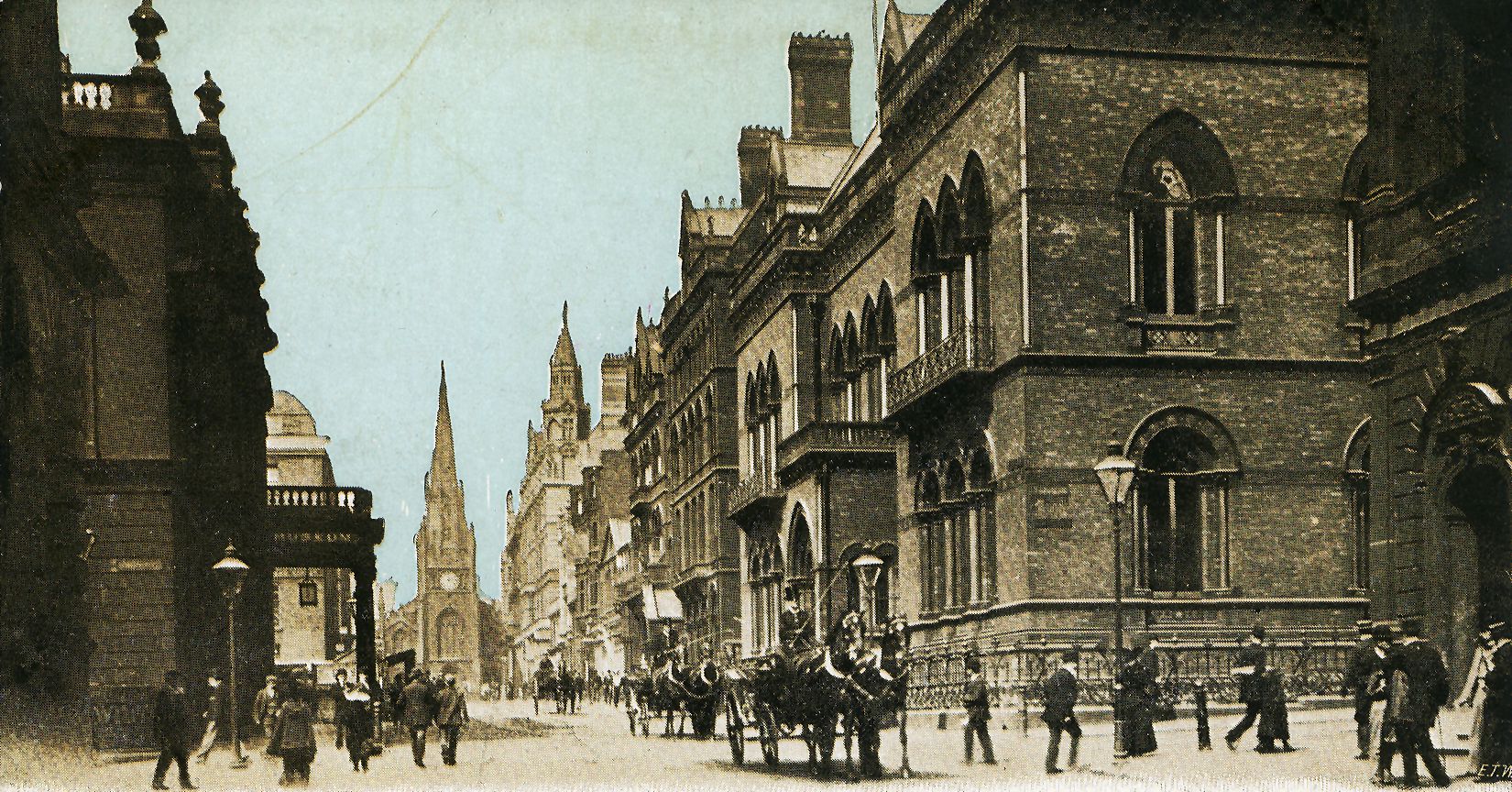
Park Row c. Thoresby Society
The photograph above shows a tinted postcard of the same scene just a few years later, possibly around 1898, taken from the Leodis website. That view today has some buildings that are recognisable, although Beckett’s Bank has long been demolished and the National Westminster Bank now stands in its place. The original Leeds Cathedral, which can be seen at the end of Park Row, was also demolished in the late nineteenth century, to make way for the widening of the Headrow. It was then rebuilt in its present position on Cookridge Street and its former site later developed by the Leeds Building Society. The site is now Browns Brasserie and Bar.
Walking down Park Row and turning left after City Square brings us to the location of a second classic example of Grimshaw’s urban scenes. Boar Lane, Leeds by Lamplight painted in 1881 is a busy street scene, which Robertson describes as “one of Grimshaw’s most lovingly painted street scenes.” This is not only due to the suggestion of night-time atmosphere, but also in the way that the light from the shop windows is reflected on the wet pavement and cobbles. As Robertson notes, “the reality of the scene was probably unpleasant and muddy, but in Grimshaw’s hands it is transformed into a mysterious wonderland.”
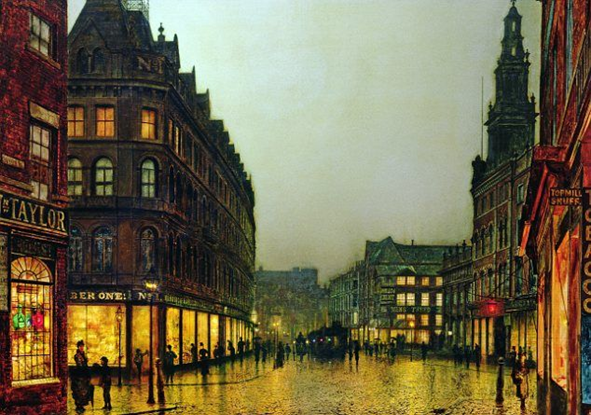
Boar Lane, Leeds by lamplight (1881) by John Atkinson Grimshaw | WikiArt Store
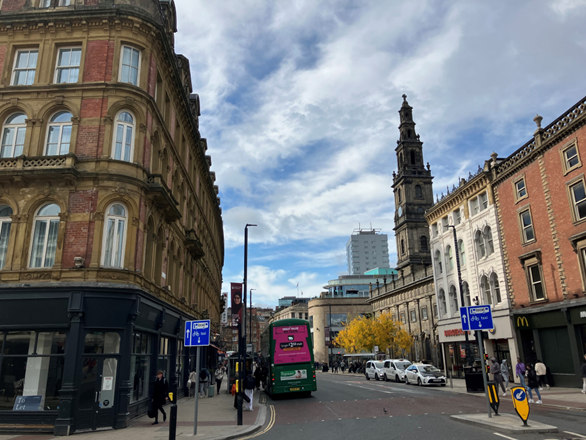
The same location on Boar Lane today by Janet Pinder, 2025
Looking at the same scene today, we can recognise the distinctive outline of Trinity Church and the corner building on the left but few of the other buildings remain. The corner building now houses the Marriott Hotel.
Turning right down Lower Briggate from Boar Lane brings us to the next location. Leeds Bridge, 1880, shows the bustle of an inland working port, with the river traffic bringing goods directly into the centre of the city. This work was covered in some detail in a previous Grimshaw blog article but is included here due to its importance in showing both the economic and social life of Victorian Leeds.
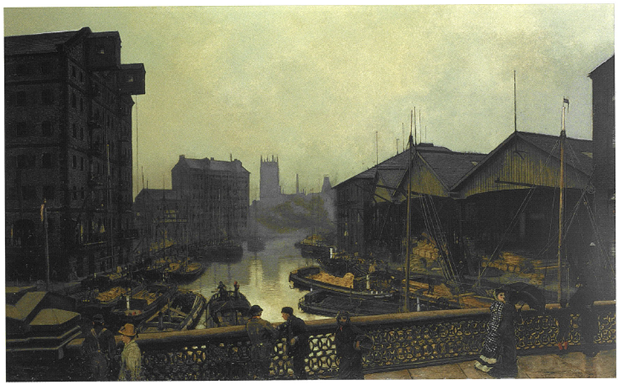
Leeds Bridge, 1880 from John Atkinson Grimshaw ( 1998) by Alexander Robertson ST 759.2 GRI
Besides the now vanished busy traffic of the barges, it also shows the wide spectrum of Leeds society in the people depicted on the bridge going about their everyday lives. Some buildings are still recognisable, such as St Peter’s Church and the warehouse to its left. The painting is also significant in that it was bought by Grimshaw’s most important patron in Leeds, Walter Battle.
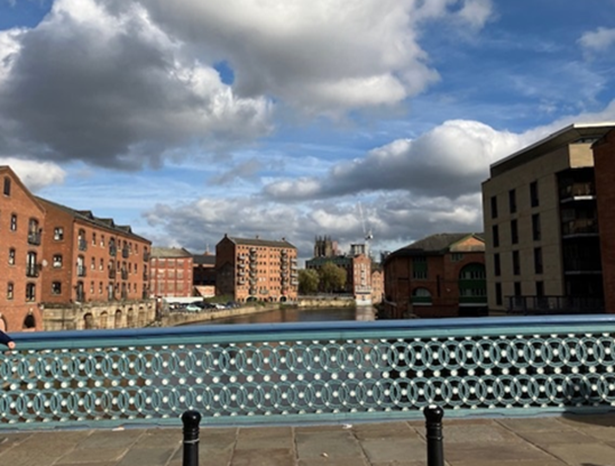
Leeds Bridge today by Janet Pinder 2025
It is interesting to compare this work to the view from the same position on Leeds Bridge today, where some buildings remain, including Leeds Parish Church. The ornate metalwork on the bridge is also still very recognisable.
The location of the final painting of this post requires a walk on the river path out of Leeds, past the Royal Armouries. Reflections on the Aire – On Strike, 1879 is considered a rare example of the artist painting a social realist scene. It was acquired by Leeds Art Gallery in 2022 and shows a sombre industrial cityscape with a lone female figure looking out over the River Aire towards Hunslet.
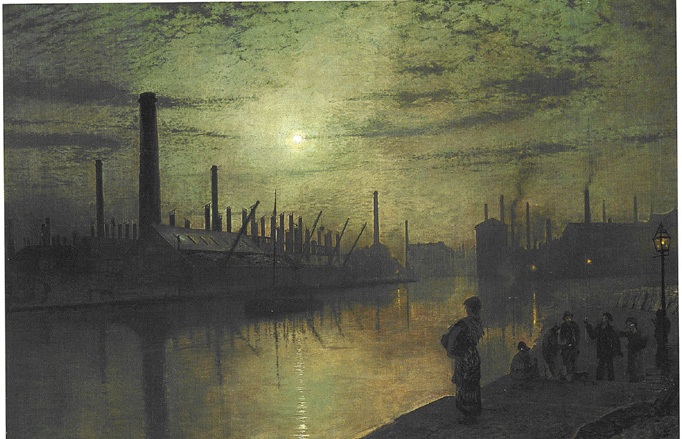
Reflections on the Aire – On Strike from John Atkinson Grimshaw ( 1998) by Alexander Robertson ST 759.2 GRI
This work is particularly significant as Grimshaw painted very few pictures of industrial buildings and rarely made social comment. The location for the artist’s viewpoint is thought to be Knostrop Cut, across from Hunslet Mills. This was established by the Art Gallery curator Nigel Walsh and the curator of Industrial History, John McGoldrick, when the painting returned to Leeds in 2022 after being housed in a private collection for many years. It was painted at a time of great hardship for industrial workers and strike action was common. Grimshaw lived just along the river at Knostrop Hall at the time. As with many of the twilight and moonlit suburban scenes, we are drawn to the figure of the woman and curious to know her story. Who is she and what are her thoughts as she looks out across the water? Robertson notes that the view is a grim stretch along the river in Leeds and that it was described by the Yorkshire Post as follows:
‘”… some iron works at Hunslet seen from the North bank of the River Aire, between Leeds and Knostrop. The scene here when the furnaces are out of blast, is dismal and desolate in the extreme, and yet Mr Grimshaw chose it for pictorial illustration, partly, it would seem, for the chance it gave him of producing the iridescent effects of light which he knows how to manage so cleverly and partly for the chance it gave him of suggesting a story …“
This painting inspired Leeds author Chris Nickson to pen such a short story which can be read here The Very First Annabelle Harper Story – Chris Nickson. The story features Annabelle, one of the main characters from his Tom Harper series, as the mysterious figure looking out over the river.
I am unsure of the exact location of the artist’s viewpoint, but the photograph below shows the pathway by Knostrop Cut in 1999. The numerous chimneys are gone from the skyline and the landscape has changed considerably since Grimshaw’s time. On the left of the photo are the grey warehouses of Atkinson Hill and in the distance on the right are the red brick warehouses of Knowsthorpe.
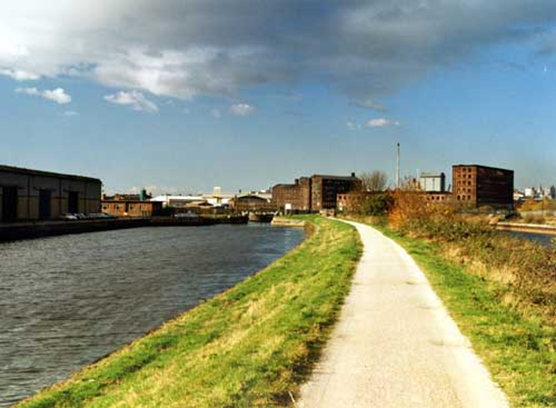
Knostrop Cut Pathway / c. Leeds Libraries, Leodis
Grimshaw also painted another scene of Knostrop Cut in 1893 from a different viewpoint. The artwork titled Knostrop Cut, Leeds, Sunday Night is another of his atmospheric night time scenes, this time showing a tranquil twilight with rich colours and a contrast of light and shadow. The foreground shows a calm waterscape, which contrasts with the misty industrial landscape in the background.
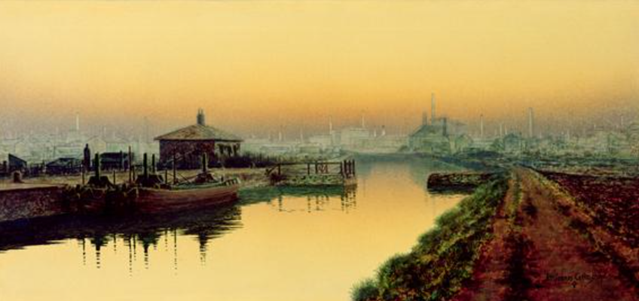
Knostrop Cut, Leeds, Sunday Night, 1893 – John Atkinson Grimshaw | WikiArt.org
Grimshaw’s city scenes of Leeds capture the changing face of Leeds as an emerging industrial city in the late nineteenth century and at times show his empathy for those living there. He chose to depict the more prosperous and commercial streets rather than the social deprivation of yards and alleyways that would have made up much of the centre. He did include some industrial scenes in his work, but only occasionally made any social commentary or showed the harsh reality of the lives of most people of that time in Leeds.
If you would like to find out more about the life and work of John Atkinson Grimshaw please see Leeds Art Library’s Atkinson Grimshaw Collection Research Guide and visit Leeds Art Gallery to view the works covered in this article. In addition, an exhibition ‘Don’t Let’s Ask for the Moon …’ Nocturnes and Atkinson Grimshaw will be running from 14 November 2025 to 19 April 2026 at Leeds Art Gallery, which will bring together its collection of Grimshaw’s nocturnal paintings alongside images of nocturnal themes by four contemporary painters.
 The Secret Library | Leeds Libraries Heritage Blog