This week Jan Pinder concludes the Atkinson Grimshaw journey with an exploration of his, perhaps lesser known, beautiful portrait paintings.
John Atkinson Grimshaw is most famous for his landscapes and in previous blog articles we have focused on his nocturnal scenes of urban lanes and his atmospheric paintings of the centre of Leeds. However, Grimshaw was not just a landscape artist, and this post will show that with his accurate use of colour and lighting and his vivid detail and realism, he was also an accomplished portrait painter. Alexander Robertson, the former Senior Curator at Leeds City Art Gallery was well known for his work on John Atkinson Grimshaw, and his book Atkinson Grimshaw ( 1988 ) has provided much of the material for this article.
Like many of the artists of this period Grimshaw was attracted to and influenced by the methods and the style of the Pre-Raphaelite Brotherhood and their ‘Truth to Nature.’ This is evident in his early still life works and landscapes, but his portraits also show a love of nature and strong attention to detail. Although Grimshaw included men in several works, most of his portraits feature women, many of which are colourful portraits of Victorian ladies.
During the 1870s Grimshaw chose to compete more directly with mainstream artists such as James Tissot. Tissot’s hallmark was fashionable women in exotic interiors and Grimshaw too attempted this genre with a group of paintings showing beautiful Victorian home interiors and stylishly dressed ladies. It is thought that the model for some of this series of works was Grimshaw’s wife, Frances Theodisia Grimshaw, known as Fanny. Grimshaw had married his cousin Frances in 1858 and their marriage was a very happy one. Fanny’s main concern would have been motherhood and the home, but she supported her husband in his ambition to paint.
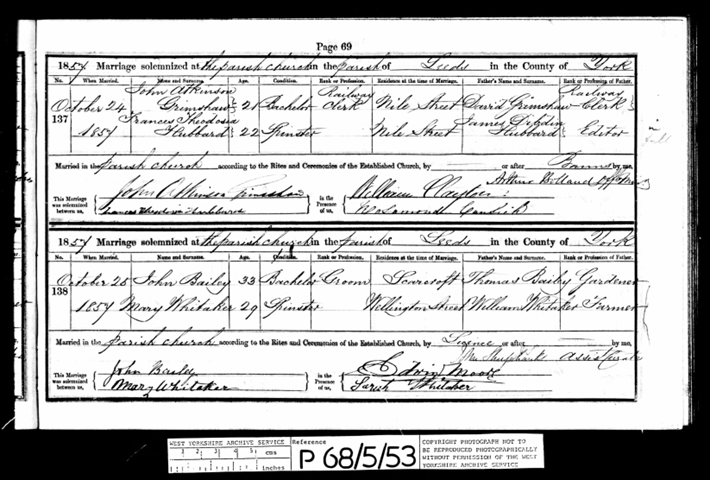
Marriage Certificate of John Atkinson Grimshaw and Frances Theodisia Hubbard
Family photos and considerations of age suggest that Fanny was not the only model for these works. A drawing said to be of Miss Agnes Leefe, who later joined the Grimshaw household as a governess, is sufficiently like the face of two of the paintings, Summer and Il Pensero to suggest that they are portraits of her.
As a setting for these Knostrop paintings, Grimshaw chose his own home, Knostrop Hall. This seventeenth century manor house had been purchased by Grimshaw in 1870 and was to be his main home for the rest of his life. It stood two miles east of the town centre by the River Aire on the Temple Newsam Estate. The hall was demolished in 1960.
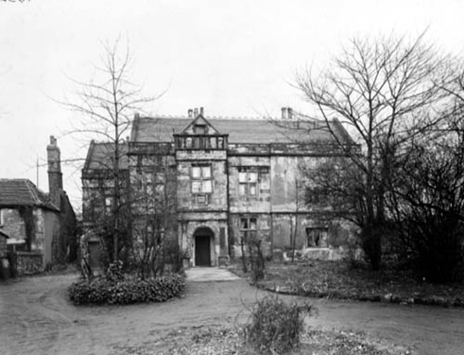
The series is mainly painted in the familiar rooms of Grimshaw’s home, garden and conservatory and can be seen as celebrating Victorian domestic life. It shows the skilful observation and technical expertise seen originally in Grimshaw’s early still life compositions.
These paintings were widely admired and considered by some as among his finest works . Perhaps the most elaborate work in the Knostrop group is Summer, which shows a tranquil Victorian interior, with a woman looking thoughtfully out of the window. Known for its warm glow and serene atmosphere, Robertson describes this work as a celebration of light and colour.
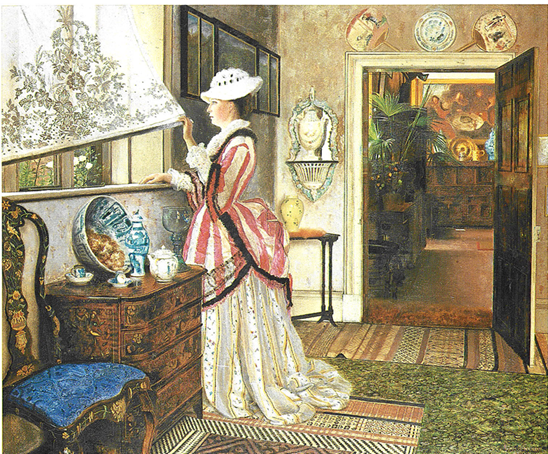
Summer ( 1875 ) Atkinson Grimshaw
The companion to Summer is Spring, which presents a much more carefree scene of a lady tending her plants in the early morning. It can be seen as characteristic of Grimshaw’s work in its detailed and realistic depiction of a seasonal scene.
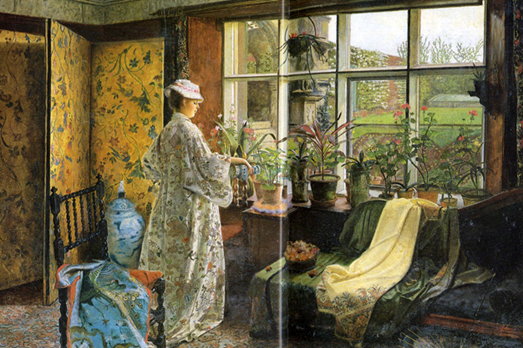
Spring – John Atkinson Grimshaw – WikiArt.org
Through the window can be seen Knostrop Hall garden. Grimshaw was to paint another of this series in the garden here, In the Pleasaunce, a Pleasaunce being an area attached to a house or estate used for pleasure or recreation. This work features Mrs Grimshaw sitting in her garden holding a Japanese parasol and is the subject of a note in the Leeds sketchbook ‘must paint Fanny in the garden.’ The same sketchbook contains lists of exotic plants which Grimshaw bought for the Knostrop conservatory.
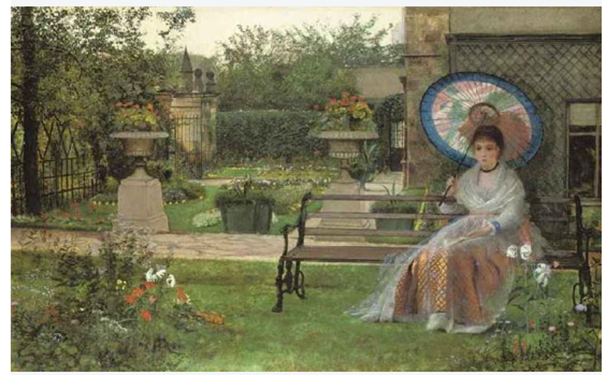
In the Pleasaunce, 1875 – John Atkinson Grimshaw – WikiArt.org
The conservatory is used as the setting for Il Penserosa, which shows Mrs Grimshaw surrounded by hothouse plants. This may be the conservatory at Knostrop, or it could be the conservatory which surrounded three sides of ‘The Castle by the Sea,’ the house Grimshaw rented in Scarborough from around 1876. Mrs Grimshaw is wearing an elegant dress and hat, and both the Japanese fan that she holds and the blue and white vase show their passion for oriental objects, which was quite typical of the time.
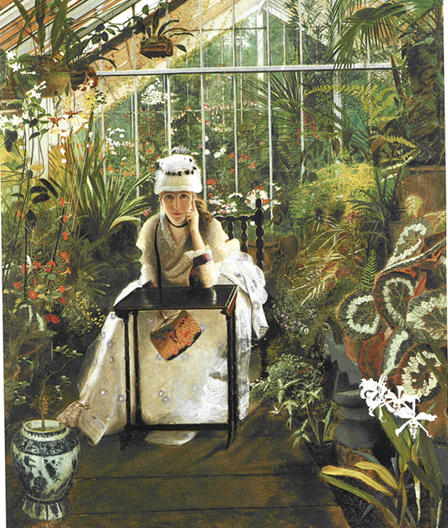
Il Penseroso ( 1875 ) Atkinson Grimshaw
The title of the work means ‘the serious man’ or ‘the thinker’ and is a reference to a poem by John Milton. Grimshaw had a love of the literary and was a passionate admirer of Tennyson. He also read Shelley and Keats. Many of the titles of his paintings are quotations from Wordsworth, Shelley and Browning and he named five of his children after characters in Tennyson’s Idylls of the King: Gertrude, Enid, Arthur, Lancelot and Elaine.
Another work from the series which was greatly admired was The Chorale. This room was again in Grimshaw’s Scarborough house ‘The Castle by the Sea’ and offers an intimate glimpse into his life and art. Grimshaw made various improvements to the house, including cultivating vines, fruits and plants, which he reputedly used to develop his own pigments.
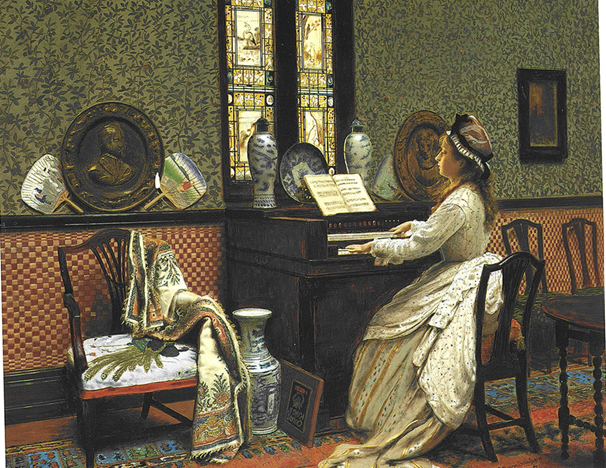
The Chorale ( 1878 ) John Atkinson Grimshaw by Atkinson Grimshaw
The model for this work is Anna Leefe and she is again surrounded by fashionable objects of the day such as the blue and white vases, Japanese fans and fabrics, Persian carpets and an album of prints. There are also the most up to date Victorian furnishings and wallpaper designs.
The final picture of the Knostrop group was started in 1876 but not finished until 1885. Dulce Domum has rare comments from Grimshaw on the reverse, the words ‘mostly painted under great difficulties’ and ‘LABOR OMNIA VINCI’ ( work conquers all ) suggest difficulties in Grimshaw’s personal life at the time. These comments could refer to family problems, painting difficulties, the financial crisis that struck at the end of the 1870s or to the recent deaths of some of his children.
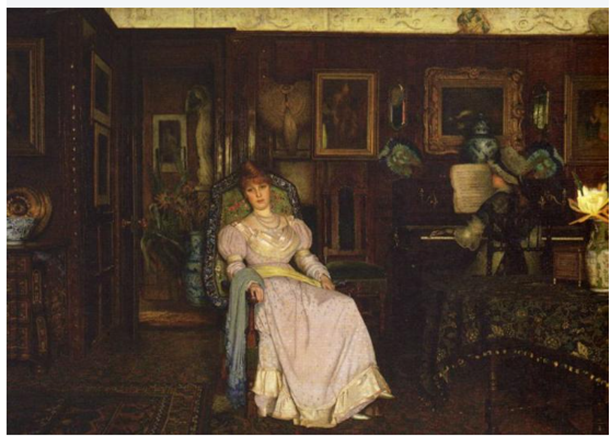
Dulce Domum, 1885 – John Atkinson Grimshaw – WikiArt.org
The painting again shows in detail an elaborate, richly decorated Victorian room interior and captures the music of the piano player and the still young woman who is listening. Robertson notes that these Knostrop figure paintings can be seen as celebrations of peaceful domesticity, free from the cares of work or the problems of an increasingly urban society. This work and Iris were greatly admired when they were shown at the Royal Academy and helped to establish a significant reputation for Grimshaw as a figure painter as well as a landscapist.
Grimshaw went on to produce many more portraits, often with Agnes Leefe as his model. Agnes was reputed to have been the model for Iris. There are several versions of this work, which in 1886 was his last exhibited work at the Royal Academy. Iris was a messenger of the gods, sent to wither flowers in autumn, she stopped to admire the water lilies and was turned into a rainbow for her disobedience. These works are from a time when Grimshaw was beginning to produce more subjects from myth and literature.
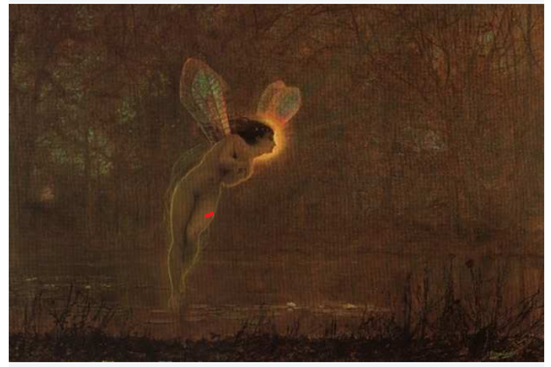
Iris, 1886 – John Atkinson Grimshaw – WikiArt.org
An article on the portraits of John Atkinson Grimshaw would not be complete without mention of an original piece of artwork of his son ‘Arty’ which forms part of The Grimshaw Collection at Leeds Central Library. Grimshaw and his wife had sixteen children but sadly only six survived into their maturity. Four of these became artists themselves, including ‘Arty.’
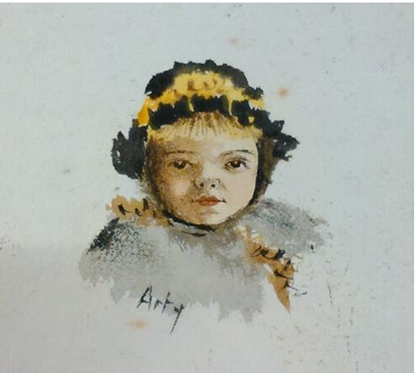
Arty by John Atkinson Grimshaw, Courtesy of Leeds Libraries
The collection features a number of paintings by members of the Grimshaw family, including this piece of Arthur Edmund Grimshaw. Although he was an artist and musician, Arthur was best known as a composer and became the first choir master and organist of Leeds Cathedral. The Central Library holds an original manuscript and score of his work.
To view items from the Grimshaw Collection please contact the Local and Family History department. The library has also produced a research guide, The Atkinson Grimshaw Collection, which gives an overview of the books and resources available.
 The Secret Library | Leeds Libraries Heritage Blog