This week guest author, Geoffrey Mogridge, tells us about the formation of professional orchestras in Leeds.
In 1902 Herbert Fricker, Leeds City Organist, inaugurated a series of ‘Saturday Evening Free concerts’ in which several local organisations, choral and orchestral were invited to assist. 850 seats were reserved at prices of 1/-, 6d and 3d. In 1903/4 the title was changed to Leeds Municipal Concerts and the 50 strong Leeds Municipal Orchestra was formed, chiefly of professional players with Fricker as principal conductor. Thus began fifty two years of Leeds based professional orchestras. By 1905 the Orchestra was formed entirely of professional players and their names are listed in the concert programmes. Mr. Edward Elliot was the principal violin.
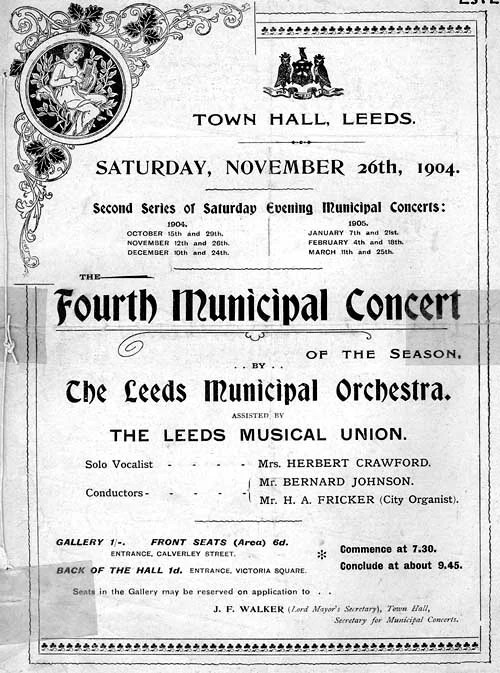
Leeds Symphony Orchestra
This continued in 1908 when the orchestra became a limited company entitled the Leeds Symphony Orchestra. In 1912 Mr. Elliot retired from the leadership of the orchestra and Mr. Alex Cohen was appointed principal violin. Fricker stayed as conductor until 1917 when he left Leeds to take up the conductorship of the famous Toronto Mendelssohn Choir. Conductors following Fricker include Julian Clifford, Sir Hamilton Harty and Eugene Goosens. Four years later in 1921 Alex Cohen retired from the orchestra and Mr. Edward Maude was appointed principal violin. Between 1925-1933 Julius Harrison was principal conductor of the orchestra, which, from 1930, was given a guarantee against loss by Leeds Corporation. A further change came in 1933 when John Barbirolli became principal conductor (an appointment he fitted in with his conductorship of the Scottish Orchestra). Barbirolli was credited with reviving the orchestra’s fortunes and its parlous finances.
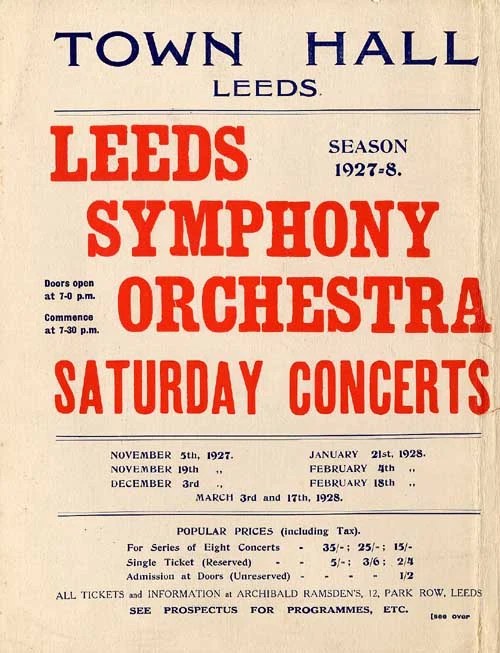
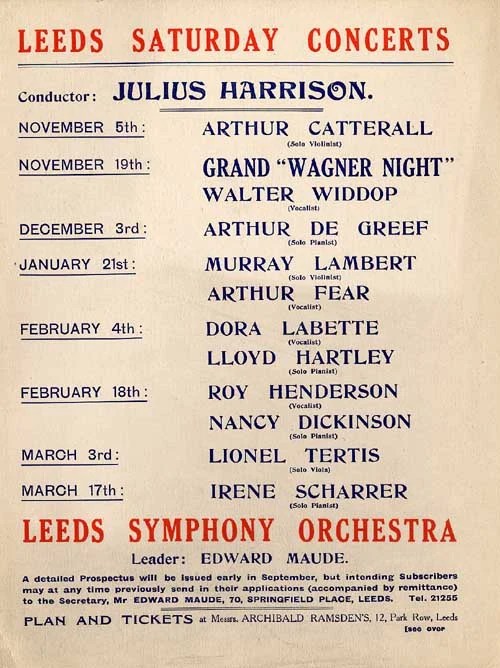
A change of name
In 1935 Leeds Symphony Orchestra changed its name to the Northern Philharmonic Orchestra and increased its concert commitments around Yorkshire. Barbirolli left two years later to succeed Toscanini as conductor of the New York Philharmonic Symphony Orchestra. In the 1937/8 season the Northern Philharmonic concerts in Leeds Town Hall were conducted by Malcolm Sargent, Heinz Unger, Albert Coates, Eugene Goossens and Leslie Hewerd. The orchestra arranged 8 concerts for the upcoming Town Hall season. The last concert before the outbreak of World War II took place in April 1939 conducted by Malcolm Sargent.
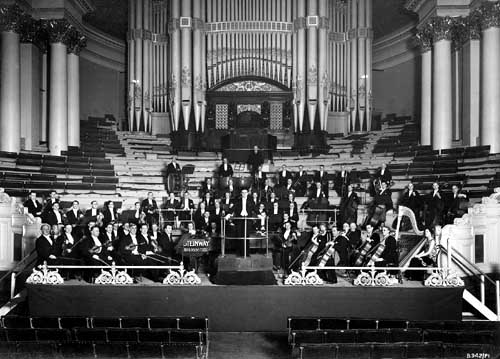
Leeds Based Professional Orchestras
The Northern Philharmonic’s Leeds Town Hall concerts resumed in early 1940. Due to wartime blackout regulations, concerts were given on Saturday afternoons with the audience restricted to the stalls. The Town Hall sustained a direct hit in the Leeds Blitz of 14th and 15th March, 1941. Fortunately the auditorium escaped damage and concerts were soon able to resume. With the ending of the war in the summer of 1945 came a huge public appetite for live music. Leeds City Council and several neighbouring authorities embarked on the provision of a professional civic symphony orchestra at a projected annual cost £50,000 (over £2m in 2022).
YSO is born
The brand new Yorkshire Symphony Orchestra gave their inaugural concert in Leeds Town Hall, on Wednesday 3rd September 1947, under the baton of chief conductor Maurice Miles. The conductor and sixty musicians (later increased to seventy) were engaged as superannuated employees of Leeds City Council. Over thirty 20th century British works were featured in that first season which included forty Leeds Town Hall concerts.
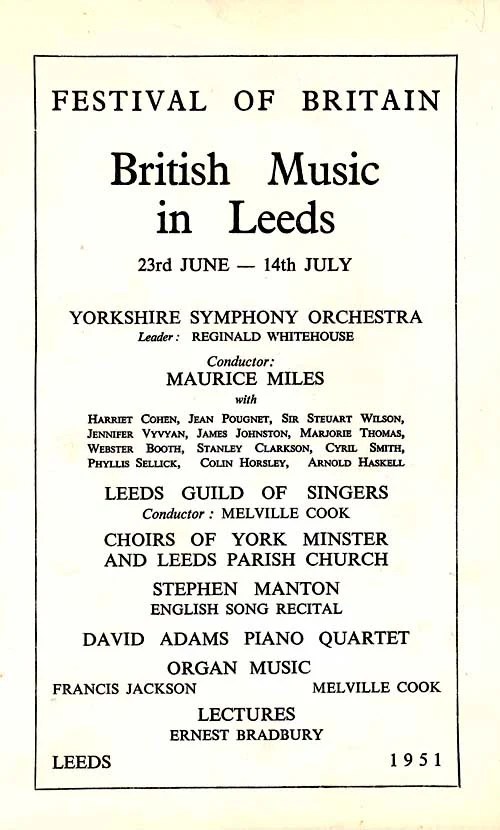
Meanwhile, the Northern Philharmonic had been dislodged by the YSO from its regular Town Hall slots. The orchestra struggled on for a few years by giving concerts at the Albert Hall in Cookridge Street and accompanying Bradford Festival Choral Society performances. Closedown of both the Northern Philharmonic and the orchestra that had displaced it dealt a blow to the city’s prestige as a musical centre.
Happily, the creation of Opera North in 1978 bestowed on Leeds and Yorkshire an orchestra and chorus that continues to garner international acclaim.
To read more about the history of classical music in Leeds, please visit Discovering Leeds. Here you will find information on the orchestras, choirs and people that played a part in the development of classical music in Leeds.
 The Secret Library | Leeds Libraries Heritage Blog
An interesting article on the musical life of our city.
Has anyone considered writing an article on the brass band tradition in Leeds?
The City had some excellent bands consisting of volunteers who were skilled musicians who~despite holding daytime jobs gave up their leisure hours in the evenings and weekends .
A few notable organisations were :
Leeds Model Band
Stourton Band
Bramley Band
Leeds Rifles
Copperworks Band
Added to the list are bands from areas now within the city,Rothwell, Wetherby, Yeadon.
The brass band movement is really true ‘ folk music’. The bands folk are mainly drawn from the working class. Sadly now in slow decline.
Hello,
Thank you for your comment and your interest in the Secret Library Leeds blog. We’re very open to an article on brass bands, if you or anyone else reading this comment would like to research and submit to us. We’re always open to guest posts by external contributors!
Best wishes,
Antony
Librarian
Leeds Central Library
My mother often recalled the wonderful concerts, plays and ballet she attended during the war as the major cultural institutions were moved out of London for safety and she mentions these in her war diaries. It gave her a taste of culture that she never would have been able to experience otherwise. She was at the concert by Benno Moiseiwitsch and it has been wonderful to see a photograph of the occasion and imagine her in the audience.