This week we have the first in a potentially recurring segment from one of our librarians, Harry-Anne Bentley, who has a keen interest in LGBTQ+ history, and the ways that art and literature seek to fight and survive in an oppressive world.
Welcome readers, for our first discussion on Surviving Censorship, I thought we’d explore the history of a recent figure, whose work is very celebrated today, but in it’s time almost didn’t happen.
Heads up, it’s a complex tale of homophobia, self-loathing and secrecy, around a complex author with some unfortunately quite bigoted views.
Patricia Highsmith is known for some of the world’s most popular suspense novels and psychological thrillers, such as Strangers on a Train and The Talented Mr Ripley series, but she’s also often cited as the creator of the first ever Lesbian Romance novel, without a tragic ending.

Carol (Originally published as The Price of Salt) by Highsmith (Originally under the pseudonym Claire Morgan) was rejected by her publisher Harper & Bros, and her agent warned her that following up Strangers on a Train with a blatant lesbian pulp story would be career suicide.
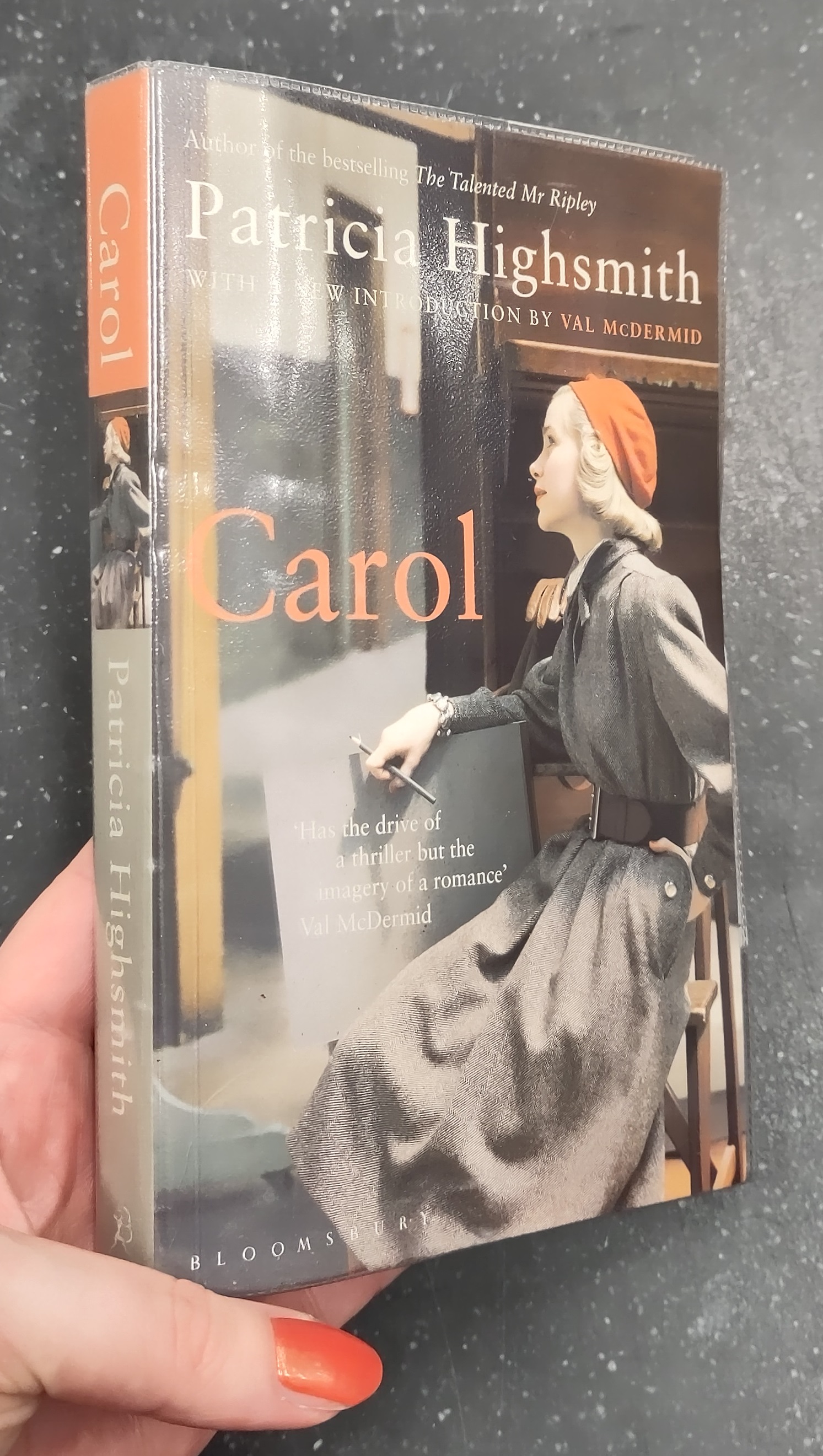
Coward-McCann published it in 1952, and despite being marketed as a suspense novel and featuring no women on the original cover, it quickly became a darling within the Sapphic community. For the first five years of it’s existence, the publisher would receive 10-15 fan letters a week for the attention of ‘Miss Morgan’[1]. Readers loved seeing themselves on the page, and that the queer characters were written as complex people, and not just the usual stereotypes of the butch/femme paradigm – Highsmith herself later noting that the character Therese is written as being somewhat puzzled that her experience does not match the archetypes she’s heard of.

The title “The Price of Salt” is a riff on the old phrase ‘The Spice of Life’; spices were imported and sold at very high prices to the Americas, and were essential for many types of cooking.
Ergo ‘What will you give up for something required, but so valuable?’ is a question posed to the character of Carol Aird – She wants to be with her lover, Therese Belivet, but her husband Harge is holding custody of their daughter over her as leverage for to ‘not be an invert’.
Carol must choose between being a mother, in an unhappy marriage, or a potentially loving relationship where Harge gets full custody by outing her to the courts. To ensure this Harge even hires a private investigator to follow Carol and collect evidence he can use in a legal case against her. This echoes very real queer fears around being ‘out’ in public getting your reported, followed or attacked. Fears that to some extent, still exist today.

It wasn’t until 1990, five years before her death, that the Bloomsbury republishing used the title Carol and Patricia Highsmith’s own name, with the addition of an afterword by her. The novel was so personal to Highsmith that playwright and close friend Phyllis Nagy said “it was difficult for her to take ownership of it as a writer for many years.”[2]
The Book’s mainstream adaptations wouldn’t come for another few decades, with the radio play on BBC4, and the six-time academy award nominated film adaptation by Todd Haynes, starring Cate Blanchett, Rooney Mara and Sarah Paulson. Phyllis Nagy had written the theatrical adaptation of The Talented Mr Ripley years prior, and returned to do the screenplay for Carol.
Perhaps the strangest response to the book’s success, was screen treatment attempt in the early 1950s to turn the novel into a movie. Where the title was changed to Winter Journey and Carol was changed to… Carl. It was not made.
Patricia Highsmith herself had a complex relationship with her sexuality – voluntarily going to conversion therapy (non-torturous counselling meetings). She was famously alcoholic, misanthropic and anti-Semitic, preferring the company of her pet snails to other people.
A diary entry from 1970 read “[I] am now cynical, fairly rich … lonely, depressed, and totally pessimistic.”
Fearing that people would see Carol as semi-autobiographical, she tried to prevent herself from being outed by having an ‘unsuccessful’ affair with Arthur Koestler.
If you’d like to get a detailed picture of the author herself, I’ve got two biographies I’d recommend:
Firstly the graphic novel Flung Out of Space: Inspired by the Indecent Adventures of Patricia Highsmith by Grace Ellis and Hannah Templer. The book gives an ‘Imagined Portrait’, aiming to give a true-to-character picture of Highsmith, while time-skipping and merging the details of the world around her.
And for a more detailed view, ‘Devils, Lusts and Strange Desires: The Life of Patricia Highsmith, by Richard Bradford’, offers an unflinching view of Highsmith’s successes, and personal failures – with more specific dates and direct quotations from friends and colleagues.

References;
[1] – Devils, Lusts and Strange Desires: The Life of Patricia Highsmith, by Richard Bradford, Page 74.
[2] – Archived radio discussion between screenplay writer Phyllis Nagy (Highsmith’s longtime friend) and director Todd Haynes discuss their Oscar-nominated adaptation of Carol. Originally broadcast on NPR Fresh Air, Jan. 6, 2016.
 The Secret Library | Leeds Libraries Heritage Blog
One Comment Add yours