This week we’re delighted to publish the first in a series of guest posts for Local and Community History Month. Today, we hear from researcher Andrew Littlewood on his exploration of resources in our Local and Family History department, in his search for information on Henry Thorne & Co. Ltd…
You can find out more about the place of chocolate and confectionary in the history of Leeds in a current exhibition, ‘The Power of Persuasion,’ taking place at Abbey House Museum.
Imagine that you have found a tin that contains jigsaw puzzle pieces – there isn’t a picture, the pieces may not be all from the same jigsaw and there may not be enough pieces to build the complete picture.
At Chesterfield Flea Market in 1983, I bought an old tin. I was attracted by its design – a dog begging for a piece of toffee and a girl telling the dog that “It’s too good for you Spot!”.
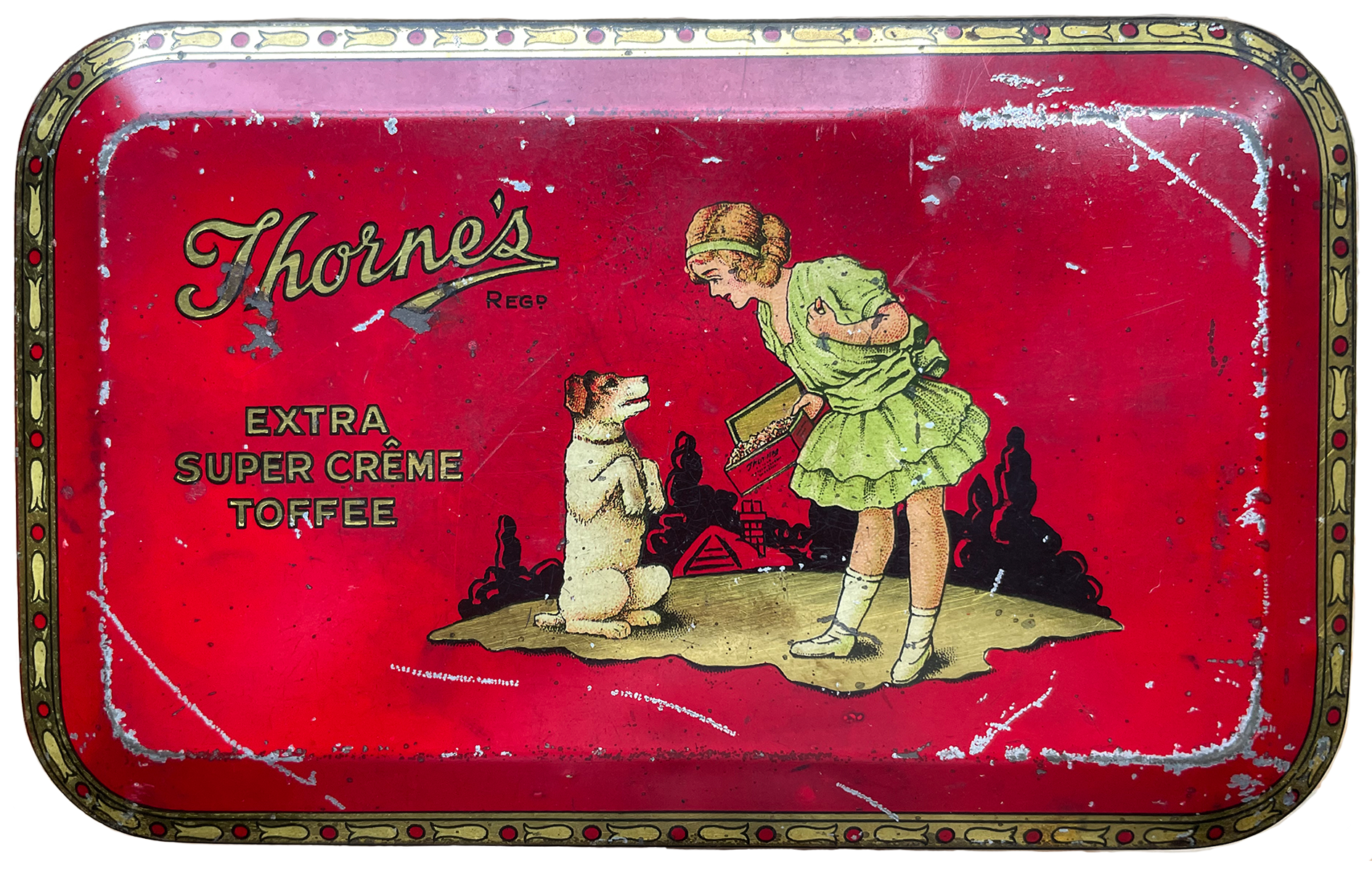
The tin didn’t contain a jigsaw but it did become the first piece of my research into Henry Thorne & Co. Ltd. Fifteen years later my tin collection had grown – about 25 items being from Thorne’s.
Neverhaving heard of the company, nor sampled their goods (and wondering why a Leeds firm was so prominent in Chesterfield) I decided to do some research. I wrote to Leeds Local and Family History department in May 1997, asking for information. The Library’s response is now Document 1 in a filing system built over 25 years, stretching over ten lever arch folders and 1,200 computer files.

This first encounter with the Library supplied several newspaper clippings. One 1961 article described Thorne’s as “turning out 2 million wrapped pieces of confectionery in a 8½ hour day”. Articles from 1972 reported the company’s demise. Also provided was a lengthy advertising article from The Yorkshire Post Leeds Tercentenary Celebrations Supplement 1926. This contained a photograph of “the founder, Henry Thorne”. The article missed out this man’s middle name, ‘Marshall’, leading to a jigsaw piece being put in the wrong place for a while!
Moving forward to 2024, the picture still has missing pieces. However, the Thorne’s story. is becoming clearer. I still visit Leeds Local and Family History department; the staff are always welcoming and helpful and I manage to find new snippets of information that help move this research jigsaw forward.
So what kind of information do I find in the Local and Family History department? Let’s consider some research jigsaw pieces, relating to people:
Henry Thorne
The Library holds the book Leeds – Illustrated 1892, which reported,
The business was founded as long ago as 1832 by Mr. Henry Thorne, the father of the present manager, in partnership with Joseph Linsley, as a manufactory for chicory, cocoa, chocolate, ginger-grinding and dressing and for the importation of arrowroot.
The British Newspaper Archive has made it possible to find a contemporary record of Thorne’s in the Leeds Intelligencer of 11 October 1832,
A man walked into the shop of Messrs. Thorne and Co. grocers, at the end of Cheapside, Briggate, while the person in the shop had his back turned to the door, and snatched up seven sovereigns that were laid upon the counter, with which he ran off.
Through The Secret Library, I discovered that the Library holds an 1844 map of Briggate which shows Cheapside close to the time Thorne’s began business there.
These three jigsaw pieces transport us back to Thorne’s early days.
Joseph Linsley
Research into the Thorne and Linsley families has found that Henry Thorne and Joseph Linsley, both Quakers, married each other’s sisters in 1828 and 1843 respectively. Leeds – Illustrated 1892 said that Henry and Joseph set up the mustard and cocoa business, however the Leeds Times of 7 March 1840 recorded that Joseph Linsley’s business partners were James and Charles Thorne (Henry’s brothers).
Directories in the Library’s collection show that there were seven Thorne and Linsley family businesses in Leeds through the mid-1800s, all but Henry’s being Grocers. Historic accounts of the firm’s early history tend to confuse these businesses. For example, West Yorkshire Archives hold a copy of Confectionery Journal, 11 January 1923, which, as part of their “How Great Businesses Grew” series, contains
The earliest printed record we have been able to find relating to the House of Thorne is a directory in the City of Leeds Library, dated 1834. Therein we find the entry: ‘Linsley, Joseph, Grocer, 150, Briggate’.
In the same publication,
Another search round the shelves of this splendid old library brought to light a still further copy of the directory of Leeds, bearing date 1842, and we find an entry similar to the previous one, with the exception of the address, which is given as Lady Lane.
Sometimes pieces of the jigsaw appear to fit well, but the following piece tells you otherwise!
Peter Pearson
A London Gazette notice and a Patent document revealed that Peter Pearson was a partner in Henry Thorne & Co. from some point in the 1860s to February 1874. Who, though, was Peter Pearson and why was he a partner in Thorne’s? A clue to this mystery was found in White’s Directory of Leeds and West Riding 1870. The directory entry simply says, “Pearson Peter, mustard mfr. (H. Thorne & Co.); h Southpt.” Without this record from the Library’s extensive, important and must-consult collection of directories it would have been impossible to know that the hunt for Peter Pearson’s jigsaw pieces should move to Southport.
Henry Marshall Thorne
When Henry Thorne died in 1850, his eldest son Henry Marshall was just four years old. Joseph Linsley kept Thorne’s going until he died in 1865, by which time H. M. Thorne was ready to join the firm’s partnership.
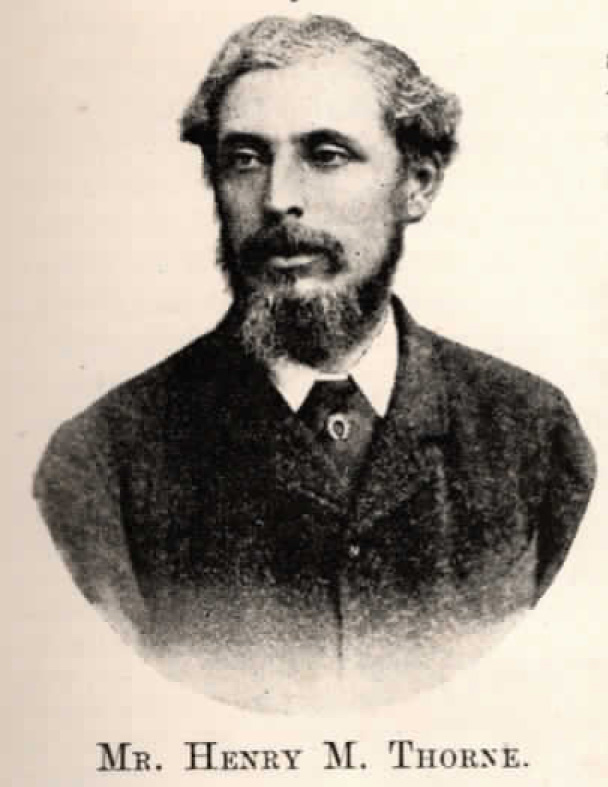
The Library’s copy of Leeds Industrial Exhibition Handbook 1926 recorded, “In the year 1889, Mr Henry Marshall Thorne was instrumental in forming a Company to carry on the business”. Both father and son founded a Thorne’s firm (Henry Marshall converting the firm to a Private Limited Company) which explains how, for want of an ‘M’, the jigsaw piece can easily be put in the wrong place!
Hon. Gerald William Lascelles
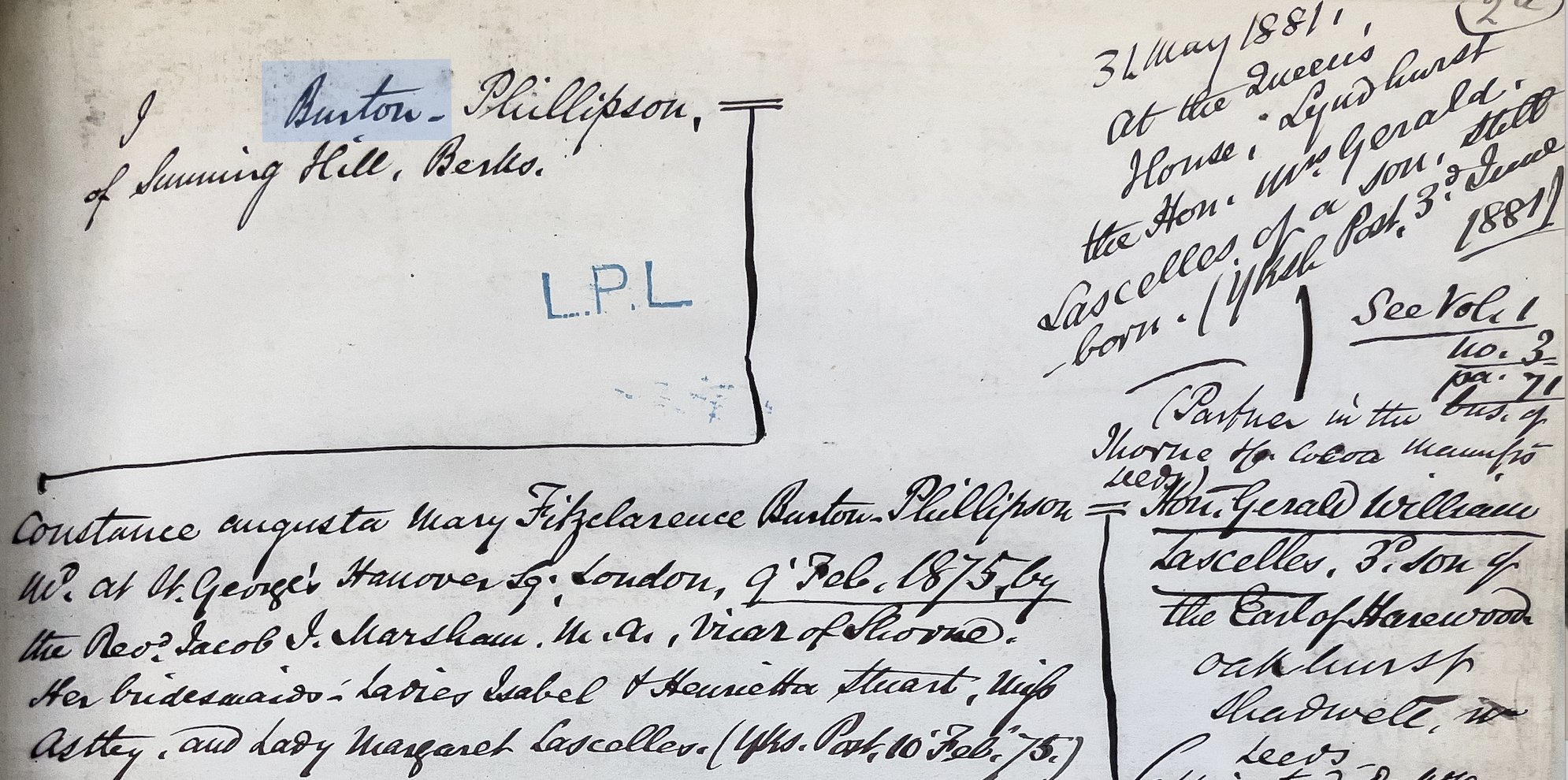
Although there are documents in Leeds Museums and West Yorkshire Archives that record Gerald Lascelles as a partner in Thorne’s, my favourite Lascelles jigsaw piece is held in the Library within the Sykes Collection, Volume1, Part 1. This book, contemporary with Lascelles involvement in Thorne’s, contains handwritten notes and newspaper cuttings compiled by William Sykes (his own research jigsaw). In a family tree drawing of Hon. Gerald William Lascelles’ 1875 marriage to Constance Augusta Mary Fitzclarence Burton Phillipson, Lascelles is described as ‘3rd son of the Earl of Harewood’ and ‘partner in the bus. of Thorne Hy, Cocoa manufrs, Leeds”. Thorne’s brush with nobility!
Sir William Scott Barrett
When Henry Thorne & Co. Ltd. was incorporated, one of the first Directors, later Chairman, was William Scott Barrett. In the Library’s Newspaper Cuttings Books is a clip from the Leeds Weekly Citizen, 11 July, 1913:
Leeds Man Knighted – Quaint Scene On Lawn – Mr. W. Scott Barrett, Chairman of the Lancashire County Council, was knighted by the King on the lawn at Knowsley Hall on Monday, with a sword which was procured from the house. The new knight is a native of Leeds, where he was born in 1843. He was educated at Leeds Grammar School and the Liverpool University. Sir William has been a member of the Lancashire County Council since 1885. He is also a Director of the Leeds and Liverpool Canal, and for several years was Deputy-Lieutenant of Lancashire.
On this jigsaw piece Thorne’s don’t get a mention even though Sir William was Chairman of Thorne’s when he was knighted.
Of course it is not just people stories that build the history of a company. Product and factory information are critical to the complete picture too, so let’s finish this perusal of my Thorne’s research jigsaw with a fabulous piece on each topic from the Library’s collection.
The World’s Premier Toffee!
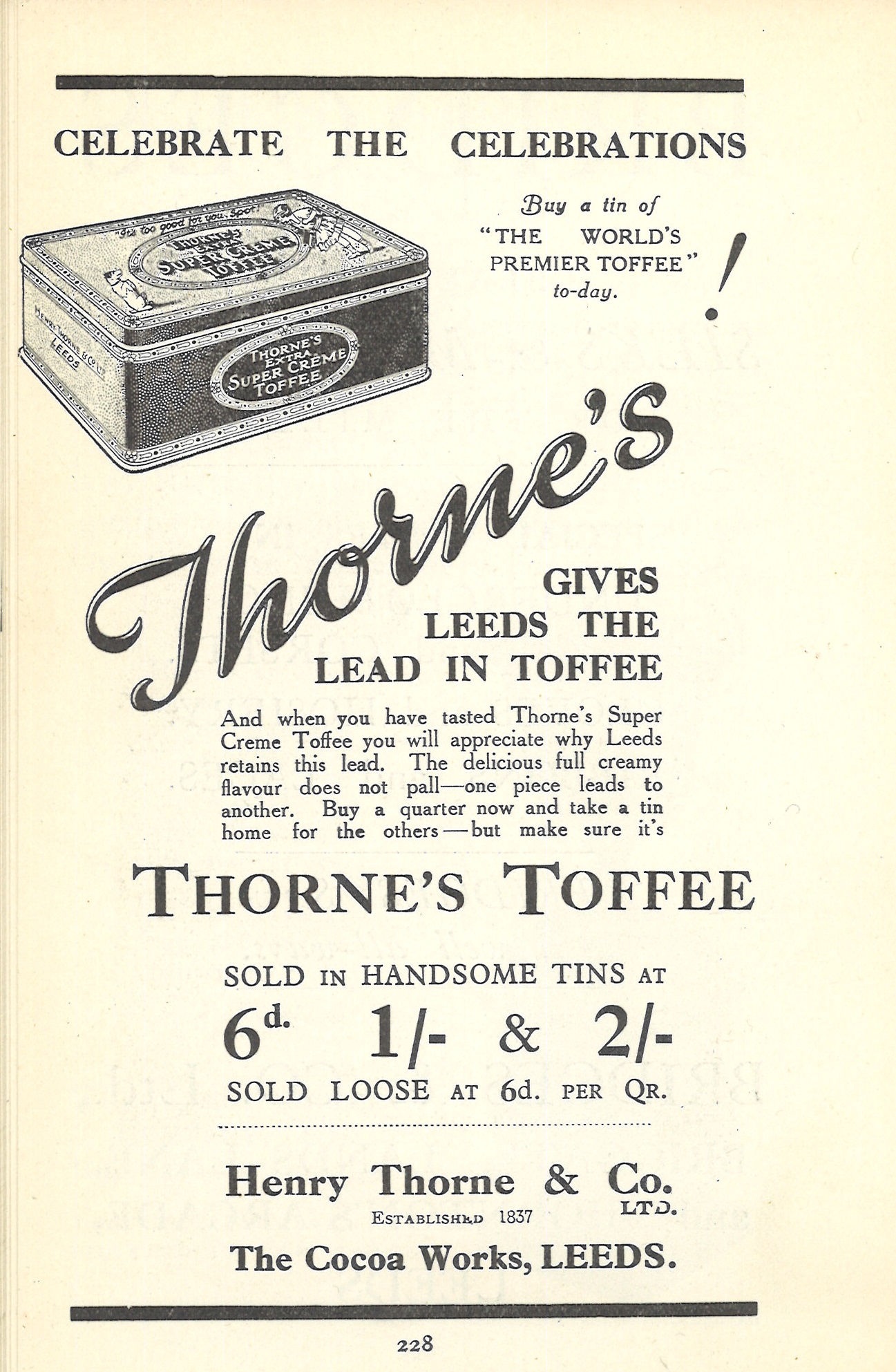
Featuring Spot the dog on a “handsome tin”, an advertisement in the Leeds Tercentenary Handbook July 8th to 17th 1926, helps date the tin design and gives the weights and prices toffee was sold in. I celebrated finding this jigsaw piece!
The Cocoa Works – Lady Lane
Leeds Sketches and Reviews – 20th Century Commercial, Social and Biographical Review, c1900, contained an advertising article that claimed Thorne’s Health Cocoa had “the unanimous commendation of the highest medical authorities and leading journals of the profession”. A description of the factory is given and, accompanying the article is a marvellous sketch. If a picture paints a thousand words then this picture is worth a thousand jigsaw pieces!

The Cocoa Works, as the premises are styled, occupy a spacious area of ground in Lady Lane, Leeds, and comprise a substantial block of building of four storey’s elevation, of which the ground floor is occupied as warehouse and suite of handsomely appointed general and private offices. The upper floors are used for the manufacturing departments, and combine every modern appliance for the preparation for the celebrated “Health” Cocoa, Chocolate, Chicory etc., and grinding and dressing of ginger, which, with arrowroot, is largely imported by the firm. A complete plant of machinery has been installed for facilitating the various processes, motive force being provided by a steam engine and boiler erected in the ground floor portion of the establishment.
Not found in Leeds Local Local and Family History department, this marvellous illustration of a selection box from 1939 shows that Thorne’s understood jigsaw puzzles too!
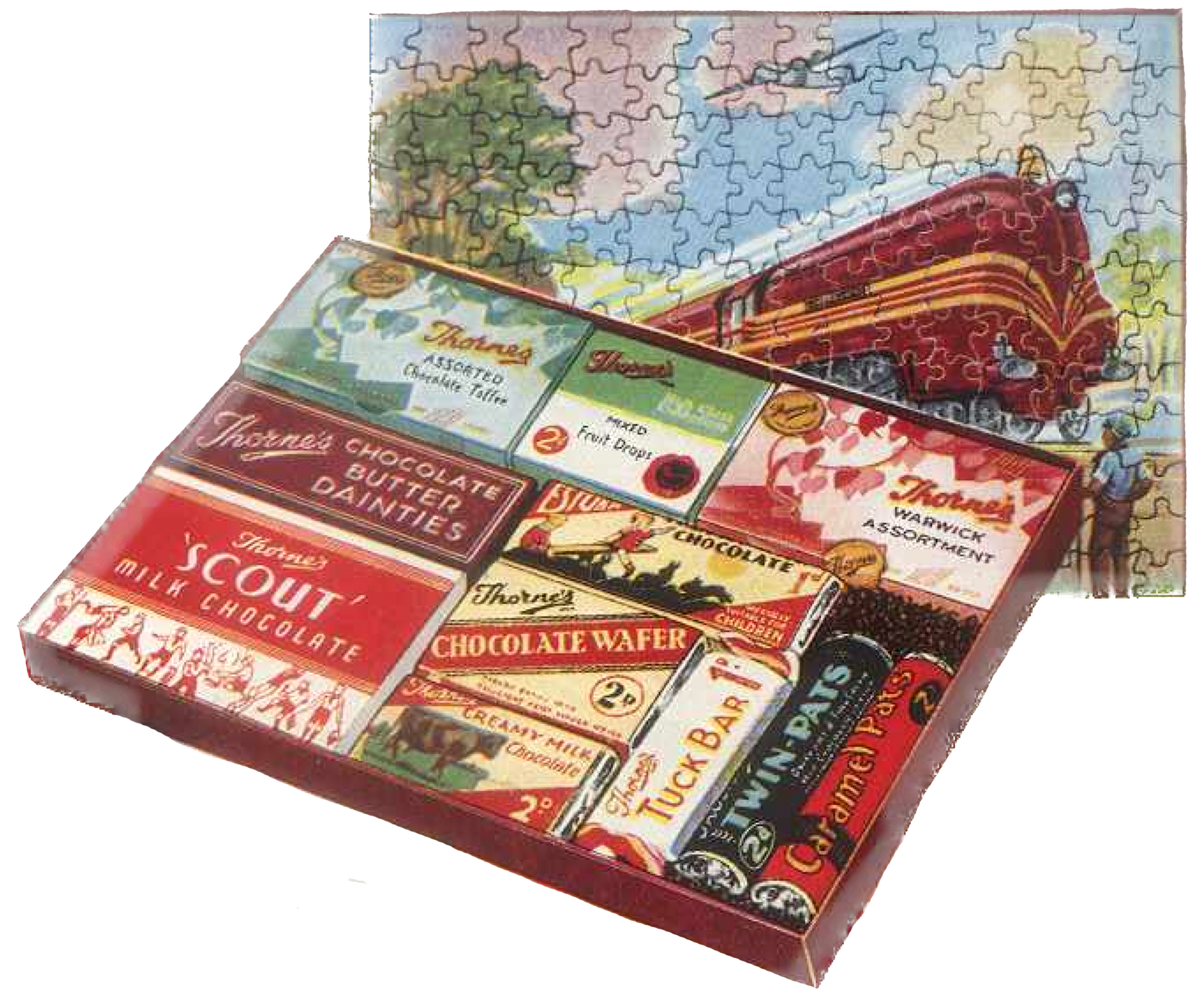
My research jigsaw puzzle journey continues and is documented on my website. Please take a look.
Should you have memories of Thorne’s, documentation, or old packaging (especially for chocolates or biscuits), I would love to hear from you.
You can contact me through my website, by messaging Spot.
Andrew Littlewood
Sheffield
Please note: where possible a link has been added to the Leeds Libraries’ online catalogue where Andrew mentions particular items of stock. Some stock items, however, have not yet been added to the digital catalogue and can only be accessed through the department’s card catalogue. Please contact us for further details.
 The Secret Library | Leeds Libraries Heritage Blog
It’s interesting what constitutes history. When is something no longer going on so that we can sit around in armchairs commenting about it. My idea is to do something about things (by my own actions if at all possible). Thus what comes to mind on this case is encouraging an environment whare it is not just extremely large global concerns such as Nestle which has the economic drivers to produce chocolate (which is a luxury using African imports and not necessarily a mass need or foodstuff).
Fabulous post. I love this kind of research and will definitely be taking a look at your own site too. Thank you!