We welcome Library and Digital Assistant Becky Bavill back to the Secret Library Leeds this week, for another short biography of a Leeds soldier in World War I. Keep a look out for one more article in this series coming soon…
Eric Stowell is mentioned in the diary of William Smith. I found two links between them – they were both territorials, and both worked for the Leeds Mercury. Eric was on the editorial team whilst William was in the print room. Eric had several entries in the newspaper cuttings index – he received two significant decorations in the form of the Distinguished Conduct Medal and the Military Cross. Before the war his family lived at Reginald Terrace in Chapeltown. What else can we find out to tell Eric’s story?
Eric Finlinson Stowell was born 1891 to Arthur Knight Stowell and Elizabeth Ann Finlinson (as was). Arthur was a Congregationalist Minister at Newton Park Union on Chapeltown Road. Eric had 5 siblings – Helen Elizabeth, Kathleen Mary, Kenneth Arthur and Gordon William. Kenneth died aged 7.
Eric enlisted in the Royal Field Artillery and seems to have had a service number of 40 in November 1914; arriving in France at the same time as his friends in April 1915. He is mentioned in William’s diary twice, both times in August 1915. William meets him apparently by chance on 18/8/1915 and mentions that Eric had been made up to Lance-Corporal. On 27/8/1915 William takes a trip to the AC (probably administrative centre) to see Stowell, describing him as ‘champion’. February 2016 he was part of a trench mortar battery with the rank of Corporal, also known as a Bombardier. This website is very helpful in describing the ranks of the British Army:
British Army ranks | National Army Museum (nam.ac.uk)
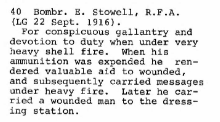
In September 1916 Eric was nominated for a Distinguished Conduct Medal – a DCM. This decoration is second only to the Victoria Cross for other ranks. His actions were reported in the Leeds Mercury by a fellow soldier on 28/8/1916.
“Eric Stowell has got the DCM but everybody says he ought to have got the VC. But I suppose the fact is that there are so many people who have distinguished themselves that if VCs were given where they would have been given in the old days they would get far too common. I was speaking to Eric’s commanding officer yesterday and he told me not only had Eric done his own job absolutely without regard to the terrible shelling to which he and everybody else in the neighbourhood was subjected, but he went out in front of the trenches and brought wounded men in. Finally, when his turn for relief came, as men were short, he volunteered to stay on in the trenches and did so.” (1)
On 18/6/1918 Eric was reported as recuperating in Plymouth following award of the Military Cross. By that time he was a Second Lieutenant. This is a great website for general information about medals awarded in WW1:
Eric was probably recovering from a shoulder wound that he received in March 1918. He received his Military Cross from the King in December 1919.

The next mention I found of Eric was of his marriage in Leeds in April 1920. By this time he was living in Manchester and working for the Daily Dispatch. His father conducted the ceremony and there is a lovely picture of the Eric and his wife Minnie Blakeborough (as was), with the best man and chief bridesmaid. According to the marriage certificate the witnesses were Gordon Stowell and Nellie Blakeborough so they may also be in this photograph.

Eric’s career as a journalist continued to flourish. In 1931 he joined the Daily Telegraph as Assistant Night Editor. This was quite a high-pressure job right at the front edge of journalism, prioritising and editing the breaking news as it landed. Sadly, Minnie died in 1938 at their home in Highgate. They don’t seem to have had any children. On the 1939 register Eric was still living at the home he had shared with Minnie, describing himself as a journalist on a daily newspaper. In 1940, Eric married for the second time to Dorothy Nancie Haisman. On the 1939 register Dorothy described herself as a ‘private secretary at a newspaper’. This leads me to imagine a thrilling office romance conducted amidst the drama of World War II reporting. By 1945, Eric was the assistant editor of news, a post he held for the rest of his career. Eric and Dorothy had 2 children. He died 08/10/1960 and is buried with Minnie at Marylebone Cemetery.
- Leeds Mercury, 28/8/1916, p 4
You can download extracts from the Leeds Mercury war diary to read this fascinating slice of local and international history for yourself.
 The Secret Library | Leeds Libraries Heritage Blog