This week on the Secret Library we are delighted to hear once again from Andy Armstrong, one of our heritage volunteers, on a significant piece of cataloguing work we’ve asked them to help us with. You can find more articles about housing in Leeds elsewhere on the blog…
Hi. My name’s Andy Armstrong and I have taken on the task of sifting through 200 years of Leeds CC papers held by the library and to bring some structure to them and to produce a research guide. I have previously produced guides on Transport and Health, and now Housing.
Leeds City Council (then called Leeds Corporation) became a local authority as we know today following the Municipal Corporations Act 1835. At that time, its role was mostly around the election of aldermen, but the industrial revolution had led to a rapidly increasing urban population in Leeds. This created many problems for which the small-scale local government could not cope with.
At this time, developers were mostly building back-to-back houses which were of a high density and to the lowest possible standards. They were cheap to build and cheap to rent. But the overcrowding and poor sanitation soon turned these into slums.

It took until 1866 for the first bye-laws to be introduced which set building standards on new dwellings, including gated yards, wider streets and improved interior design. But in the rest of the country, back-to-back housing was stopped, and despite the Leeds Medical Officer for Health calling for a ban in Leeds in 1880, Leeds Corporation refused to halt the building of such properties, and instead sought continued improvements.
Housing continued to be seen as primarily a health issue for the Corporation, and the Housing of the Working Classes Act in 1890 finally gave it the power to be more pro-active in dealing with the slums. This allowed them to condemn the slums, and to purchase the land so that better housing could be built.
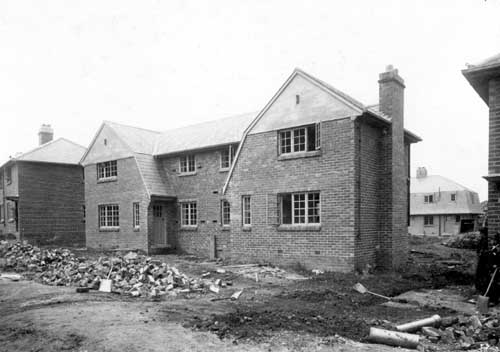
From having no role in housing in 1835 to the gradual oversight of regulations to dealing with the inner-city slums, the Council’s housing influence finally reached its peak following the Housing and Town Planning Act of 1919. This enabled the Council to take on the supply and management of housing across Leeds. In the next 20 years, the Council built 20,000 dwellings and became the largest landlord in the city.
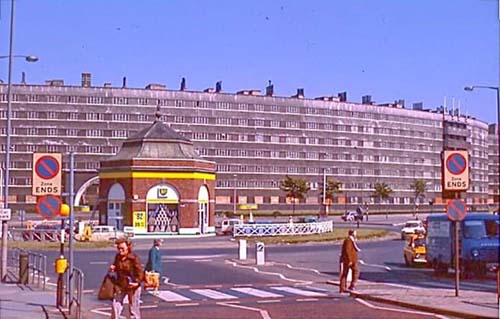
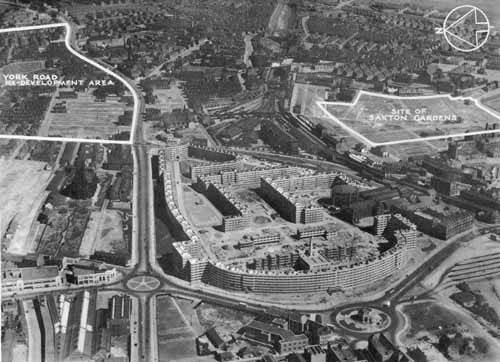
The City Council was able to address the longstanding issues around the poor housing in the Quarry Hill and York Street areas and built the Quarry Hill flat complex, which was the largest social housing development in the country. It was built to a futuristic modernist design and contained nearly 1,000 flats. The whole development was demolished only 40 years later due to poor maintenance and social problems.

While council house building had slowed considerably by 1980, the Housing Act stopped it completely and also introduced the Right to Buy policy, where tenants could buy their rented property at a discount. The Council’s portfolio of 90,000 dwellings has reduced to 50,000 today, but unlike many local authorities, Leeds City Council has retained its role as landlord.
 The Secret Library | Leeds Libraries Heritage Blog
I remember watching Quarry Hill flats being built; by 1938 they were putting the 7th floor and roof on.most of the children went to St.Charles RC school. And I then saw them demolished in 1977 due to the concrete being reinforced with asbestos steel that had deteriorated.
My brothers used to play on the swings and slide in the grounds and then ride up and down the lifts
Good piece!
We live in a ~1900 back to back that is clearly very much habitable today, so I’ve always been fascinated by the way Leeds clearly raised the standard whilst other cities banned them. I imagine these houses were positively luxury when they were built, compared to the slum housing being demolished in the same era.