To mark the upcoming Heritage Open Day Week (6-15 September 2024), Library and Digital Assistant Becky Bavill brings us some fantastic detective work in our Central Library archives to (re)discover the site of a long-forgotten mansion in the centre of Leeds…
Join us on Saturday September 7 in the Central Library’s Local and Family History department for our annual local history open day, part of Heritage Open Day Week. Our friends at The Thoresby Society will also be opening their doors during the week, showcasing treasures from their rich archive.
*****
It started, as it so often does, with a post on Leodis:

Challenge accepted! Surely a building of this size, so close to the city will have left some serious traces in our history?
Erm, no. This one took several of us some seriously determined ferreting, rooting, googling and tiptoeing through the card catalogue and many other sources. The problem we kept coming up against was that any time we found what looked like a reference to Hustorpe House, it turned out to be Austhorpe Hall, in Whitkirk.
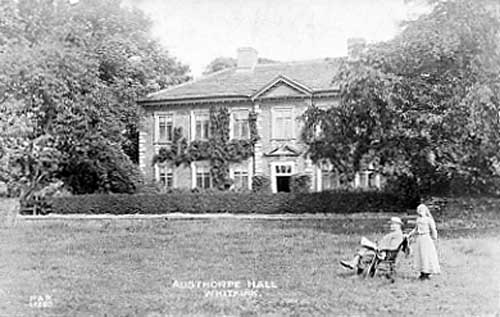
That building and its provenance is well known, but of Hustorpe, there was little trace. We found two maps that depicted it by name, in 1850 and 1891, but after that the outline remained until the 1930s but the name disappeared. Our first inkling that there might be more to the Austhorpe connection came from the Thoresby Society – they have a lantern slide, the same Alf Mattison image that is on Leodis. They label it as Austhorpe Hall on Meadow Lane, a 17th century mansion demolished in 1935. The names do sound similar, so we started our searches again, using both variants of the name. Our breakthrough came – as it has done in the past – from the hugely informative forum, SecretLeeds – History, culture and architecture in Leeds – Index page.
This is an amazing resource and one that almost always pops up in your results if you are searching for information about Leeds. The forum members are always very generous with their time and they gave us a really big clue here, all the way back in 2008:

The Douglas family eh? Well that’s a name we can find, and in spectacular style, we found them in a lovely set of 3 volumes, Leeds Past and Present. This is a collection of newspaper clippings amassed by B Scott. Sadly, we don’t know anything else about B Scott (I smell another story here) although there are invitations pasted into the collection addressed to J Scott. They very rarely cite their sources, but it is a delightful collection, lovingly put together over a period of years by collecting information from newspapers and pasting it together; interspersed with engravings, pictures, playbills and invitations. It is slightly distressing how many engravings are stamped ‘Leeds Reference Library’, we can only hope they came by them honestly. Our card catalogue pointed us at the one Douglas reference in the collection. In a list of Mayors of Leeds, one John Douglas was mentioned, Mayor in 1732. It described him as ‘a freeholder in Hunslet in 1713, as also was a Martha Douglas, November 1744 to let, with or without land, Austhrup Hall’.(1)
Finding the volume a little irresistible, we continued browsing and were rewarded with another 3 articles, all referring to the site as Austrop Hall. Even better, one of them directed us to one of our most esteemed Leeds forefathers, Ralph Thoresby. You can learn more about him here:
https://www.thoresby.org.uk/content/sochist/thoresby.php
And also in our Ralph Thoresby research guide.
We checked the index and sure enough, Thoresby had recorded the existence of ‘Austrope Hall’ near Holbeck-beck. He noted that it originally belonged to a family of the same name; but had passed to the Douglass’s by marriage ‘since the 31 Eliz’. Regnal dates are often used in antiquarian documents – this means the 31st year of the reign of Elizabeth or 1588/9. To help us even further, good old Ralph observed that of the original family of Austropes, ‘How near these were related to those of Austrope, in the contiguous Parish of Whitkirk, I cannot learn.’(2)
Just to recap, at this stage we now had five variants of the name:
Austrop
Austrope
Austhrup
Hustorpe
Husthorpe
The next stage was to the consult the newspapers. There were 3 particularly exciting looking articles. Two were from 1886, part of the Leeds Mercury’s Local Notes and Queries section of the Saturday supplement. Coincidentally, quite a lot of the contents of Leeds Past and Present looks to be drawn from here. Two articles about the hall were published in quick succession in Autumn 1886, the one responding to the other. The first described Austrope Hall as having been extensively modernised, at least on the exterior which had meant the pulling down of one of its timber framed wings ‘about eighty years ago’. This tallied with a note that had been added to the Ducatus by Whittaker, in which he contended it had happened about 15 years ago. The combined date range for that then is the first decade of the 1800s. The follow up article offered the kind of quibbling about the date of a wooden bridge that only antiquarian historians can deliver, but added a deliciously gruesome story about a murder having been committed there:
“I recollect being told, when I was a very young boy, that a man was cruelly murdered at the hall, his body being thrown out of an upper window into the garden, and fell on the flags, where a red mark was to be seen for several years, and was believed by many to be caused by the blood flowing from the murdered body.” (3)
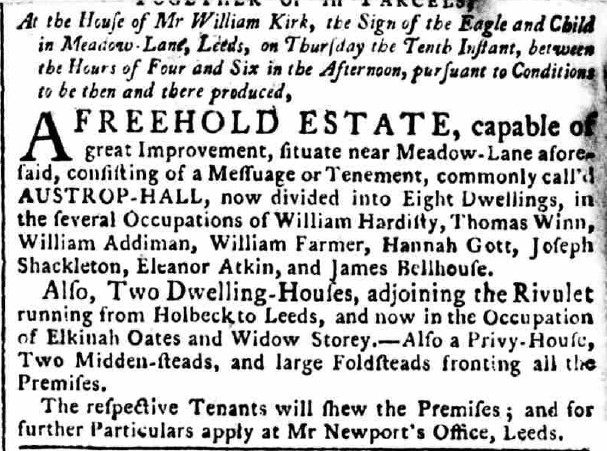
Our third article helped fill in some more of the back story of the hall, being an advertisement for the sale of the site in 1781:
The buildings were for sale again 1901, and this advert helpfully detailed the addresses that had once been part of the Hall:
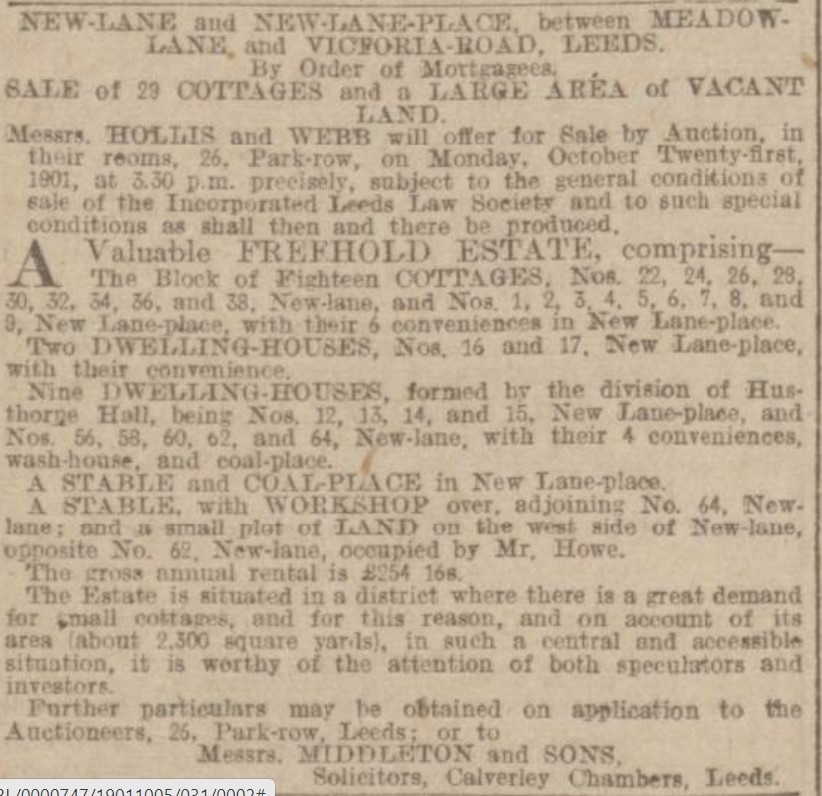
I cross referenced these addresses in the 1901 census. There are a variety of occupations listed for the residents, including painter, cigar maker and washer woman, but the one that comes up again and again is general labourer. The hall had become home to the working classes. In a lovely piece of symmetry the Thoresby Society hold the sales particulars for this event which includes a map. This showed very clearly how the once great house had been divided.
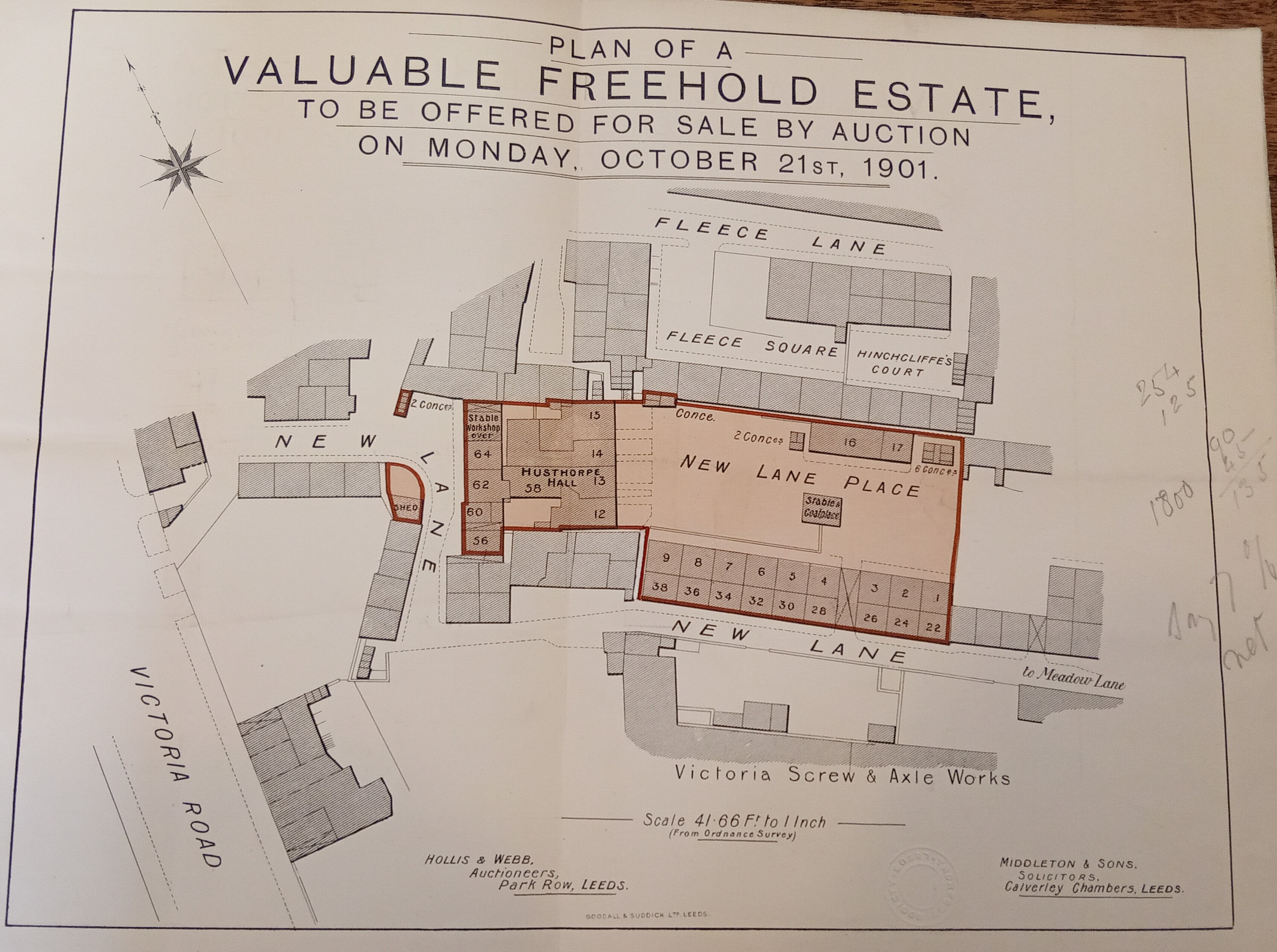
It’s interesting to see that this once significant site in Leeds very quickly disappeared. Buildings, their purposes and the needs they fulfil change over time, and what once been a grand country house by a pretty river, was quickly hemmed in by industrial and retail property, to the extent that 200 years after its first construction it had been split into separate dwellings and ultimately became part of an area that was hovering on the definition of slum, if not quite stepping in there. At the same time the antiquarians were reminiscing so fondly about it, the 1898 trade directories had absolutely no trace of it, although there are a couple of lodging houses listed on the nearest street – it would seem to be a good use of a property like this, but there is no evidence that supports this theory. The listings in the 1901 census reflected a group of residents that would have had no interest in being in the trade directory, a reminder that as useful these documents are, they do offer a slightly skewed picture of the city.
A building that has a similar history is Bromwich Hall near Sandwell; a medieval manor house, that became a farm and was later split into tenements. Incredibly it somehow ended up as pub and restaurant which ensured the survival of that building up to the present day.
Sandwell Museums and Arts (home.blog)
After all this, you might be thinking about paying a visit to Austrope/Austrop/Austhrup/Hustorpe/ Husthorpe Hall. Sadly, the site of this lost building is somewhere beneath the Asda Merchandising Centre of Excellence between New Lane and Great Wilson Street. The oldest building reputedly still standing in Leeds can be found in Lambert’s Yard off Lower Briggate – you will find pictures of it on Leodis here but unfortunately it is not accessible to the public as of the date of this article.
(1) Scott, B, Leeds Past and Present, undated LQ 942.819 (60924324)
(2)Thoresby, Ralph (ed. Whitaker, Thomas Dunham), Ducatus Leodiensis, Robinson, Son and Holdsworth (Leeds) 1816, p97. F942.75
(3) Leeds Mercury supplement, Saturday 09 October 1886, p5
 The Secret Library | Leeds Libraries Heritage Blog
Fantastic work!
loved this piece! Thank you