To conclude this year’s ‘Routes – Networks – Connections’ themed Heritage Open Days, Senior Librarian for Special Collections and Heritage, Rhian Isaac, shares her journey into researching a special collection of photographs.
As lockdowns began to ease during the Covid pandemic, I was finally able to return to the Central Library to check on our special collections. The building was eerily quiet, with only the distant sound of footsteps from the two other staff members allowed inside, their masked faces rarely glimpsed across the staircases. The familiar corridors and bookshelves provided a sense of comfort and peace, something I had missed after months at home. My responsibilities whilst on site, included inspecting the areas where our special collections are housed, cleaning the books, and monitoring environmental conditions to ensure there were no leaks or signs of pests taking advantage of the unoccupied building. We also wanted to keep our collections accessible to the public by sharing stories and materials through our blog, social media, and virtual events. During this time, we also tackled a long-standing backlog of thousands of rare books, though I can’t take credit for that monumental task—my incredibly skilled and determined colleagues worked tirelessly to complete it.

During one of my visits to the library, while browsing the shelves, I stumbled upon an unassuming volume that I might have normally overlooked—except for the title on its spine: Antarctic Expedition 1901-4: “Morning” & Scott. Curious, I opened it and discovered it was an album filled with photographs taken during the Antarctic expedition, documenting the relief ship Morning‘s support of Captain Scott’s 1901-4 mission.
Captain Robert Falcon Scott is a name forever linked to Antarctic exploration, with most people remembering his tragic race to the South Pole during the 1910 –1913 expedition. However, it is less well known that in 1904, Scott’s earlier expedition had to be rescued by the Morning, captained by William Colbeck from Hull and accompanied by Harry McKay’s Terra Nova from Dundee. Without this intervention, the famous ship, the Discovery, might never have returned.

A relief ship like the Morning had a critical role in Antarctic expeditions: checking on the crew, delivering mail, and evacuating any sick, injured, or insubordinate members. This was especially vital at a time when there were no radios or satellite communications. The Morning had no way of knowing exactly where it would find Discovery, relying on messages left in cairns at pre-arranged locations to track the ship’s movements. Although rescuing an expedition wasn’t part of the plan, when the Morning found Discovery trapped in ten miles of ice, an unsuccessful attempt was made to free it. The ship left with Ernest Shackleton, who was still recovering from the failed attempt to reach the South Pole. In 1904, the Morning was ordered to return, this time Discovery was stuck in 18 miles of ice. With the help of whaling captain Harry McKay and his ship Terra Nova, explosives were used to finally free Discovery. McKay’s expertise in this area was instrumental in the rescue.

The photograph album captures some incredible moments from the voyage (as well as many pictures of ice floes!) but I was intrigued as to how this remarkable collection came to be in Leeds Central Library and wanted to know more about who took the photographs?
I began researching the crew, starting with Captain William Colbeck, who was born in Hull in 1871 and educated at Hull Grammar School. He started as a merchant navy apprentice in 1886, joining The Wilson Line in 1898—a Hull-based company that sailed between England and Scandinavia, transporting cargo, mail, and passengers. Colbeck’s exceptional navigational skills, along with his rare (for an Englishman at this time) ability to ski, earned him an invitation to join an Antarctic expedition as a magnetic observer. This polar experience would prove invaluable when he was later tasked with commanding Discovery‘s relief ship, the Morning. Of the 29 men on the Morning, 18 came from Hull, giving the voyage a strong northern connection, if not directly to Leeds.
We believed the photographs in our collection were taken by John Donald Morrison, the ship’s Chief Engineer, who served as the unofficial photographer (it wasn’t until Scott’s 1910 expedition that a professional photographer was included for the first time, as the importance of high-quality images for fundraising and documenting achievements became clear). However, I also found out that other crew members, including Colbeck, had cameras, and the men frequently exchanged photographs upon their return to be used in publications and lectures about their Antarctic adventures. Morrison is credited with the striking photograph of Discovery‘s first sighting, which appears in our album and is reproduced in Third Officer Gerald Doorly’s Voyage of the Morning.

I took a busman’s holiday to Dundee and visited the Dundee Heritage Trust to look through William Colbeck’s archive. It was fascinating sifting through boxes of personal material and reading about famous events and people first hand.

I didn’t find any information about the photographs and ideally I needed to spend a week there, rather than just one day, but I did develop a greater understanding of the voyage and Captain Colbeck’s character. I also was very excited to visit Discovery and walk on the same deck that Scott and Shackleton would have been so familiar with over a hundred years ago. To read more about the fascinating collections held by the Dundee Heritage Trust please visit their blog.
Determined to learn more, I submitted the photograph album to Antiques Roadshow, which was filming at Roundhay Park. I hoped one of their experts would take an interest. I was in luck. On a thrilling (and thankfully dry) August day, I arrived with my excited family and friends in tow. Marc Allum confirmed that these were genuine gelatin silver prints from the time of the expedition – of course I said that the library would not sell them but they were to be enjoyed and made accessible to researchers and library visitors.
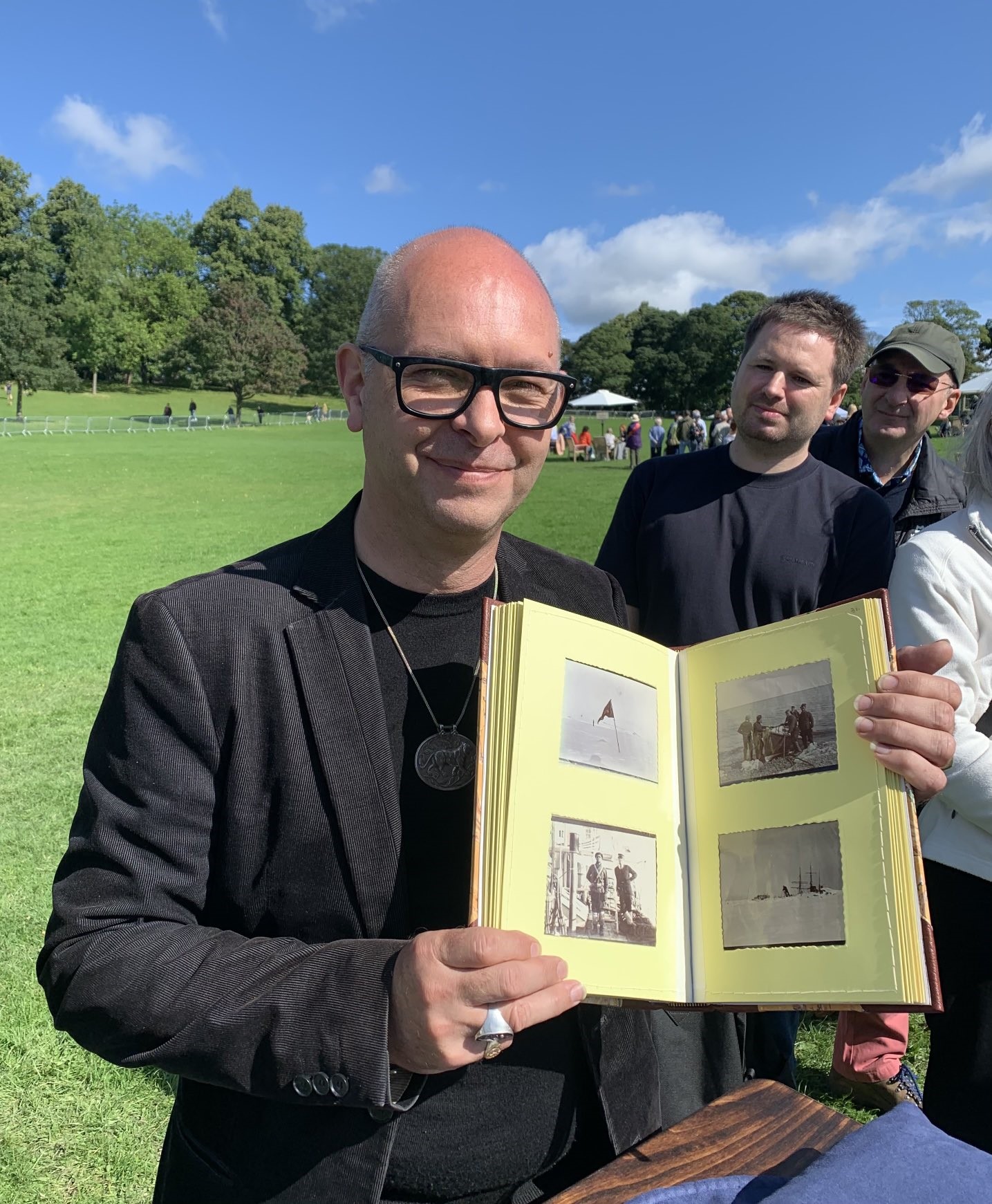
After our episode of Antiques Roadshow aired, we received a flurry of messages from the crew’s descendants with remarkable stories about their relatives. I was fortunate to meet two descendants of boatswain Alfred Cheetham, speak with a relative of First Officer Rupert England, and correspond with John Donald Morrison’s grandson. I was also contacted by the National Maritime Museum in Greenwich, who confirmed they held some of the original negatives in their Colbeck collection. My next step was to visit the museum to compare the negatives with our prints, searching for imperfections or marks that could link the two. It was immensely satisfying to identify matches, establishing a direct connection between the originals and our prints. We did not find negatives for all the photographs in the collection and there were examples of images that had been previously credited to John Donald Morrison. There are still many unanswered questions, but it seems likely that our collection contains photographs taken by both Morrison and Colbeck. However, we are no closer to understanding how this collection came together or was deposited with us in Leeds.
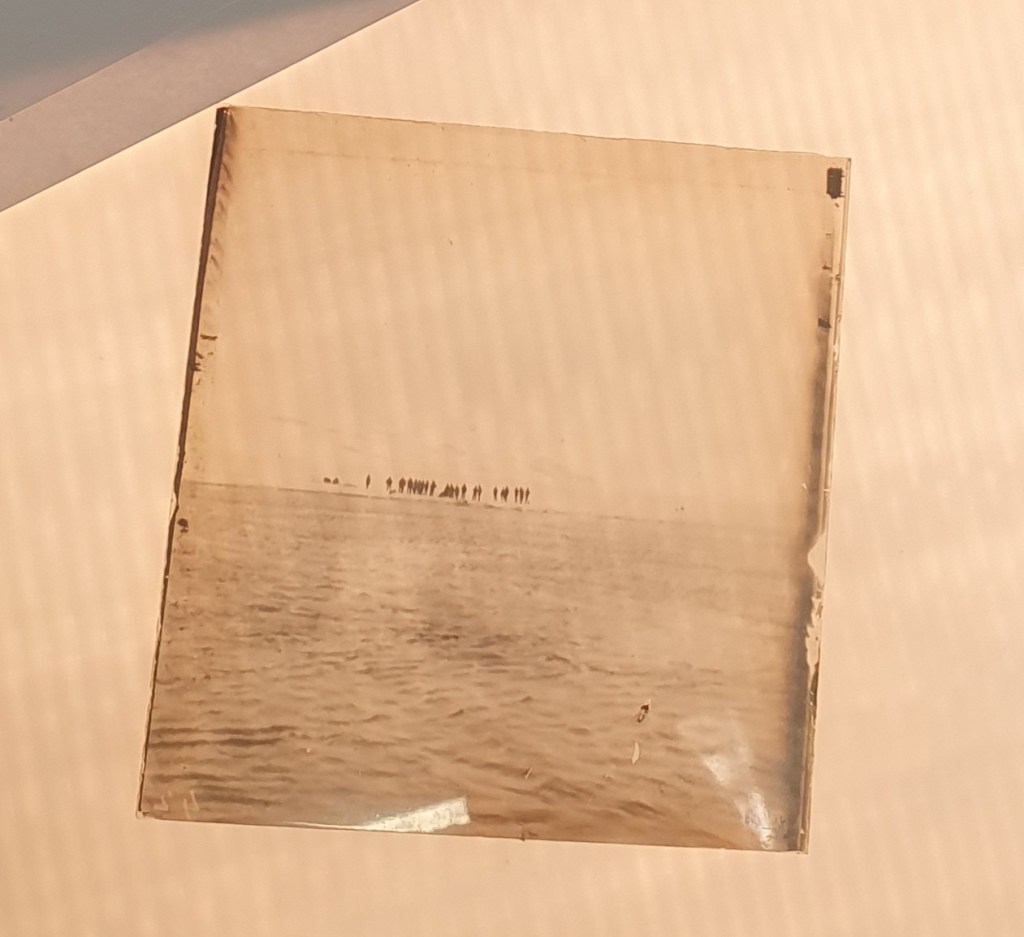

We are now aiming to raise the funds needed to conserve the photographs and repackage them in an archival-quality album. There’s always the hope that, during this process, we might uncover hidden clues that could shed light on how these remarkable images made their way to Leeds Central Library.
Ultimately, it has been the places I have visited, the stories I have encountered and the people I have met on this journey that has made this a special personal project. Curators, archivists, academics and descendants have been incredibly generous with their time and expertise. I also must thank my dad, who lent me his favourite Shackleton book and first inspired my interest in polar exploration. He has been integral to this research, tirelessly comparing photographs and accompanying me on my archive visits. It has been a great adventure so far and who knows where it might take us next!

 The Secret Library | Leeds Libraries Heritage Blog