This week we welcome guest author Pete Slater. Pete is one of a small team of volunteers working on a project based on football fandom. He traced the following story during his research using our local newspaper archive, as part of that project work. We publish this piece as part of Black History Month. For more articles about Black History in Leeds, please see our dedicated tab – and this article is also #22 in our People of Leeds series.
In the late spring of 2025, the Leeds Central Library will present an exhibition about football fanzines and culture. As part of that project the research team decided to look at football and football supporting in Leeds before fanzines existed. What were fans thinking about, talking about and how was this and football generally reported? One of the key parts of fanzine culture was an incredible passion for protest against all sorts of topics and the fight against racism was an important part of this in Leeds through the Marching Altogether fanzine in particular. With this in mind we started to look back at key time periods pre fanzines and one of those key points in time was the first black player to feature for Leeds United. During that research we uncovered some interesting facts about Leeds’ first black player, his and Leeds United’s part in a piece of history worth celebrating during Black History Month.
The great thing about the Central Library is the incredible range of resources it has allowing us to delve into just about any subject, unfortunately for the author he volunteered to search the microfilm archive. Not familiar with microfilm? Well, no, only librarians, newspaper buffs or people over 50 really are. Put simply microfilm is transparent film storing printed information in a miniaturized form, in this case newspapers. To read the film you place it under the lens of a microfilm reader machine and magnify it. That’s the good part, now consider that there is no indexing, no search function, no google and on many machines you have to manually wind the film over the lens…it takes a lot of time and patience searching microfilm and Leeds Central library has a lot of microfilm including copies of all of Leeds newspapers dating back well over 150 years.
Ask Leeds supporters who the club’s first Black player was, and the vast majority will answer Albert Johanneson. Quite rightly much has been written about Johanneson who started his Leeds career in April 1961 but in terms of appearing for Leeds he was nearly 4 years behind Leeds’ first black player, a certain Gerald (Gerry) Francis who made his debut against Birmingham at Elland Road on the 11th November 1957.
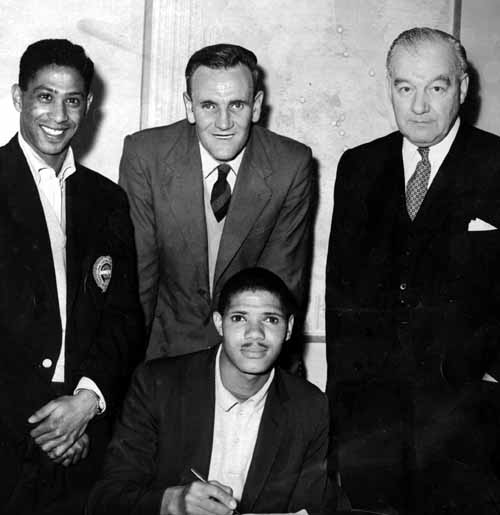
Though his place in history has been reported elsewhere before his part is often skipped over in favour of Johanneson’s more illustrious career and this needs correcting, the microfilm records in Leeds Central Library help us to tell the story of Francis more clearly and completely. Francis played a key role in helping Johanneson settle in Leeds, they are seen together this picture of the official signing of Johanneson and spent a lot of time socialising together.
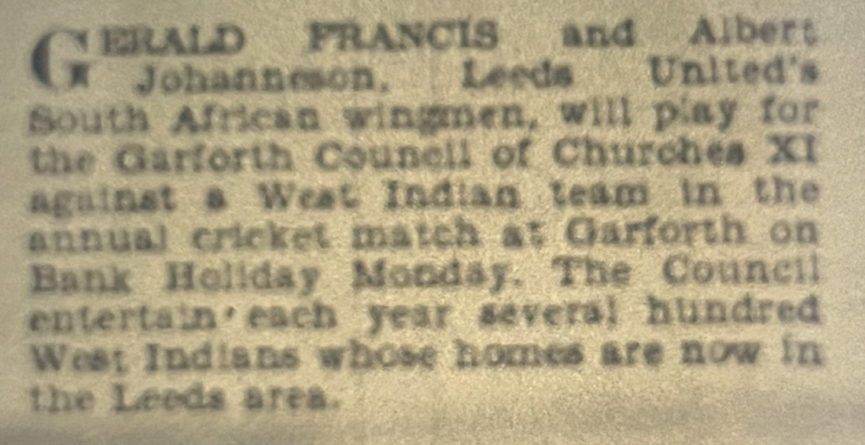
Francis tells the story of teaching Johanneson how to run in English conditions on Beeston hill and they appeared for Garforth council of Churches cricket XI on the August bank holiday, 1961 according to this article from the time from the YEP. A lovely little picture of the past.
Before we go further let’s find out how “Gerry” Francis came to England from Johannesburg in apartheid era South Africa, a story which he tells himself in an excellent interview with Phil Hay from 2020.
Francis and his brother both played in the segregated leagues in Johannesburg and he worked as a boot maker, tiring work earning £15 a week. Both were reportedly extremely talented players and gained a lot of attention, but their careers would always be limited by apartheid as only white players were allowed in the national league. Francis takes up the story: “Then these English teams came across and I hear about the footballers and what they do. The money they earn! And for playing two times a week, sometimes only once. I decided it was time to strike out.”
All of a sudden Steve Mokone, another talented player, left the country and signed for Coventry City becoming the first black South African to play in Europe and the future changed. Francis is quoted as saying that the reason he didn’t go at the same time as Mokone was that he didn’t have a passport, and didn’t know that Mokone did “Just like that, he buggered off. But I wasn’t far behind”. Encouraged by an Indian friend a letter was sent to Leeds United, and they invited Francis over for a trial. All of this was facilitated and funded by the Indian friend of the family, chairman of a local football club. He told Francis “Why I want you so badly to go, I want you to show people what non whites in South Africa can do”. Leeds was apparently chosen by Francis as he was fascinated by John Charles, a man whose physique would have made him a rugby player in South Africa.
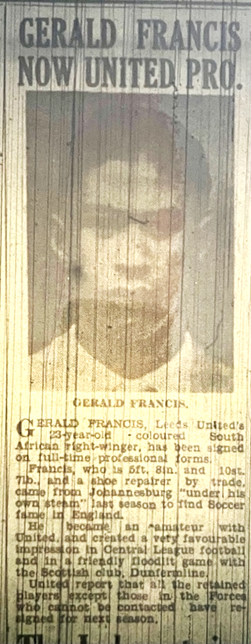
The microfilm archives revealed the outcome of Francis’ journey: this article (right) from the Yorkshire Evening Post (YEP) reported that an amateur contract was offered and that Francis subsequently turned professional in 1957. The rest, as they say, is history.
Though he took some time to adjust from the fast, hard baked pitches of South Africa to the slow muddy heaps of England Francis went on to make 52 appearances for Leeds scoring 9 goals before scoring 4 goals in 16 games for York City. His time as a Leeds player was very stop start due to selection policies and injury.
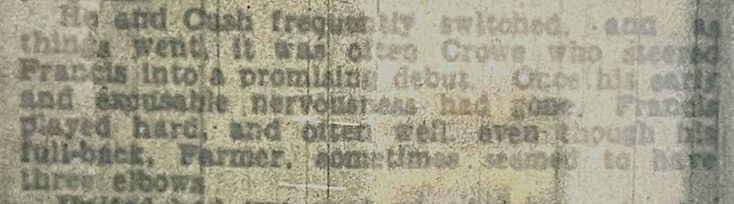
Francis made his debut and history vs Birmingham in November 1957 when he became the 1st black South African to play in Division 1. He won praise in the YEP match report on Monday the 2nd, making a good impression against a full back that appears to have been “uncompromising”.
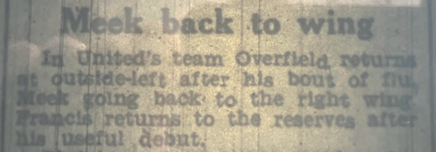
Despite such a promising debut Francis was dropped the next week when George Meek returned from a bout of flu and it was nearly 2 years before Francis made another first team appearance. Such gaps like this were a feature of Francis’ time at Leeds, the lack of playing time after making his debut is blamed by Francis on a racist undercurrent from the “top men” at the club who he feels were instructing Raich Carter, the Leeds manager at the time.
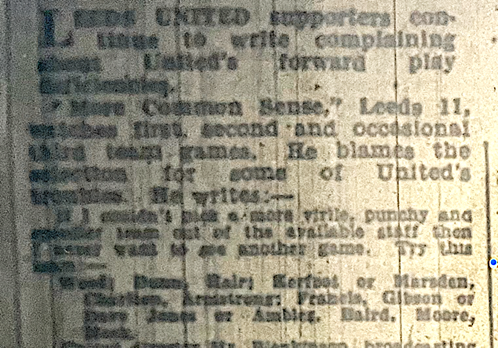
Whatever the reasons Francis was certainly liked by some sections of the fanbase, here (right) he is mentioned in fan letters to the YEP on Thursday 7th November 1958. His performances for the 2nd XI were being noticed.
By the start of the 1959-60 season United had gone through 3 managers since Francis’ arrival, Raich Carter, Bill Lambton and Bob Roxborough so it had been a turbulent time at the club. The arrival of Jack Taylor changed things and Francis played 40 times under Taylor over 22 months.
When he did get recalled his 2nd game was on the 9th September 1959, Leeds were still in Division 1 but the 6-0 drubbing at Old Trafford was a sign to come for a difficult relegation season. Francis was again dropped and didn’t return to the team until a month later when he finally started to retain his spot and began to feature on a regular basis for Leeds.
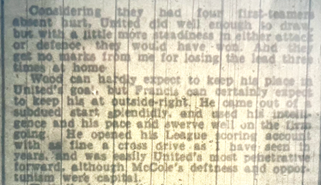
His 3rd game for Leeds vs Everton on the 10th October 1959 brought high praise for Francis. The report in the YEP on the 3-3 draw at Elland Road on a “firm” pitch. His pace and intelligence highlighted; the reporter felt sure Francis deserved to stay in the team because of a “as fine a cross drive as I have ever seen” to open his scoring account for the club.
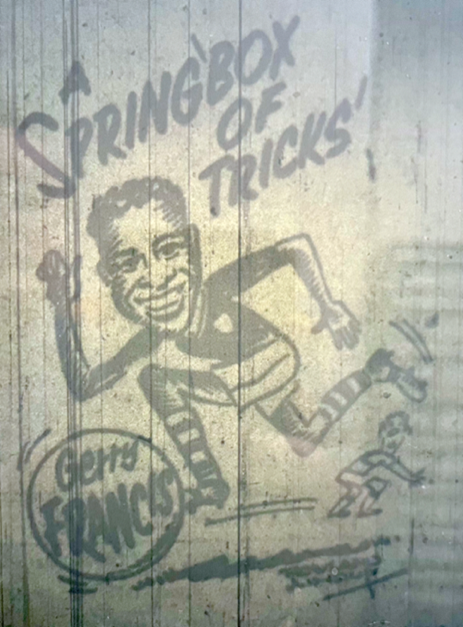
His performance against Everton also impressed the caricaturist at the YEP and along with the match report a caricature including the terrible pun “A Spring ’box of tricks’ appears.”
Francis display certainly seems to have been the highlight of the day, the same report opens with the line “Thanks heavens there were six goals to decorate an ill-starred and ugly game”, goes on to heavily criticise Leeds “halves” (midfield) and also mentions that the attendance was poor at 19,000, the lowest of the day for Division 1. How times change.
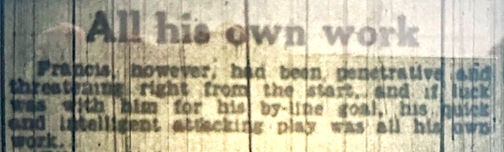
The next game at Blackpool saw more praise for Francis who scored again for Leeds in another 3-3 draw: “His quick and intelligent attacking play was all his own work”. (right)
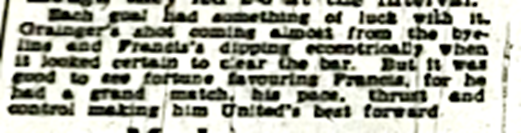
Francis became a regular starter during the 1959-60 season in Division 1 but suffered a series of injuries before settling well in the team throughout the 1960-61 season in Division 2. Here we see more praise, “United’s best forward” from the YEP on Monday the 17th of October 1960 for his performance in a 2-1 win vs Plymouth at Elland Road. (Newspaper match reports were not always published on the weekend at this time)
So, Francis seems to have been playing well and receiving praise despite Leeds enduring a wretched 1960-61 season. The start of the 1961-62 season under new boss Don Revie was just as bad and Leeds languished at the foot of Division 2 in early season.
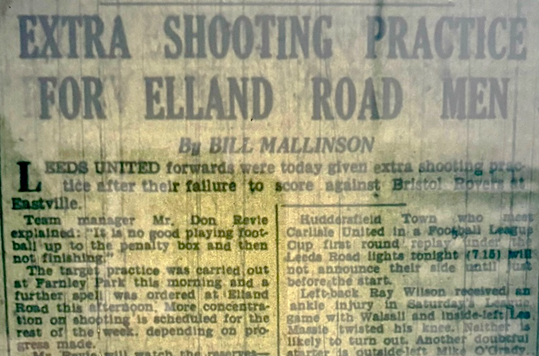
After a 0-4 loss at Bristol Rovers on the 23rd September Revie said “It is no good playing football up to the penalty box and then not finishing” in an article reporting that certain players had been told to report to Farnley Park on the morning of the 25th with a further spell at Elland Road in the afternoon.
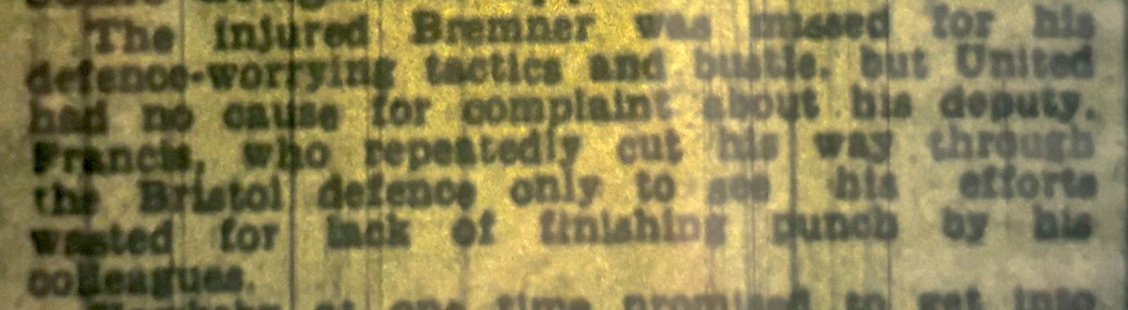
We think that Francis was one of the players which seems harsh as once again Francis came in for praise from the YEP in the match report for this game, clearly laying the blame for missed chances on his teammates.
The next weekend saw Francis’ final appearance for the Leeds first team, a 1-2 home loss to Preston. The match report from the game makes for grim reading including a spectator climbing into the director’s box to say a few “incensed words”. Ironically, Don Revie wasn’t even in attendance at the Preston game as he was still playing occasionally and turned out for the reserves in a game vs Liverpool that day.
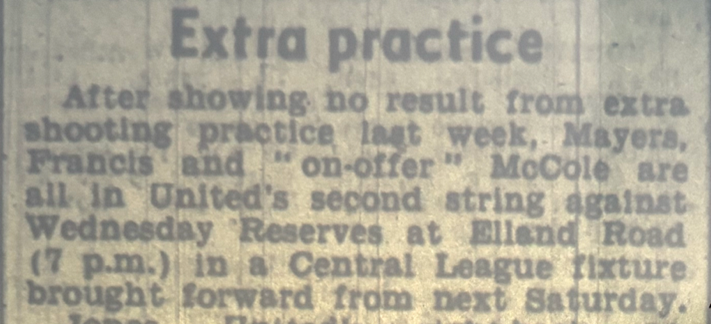
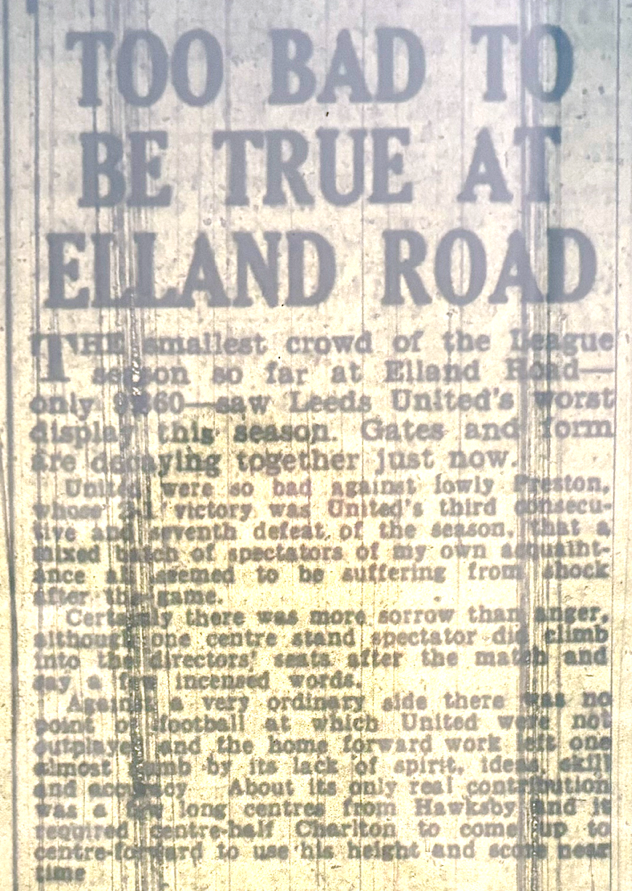
They YEP reported on Monday the 2nd that with the shooting practice deemed a failure 3 players including Francis were to be dropped to the reserves, Revie and the board were getting desperate and Francis’ time at Elland Road was at an end.
So how do we summarize Francis career at Leeds? He clearly feels that under Raich Carter he was not given enough opportunity, maybe not because of Carter but he did feel that someone at the club was not happy with him being in the team because of his race and at times he became angry about this with Carter. Racism was rife in Britain at the time, in particular on the terraces, Francis says he didn’t really take much notice of what fans said, but that’s not to say things weren’t happening, he just ignored it. Rob Hughes said this about football racism in his New York Times obituary of Johanneson
‘’South African apartheid had its English abettors. There were spectators who bated Johanneson with vile Zulu chants, full-backs who kicked him because they thought black men lacked courage. The stigma stuck to Johanneson. After a series of leg injuries, he slipped down to lower division soccer with York City, and succeeding blacks were branded cowards.”
Perhaps the best comparisons we can make are against the 2 other South African black players in England at the time, as good a place to look as moving from the bone dry dirt pitches playing with no boots to the heavy grass/mud pitches must have been tough for all concerned.
Of course, we know that fellow countryman Alfred Johansson went on to score 48 goals in 172 appearances for Leeds in a storied career including being the first African footballer to appear in the FA Cup final. His goal ratio was better than Gerry Francis at a goal every 3.58 games. (Cf 5.77) The emergence of Eddie Gray and a series of injuries limited his chances at the end of his time at Leeds and it seems Francis might also have suffered because of the arrival of another club legend in Billy Bremner. In another neat little symmetry, both Francis and Johanneson joined York City upon leaving Leeds.
Another reference point is Steve Mokone, whose move to Coventry sparked Francis and Johanesson’s migration. Mokone was signed by Coventry when he wrote asking for a trial after seeing their name in a newspaper. However, despite having well reported skill and flair, Mokone failed badly at Coventry, Cardiff, and Barnsley and only ever played a handful of games in the lower divisions for them (4,3 and 1 respectively). Bizarrely he then went on to sign for Barcelona, Torino and Marseille but doesn’t seem to have appeared in a 1st team game for any of these clubs. In between his Coventry and Cardiff stints though he became a hero at 3rd division Heracles in The Netherlands where the club would eventually name a stand after him! It is perhaps also interesting to note that a disagreement over being in a team playing long ball football at Coventry led to his departure and being asked to play with an ankle injury led to his departure from Cardiff. As mentioned, early match reports for Francis note similar injuries early in his time at Leeds. Nothing unusual for wingers to suffer this type of treatment at that time of course but…
Francis’ career sits in the middle of his two compatriots experience and his stop-start career and limited number of appearances is one mirrored by many, many players over the years.
Gerry Francis was well liked by some Leeds fans as evidenced by the letters presented here and there were plenty of match reports praising him. As noted and as with all wingers at the time he was on the end of some crunching tackles which left him injured for periods and despite the stop start nature of his career a goal every 5 games isn’t such a bad return for an out-and-out winger. However, the 9 goals he scored for Leeds all came before December 1960. Before that in 21 appearances he was scoring at a goal every 3.44 games, after that, in a further 21 appearances, he didn’t score…If only we had assist stats for the 1950’s and 60’s. Even under Taylor, Francis was used on more than a few occasions out of position on the left wing and sometimes he missed out to the two-footed George Meek before a young Billy Bremner played initially in the right-wing berth. Raich Carter should probably have used him more and Don Revie apparently saw enough in 10 games as manager (after having played with Francis as Captain) to decide to move him on. Based on contemporary reports this does seem harsh, but managers have their favourites, and the reasons are rarely clear.
For sure we know that Francis did create two pieces of history in his football career: He was the first black footballer at Leeds United and the first black South African to play in the first division, both very significant claims as it is. But there is more…
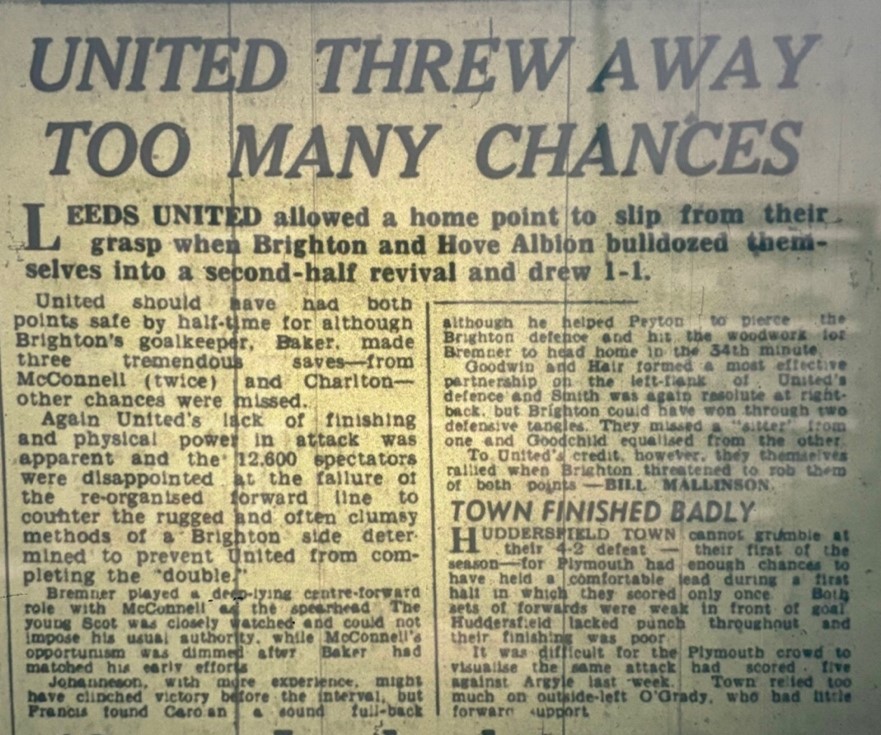
During the course of this research we realised that Francis and Johanneson played only 2 games together for Leeds, after further research through the excellent Football’s Black Pioneers website and other sources we now believe that Francis and Johanneson were the first two black foreign players to appear for a professional team in the UK. This happened on the 30th August 1961at Elland Road in a Division 2 match versus Brighton, a frustrating 1-1 draw according to this account in the YEP. Although both were mentioned in the match report and Francis was involved in the Leeds goal the importance of the occasion was not mentioned.
They also appeared together in the next home game vs Rotherham on the 2nd September before Francis’ career at Leeds faded from view and he was transferred to York in October 1961 for £4,000
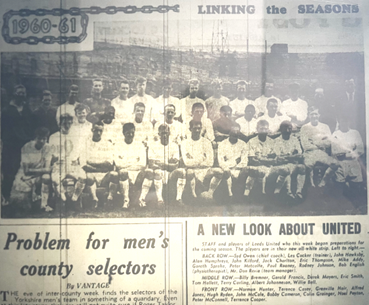
The microfilm search also revealed remarkable photo that appeared in the YEP on Saturday 22nd July 1961. We believe this is the oldest photo available of a Leeds team in their all-new white strip. In addition it is one of very few photos of Francis and Johanneson together.
At the time of writing Gerry Francis is 90, still alive and well and living near Toronto in Canada with his wife of over 50 years. There is a tremendous interview by Adam Pope with Gerry Francis on BBC sounds, well worth your time, Francis really does sound like a fantastic character.
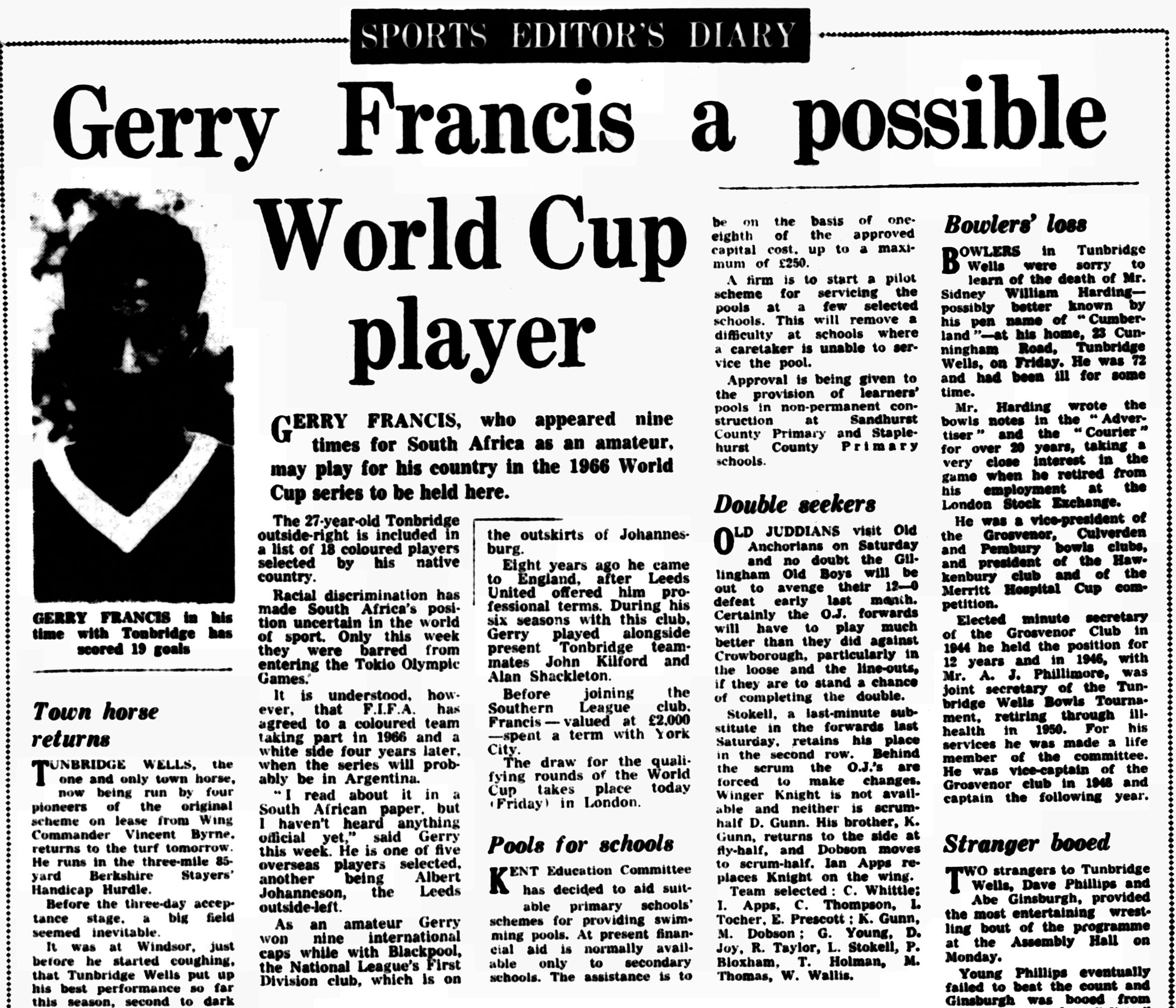
They moved there in the late 1960’s after his career ended with non-league Tonbridge Angels in Kent where he said he spent his happiest time in Britain. He was clearly enjoying his football at the time and was considered for the South African squad for the 1966 World Cup qualifiers. According to this article from the Kent & Sussex Courier on January 31st 1964 Francis found out when reading a South African newspaper! (He had appeared 9 times as an amateur for South Africa) South Africa were eventually disqualified from the tournament because of apartheid. Tonbridge’s name is associated with a pub with a Leeds nickname, The Peacocks, one final little coincidence in this story related to Leeds United? Well not quite..
When Phil Masinga found the net three minutes into the 3-2 defeat by Chelsea on 27 August 1994 Sky went into overdrive with their history washing machine hailing Masinga as the first black South African to play in the Premier League. (He had made his debut a week before in a 0-0 draw vs West Ham) There is an oft used phrase about history being written by the winners, the origins and countenance of this are apocryphal as is much of Sky’s coverage of football. Gerry Francis made the huge leap from South Africa to the top division 37 years before, the first black South African to play in England’s top division and Leeds United’s first black player of any sort, nearly 4 years before Alfred Johanneson arrived.
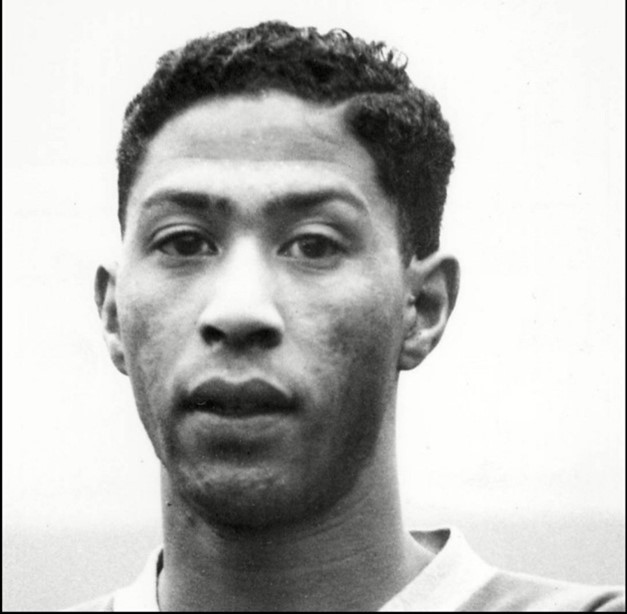
These are two incredible achievements alone that deserve remembering. That they both played a part at Leeds in being the first two overseas black players to play in a professional football team is another detail about their past that needs celebrating and it’s a lovely little vignette about two players from the same corner of the world who made the very long journey of hope to this corner of Yorkshire before separating on two very different paths in life.
Johanneson is deservedly remembered at Elland Road with a blue plaque, it’s the very least we could do to commemorate Gerald ‘Gerry’ Francis in the same way. More importantly though, his story needs to be told and retold as much as Johanneson’s, it’s an incredible story and the least we could do.
 The Secret Library | Leeds Libraries Heritage Blog
Excellent research as usual. Thanks.
Fantastic. My knowledge of football is lacking so it’s good to see someone with a passion for the sport researching and writing about Black players.
Wow, brilliant!
What a fascinating and powerful story! Pete Slater’s research truly illuminates the legacy of Gerry Francis as Leeds United’s first Black player, a milestone that deserves far greater recognition. This article not only celebrates Francis’ bravery in challenging apartheid barriers but also showcases his influence on the club’s history and Leeds’ football community. An inspiring example of perseverance and passion that we should always remember and honor.
4o with canvas