Halloween is officially here so today we continue with some more gruesome tales from the spooky scrapbook compiled by Edwin Hick. As mentioned in Part 1, this scrapbook is officially called ‘Ghost Stories and Weird Experiences, Life after Death etc.’ and is full of newspaper cuttings from the local newspapers detailing weird and wonderful stories from across the UK.
It has also served as inspiration to local illustrator, Simon Smith, who has created some gruesome illustrations to accompany some of these ghostly goings on. From 23rd October – 9th November 2024 you’ll be able to hunt down these images in the Local and Family History Library and use the accompanying QR code to link to the full story. Grab an activity sheet to tick off all you find. But in the meantime here’s a few more of these ghoulish tales in full.
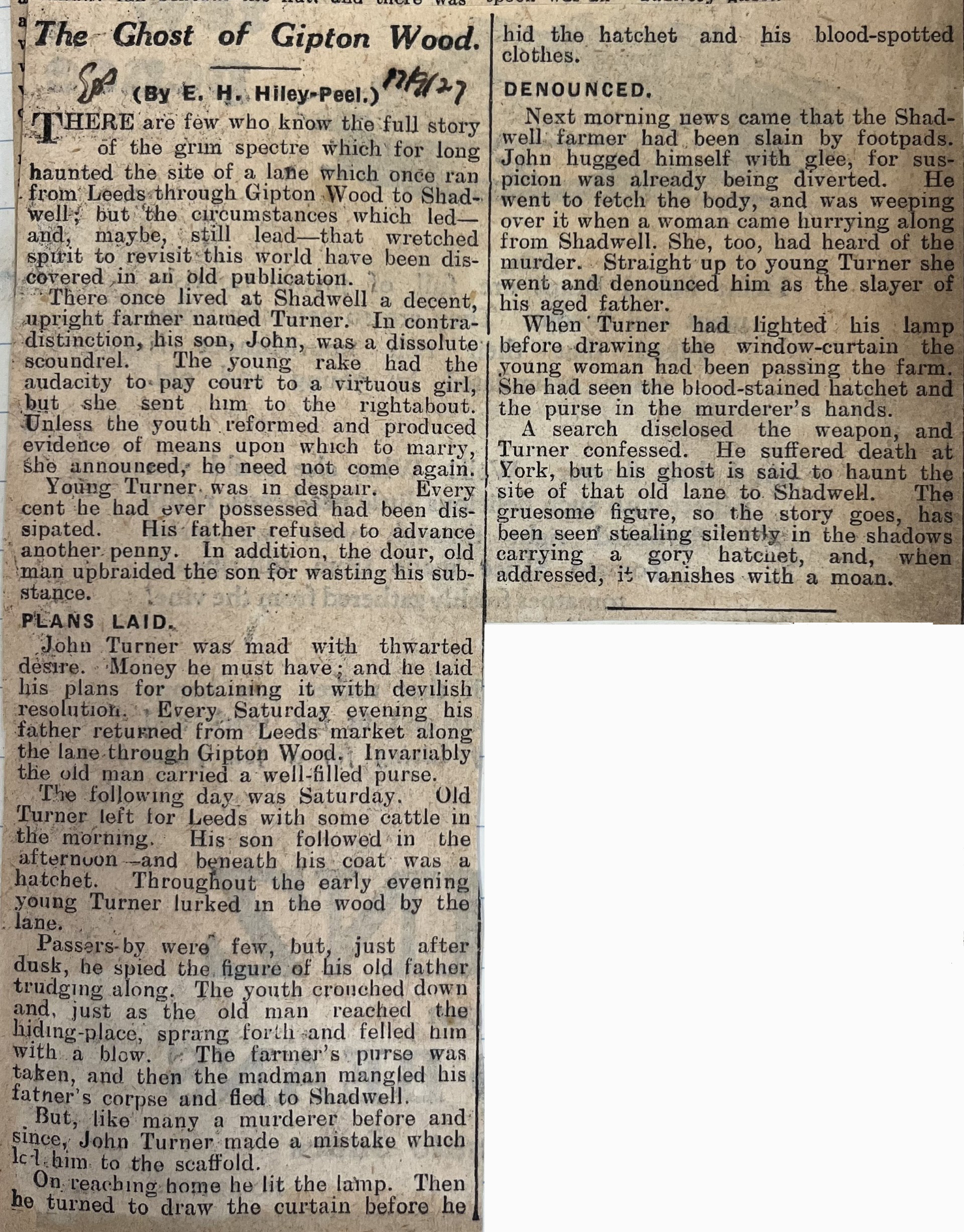
The Ghost of Gipton Wood
There are few who know the full story of the grim spectre which for long haunted the site of a lane which once ran from Leeds through Gipton Wood to Shadwell; but the circumstances which led – and maybe, still lead – that wretched spirit to revisit this world have been discovered in an old publication.
There once lived at Shadwell a decent, upright farmer named Turner. In contra-distinction, his son, John, was a dissolute scoundrel. The young rake had the audacity to-pay court to a virtuous girl, but she sent him to the rightabout. Unless the youth reformed and produced evidence of means upon which to marry she announced; he need not come again.
Young Turner was in despair. Every cent he had ever possessed had been dissipated. His father refused to advance another penny. In addition, the dour, old man upbraided the son for wasting his substance.
John Turner was mad with thwarted desire. Money he must have; and he laid his plans for obtaining it with devilish resolution. Every, Saturday evening his father returned from Leeds market along the lane through Gipton Wood. Invariably the old man carried a well-filled purse.
The following day was Saturday. Old Turner left tor Leeds with some cattle in the morning. His- son followed in the afternoon – and beneath his coat was a hatchet. Throughout the early evening young Turner lurked in the wood by the lane.
Passers-by were few, but, just after dusk, he spied the figure of his old father trudging along. The youth crouched down and, just as the old man reached the hiding-place, sprang forth and felled him with a blow. The farmer’s purse was taken, and then the madman mangled his fathers corpse and fled to Shadwell.
But, like many a murderer before and since, John Turner made a mistake which led him to the scaffold.
On reaching home he lit the lamp. Then he turned to draw the curtain before he hid the hatchet and his blood-spotted clothes.
Next morning news came that the Shadwell farmer had been slain by footpads. John hugged himself with glee, for suspicion was already being diverted. He went to fetch the body, and was weeping over it when a woman came hurrying along from Shadwell. She, too, had heard of the murder. Straight up to young Turner she went, and denounced him as the slayer of his aged father.
When Turner had lighted his lamp before drawing the window-curtain the young woman had been passing the farm. She had seen the blood-stained hatchet and the purse in the murderer’s hands.
A search disclosed the weapon, and Turner confessed. He suffered death at York, but his ghost, is said to haunt the site of that old lane to Shadwell. The gruesome figure, so the story goes, has been seen stealing silently in the shadows carrying a gory hatchet, and, when addressed, it vanishes with a moan.
The Spectre of Bramley Hall
Bramley Hall, the once fine residence of a yeoman family, is in a decrepit state to-day. It stands with its gable-end to Town Street, and passers-by may easily miss noticing it. See from the outside it is a picture of forlorn decay. Within, the paper peels off the walls, and throughout is the atmosphere of a long dead past.
In a bow-windowed room on the ground floor is a fine, diamond-flagged floor. Like every other part of the building, it betrays patches of damp. But there is one dull stain on the diamond-shaped flags which no scrubbing nor drying will ever remove.
It is the stain of a murdered man’s blood; and from that obstinate blot, so some people say, there arises each midnight hour the shadowy form of Oliver Isles, the man who was slain for the gold he loved more than his soul.
The miser’s soul cannot rest, for Oliver died a violent death. Until that blood stain wears away he must return to count and recount his chinking coins while he chuckles in glee at the way the blood thirsty thief was foiled.
The Isles came of well-to-do stock, and they inhabited Bramley Hall for many generations. The name is mentioned in Thoresby’s “ Leodiensis.” They were land-owners, yet stinginess was in the marrow of their bones. In the old “Town Book” of Bramley, under date November 17, 1684, Thomas Isles was listed as owing the township the sum of 2s. 4d. “which he refuses to pay.”
Oliver, the last of the line, was a miser such as is rarely met with outside fiction. With the exception of the little affection which he lavished upon his dog “Chance”, he lived solely for gold. The home of- his fathers went to rack. The windows were always shuttered, and never a penny was spent upon the place.
Only through the chinks of one shuttered window was a light ever seen. Those who dared would stand outside that window. Nothing could they see, but they heard the rattle and tinkle of coin as Oliver trickled his wealth through his fingers.
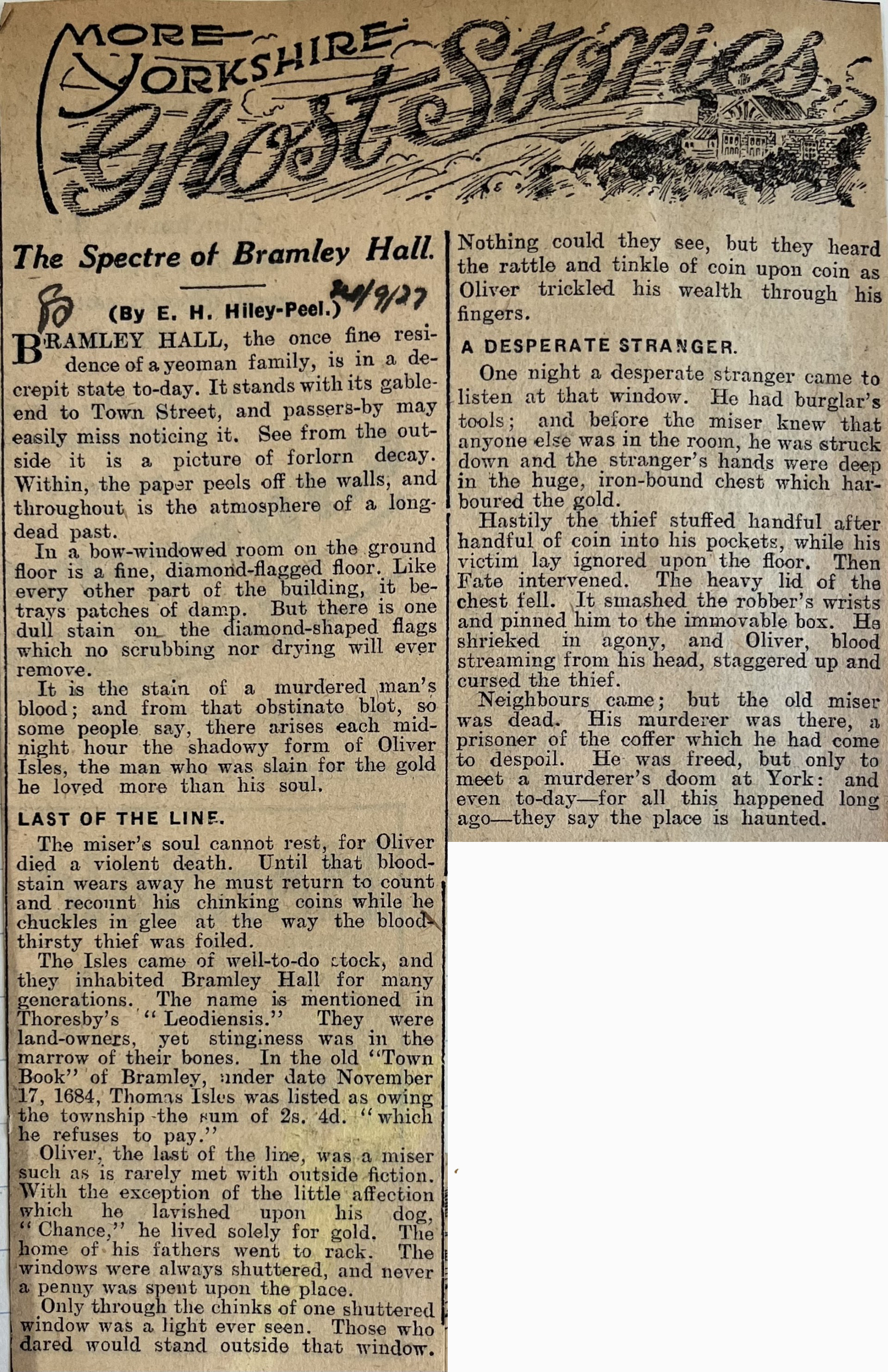
One night a desperate stranger came to listen at that window. He had burglar’s tools; and before the miser knew that anyone else was in the room, he was struck down and the stranger’s hands were deep in the huge, iron-bound chest which harboured the gold.
Hastily the thief stuffed handful after handful of coin into his pockets, while his victim lay ignored upon the floor. Then Fate intervened. The heavy lid of the chest fell. It smashed the robber’s wrists and pinned him to the immovable box. He shrieked in agony, and Oliver, blood streaming from his head, staggered up and cursed the thief.
Neighbours came; but the old miser was dead. His murderer was there, a prisoner of the coffer which he had come to despoil. He was freed, but only to meet a murderer’s doom at York: and even today – for all this happened long ago – they say the place is haunted.
The Dark Mystery Of A Haunted Cellar
The legend of a haunted cellar in Butts Court, Leeds, which has come down from the dim past, persists to this day, and an interesting investigation, begun in the true spirit of scientific inquiry, but not continued and ended in that spirit, was undertaken a short time ago.
Hard by the cellar in question, there is a “bottomless” well of water, the taste of which is said to be not unlike that for which Harrogate is famous. Whether the “spirit” of the cellar is affected by the nature of the water or not, the description of the noises which it is said to make suggests a sulphurous quality.
No one seems to have seen the “spirit,” but an “Evening Post” reporter was told, to-day, that lots of people have heard noises so weird and blood-curdling as to give colour to the theory of the credulous that someone, at some time, came to an end at the well, or in an old subterranean passage, which leads from the premises to—no one knows where.
From the accounts given, the noises are such as might be made by a wife with a strong voice being strangled by an irritated husband.
In these days of healthy scepticism of ghostly manifestations, it is not surprising that a considerable number of people have found courage enough to search in the cellar for natural explanations of the cause and origin of the noises.
A business man who occupies part of the premises, and from whose office there is a door leading to the cellar, regards the vocal manifestations as rather amusing. After going through the war, he says, he is not one to be frightened by mere noises in the basement. He has laid traps of fine thread for the “ghost”, but nothing has ever been disturbed. He has invited it to come out and say what it has to say, but there has been no response.
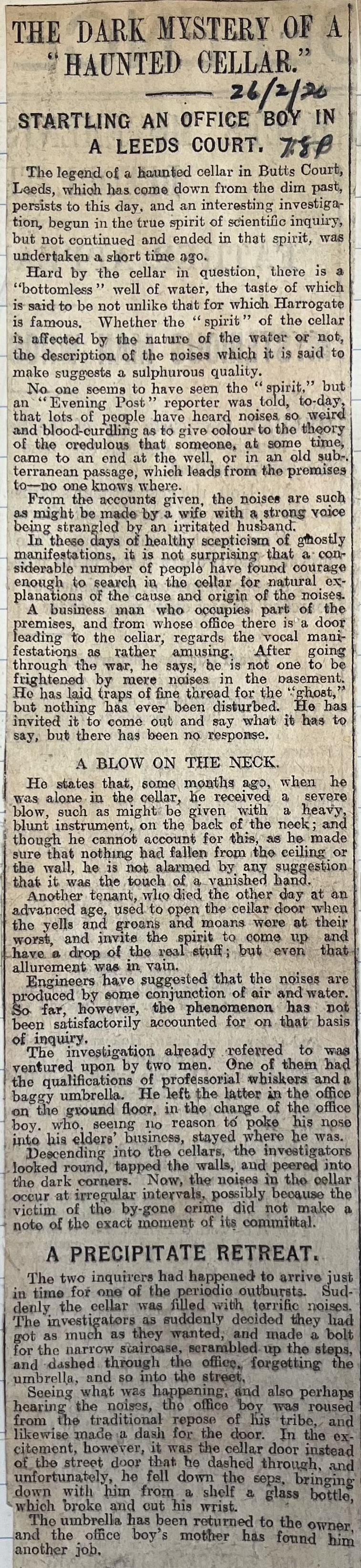
He states that, some months ago, when he was alone in the cellar, he received a severe blow, such as might be given with a heavy, blunt instrument, on the back of the neck; and though he cannot account for this, as he made sure that nothing had fallen from the ceiling or the wall, he is not alarmed by any suggestion that it was the touch of a vanished hand.
Another tenant, who died the other day at an advanced age, used to open the cellar door when the yells and groans and moans were at their worst, and invite the spirit to come up and have a drop of the real stuff; but even that allurement was in vain.
Engineers have suggested that the noises are produced by some conjunction of air and water. So far, however, the phenomenon has not been satisfactorily accounted for on that basis of inquiry.
The investigation already referred to was ventured upon by two men. One of them had the qualifications of professorial whiskers and a baggy umbrella. He left the latter in the office on the ground floor, in the change of the office boy, who, seeing no reason to poke his nose into his elders’ business, stayed where he was.
Descending into the cellars, the investigators looked round, tapped the walls, and peered into the dark corners. Now, the noises in the cellar occur at irregular intervals, possibly because the victim of the by-gone crime did not make a note of the exact moment of its committal.
The two inquirers had happened to arrive just in time for one of the periodic outbursts. Suddenly the cellar was filled with terrific noises. The investigators as suddenly decided they had got as much as they wanted, and made a bolt for the narrow staircase, scrambled up the steps, and dashed through the office, forgetting the umbrella, and so into the street.
Seeing what was happening, and also perhaps hearing the noises, the office boy was roused from the traditional repose of his tribe, and likewise made a dash for the door. In the excitement, however, it was the cellar door instead of the street door that he dashed through, and unfortunately, he fell down the s[t]eps, bringing down with him from a shelf a glass bottle, which broke and cut his wrist. The umbrella has been returned to the owner and the office boy’s mother has found him another job.
Hick’s ghost scrapbook is entitled ‘Ghost Stories and Weird Experiences, Life After Death etc.’ Full details can be found here.
Simon Smith’s illustrations can be seen in the Local and Family History Library from Wednesday 23rd October – Saturday 9th November during normal library opening hours. Follow Simon on Instagram @curmudgeonly_si
Please book an appointment if you wish to view any of the Hick Collection by contacting localandfamilyhistory@leeds.gov.uk or 0113 378 6982. ID will be required.
 The Secret Library | Leeds Libraries Heritage Blog