This week we welcome back guest author, retired librarian Lucy M. Evans, who enjoys delving into the obscure Victorian world of northern librarians and learned societies. She has previously written about the longevity guru Maurice Ernest, Andrea Crestadoro, a Chief Librarian in Manchester (copy available at LCL), and is currently finishing a biography of his friend William E. A. Axon, a prolific writer. Researching Axon led to an encounter with John Searle Ragland Phillips, former editor of the Yorkshire Post. This is the second and final part of her research on John Searle Ragland Phillips (known to all as JSR), in which she looks at his upbringing and professional life. Part one of Evans’ research can be found here.
Yorkshire Post Editor and Leeds Citizen
JSR’s professional life as an eminent figure in the newspaper world is well covered by various obituaries and by the tract produced on his death in 1919. The tract is largely made up of reprints from the Yorkshire Post. It is neatly divided into sections: his public life is detailed under journalism, philanthropic work, and lecturer. As might be expected JSR held weighty positions, influenced the commercial, political and social life of Leeds, and played significant parts both locally and nationally. For instance, he was Chair of the Press Association in 1912 and President of the Newspaper Society in 1914. He was the dynamic Chairman of the West Riding District Committee of the Newspaper Press Fund. As a worthy Leeds citizen, he was active in the Leeds Children’s Holiday Camp, the Royal National Lifeboat Institution, and Leeds War Hospitals Entertainments. Always a favourite choice as an after-dinner speaker and lecturer, he combined ‘kindly humour with shrewd common-sense.’ As a newspaper editor he was extremely well informed on current affairs and widely travelled on the Continent, especially Finland and Germany. Fellow editors on an exchange tour with German journalists in 1907 were stunned when the socially confident JSR conversed and joked with the Kaiser at a banquet in Hamburg. Whilst JSR energetically promoted international relations between Britain and Germany, he perceived the developing hostilities, and supported armament, especially naval.

From Warehouse Boy to Editor
So, the JSR of Balmoral House, Headingley, was an important man, well respected and popular in the different circles in which he moved. How did he acquire this status?
The drama of rags to riches is always satisfying, whether in fact or fiction. JSR’s rise from sweeping streets outside a Manchester warehouse to the resplendent role of Yorkshire Post editor, host to the stars, and philanthropic Leeds citizen does not disappoint.
Born in 1850 in Pendleton he was fortunate in having a family he loved and the ties between them were always strong. The first calamity struck when he was a young child and his father, a respected accountant, died. JSR scratched a basic education at a girls’ boarding school run by his mother and aunt, topped by two years at a boys’ private day school.
At the age of thirteen JSR, determined to help his family, was employed in a Manchester wholesale drapery warehouse. The hours were hard and long: he sometimes worked from eight in the morning to past midnight. Whenever he could snatch breaks, he haunted the nearby Manchester Free Library, reading ‘book after book to improve his mind and broaden his outlook.’ [17] These precious moments remained vivid in Phillips’ mind: ‘I was at that time sweeping a floor and tying up parcels in the warehouse of S. & J. Watts & Co., in Portland Street, Manchester, and I spent my dinner hour in rushing to the free library at Campfield, for may be three-quarters of an hour’s reading while surreptitiously I munched some bread and cheese, or when the warehouse was closed, after tea in the street, reading until 9 o’clock, when the great handbell rang us all out.’ [18]
He became friends with the boy assistants there, principally William E. A. Axon, W. R. Credland and Charles W Sutton. All were equally passionate for learning and determined to earn their livings in the world of print. All succeeded. Axon became Deputy Librarian, then a Manchester Guardian journalist and an astonishingly prolific author. Sutton became the dynamic Chief Librarian and Credland his Deputy. There is a note in Growth of Journalism that W. R. Credland, Deputy Librarian of Manchester, compiled the bibliography. The ties lasted.
JSR and Sutton attended evening classes at Owens College, the forerunner of Manchester University. JSR’s special studies were English language and literature under Dr. A. W. Ward, ‘with whom he maintained a life-long friendship.‘ [19] Years later it was Ward, now Sir A. W. Ward and Master of Peterhouse, who as the editor of the Cambridge History of English Literature commissioned his former pupil to cover the journalistic section.
Still employed in warehouses and the textile trade, JSR pursued his ambitions as a writer: he was paid for his first published article in 1867, became a respected contributor to local publications as well as the college magazine. He won prizes as a student and became a founder member of the Manchester Shakespeare Society.
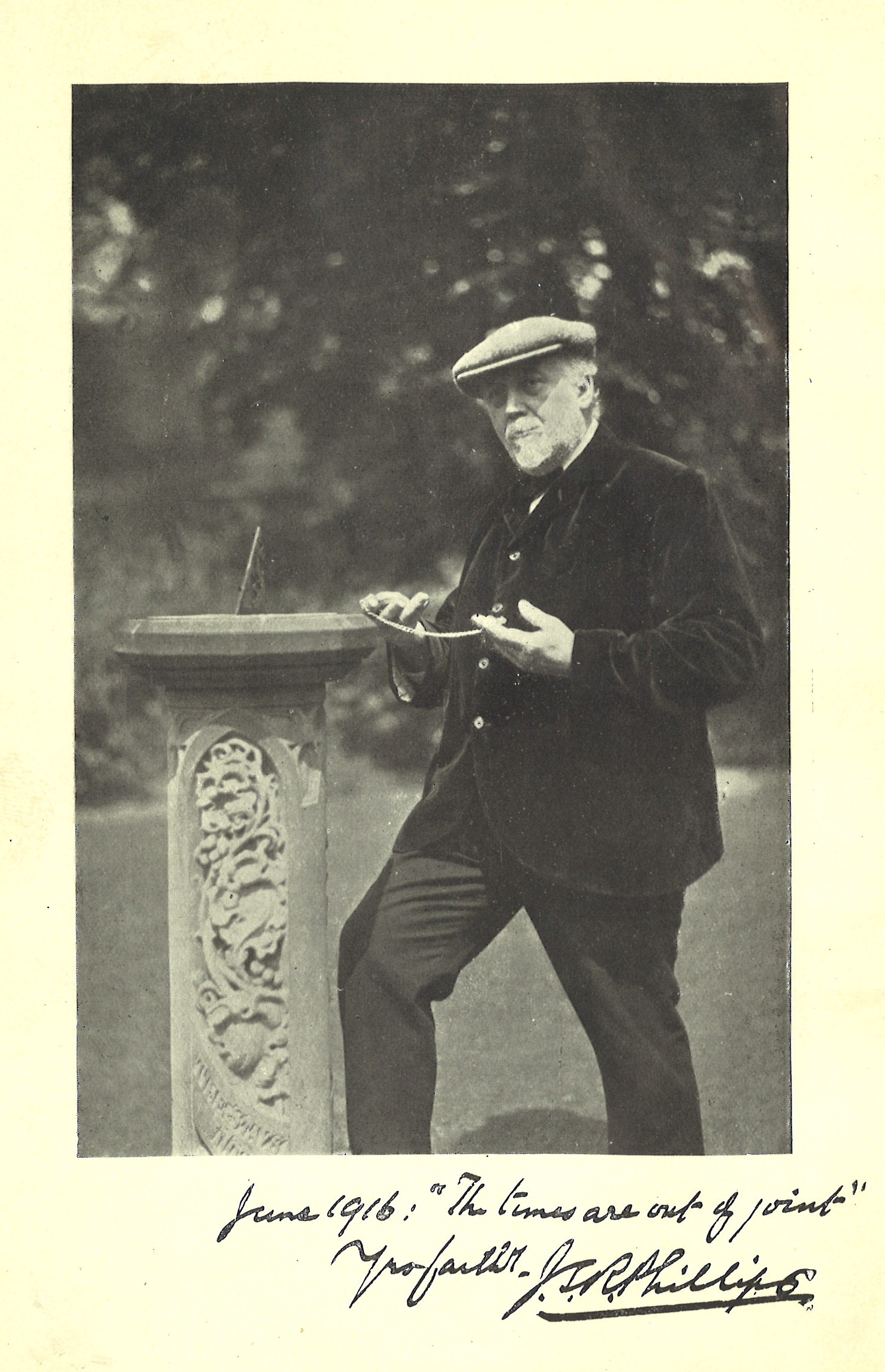
As the photograph in Growth of Journalism shows (below) JSR was a handsome, upright man, admired for ‘his fine physique, fair hair, and ruddy complexion.’ He prided himself on his Welsh and Nordic descent: his robust constitution provided him with the energy to combat the obstacles in his path and to give others a hand. Even in those hard early years in Manchester he found time to volunteer with the fire brigade.
In 1875 JSR married the artist, Sarah More. Two years later he finally broke free from Manchester warehouses. He joined the Kendal Mercury as sub-editor: when this was bought out, he moved onto an evening paper in Gateshead for the election year of 1880. He then served six years on a Worcester journal, followed by the York Herald and the Newcastle Leader where he became chief sub-editor. In 1886 his support of the Unionist cause in the split over Home Rule in Ireland, brought him to the Scotsman and then the failing Manchester Examiner. When this ended in 1891, JSR was invited by Mr Palmer, editor of the Yorkshire Post, to come to Leeds as leader-writer and Assistant Editor. He provided such support for the frail editor Mr Palmer that he succeeded him on his death in 1903. Like C. P. Scott of the Manchester Guardian, JSR was greatly revered at both a local and national level. JSR was a professional of high standing, serving the Tory readership of the Yorkshire Post with quality reporting, and in particular pleasing the agricultural community with rare understanding of their lives. He gave C. P. Scott expert advice during the Manchester Guardian’s difficult internal struggles, known as the ‘War of the Taylor Succession.’ Together with other leading editors JSR was involved in deputations to Government and in battles over press standards.
JSR to the Rescue: William E. A. Axon
JSR never forgot how Axon helped him when he was crippled with rheumatism in the late 1890s. In 1905, Axon was devastated by being let go by the Manchester Guardian after thirty years’ service. Only a few intimate friends knew the truth: most thought he had retired willingly. Axon was granted a five-year pension, but this alone did not enable him to support his family. In desperation he sought to extend his freelance work, and it was principally his old friend JSR who came to his rescue. JSR was now the highly respected editor of the Yorkshire Post: he commissioned regular biographical sketches from Axon, and knowing his friend’s radical sympathies, promised him there would be no Tories on the list
There are over 50 letters from JSR to Axon, running from 1878 to Axon’s death in 1913. These are amongst the Axon Papers at John Rylands Library in Manchester. Here is the very direct voice of JSR, giving the most intimate insight we have of this bold, generous and forthright man.
Some letters concern purely business matters and are sharp in tone with no sparing of feelings. JSR had no qualms about calling a spade a spade: or in the case of the philanthropist Andrew Carnegie ‘a bounder’ and the geologist Boyd Dawkins, ‘a perfect beast.’ Other letters contain lengthy debates with Axon where JSR enlarges on topics: again, he has no fear of speaking his mind. The longest dispute is over garden cities where JSR expounds for three pages his observations of why working people prefer to be in cities. He based his observations partly on his experiences long ago when employed by Reade and Wallis, Portland Street Manchester. It is typical of JSR that he engages at all levels with this issue, dismissing facile speculations, ‘for I did not believe, and do not believe in any of those slap-dash reasons which attribute preferences of the kind to the insensate folly of mankind.’ [20]
In most of his letters JSR shares news, personal events and their impact on him. JSR was no buttoned-up Victorian. He was uninhibited in his warmth: unusually even for close friends he always addressed Axon by his forename as ‘Dear Willie,’ expressed concerns for his health, and cheered him with such remarks as ‘You are always sunshiny internally.’ [21] Wherever he is, from York to Newcastle, he misses his old Manchester comrades and urges Axon to visit. He reminisced fondly, ‘The many jets & hot discussions we have had, the many pipes & cups of coffee!’ He expressed his emotions freely, writing of his concern for his beloved sister who has cancer, and his sadness that the circle of friends are reaching the last stages of their lives, ‘Yes, our friends go. I feel as if I had got into the region of icebergs.’ [22]
He can safely compare notes and share complaints with Axon, a trusted fellow journalist, ‘The Grind is not much less severe in York than in Manchester.’ [23] Whilst at the Scotsman he warned Axon to mind his health and not overwork, ‘I do so little or nothing besides the daily take of books, & find that enough- say five leaders (turn over cols.) & four or five books to review in a week.’ [24] He tried with Axon’s help to get his stories published but apparently without success for he wrote of the ‘difficulty of making profit from literature.’ [25] One of his stories, Martha, was based on a real case of a Miss Richardson whom they both knew: like the heroine Martha she refused to marry her child’s father.
In 1912 Phillips again looked back on their youthful days with great fondness, ‘We had indeed, ideals and hopefulness in those old days to which you refer. I think we all worked. We certainly thought and talked, and I am sure that we all had enjoyment in the reception and clash of ideas. Those days seem very close. When I think of them, I can scarcely imagine myself old.’ [26]
When Axon died in 1913, JSR wrote a very affectionate account of their long friendship, recalling being one of the young people who frequently gathered at Axon’s first home. Axon had shocked friends by a seemingly reckless early marriage but despite gloomy forebodings this was a very happy partnership and their home a haven of lively debate. Several of the young people became vegetarians: JSR and his wife eventually lapsed.
Farewell
The gossipy stories of the wheelbarrow knight, the Atkinson Grimshaw rescue, the picaresque desk and correspondence add substance to the official image of JSR. His lively and robust personality with an odd strain of melancholy, particularly emanates from his letters to Axon. He never lost his boyish enthusiasm and geniality: good natured, ever helpful, he was a paternalistic but forceful friend and employer.
Looking back at his life, JSR admitted to Axon that he had worked too hard and too long. Overwork, extra duties and anxieties during WW1 further undermined his health: he had snatched any spare moments in 1914 not to rest but to complete the Growth of Journalism.
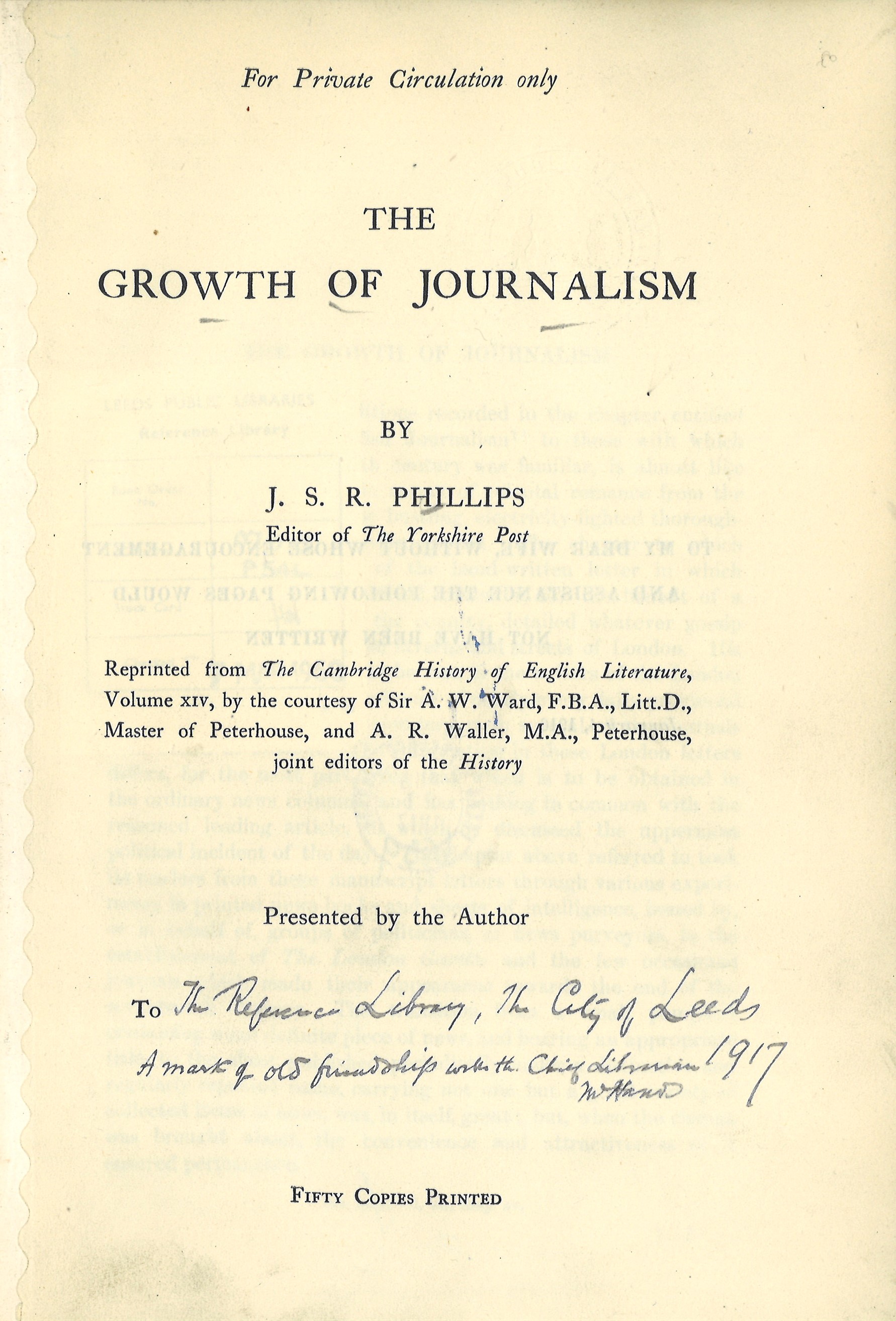
I have said little about Growth of Journalism itself, but it is a splendid reflection of JSR’s long years of experience and scholarship. It is a sparkling piece, full of anecdotes, quotations, and information: probably one of the best sources still for the history of specific newspapers. The history, as might be expected of JSR, is firmly embedded in people. He looks at the aspects from the perspectives of readers, writers, critics, war correspondents, people in the newspaper trade as well as the journalists. This underlies the richness of his understanding of the impact of society, technology and politics on newspapers. Unlike many he sees the value of advertisements for future historians: a spot-on prediction. There are dramatic touches too: JSR describes the revolution of newspapers in the nineteenth century as ‘almost like being carried on the magic carpet of oriental romance from the middle of the Sahara to the bustling, electricity-lighted thorough-fares of a modern European capital.’ Knowing a little about JSR adds to the understanding of his swansong.
Armistice with social and industrial turbulence brought little relief for JSR. He struggled on despite the pleas from colleagues, friends, and family, finally collapsing with cerebral haemorrhage. He died at Balmoral House on 4 November 1919.
JSR was a powerful intellectual with a gift for friendship and a very warm heart. His life was full both of worthy achievements and a vast array of people he enthusiastically engaged with, irrespective of status, wealth, politics or religion.

I was intrigued by the tribute poem, written by that wild Cumbrian poet, James A. Mackereth. Not many managed to befriend Mackereth though a young J. B. Priestley often sat with him in his isolated cottage above Bradford. Again, it is frustrating not to have details of the encounters between JSR and Mackereth: they were evidently walking comrades as well as friends. Mackereth ends his poem, Valediction, with reference to the frontispiece portrait of the Growth of Journalism,
Now you have wandered to that farther place
Folded in mist and silence. More alone,
I tread thought’s quiet ways-that were your own
In secret, fondling for a little space,
Your gift- this picture of your kindly face
Poising, perplex, above a dial stone. [27]
[17] J.S.R. Phillips, Editor of the Yorkshire Post 1903-1913, p.7 [18] J. S. R. Phillips, ‘A Reminiscence’, Vegetarian Messenger, 11 1914, p52-59 [19] J.S.R. Phillips, Editor of the Yorkshire Post 1903-1913, p.7 [20] John Rylands Research Institute and Library, University of Manchester Library, Axon Papers, AP 5209 [21] AP 5182 [22] AP 6207 [2]3 AP 1770 [24] AP 2715 [25] AP 4379 [26] AP 6210 [27] J.S.R. Phillips, Editor of the Yorkshire Post 1903-1913, p.38.
 The Secret Library | Leeds Libraries Heritage Blog