This week we welcome guest author, retired librarian Lucy M. Evans, who enjoys delving into the obscure Victorian world of northern librarians and learned societies. She has previously written about the longevity guru Maurice Ernest, Andrea Crestadoro, a Chief Librarian in Manchester (copy available at LCL), and is currently finishing a biography of his friend William E. A. Axon, a prolific writer. Researching Axon led to an encounter with John Searle Ragland Phillips, former editor of the Yorkshire Post. Split into two separate blog posts, in this part she looks at Phillips’ time living in Headingley and his links to some very well known names.
Party Days at Balmoral Terrace
Balmoral Terrace in Headingley is one of Leeds’ hidden gems. It slants across Claremont Road and Shaw Lane, discreetly tucked away with a little mossy lane running along the end of the long gardens. Built in 1857 as a very desirable property, its gardens then fronting fields, the Grade II listed terrace is still quiet, leafy and private.
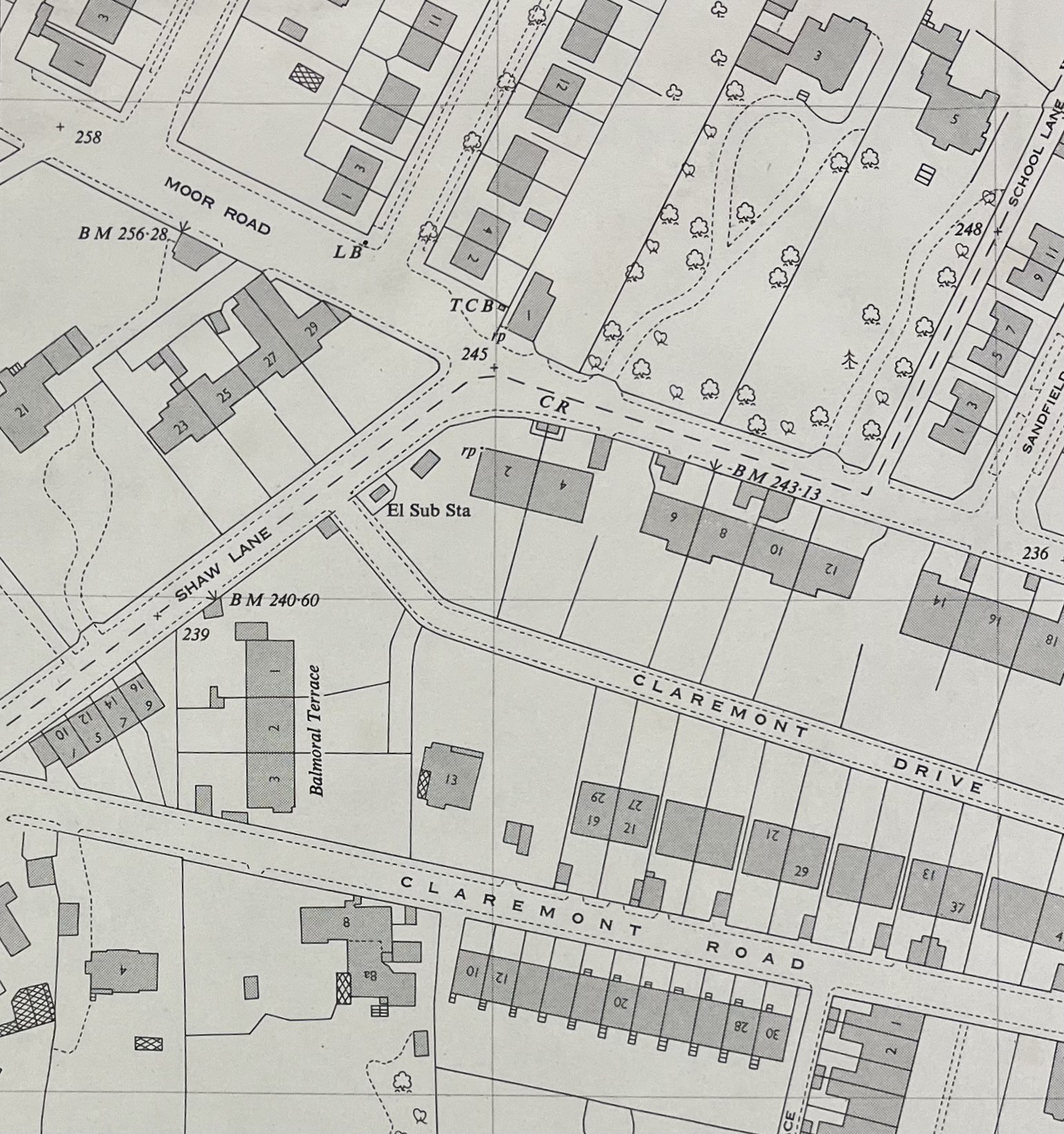
It is hard to imagine the lively crowd of visitors that once descended on Balmoral House, as No.1 was called. The acting duo, Fred Terry and his wife Julia Neilson, stars of The Scarlet Pimpernel at the Grand, turned up ‘in their enormous old red Rolls-Royce, sporting its acetylene lamps (long after cars went over to electric lamps), internal make-up cabinets, and wardrobe.’[1] Wilson Barrett, the flamboyant actor manager of the Grand Theatre, Sir Henry Irving, the rock star of British theatre, were regulars, as were assorted members of the Atkinson Grimshaw clan, as well as briefly the frail artist himself. Another mercurial presence was the ‘ big red-headed Irish giant’ [2] as the artist’s daughter, Elaine Grimshaw, described him, none other than the conjuror of the world’s most famous vampire: Bram Stoker, author of Dracula. The very desk on which he wrote his masterpiece eventually resided at Balmoral House, a bulbous monstrosity regarded with loathing by its recipients.
For a couple of years the Ransome family lived next door at No.2: the six year old Arthur, his brother and sisters, must have been entertained by the comings and goings at No.1. Arthur’s father was Professor of History at York College, later Leeds University, and his mother the daughter of the Australian grazier and artist, Edward Baker Boulton. Perfect neighbours for the inhabitants of Balmoral House.
So, who was the host to all this throng? It was none other than the larger-than-life character, John Searle Ragland Phillips, charismatic Assistant Editor and then from 1903 Editor of the Yorkshire Post, known to all as JSR. He, his artist wife, Sarah, and initially his three sons, lived at Balmoral House from around 1891 to 1919. He boasted happily to a friend in June 1902, that Headingley was very pleasant ‘& our garden is one of the pleasantest in Headingley.’ [3]
JSR had a vast capacity for friendship, embracing not just the theatrical, literary and artistic crowd but librarians, business men, farmers, journalists, gardeners, lifeboat crews, firemen and beekeepers. He differed from his radical friends being a Liberal Unionist opposed to Home Rule and was decidedly anti women’s’ suffrage. But his genial courtesy and fair-minded attitudes in debate won him admiration even from Labour leaders.
The Growth of Journalism
Here is JSR in a delightfully informal portrait, taken in the garden of Balmoral House. The motto below reads ‘June 1916 “The times are out of joint” Yours faithfully, J S R Phillips.’
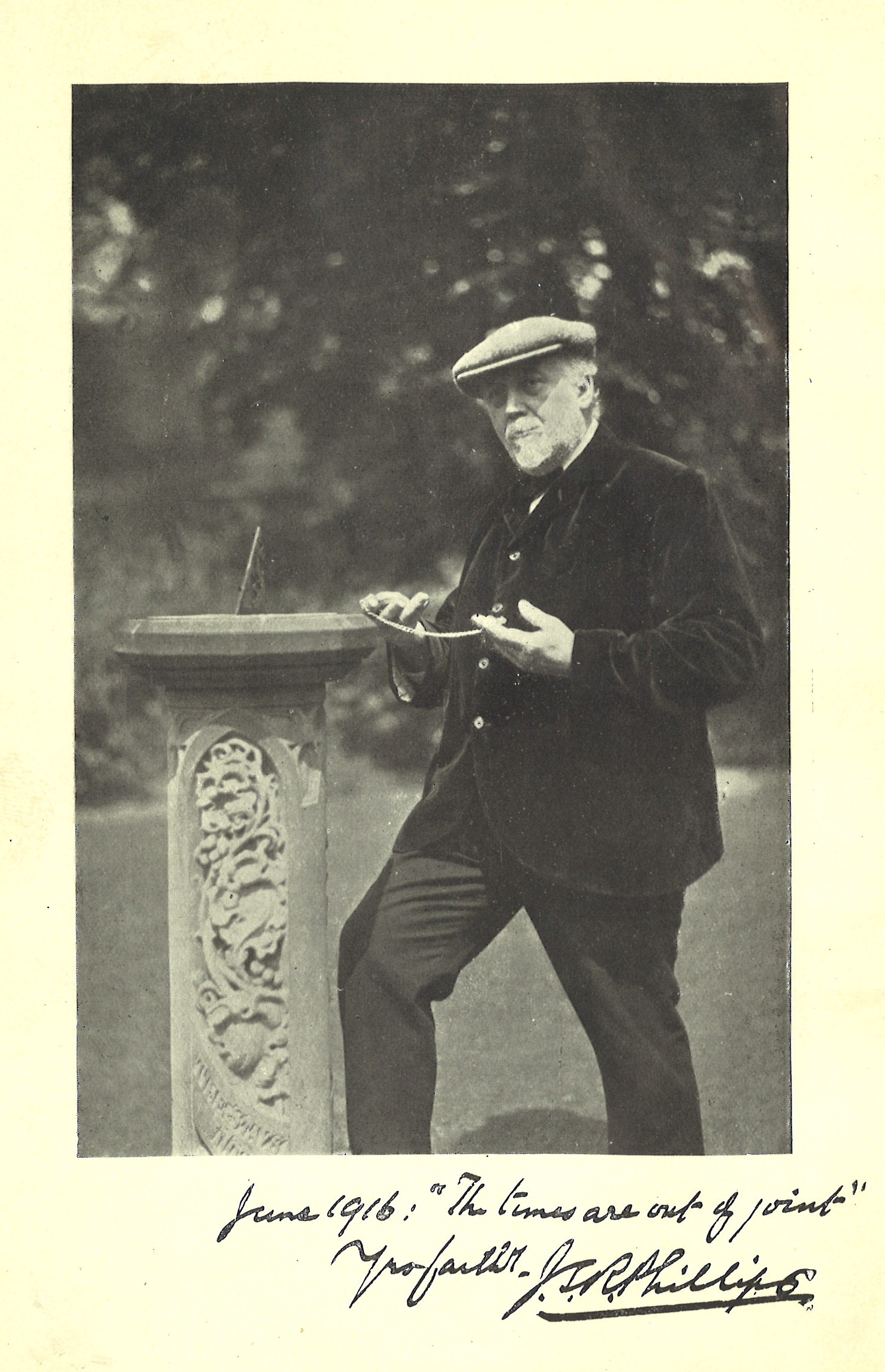
This could be taken as a reference to WW1 but in fact it is a wry comment on JSR’s unsuccessful campaign against the proposals for British Summer Time. The portrait fits exactly with Elaine Grimshaw’s description of him as ‘a six-foot sturdy man, bearded, fresh-complexioned and vivacious, wore no top-coat over his buttoned jacket; on his head he wore a countryman’s cloth cap.’ [4]
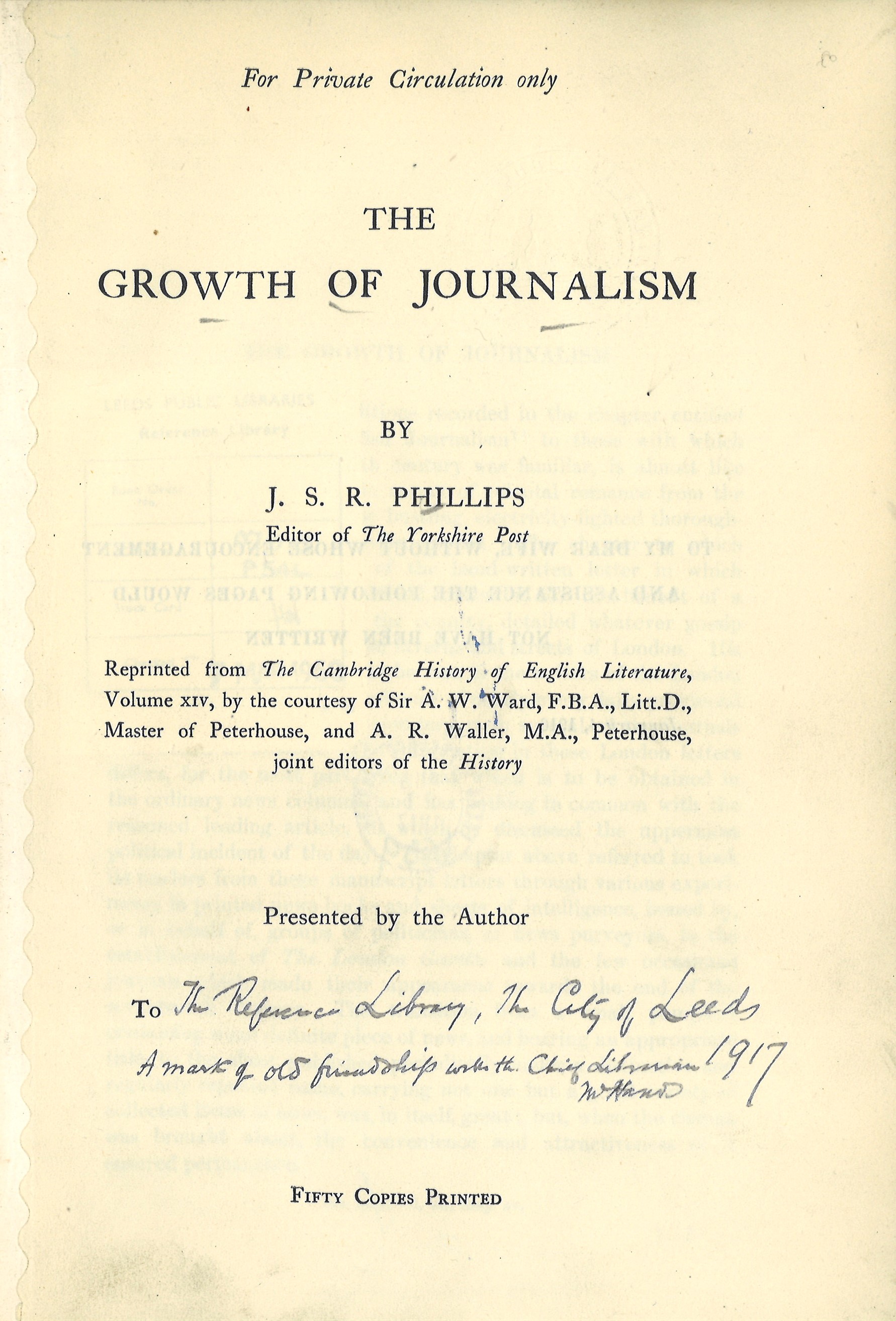
This photograph was chosen by JSR as the frontispiece for his little book, the Growth of Journalism. In 1917 he presented Leeds Central Library with one of the 50 copies he had printed for private circulation. It is an impressive history of the English newspaper industry, written with inside knowledge by one of the greatest newspaper editors of the time. It was originally published in 1914 as the journalism section of the Cambridge History of English Literature. Quite understandably JSR had his prestigious contribution reprinted for family and friends, adding in a couple of updates. He dedicated the book to his ‘dear wife,’ and noted that he gave it as ‘a mark of old friendship with the Chief Librarian T W Hand.’
Balmoral Tales: Atkinson Grimshaw and Family
JSR could perhaps be overbearing in his determination to sort out people’s lives. His intervention in the lives of the Atkinson Grimshaw family is rather astonishing. The story has only emerged through chance preservation of family gossip.
Guy Ragland Phillips, JSR’s grandson, allowed author Sandra Payne to access his and his mother Elaine’s unpublished material for her book on Elaine’s father, the Leeds artist Atkinson Grimshaw. [5] This and subsequent studies of Atkinson Grimshaw, particularly by Jane Sellars, unearthed some fresh glimpses of JSR.
In 1891 JSR was invited by Mr Palmer, editor of the Yorkshire Post, to come to Leeds as leader-writer and Assistant Editor. Atkinson Grimshaw died in 1893: their friendship, albeit of brief duration, was intense. In an article in the Yorkshire Post in 1963, Elaine recalled how an encounter on a Headingley horse-tram proved a momentous event for both her father and JSR. In contrast to the much younger and robust JSR, her father was barely five feet tall and in frail health. (Elaine gave the date of the meeting as early spring, 1893: others have given 1891.)
Atkinson Grimshaw was struggling with financial disasters as well as cancer. His reputation was beginning to fade, damaged by his use of photographs. JSR was appreciated as ‘a good listener and was sympathetic to the worries of artists because he was married to one.’ [6] He sat with the dying artist, comforting him with singing Schubert’s Schlafe, Schlafe.
Atkinson Grimshaw died on 13 October 1893, leaving nothing for his family. Their magnificent home, Knostrop Hall, and its contents were sold off. The family broke up, some moving to a terrace house on Ash Road, Headingley.
Elaine lived to 94 and her granddaughter April Marsden recalled the family history that, ‘After Atkinson Grimshaw died, it was the Phillips side who saved their bacon. JSR helped the family out after the bankruptcy.’ [7]
One way he did this is startling to modern readers. JSR apparently suggested to his son Edmund during a railway journey that he should marry the sixteen-year-old Elaine Grimshaw. He thought this would steady Edmund as well as helping the Grimshaws. Whilst Edmund was at Balliol College, Oxford, Elaine studied at the Slade School of Art, and they married when she was twenty. The couple lived for a time at 11 Woodbine Terrace, close to Balmoral House. JSR was ‘remembered with special fondness for his actions in their hour of need after Grimshaw’s death.’ [8]
Balmoral Tales: Bram Stoker
The great-hearted JSR was a man of many passions: his family and friends, art, gardening, bee-keeping, agriculture, literature, and of course journalism. He also had a great love of theatre, especially Shakespearean. He studied an obscure topic, the ventures of the early Elizabethan touring companies in Germany, ‘spreading a knowledge of English dramatic art which was then the highest and most accomplished in the world.’ [9] In 1909 he gave a lecture, Elizabethan Actors in Germany, to the Manchester Playgoers’ Club but sadly no text was recorded. The theatre people who enjoyed the hospitality of the Phillips family at Balmoral House often bestowed them with complimentary boxes and back-stage visits.
Theatre lay at the root of his friendship with Bram Stoker, devoted assistant to Sir Henry Irving. Irving is thought to be the model for Dracula, and Stoker’s worshipping relationship with him represented by Renfield. Irving’s Lyceum company appearing at the Grand in Leeds was a tremendous event and of course JSR would have been involved as the Yorkshire Post editor. Both Irving’s performances and Bram Stoker’s novels regularly received appreciative coverage in the Yorkshire Post such as, ‘The visits of the Lyceum Company to the Grand Theatre, few and far between though they be, always form the great event of the theatrical year in Leeds, but at no time has its appearance been looked forward to with greater interest than this week. The bookings have been unexampled, and seldom has the beautiful house presented a scene of greater animation and brilliancy than it did last night, when an audience crowding the house from floor to ceiling, and as enthusiastic as it was large, gave Mr. Henry Irving and Miss Ellen Terry the heartiest of welcomes.’ [10] Whether such appreciation laid the ground for the friendship or whether JSR and Stoker were already connected is unknown.
JSR may well have admired Stoker’s attempted rescue of a drowning man that earned him a rare British Humane Society award. Both men were alike in their physical robustness and courage. When the legendary Wilson Barrett, of equal imposing stature, visited Balmoral House as well the three magnificent men must have made an imposing spectacle.
As editor of the Yorkshire Post JSR ensured support for his beloved Royal National Lifeboat Institution. Bram Stoker was glad to help on one of the Roundhay Park Lifeboat Saturdays, welcoming the Filey and Bridlington crews to the Grand, ‘Subsequently both crews will go to the Grand Theatre, where, by the favour of Mr. John Hart and Mr. Bram Stoker, Sir Henry Irving’s business manager, they will be permitted to make a collection in the corridors.’ [11]
Bram Stoker frequently stayed at Balmoral House. There is speculation that Atkinson Grimshaw may have met Stoker there. Elaine was dismissive: ‘She did not think her father knew him, but she loathed “Dracula” anyway.’ [12]
The explanation of how JSR and Stoker first met might lie buried in the immense collection of Bram Stoker correspondence at the Brotherton Collection, University of Leeds. It is frustrating not to know more of this friendship, overlooked in biographies of Bram Stoker and Henry Irving. Bram Stoker died in London in 1912. Either before or after his death, his famous desk was gifted to JSR.
Dracula’s Desk
The desk subsequently acquired a complex provenance as described in the draculadesk blog, [13] passing down through the Phillips family and suffering various vicissitudes. Edmund, now Assistant Editor at the Yorkshire Post, inherited it but his wife Elaine disliked it. For years It was left outside in their garden at Scotton near Knaresborough. They let their son Guy take it to London: he later bought a house at Hartlepool and when he sold this house to a Mrs Broderick, he abandoned the desk. In 1975 he confirmed in a letter to Mrs Broderick that it was indeed the Dracula desk given by Bram Stoker to his grandfather. Mrs Broderick liked the literary associations but not the desk. It had already lost its drawers and parts of its legs and her young son Andrew completed the destruction, using it as a workbench for his paints and model planes. Mrs Broderick gave it to a local writer Billy Yull. It was eventually purchased by the art dealer Andrew Lamberty, and so met salvation with his friend, the fantastic artist, sculptor and furniture designer, Mark Brazier-Jones
Whatever JSR’s opinion of the desk, he had kept it to himself. It was not popular with the family. It was dismissed, presumably by Elaine or Guy, as a ‘huge heavy, ugly thing, with thick bulbous legs.’ There were battered white pot knobs and a dummy drawer concealing a fifth drawer, ‘This abominable piece of furniture contains no more mystery than that.’ [14]
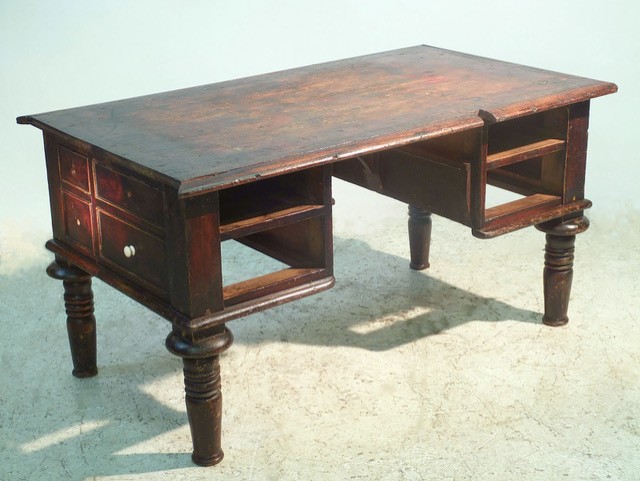
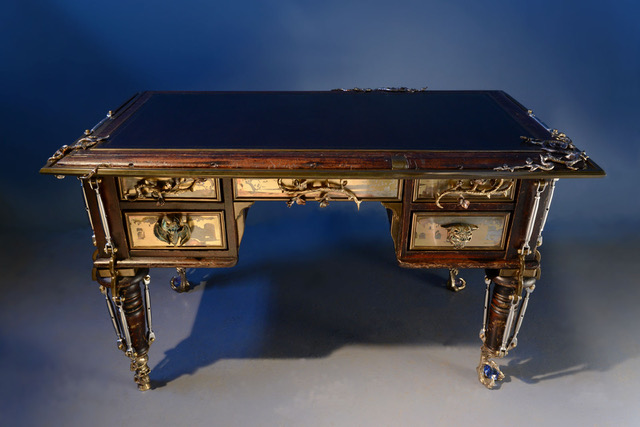
It is miraculous that the battered and despised carcass has since been creatively transformed by Mark Brazier-Jones into a breathtaking mythic object. Bronze and burnished steel embrace and envelop the carcass, honouring it as a reliquary. Unsurprisingly, Mark Brazier-Jones could not part with it. Those men of the theatre, JSR and Stoker would surely adore the desk in all its new splendid mystery.
Cumberland Farm and Headingley Allotment
JSR in his letters to his old friend William E. A. Axon often mentioned his wish to be back on his farm and busy with beekeeping. In 1877 JSR joined the Kendal Mercury as sub-editor: his first newspaper post. Presumably it was in this period that he bought a small farm in Cumbria, Knott End, Eskdale. It is still there. No wonder with his countryman’s experience that he later sympathised more than most newspaper editors with the challenges facing farmers in the West Riding or campaigned vigorously against Lloyd George’s land tax. JSR escaped to his farm whenever he could, often providing sanctuary there for friends to recuperate from the pressures and illnesses of industrial cities. In one letter to Axon, he combined journalism with bees, ‘I am putting the new Bee article into type. Some of these days I hope you will go into Cumberland, Eskdale, via the Ravenglass Station, and see my bees. I have at present ten hives.’ [15]
In Leeds JSR satisfied his need to engage with the soil by keeping an allotment, most likely one of the still surviving allotments on the Otley Road, close to his home.
A correspondent to the Yorkshire Evening Post was struck by the great man’s kind chivalry. He told of an elderly gentleman ‘trundling a wheelbarrow’ on his way home from the Headingley allotment, who insisted on helping a ‘a woman of the working classes’ with her heavy shopping, placing the carpet bags alongside his fork and spade in the barrow, and wheeling it alongside her, ‘A knightly action, I thought; and it set the key-note for my estimate of the sterling character of the late Mr J.S.R. Phillips. For he it was who wheeled the barrow.‘ [16]
Look out for part two of this fascinating history of John Searle Ragland Phillips.
[1] Sandra K. Payne, Atkinson Grimshaw Knight’s Errand, Corporate Link, 1987, p.13 [2] Sandra K. Payne, Atkinson Grimshaw Knight’s Errand, p.13 [3] John Rylands Research Institute and Library, University of Manchester Library, Axon Papers, AP 4379 [4] Sandra K. Payne, Atkinson Grimshaw Knight’s Errand, p.1 [5] Sandra K. Payne, Atkinson Grimshaw Knight’s Errand [6] Michael Hickling, ‘Career of Light and Shade’, Yorkshire Post, 18 April, 2011 [7] Michael Hickling, ‘Career of Light and Shade’ [8] Michael Hickling, ‘Career of Light and Shade’ [9] ‘Early Days of English Drama’, Manchester Evening News, 29 March 1909 [10] ‘Grand Theatre’, Yorkshire Post, 20 October 1891 [11] ‘Lifeboat Saturday’, Yorkshire Post, 4 July 1896 [12] Sandra K. Payne, Atkinson Grimshaw Knight’s Errand, p.13 [13] draculadesk.blogspot.com [14] Sandra K. Payne, Atkinson Grimshaw Knight’s Errand, p.13 [15] John Rylands Research Institute and Library, University of Manchester Library, Axon Papers, AP 6186 [16] J.S.R. Phillips, Editor of the Yorkshire Post 1903-1913, Leeds, Beck & Inchbold, printers [1919], p.37.
 The Secret Library | Leeds Libraries Heritage Blog
What fascinating people and stories! Thanks for sharing.