Becky Bavill brings us the second part of this fascinating story of a musical life in Leeds…
In the first part of this article, I had identified the author of the music and her family. What I was interested in now were the two people Amelia’s father felt were important enough to him or his daughter to be presented with a copy of it – Amy Young and Martin Cawood.
Amy Young has proved challenging. She appears in some newspaper reports as Miss Amy Young, attending various events with her father and mother, Mr and Mrs John Young. Sometimes an E or Edith Young is mentioned, as well as a Mrs Yorke and a Mr and Mrs Thos Young. The way the names appear in the paper suggests that they are linked as a family, but then again, perhaps not.

John Young, tailor and draper of St Johns Terrace did not have a daughter called Amy. His sons were John William and Robert, his daughters Elizabeth Ann, Emma and Matilda. There are no marriage links to Yorkes, and no Thomas Youngs.
John Young, accountant and brewer of many places but ultimately Moor Hill Farm Headingley did not have a daughter called Amy. His sons were Walter, Albert Arthur and Oswald Gordon. His daughters were Mary Alice, Edith and Helen. There are no marriage links to Yorkes, and no Thomas Youngs. In fact the only Thomas Youngs in the trade directory that I can find are a grocer and a mechanic – there are no Yorkes at all.
A chance encounter with the London Evening Standard led me to Agnes Mary (Amy) Young. She died in Italy in 1880 aged 35, the daughter of Francis Mortimer Young, a civil engineer of Leeds.

Her age is right, as an older single woman in a well to do family it is certainly feasible that she might have been a friend of Amelia’s. Her father was a civil engineer with railway connections and had died suddenly in 1860, the family relocating to Cheltenham by 1871. However I cannot solidly connect them in any way and the only evidence of musicality in these three families is that John Young the brewer had a brother called George who sat on the committee of the Musical Union (watch out for that later). Francis Mortimer Young was based at York Place, which is very close to the Smiths on Park Place, but these insubstantial wisps are all I have. Sadly I think I have to give up on Amy.
Happily, Martin Cawood is a much less insubstantial figure, and I’m quite surprised to have not run across him before. He was born in 1813 the son of John and Ann who had married in Otley in 1799. John and Ann had 2 children – Martin and Anne Elizabeth(1816). Industry was in Martin’s blood – his grandfather Martin and his father ran a Leeds iron foundry – a brass and iron founders, manufacturers of coal gas apparatus, fire proof buildings, patent metallic cocks & tinn’d cast iron kitchen furniture of Marsh Lane to be precise.
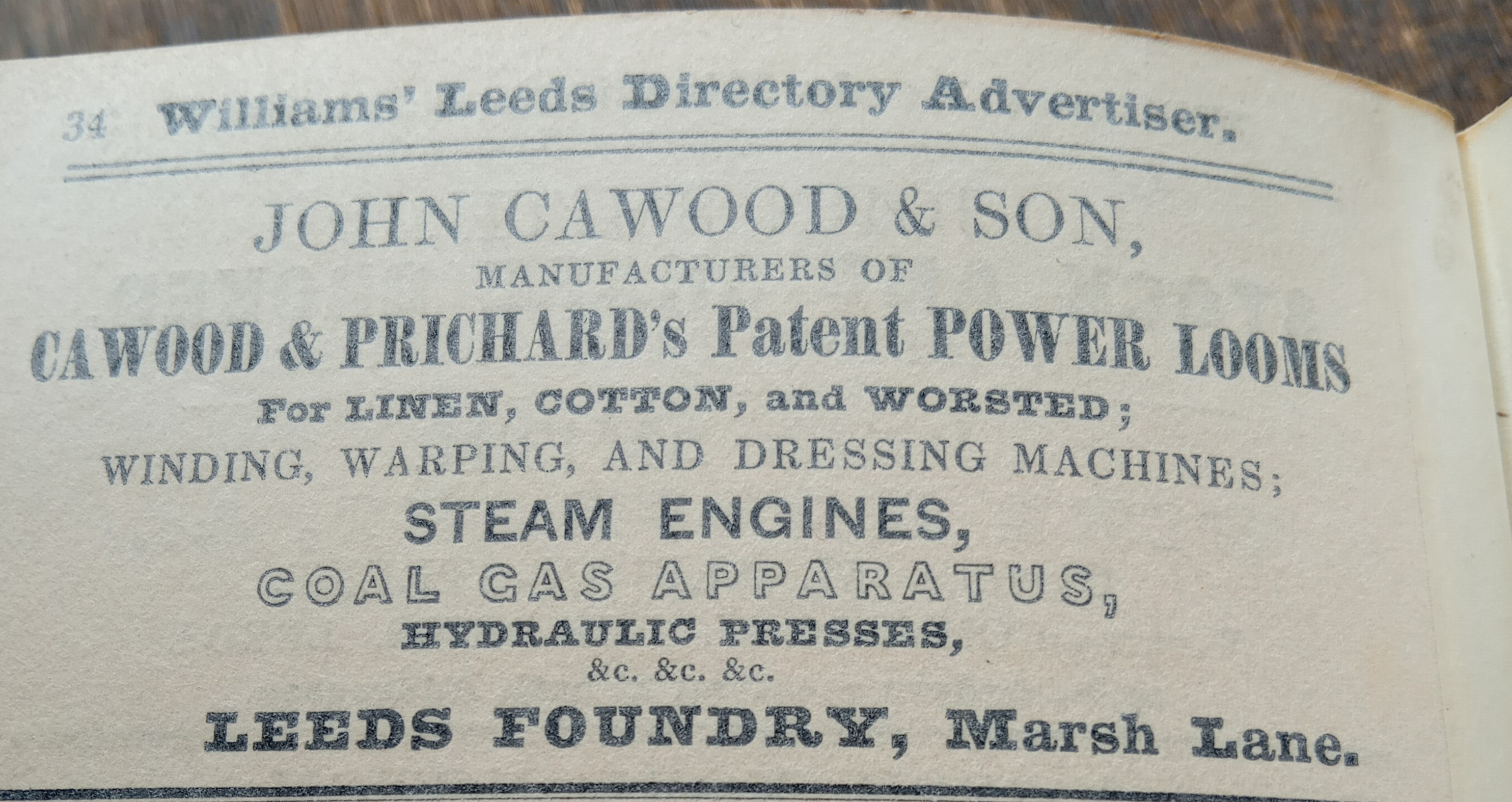
Work was not all they shared, both men were heavily involved in local politics, acting as elected Conservative/Tory Town Councillors for a number of years. John was particularly well known as chairman of the Board of Guardians from its inception to his death in 1846. The foundry was inherited entirely by Martin at John’s death. Sadly, the business was a poor state when Martin took it on, and he was left with no choice but to declare himself bankrupt in 1848. At the time this was reported in the paper being through no fault of his own. Not a man to allow the grass to grow under his feet, by 1850 he had become agent and secretary for the Crystal Palace Leeds Exhibition Committee. His job was three-fold. He publicised the event and collected subscriptions to fund it; he organised the Leeds exhibits; and he publicised it to potential visitors. You can find an article about it here, written by renowned Leeds historian, R J Morris. You may need to register with JSTOR but the article is available for free:
He also wrote weekly accounts of the exhibition from London which were published in the local papers – for an example, see Leeds Mercury 01/03/1851. You can view this article for free using our 19th century newspapers resource for free, either at home or on a library computer.
At around the same time as the exhibition, he took on a role as the secretary to the Leeds, Bradford and Huddersfield railway. At this stage of his life he becomes very difficult to properly track, but in a way I haven’t encountered before – he is CONSTANTLY in the papers! Whether it’s for the railway, the Chamber of Commerce (founding secretary in 1851), the Leeds Musical Union (ditto – remember that?), or any one of many charitable or civic events, Martin Cawood is never out of the Leeds news – I noted his involvement with the Philosophical and Literary Society, the Sir Robert Peel memorial statue, the Wellington memorial statue, the Tradesmens Benevolent Fund, the fund for a public hall, the Holmfirth relief fund. . . His poor family must have never actually seen him. All this seems to stop in around 1861, at the same time as when he stops being mentioned in trade directories. He is still being mentioned in national newspapers though, and in July 1861 an advert appears for the English Opera Company, secretary Martin Cawood Esq, late of Leeds. This was a touring company and Cawood’s name appears frequently in the national press as the contact for the company, as well as seemingly an agent for individual artistes. I have been unable to find the family on the 1861 census, possibly they were touring abroad at the time it was taken.
He was reported missing in early February 1867, after visiting his friend Frederick Buckton in Roundhay. He was working in Bradford and was planning to head back there by train. On Sunday 24th March his body was found in the river at Allerton Bywater. It was presumed that he had been robbed, but subsequent examination showed he had all his valuables on him. The coroner recorded an open verdict as it was by that time impossible to judge what had happened. A couple of days after one could visit Harrison’s photographic studios in Leeds to look at a picture of him, you could even buy a copy to take home at the very reasonable rate of 1s.

Reports of his death were widely syndicated across the press, and the eloquent phrase ‘a man of genial heart and of generous disposition’(1) was often used. Like his father, Cawood was buried at St Matthews in Chapel Allerton in an individual grave. After his death, his wife Sarah (they had married in 1836) and his only son, John, eventually relocated to Scotland. On the 1891 census, John was a theatrical manager, following in his father’s footsteps.
This quest started out as a bid to identify Amelia Smith. We’ve done that and much more. Mid-nineteenth century Leeds might seem like a big place, but time and again we discover just how interconnected the people, businesses and societies are. If we are lucky, in the future more evidence might be unearthed about the connection between the Smiths, the Cawoods and the elusive Youngs. In the meantime, we’ve filled in the background of a very rare item, grounding it firmly in the history of our city.
(1) Yorkshire Post and Leeds Intelligencer 25/03/1867, p 3
 The Secret Library | Leeds Libraries Heritage Blog