This week Librarian Antony Ramm offers a very short tour of Clarendon Road in Little Woodhouse, based on a walk delivered to library staff on Monday November 25 2024. Some of this article and tour is based on information posted in a previous blog post about Little Woodhouse, and relies heavily on details given to the author by Professor Shane Ewen of Leeds Beckett University.
You can also browse a curated Leodis gallery covering some of the sites in the article.
Woodhouse Square
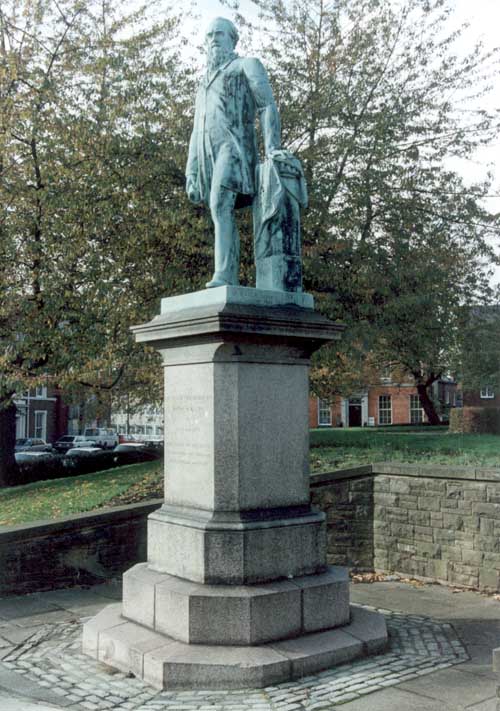
We start our tour with a statue at Woodhouse Square. The man you can see here is Peter Fairbairn, a textile engineer who rose from poverty to become the Mayor of Leeds in the mid 19th century.
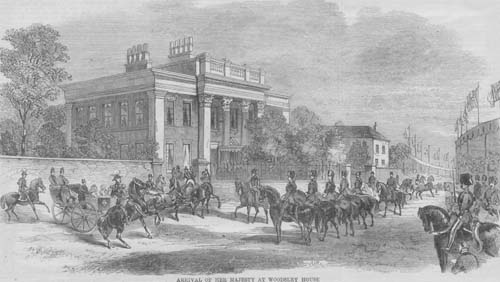
In fact, Fairbairn was Mayor when Queen Victoria arrived in Leeds in 1858 to open the Town Hall, and she stayed overnight at his home prior to the official inauguration. (We’ll see his house further on during the tour). The day after her stay at Fairbairn’s home he was knighted by the Queen in the Town Hall, becoming Sir Peter Fairbairn.
2 Claremont Villas
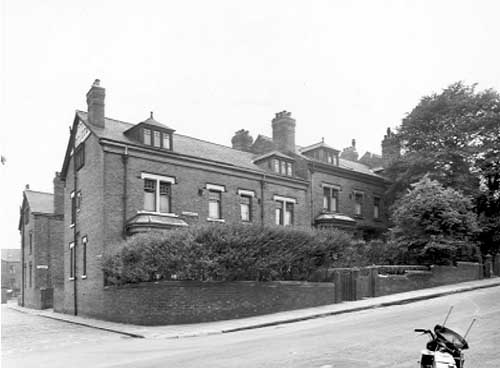
The image above shows the south west side of Claremont Villas off Clarendon Road. The end of Back Claremont Villas can be seen. No 2. Claremont Villas was home to suffragette Leonora Cohen from 1923 – 1936. Her blue plaque reads;
Leading suffragette famous for smashing a showcase in the Jewel House at the Tower of London and for her hunger strike at Armley Gaol in 1913. 1873-1978.
A note tied around the iron bar used to smash the case carried the message
This is my protest against the Government’s treachery to the working women of Great Britain.
In later life Leonora became the first woman president of the Yorkshire Federation of Trade Councils and the following year was appointed a magistrate, one of the first women appointed to the bench. She was a Justice of the Peace for twenty-five years and, by the mid 1920s, had been awarded an OBE for services to public life.
Little Woodhouse Street
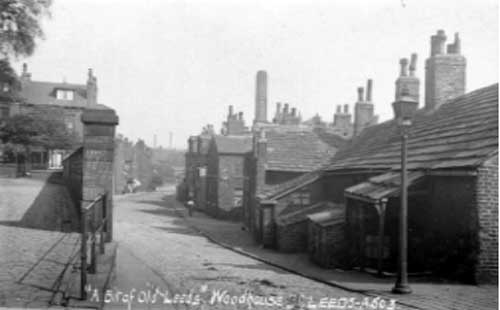
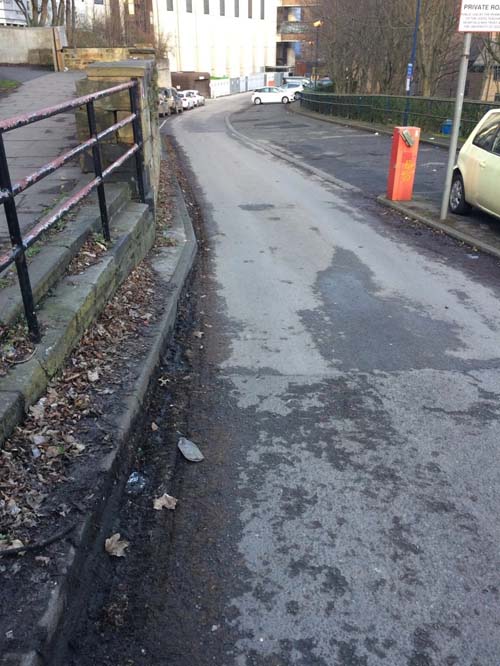
Here we can see the location of cottages that dated back to at least the 17th century and were visible here until at least the 1960s. The Central Library has in its special collections an architectural students’ record of visiting the site in 1965, just before the demolition of the houses, an account containing many fascinating and valuable photographs. Note the direction of the road today, which seems to follow the line of the road in times past, even though almost all other traces of the cottages have long since vanished. (Click on the images below to read the captions for each)
Claremont
Originally an 18th century gentleman’s home, Claremont was later purchased by the 19th century physician and campaigner, John Deakin Heaton. A Blue Plaque in celebration of Heaton’s life can be seen on the current building. Later, Claremont was the home of the Yorkshire Archaeological Society and the Thoresby Society.
Claremont was purchased by Heaton after his wife Fanny told her brother-in-law, John William Atkinson, that John Deakin was willing to pay £2,500 for it – a statement that came as some surprise to Heaton himself! Fanny herself was a notable figure, campaigning on women’s suffrage and education, often alongside her better-known sister-in-law Ellen Heaton. Ellen’s own home (and Blue Plaque) can be seen on the south side of Woodhouse Square at the current home of the Swarthmore Centre for continuing education.
Little Woodhouse Hall
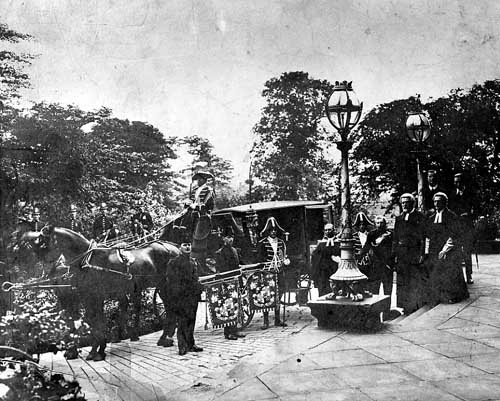
This spectacular house was the home of John and John William Atkinson, landowners who effectively created Clarendon Road and Woodhouse Square through their sale of parts of their estate. John William Atkinson married into the Heaton family mentioned above, a sign of the close connections between members of Little Woodhouse society.
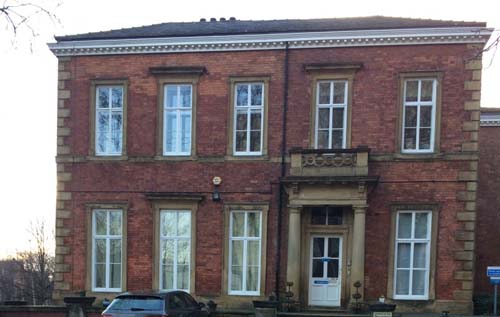
The hall later became known as the ‘Judge’s Lodgings’ – judges visiting Leeds to attend the Assize Court at the Town Hall would stay here.
Hyde Terrace (opposite 31 Clarendon Road)
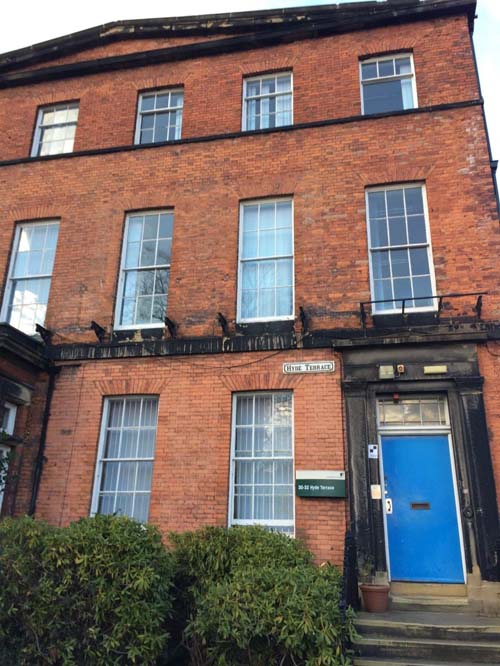
30-32 Hyde Terrace in February 2017. (c) Leeds Libraries, http://www.leodis.net
Looking down Hyde Terrace from the junction opposite 31 Clarendon Road, the viewer can see a row of houses on Hyde Terrace, parallel to Clarendon Road itself. The first of these properties was the home of Edward Baines Junior and his family. Baines was a central figure in the 19th century middle-class elite of Leeds, the owner and editor of the Leeds Mercury, and Member of Parliament for Leeds from 1859 to 1874. Baines was a key figure in the Liberal party circle that dominated Leeds politics throughout much of the 19th century.
67 Clarendon Road
This fabulous building was originally the home of the Headmaster of Leeds Grammar School, after its move to Woodhouse Moor from the town centre in June 1859.
Woodsley House
The home of Sir Peter Fairbairn, where Queen Victoria stayed during her 1858 visit to Leeds.
The house was inherited by Peter’s son Andrew Fairbairn. Like his father, Andrew Fairbairn was Mayor of Leeds and knighted. In another indication of the physical and social closeness of the Little Woodhouse elite in the 19th century: Sir Andrew was groomsman at John Deakin and Fanny Heaton’s wedding.
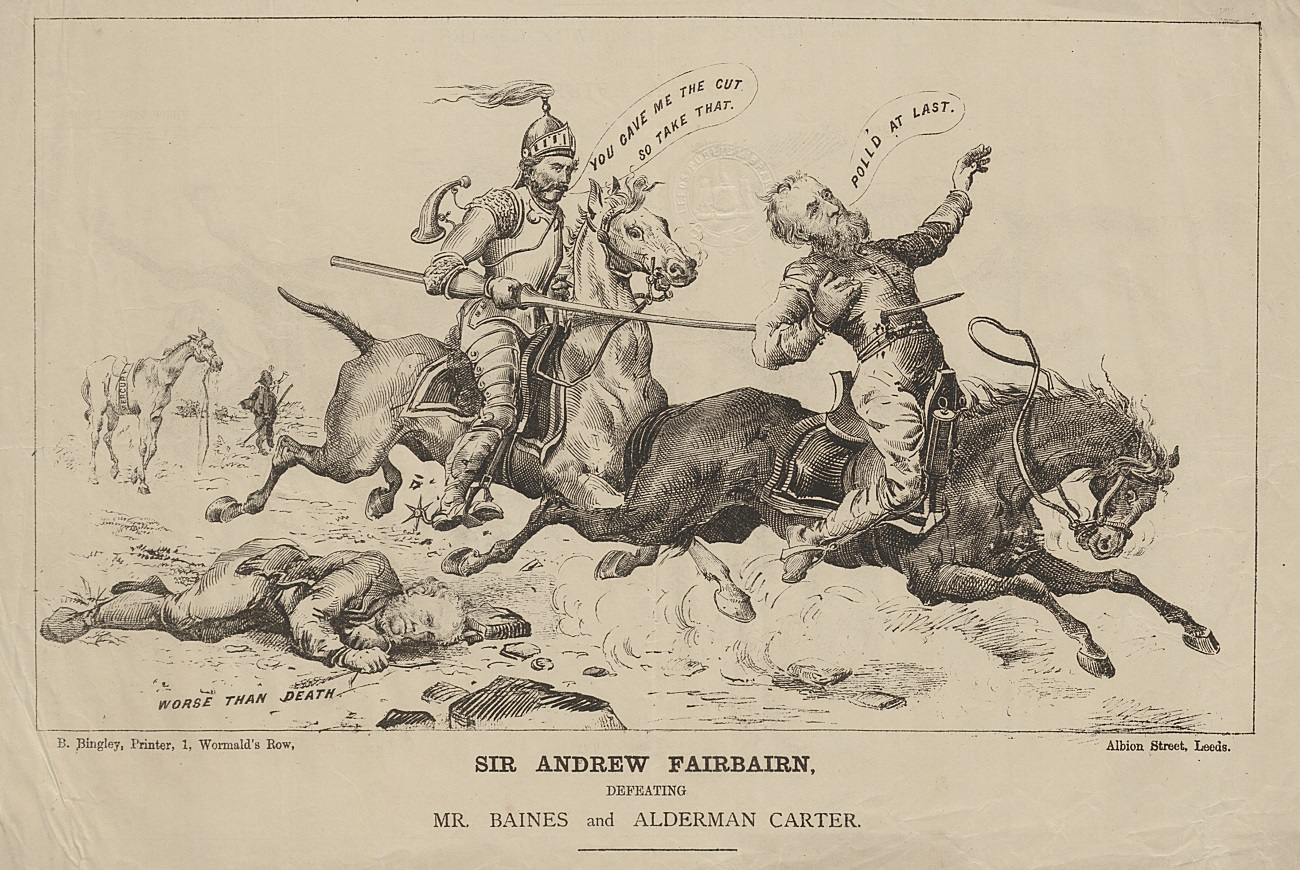
Sir Andrew also had broader political aspirations, standing to be an MP for Leeds in 1868. You can see an image from our Political Cartoons Collection for that election below: here is Sir Andrew apparently ‘defeating’ one of his political rivals, Edward Baines Junior, whose family home we have just seen. Sir Andrew in fact lost the election to Baines. Interestingly, as well as being neighbours, both men were standing for the dominant Liberal party, albeit Sir Andrew was acting independently of the Leeds political machine. (You can read more about this election elsewhere on our blog)
 The Secret Library | Leeds Libraries Heritage Blog
i remember Clarendon Road well from my life in Leeds. The Little Woodhouse end is fascinating. Thanks for the walk.
Thanks for this. Lovely post.
As a thought for future projects, posts like this that were tagged points on a map or a route would be really lovely.