This week we welcome Library and Digital Assistant Sue Stepan for an in-depth look at one of the Central Library’s real treasures – the Gledhow Hall Scrapbook. Sue also reveals a new resource that will prove beneficial to researchers of soldiers and medical staff involved in World War I.
Do you have an ancestor or family member who was wounded during the First World War? If they spent time recuperating at Gledhow Hall Military Hospital, you may be lucky to find a photograph or other information about them in the Gledhow Hall Scrapbook, compiled by Edith Cliff, Commandant of the hospital. Alternatively, if your ancestor served as a Voluntary Aid Detachment nurse at the hospital, you may find her named on here too.
One of the most interesting items among our Central Library’s treasures, the scrapbook contains photographs, newscuttings, letters and other ephemera, providing a fascinating insight into life during this turbulent time.
Many of the soldiers and nurses shown in the photographs are named, and I have spent some time going through the scrapbook and compiling the names into an alphabetical index of all those featured. (Please contact us if you wish to access this index). Also included in the index are other items which feature names such as concert programmes, sporting events, newspaper cuttings of award winners, cartoons and drawings by some of the soldiers and even a scorecard for a whist drive.
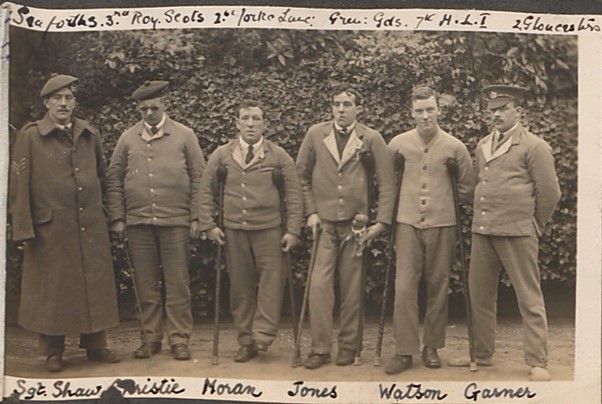
The amount of information given varies, but is often just a surname, with occasionally the rank (officers were not sent to Gledhow so the ranks are mostly privates with a few sergeants and corporals or lance corporals). Sometimes we may be lucky to also find a first name or initial, or the regiment to which they belonged. The photo below (page 57) gives names along the bottom and their regiments across the top; the soldier on the left is named as Sergeant Shaw, but no rank is given for the others so they can be assumed to be privates.
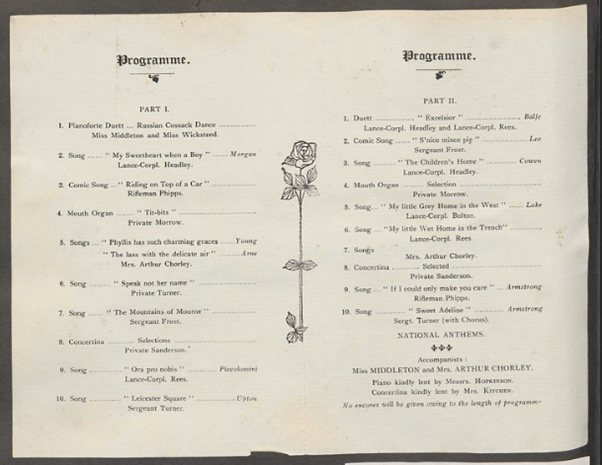
In addition to photographs there are also several concert programmes scattered throughout the scrapbook, showing entertainment put on by the nurses and soldiers on various occasions. This one appears on page 32:-
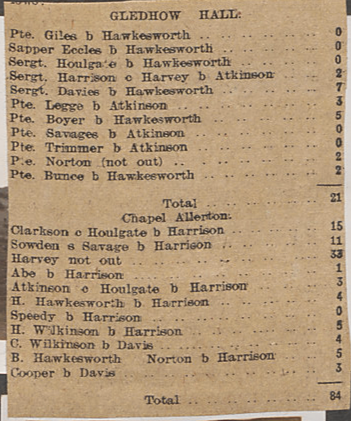
Sporting events were also an important part of life at Gledhow Hall as seen by this scorecard from a cricket match against Chapel Allerton (page 47), unfortunately not a good result for the patients of Gledhow. A newspaper report of the match on the same page says that Sergt. Harrison “is a lively cricketer in more ways than one, and his lusty shout ‘Come on’ was heard several times during the afternoon”.
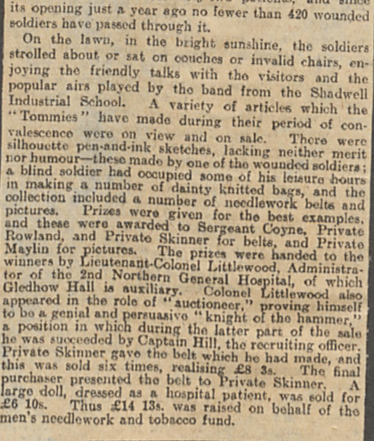
Others succeeded more at needlecraft – the following newspaper article (page 81) highlights those who received prizes for their work:-
This list of patients at the opening of the hospital in 1915 (page 196) is very informative, giving not only the surname and sometimes the initial, as well as the rank and regiment, but it also gives details of the injuries sustained by the soldiers:-
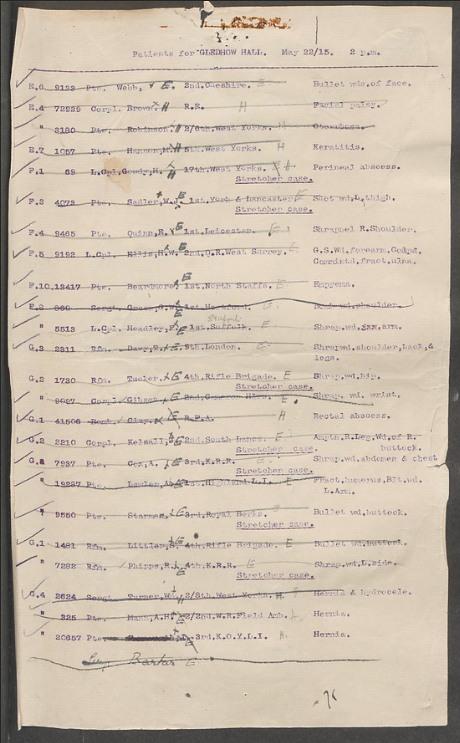
Some names crop up frequently; the most commonly occuring name is Rifleman Richard Phipps, one of the earliest patients, who appears 14 times, while Sergeant Shaw appears 12 times and Rifleman “Jock” Littler and Private Christie get 10 mentions each.
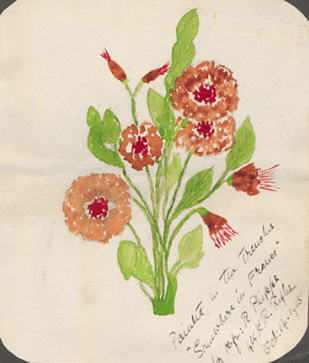
This is a drawing by Rifleman Phipps sent after he left the hospital and returned to the front (page 57).
Private Christie of the Royal Scots Regiment (no first name or initial given), another frequently appearing soldier, seems to have been something of a character; he suffered an eye injury and is mentioned in a rhyme by Edith Cliff (The Gledhow Hall War Nonsense Alphabet, page 68):
C is for Christie, he can’t see very far
But he smokes every evening a big fat cigar
Many of the soldiers are not local but from all over the British Isles; there are several from Scotland, (including Lance Corporal Headley of the Seaforth Highlanders and Corporal Gibson of the Cameron Highlanders), or Wales (Private Jones of the 1st Welsh Regiment).
There are some notable local ones though, including Harold Baxter, from Burley, who was known as the “Soldier Poet”; he is mentioned in a newspaper article (page 133), though he does not appear named in any of the photographs. A dentist before the war, he was awarded the Distinguished Conduct Medal for bravery. He may not have achieved the fame of Wilfred Owen for his poetry but seems to have been something of a local celebrity.
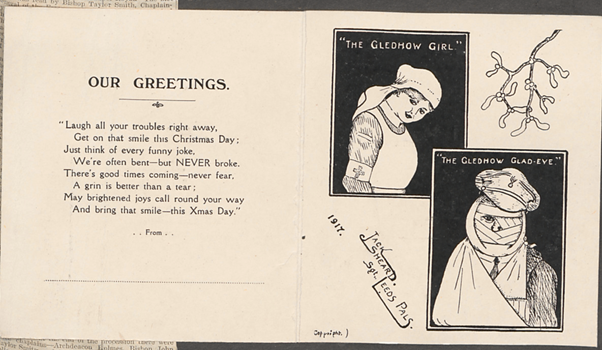
Other names from local regiments include Private Glew, Lance Corporal H Gowdy, Private M Hannon, Private Robinson and Sergeant William Turner (West Yorkshire Regiment), Private W Moran, Private W J Sadler and Private Smith (York and Lancaster Regiment), Sergeant Jack Sheard (Leeds Pals) and Private A H Mann (West Riding Field Ambulance).
This is a Christmas card sent by Sergeant Sheard in 1917 (page 150):
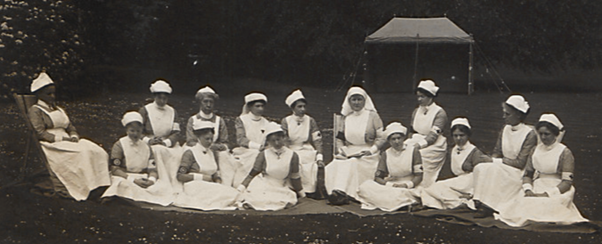
Many nurses appear in the photographs and are also named. Apart from Edith Cliff, who appears so often (on almost every page) I have left her off my index, the most frequently named nurse is Sister Lilian Ruscoe who is mentioned 10 times, while Nurse Edith Firth appears on 9 occasions. Other notable nurses include Olive Middleton (nee Lupton, great-grandmother of Catherine, Princess of Wales), who appears in a few photographs, including this one (page 29) where she can be seen second from the right.


It is worth mentioning that the uniform the wounded soldiers are wearing is the special uniform provided for the wounded and convalescent; grey with yellow lapels.
What a brilliant archive.So much hard work and dedication to the history of Gledhow Hall
I had a grandfather who served in the First World War,. He was killed at Gallipoli 1915.
Sue Itzinger
How amazing to have all of this, so fascinating! Thank you for sharing.