This week Librarian and Digital Assistant, Alexandra Brummitt, takes a look at how Victoria Square was used during the Second World War.
Over the past century the space outside Leeds Town Hall has been used for everything from memorials to protests to Christmas markets. During the Second World War this space was bustling with activity to raise morale in Leeds and raise funds for the war effort. This series will look at how the space was used during the War, the different fundraising events that took place in this space, and how Leeds managed to raise tens of millions for the war effort.
The Early Days
When the First World War started, a war on this scale had never been seen before. With the war lasting longer than planned and constant technological developments being needed to fight, effectively this war was set to be one of the most expensive that Britain had ever seen. To gain the funds that were needed the government established a National War Savings Committee in 1916. It encouraged the formation of local savings committees and introduced war savings bonds. When the Second World War started in 1939 the committee was re-established, and they came up with the idea of creating local savings weeks to not only push people to give money but to also show them why it was so important.
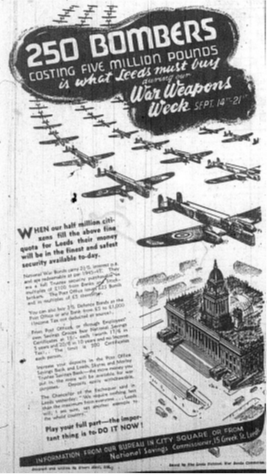
War Weapons Week
The first fundraising event was called ‘War Weapons Week’ and for most of England took place between 8th and 13th April 1941. Leeds, however, was the first city to host this event between 13th September and 20th September 1940. The goal was to raise a total of £5 million to buy 250 bomber planes for the war effort, in the end they raised a total of £3,741,410. While the city fell short of their £5 million goal this event was not a failure. The original goal for the city was set at £2 million by the National Savings Movement in London, the target was changed later by the local committee. The event included several exhibitions across the city, several speeches given by special guests and a cinema van that was located in Victoria Square.

The event was opened on 13th September 1940 by Sir Kingsley Wood, the Chancellor of the Exchequer. A ‘barometer’ was erected in City Square and remained there throughout the week to display how much money the city had raised. This is the only fundraising event to have not used the steps of the Town Hall as the main staging area. There is no explanation as to why later events were not also staged in City Square, but with such large crowds attending all these events, it would be safe to say that the space changed to fit demand.
After giving an address in City Square about the importance of every person doing their bit for the war effort, the Chancellor then opened a war photograph and poster exhibition at Leeds Art Gallery. At this event Mr Charles Brotherton (the same Brotherton as the Brotherton Library at Leeds University) gave the Chancellor an interest free loan of £250,000, separate from the city’s fundraising efforts. Donations such as this, from wealthy individuals to the Chancellor, were very popular, especially during events such as this one.
The second day of the event had a speech from Princess Mary, the Countess of Harewood, as she opened an exhibition in Lewis’s Store on the Headrow, that was dedicated to the Auxiliary Territorial Service (ATS). She thanked the service for all the hard work that they were doing and stressed the importance for everybody to do their bit for the war effort. Whether that be volunteering to join the ATS or donating during events like War Weapons Week. She led by example during her time in Leeds and the day before, during the speech given by the Chancellor, the princess pulled out her knitting to knit jumpers that would be donated to the Red Cross and be sent to British Prisoners of War.

The weekend contained multiple events, including performances from the Royal Corp of Signals in City Square. On the Sunday a parade of serving troops made their way through the city. The parade assembled on Regent Street and passed through City Square and Victoria Square before saluting to the Lord Mayor of Leeds and General Sir Ronald Forbes Adam outside the Civic Hall, before proceeding onto Woodhouse Moor where they were dismissed. The parade was led by military regiments including West Yorkshire Regiment, the RAF, Royal Artillery, the Home Guard and various cadets. They were followed by civil defence units such as the Women’s Voluntary Service, Air Raid Wardens, the Auxiliary Fire Service and Ambulance units. People were so excited to see the parade that streets were filled with spectators and people even watched from roof tops and high windows of nearby buildings.
On the penultimate day of War Weapons Week, the 19th September, an impromptu display of fighter planes occurred when a flight of aircraft swooped low over the city. Many people gathered in public spaces in Leeds to watch this impressive display of planes diving and rolling above the city. This display showed the people of Leeds how their money was being spent and encouraged many last-minute donations.
Realities of a ‘total war’
By early 1941 the blitz was at its peak, with the heaviest bombing occurring in Leeds on 14th and 15th March 1941. Just a few months after War Weapons Week, disaster struck Victoria Square. The Town Hall was hit and badly damaged during the Blitz. The spirit of War Weapons Week had not died in the city of Leeds though, and many citizens leant a hand to fix the impressive structure and cleared the destruction from Victoria Square.

The space outside the Library and Town Hall was not only used to host large events. In December 1941 construction began on three large static water tanks that were located in the square until the end of the war. These tanks were placed across the city and their purpose was to store water that could be used by the fire service in the event of bombing, specifically incendiary bombs that would catch fire upon impact.
Read Part 2 of Victoria Square and War Time Spirit.
 The Secret Library | Leeds Libraries Heritage Blog
War is very expensive in many ways – human misery, destruction and maiming of lives, destruction of private and civic structures. The cost in human labour is high. Best avoided. I’d say there’s better things to do and to spend your money on (unless there is an ineluctable need).
Hardly likely to be ‘a flight of fighter jets’! Not in 1940.
Thank you – we’ve amended the wording now.
Best wishes
The Secret Library Leeds, Leeds Libraries