In this second part Librarian and Digital Assistant, Alexandra Brummitt, takes a look at how Victoria Square was used during the Second World War. Read Part 1 here.
Over the past century the space outside Leeds Town Hall has been used for everything from memorials to protests to Christmas markets. During the Second World War this space was bustling with activity to raise morale in Leeds and raise funds for the war effort. This series will look at how the space was used during the War, the different fundraising events that took place in this space, and how Leeds managed to raise tens of millions for the war effort.
To Save a Ship
In 1941 the second fundraising event was announced, Warship Week. A week to raise money to improve Britain’s warships. Local committees were encouraged to ‘adopt’ a warship to raise money for the war effort, Horsforth for example adopted the HMS Aubrietia. In November 1941, Leeds adopted the Ark Royal ship, and set the target of £3.5 million to raise money to improve the hull of this ship. However, only days after the announcement was made, the Ark Royal was sunk in the Mediterranean. Leeds was not disheartened and instead changed their goal; their new aim was to raise £5.2 million to replace the ship entirely. This meant that in Leeds, Warship Week became known as Ark Royal Week.
Ark Royal Week

The week was opened on 31st January. Each day of the week had a different theme, this would determine the guest speaker and which troops would march in the parade. Day one was Navy Day, and the guest speaker was Admiral Sir Thomas Spence Lyne, who also set the target indicator. The event started off a roaring success with over £2 million being raised on the first day. The opening of this week also saw a temporary exhibition of naval photography open at Leeds Art Gallery.
Other days through the week included Army Day, Royal Air Force Day which included an air show, Civil Defence Day in which air raid wardens, members of the Women’s Voluntary Service and the home guard marched in the parade.
The most popular day of the week was on the 6th February, which was also Allies Day. The guest speaker on this day was Charles de Gaulle (leader of the free French forces) and over 25,000 people filled Victoria Square, Victoria Gardens and the Headrow to hear him speak. He delivered his speech in French with an English interpreter. General de Gaulle thanked the ‘beautiful and great industrious city’ of Leeds and the people in it. He then set the indicator on the Town Hall steps to a whopping £7,500,287, which was almost £2.5 million more than the original target.
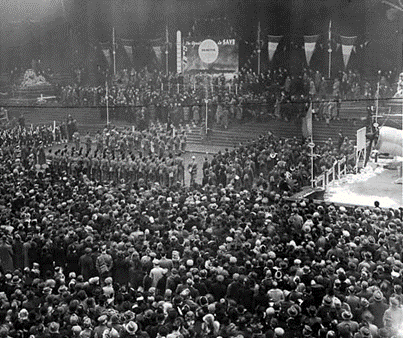
The picture above shows Charles de Gaulle giving his address. You can see on the steps of the Town Hall are free French civilians. In the far left of this picture is a Polish forces band. In the centre is a Free French band and to the right is a Signals band. Between the bands are free French forces.
The following day and final day of the event was Women’s Day. The speaker of honour was the Princess Royal and Countess of Harewood, Princess Mary. During her visit the Princess also donated a mobile kitchen to the women’s section of the British Legion. The purpose of this was to provide hot meals to air raid victims who had found themselves homeless.

With most of the men in Leeds off fighting on the front lines, women had become invaluable to the war effort on the home front. During the parade, members of the Women’s Auxiliary Air Force (WAAF), the Women’s Voluntary Service (WVS), Air Raid Wardens and members of the Auxiliary Territorial Service (ATS) proudly marched through Leeds and saluted the Princess Royal upon reaching Victoria Square. In the picture above you can see members of the WAAF as they make their way down the Headrow. As Leeds was one of the larger industrial cities, thousands of women went to work in factories to help the war effort. Even newspapers realised that women were some of the most vital players on the home front with most adverts in local newspapers urging women to ‘do their bit’ by saving every penny they could and donating it to this cause.
Schools in Leeds also contributed massively to the Ark Royal Week fundraising campaign. The children of Chapeltown School raised £333 in the first few days of the event and a further £313 by 6th February. Roundhay High School (girls) raised over £11,000 for the campaign. Due to the combined work of the people of Leeds this event managed to raise a grand total of £9,301,293 during this week. In today’s money that is over half a billion pounds.

Churchill in Leeds
On May 16th 1942, Winston Churchill, the Prime Minister of Great Britain at the time, visited Leeds as part of tour where he visited large industrial cities that were vital to the war effort. While I was unable to find an exact number of how many people went to see Churchill speak on the steps of the Town Hall, the Yorkshire Evening Post reported on the event saying that it was ‘a crowd such as rarely has been seen in Victoria Square’. Children were sat upon the stone lions on either side of the Town Hall steps to get a better view of the Prime Minister talking. In his speech, Churchill said he was visiting to “bring to the citizens (of Leeds) a word of thanks and encouragement in all the work which they were doing to promote the common cause of many nations”. He paraded through the entire city and was greeted by streets full of people desperate to see the very popular war-time Prime Minister. Churchill was joined by Dr Evatt, the Australian Foreign Minister, who was also very complimentary to the city of Leeds. In his speech he said “I want to congratulate the people of this city on their magnificent turn out this morning. I have seen nothing more touching and more impressive than the children of this city, and the welcome they have given your Prime Minister.”
Read part 3 of this series here.
 The Secret Library | Leeds Libraries Heritage Blog
Amazing people, amazing stories. Thank you so much for sharing.