In the third part of this series, Librarian and Digital Assistant, Alexandra Brummitt, takes a look at how Victoria Square was used during the Second World War. Read part 1 and part 2.
Over the past century the space outside Leeds Town Hall has been used for everything from memorials to protests to Christmas markets. During the Second World War this space was bustling with activity to raise morale in Leeds and raise funds for the war effort. This series will look at how the space was used during the War, the different fundraising events that took place in this space, and how Leeds managed to raise tens of millions for the war effort.
Soaring high
After the great success of Ark Royal Week, it was expected that Leeds would be extremely successful when the next savings week, named Wings for Victory, was announced in 1943. Wings for Victory weeks started across the country on 6th March 1943. Leeds was among one of the final cities to hold a Wings for Victory week. By the time Leeds had opened their savings week the country had already raised over £600 million for the campaign, which was significantly higher than the £545 million that was raised during Warship Week the year previous. In addition to this between 1st January and 19th June 1943, small savings bonds in Britain had raised £418 million, which was £83 million more than during the same period in the previous year. The goal for Leeds was to raise £5,000,000 to buy new fighter jets for the war effort.
Speaking at the opening ceremony Lord Kindersley, President of the National Savings Committee, stated that “to accomplish the final triumph I look to Leeds and Birmingham.” This led to a friendly rivalry between Leeds and Birmingham (a city with twice the population of Leeds at this point) to see which city could raise more money per person. Major W. Morris (formally Regional Saving Commissioner) spoke in Middleton on the first day of the event and said “In raising this money you are not only helping to bring the war to a speedier conclusion, but you are helping the government to build up a vast reservoir to help make a new world after the war. It is your job and my job to see that God’s gifts are placed within the reach of all people after the war.”
Wings for Victory week

An exhibition of a Lancaster bomber and Anson training plane was held near Leeds bus station throughout the week. A fighter plane was on display for the whole week in Victoria Square attracting crowds of thousands. There was also an RAF exhibition, and an exhibition of photographs by the Yorkshire Post, held at Leeds City Art Gallery throughout the week. This exhibition showcased over 3000 photos. In the Yorkshire Evening Post, when detailing the exhibition, it quoted that the purpose of it was to “enable them [people of Leeds] to appreciate more fully the essentials for an efficient air service”. There were also daily military bands and parades as well as a daily ceremony where an honoured guest would move the fundraising indicator.
The first day of the event was a great success, with over 3000 people participating in the initial parade and a total just shy of £2 million being raised. While this was not as much as had been raised on the first day of Ark Royal Week, it was very close. Hopes were high that this event could still beat the £9 million raised during Ark Royal Week. The first few days saw many positive speeches, talking about the benefits of this savings campaign. One speaker pointed out that during in 1943 it had only been 40 years since “man had first flown a plane” and in order for Britain’s air force to match Germany’s, they needed fast technological advances, which this money would provide.
The 30th June was perhaps one of the cutest days of the event. The day was ‘Children’s Day’ and aimed to highlight the amazing work of some of the children in Leeds. During all of the fundraising weeks, schools played a vital role, raising sometimes thousands from just one school. In addition many children spent a long time without fathers as they were at war, and had to help out with the war effort. Older children joined the scouts or guides and would help with Air Raid Precautions and first aid after air raids. The day was opened by 250 school children singing patriotic songs on the steps of the Town Hall. Doris, aged 12, spoke on behalf of the 30,000 schoolgirls in Leeds and Colin, aged 13, spoke on behalf of the 30,000 schoolboys in Leeds, both children had fathers serving in the Air Force. They then raised the indicator to £3,856,628.
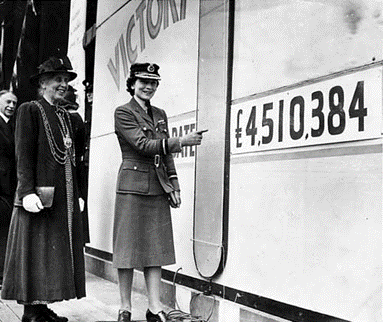
The Duchess of Gloucester, Princess Alice, visited Leeds and opened Women’s Day. She was the head of the Women’s Auxiliary Air Force (WAAF), who had 182,000 members by 1943. These women had various roles aiding the Air Force and were an integral part of the war effort. Conscription for women was introduced in late 1941 and all unmarried women were required to join the armed forces, work in factories or join up to work on farms as members of the Land Army. The parade on this day included members of the WAAF, Land Army, the Auxiliary Territorial Service (ATS), the Girls Training Corps and the Women’s Voluntary Service (WVS) to name a few.

One of the final days of the event was ‘United Nations day’. This day was opened by King Peter of (the former) Yugoslavia, today it is the countries of Bosnia and Herzegovina, Croatia, Macedonia, Montenegro, Serbia, and Slovenia. He was greeted by a warm welcome and large crowds in Victoria Square. The bands of the RAF and the York and Lancashire Regiment played the Yugoslavian national anthem to welcome the King to the steps of the Town Hall. He then gave a speech thanking the people of Leeds for their contributions to the Wings for Victory campaign, stating that it “will not only defend the British skies but will dominate enemy skies and so shorten the war and bring the peace which the enslaved nations are eagerly awaiting.” By this point Yugoslavia had been captured by Germany for just over 2 years.
A disappointing result
Despite raising a total of £7,206,768 during Wings for Victory week many were disappointed by the final figure. The MP for Central Leeds blamed luxury spending from Leeds citizens as the fault for the target not reaching the same levels that it had during Ark Royal week.

It is hard to believe that anyone would be disappointed by surpassing a target by over £2 million, however that was the case throughout Leeds’ Wings for Victory week. On the second day of the week, an appeal in the Yorkshire Evening Post said that some citizens had “failed to do their share” (as seen in the picture above). While the second day totals were very impressive, they were £325,475 short of what the city had managed to raise by that point in Warship Week 16 months prior. Sir Charles Davies, who made this comment, was the chairman of the Leeds National Saving Committee. In his speech he then went on to say that not only had some people failed to do their share but some “have done practically nothing at all”.
In the lead up to the event many had said that they believed that Leeds would be able to beat the £9,300,000 raised during Warship Week as no large savings campaigns had taken place during that time and average income in the city had increased. In a speech given by Lord Kindersley on the opening day of the event, he stated that he was sure that Leeds would be able to pass the amount that they had raised during the previous savings campaign. When speaking at the second day of the event Air Chief Sir Robert Brook-Popham suggested that Leeds should raise their target to £10 million. (He also released a pigeon with the news of how much had been raised to the RAF, which is definitely an unusual form of communication.) With such high expectations the total can be seen as disappointing, however, by the end of the war Britain had arguably the best Air Force in the world and the people of Leeds definitely did their bit.
 The Secret Library | Leeds Libraries Heritage Blog
A fascinating series that looks at part of the war effort that is often overlooked. People were struggling during those years and still gave everything they had.
Very interesting but how did they get a Lancaster bomber to the bus station? Maybe they took the wings off.
What an extraordinary , spectacular and unique place the City of Leeds is . There is nothing it cannot achieve with its people so united .