This week we welcome back Library and Digital Assistant Jan Pinder, who finds the answer to a question in the artistry of a local legend…
Why was the newest Wetherspoons in Leeds named The Golden Beam? Opened on June 8 2021 it seems a curious name choice for a pub, particularly considering that many of the chain’s bars in the city are named after local dignitaries. We have The Hedley Verity in Woodhouse Lane, Becketts Bank in Park Row and The Cuthbert Brodrick which overlooks Millenium Square, so why The Golden Beam? A conversation with a friend on this question led to a little research, which in turn revealed that it was in fact named after a painting called A Golden Beam by the Leeds artist John Atkinson Grimshaw, who painted a number of works in the North Leeds suburb of Headingley during the late nineteenth century.
Located on Headingley Lane, the building itself has had a varied history. A plaque just inside the doorway tells us that it is a grade II listed building of architectural interest constructed of white Portland stone in a mixed style of English revival and art deco.
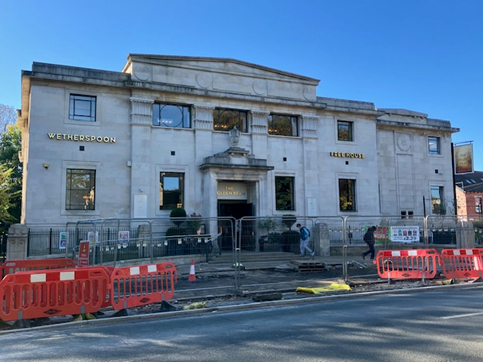
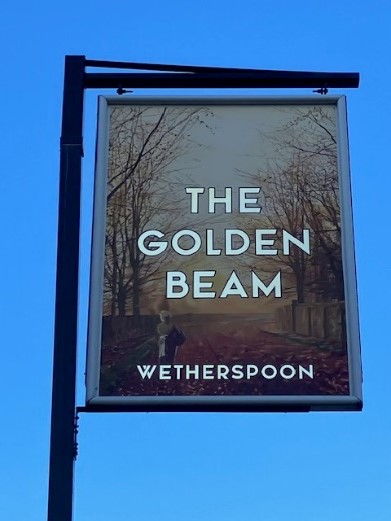
The building was originally a Sunday School from around 1912 to 1914 and was extended in the 1930s to add a church building. It was then used by Leeds Girls High School as a theatre and music centre from 1986 to 2010. They named it after Elinor Lupton (1886 – 1979), a former Lady Mayoress of Leeds. From 2010 to 2021 the building was unoccupied.
On discovering that The Golden Beam was named after a work of art by a prominent local artist I was intrigued to find out more about both the painting and the artist. A search of the Leeds Central Library catalogue revealed a range of resources relating to the life and work of John Atkinson Grimshaw, including books available for loan and rare items from our Special Collections. A detailed research guide produced by the Art Library outlines the available stock.

A good starting point proved to be John Atkinson Grimshaw by John Atkinson Grimshaw (ST 759.2 GRI ), published in 1998 to coincide with an exhibition of the work of the artist and his son at Leeds Art Gallery and edited by Richard Green. With an introductory essay by Alexander Robertson, this book provides lots of interesting biographical information, besides a detailed catalogue of works, and forms much of the basis of this post.
John Atkinson Grimshaw (1998 ) by John Atkinson Grimshaw (ST 759.2 GRI )
Search Results for john atkinson grimshaw (sirsidynix.net.uk)
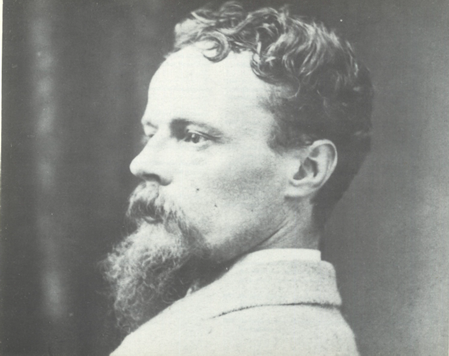
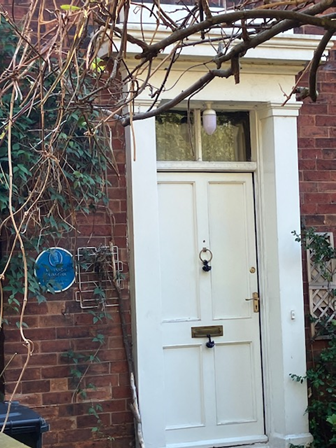
John Atkinson Grimshaw was born on 6 September 1836 at Back Park Street in Leeds, the son of David Grimshaw, a policeman. He first worked as a railway clerk, painting only in his spare time, before giving up his career with the railways and devoting himself to painting at the age of twenty five. He received no formal training, but chose to study directly from nature and was attracted to the methods and style of the Pre-Raphaelite Brotherhood. Success enabled Grimshaw and his family to move to Headingley and there is a Blue Plaque on the front of the house in Cliff Road where they lived during the 1860s.
By 1870 Grimshaw had become successful enough to move to Knostrop Hall on the Temple Newsam Estate, a stone built manor house dating from the early seventeenth century. He painted Knostrop Hall, early morning to celebrate his family’s new home and posterity. It proved to be a favourite subject in his work of the time and was to feature in many of his paintings.
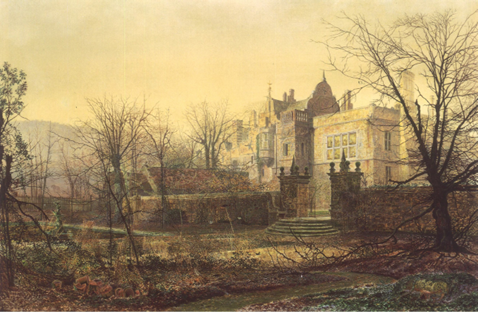
John Atkinson Grimshaw ( 1998) – Atkinson Grimshaw ST 759.2 GRI
Search Results for john atkinson grimshaw (sirsidynix.net.uk)
However, it was Headingley, a well-to-do suburb of Leeds at the time, which inspired much of Grimshaw’s best work and he painted a number of views of the area. In many ways A Golden Beam is typical of this work, depicting a lone figure on a tree lined, twilight suburban street and featuring a grand house in the background.
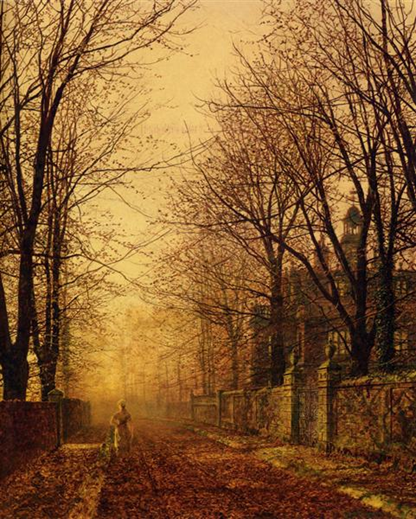
Grimshaw was to become famous for these leafy suburban lane scenes, often in twilight or moonlight and with the dark silhouettes of trees adding to the air of mystery. There is a calm beauty to these paintings, with Grimshaw’s use of colour and light creating an atmosphere unique to his work. Many of these works feature the solitary figure, often a maid, as in A Golden Beam. The viewer is drawn to this figure and curious to know their story. Who is she and why is she alone in the street at this time?
A similar work is Golden Light, which shows the same leafy lane, solitary figure and atmospheric beauty.
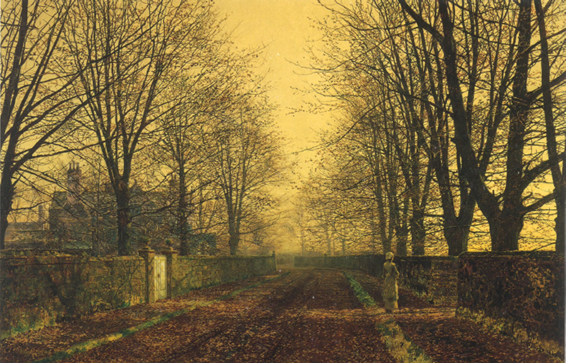
John Atkinson Grimshaw ( 1998) – Atkinson Grimshaw ST 759.2 GRI
Search Results for john atkinson grimshaw (sirsidynix.net.uk)
This time the figure is turning away from the house and the gates are firmly shut, perhaps hinting at a lost home or a new beginning. Richard Green notes that the figure of the young woman adds an element of uncertainty to the tranquil beauty of the work, as she appears lost in private thought.
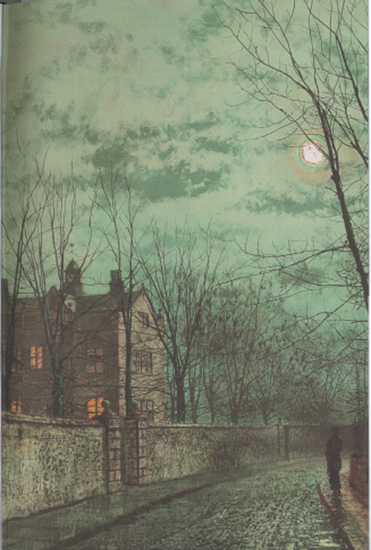
Many of Grimshaw’s moonlit paintings also share these themes and qualities, such as Under the Moonbeams. In The Lighted Window; Evening Walks Remembered (2021, 709.94), Peter Davidson (p.17) notes that ‘
the figure of the rejected lover or the unfortunate outsider, contemplating the lighted house from which they are excluded, recurs often in Victorian poetry and painting.
This interesting book looks at the interpretation of the lighted window in literature and art, and the feelings that this evokes on walks through nocturnal cities. Davidson recognises that
the lonely figure in the cold or rainy street, the lighted windows of substantial villas or mansions behind garden walls, bare trees and evening sadness are the chief subjects of the coarsely executed, emotionally powerful paintings of John Atkinson Grimshaw.
The Lighted Window: Evening Walks Remembered ( 2021 ) – Peter Davidson 709.94
Search Results for john atkinson grimshaw (sirsidynix.net.uk)
Davidson also notes that the eye is inevitably drawn to the one lighted window in the villa behind the wall in Under the Moonbeams and questions why the lone figure is out so late and what their relationship is to the house they are looking at. He sees the positioning of the viewer as an unwanted spectator, as the woman is unaware that she is being observed, and feels that often these paintings address the experience of an outsider wondering what it might be like to live in such an unknowable place.
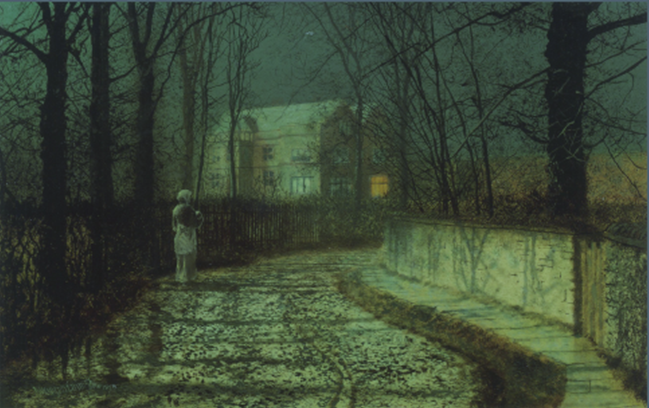
Another moonlit suburban lane is depicted in A moonlit street, which again shows a solitary female figure this time possibly a maidservant carrying a load, but again with a lighted window in the background. It is thought that the house in the background may be Knostrop Hall.
John Atkinson Grimshaw ( 1998) – Atkinson Grimshaw ST 759.2 GRI
Search Results for john atkinson grimshaw (sirsidynix.net.uk)
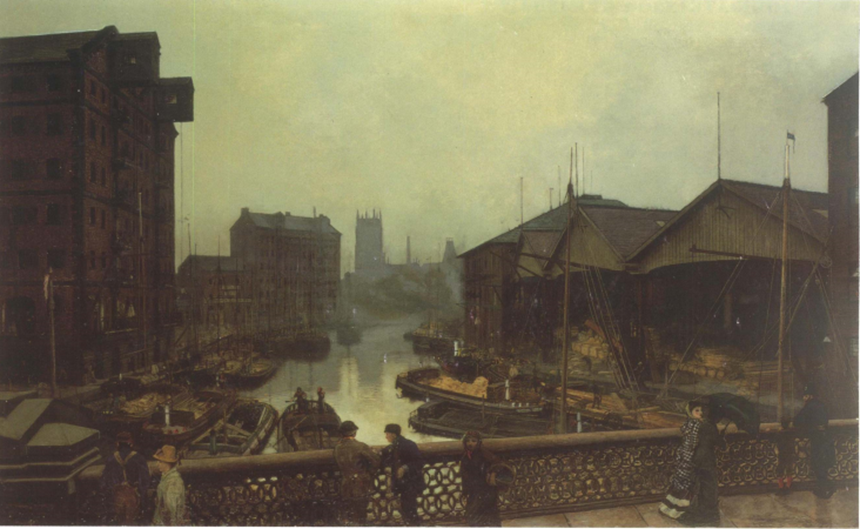
During the 1870s Grimshaw had developed the stylistic methods and techniques that characterise much of his best work. Whilst these included his twilight and moonlit scenes, they were later extended to atmospheric views of dockyards, towns and cities. City views were an important subject to him and one of his greatest efforts is Leeds Bridge.
John Atkinson Grimshaw ( 1998) – Atkinson Grimshaw ST 759.2 GRI
Search Results for john atkinson grimshaw (sirsidynix.net.uk)
Leeds itself features in several of Grimshaw’s paintings and reflects both contemporary life and the changes taking place. This painting shows us the river traffic, bringing goods directly into the centre of the city. The view looks down the River Aire towards the church of St Peter and shows some long demolished warehouses and the vanished busy traffic of barges. This is complemented by the people, showing a spectrum of Leeds society at the time. We see a snapshot from the past, with elegant ladies, workmen and the constable and boy stopping for a chat. It is interesting to compare this work to the view from the same position on Leeds Bridge today.
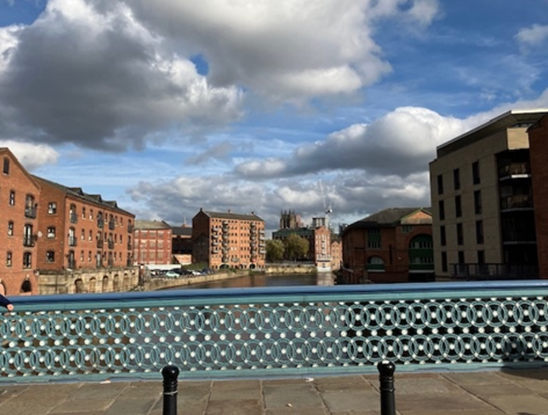
Although there are some recognisable buildings, such as St Peter’s church and the warehouse to the left (now converted into flats) and the railings also remain, there are few similarities. We can no longer see the many barges which would have carried goods down the river, the only traffic now being the odd water taxi. Grimshaw also painted many other cityscapes in cities such as London, Edinburgh and Newcastle.
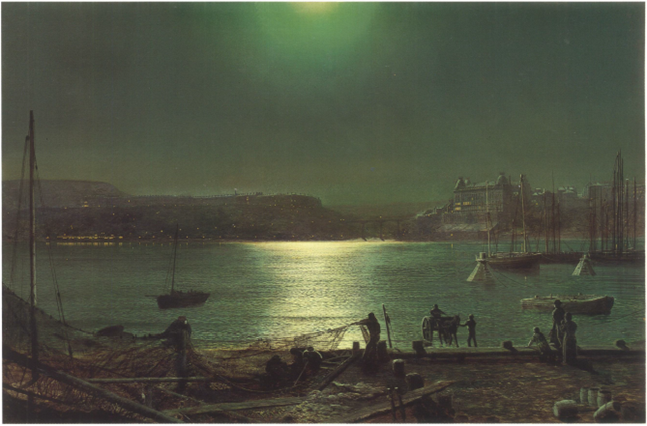
Another popular subject for Grimshaw was Scarborough Bay, which was the location of Castle-by-the-Sea, the seaside home he leased around 1876 and which today is run as a Bed and Breakfast.
John Atkinson Grimshaw ( 1998) – Atkinson Grimshaw ST 759.2 GRI
Search Results for john atkinson grimshaw (sirsidynix.net.uk)
Grimshaw died at Knostrop Hall in 1893 and was buried in Woodhouse Cemetery, now St George’s Field and part of the University of Leeds. Three of his sons, Arthur, Louis and Wilfred and his daughter, Elaine, also became painters. He left behind no letters, journals or papers and his reputation rests solely on his work.
I was drawn into the world of John Atkinson Grimshaw through a chance conversation with a friend about the origins of a pub name. I was immediate captivated by the mystery and romance of his work, particularly those twilight and moonlit scenes typified by A Golden Beam. His achievements are all the more remarkable when you consider that he was a northern working class man with no formal training and no artistic family connections. If you too are interested to find out more, please see the Leeds Art Library Research Guide mentioned above, which can be found here on the Secret Library Blog in the Research and Collection Guides section, under the Art subheading. A visit to Leeds Art Gallery is also to be recommended, as here a number of Grimshaw’s works are on display, including Leeds Bridge.
Jan Pinder
March 2025
 The Secret Library | Leeds Libraries Heritage Blog
A lovely article. So good to see the illustrations of pictures discussed too.
Thank you
Sue Watts
Sent via BT Email App
From: The Secret Library | Leeds Libraries Heritage Blog
The Elinor Lupton building mentioned was also used by Leeds City Council at one time. I know that because in the early 1990s I used to visit that building to arrange for a Social Services contribution to childcare expenses. And I once met a social worker friend who was working there.
“and the The Cutherbert Broderick which overlooks Millenium Square”, should be Cuthbert Brodrick (architect of Leeds Town Hall).
Hello
Good spot! We’re amended the article now.
Thanks
Antony
Leeds Libraries
The Wetherspoon building was also used by the Church Of Scientology in the late ‘70s early 80s.