This week we hear from guest author Lauren Stead, who has been investigating in more detail one of our Central Library’s major collections…
As a history student, I believe the most exciting element of research is working with primary sources. By looking at material created by and for people in the past, a deeper understanding of a specific time period is created. Primary sources allow us to step back in time and see what people were thinking, experiencing and discussing. Without these sources, our perception of the past lacks clarity which creates a challenge for historians and researchers.
I am currently studying for a Master’s in Social and Cultural History at the University of Leeds. A unique opportunity arose, in the form of the module “Making History: Archive Collaboration”. The main requirement for this module was to complete a fifty hour placement at an archive. I was partnered with the Leeds Central Library and I was asked to catalogue a selection of primary sources found in the Spark Collection. This collection includes 35 volumes of material collected by Frederick Robert Spark. My experience involved long hours sat in the Local and Family History department of the library, engrossed in wide range of fascinating primary sources that painted a vivid picture of how the city I grew up near came to be.
Who was Spark?
Frederick Robert Spark was an influential figure in Leeds throughout the 19th Century and is often remembered for his role in organising the triennial Leeds Music Festivals. The festival exposed the city to a wide variety of performers and created a space for classical music to thrive. While his influence in the Leeds music scene often dominates his legacy, his list of responsibilities was not limited. He was a journalist, liberal councillor, Alderman and a Justice of the Peace. His job as a journalist is what originally brought him to Leeds in 1851, where he worked for the Leeds Mercury and later the Leeds Express. By looking through the primary material, Spark’s influence in running local art galleries and public libraries was mad abundantly clear.
My role
The Spark Collection is divided into two sections. One collection is dedicated to the Leeds Music Festivals and the other focuses on the Leeds’ Public Libraries. My job was to concentrate on the latter. The 35 volumes of material will be extremely useful for future researchers; however, each box has only a brief description of the primary sources found inside. My task was to organise the materials found in the boxes and create a database to make the collection more accessible for historians and researchers.
I created an Excel spreadsheet that included the box title, the volume number, the years covered in the source, page number, item type, item title and a brief description of each source. The spreadsheet will significantly enhance the accessibility of the collection as it will allow researchers to locate necessary primary sources quickly and engage with relevant material without needing to sort through each volume manually.
What did I find most interesting?
When Spark managed the Leeds Express in the 1860s, he reduced the cost of the paper to one penny. This decision made the newspaper more accessible to the working class community. His motivation to create opportunities for working class individuals was present throughout the collection. It is a theme I did not expect to come across, but one I found genuinely fascinating.
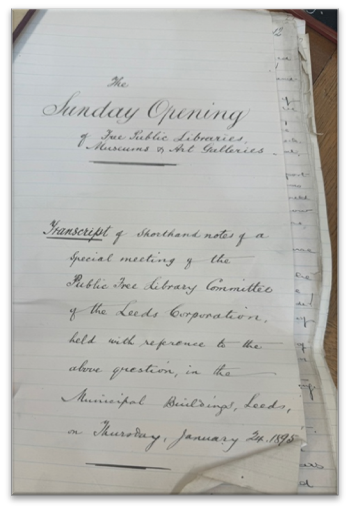
A primary source that stands out to me was a handwritten transcript from a committee meeting which was titled, ‘The Sunday Opening of Free Public Libraries, Museums & Art Galleries’. The committee was debating whether a permanent art gallery should be opened on Sundays. The transcript is over twenty pages long; however, its engaging tone, which resembles modern-day conversation makes to source a compelling read. Despite the disagreements among committee members, the meeting ended with shared laughter. We can often simplify past relationships and focus on one element such as conflict and differences in opinions. However, this source reminds us that even in times of disagreement, people could find common ground and move forward.
The conversation acknowledges that opening art galleries on Sundays would provide entertainment and opportunities for working class individuals, who normally could not visit them due to them being open during the hours they had work commitments. I found this perspective particularly captivating as it reveals a unique insight in how there were people trying to improve the lives of the working class. However, the committee ultimately voted against the possibility of extending the opening hours. This highlights not only the tension surrounding the idea of providing more opportunities for the working class, but also a broader lack of consideration for their needs.
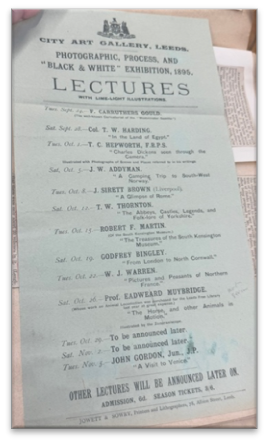
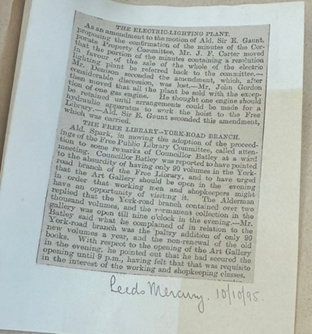
While this specific primary source does not fall in the working class’s favour, there are several examples within this collection that do. For example, there is a selection of leaflets that advertise free lectures on a wide variety of topics. The Leeds Public Library Committee organized these, with Frederick Robert Spark serving as the chairman. A newspaper clipping from the 10th of October 1895 titled, ‘The Free Library York branch’ describes a committee meeting where Spark addressed concerns by Councillor Batley, about the low number of volumes in the York-road branch and the opening times of the art gallery. Batley wanted the gallery to be open later so shop keepers and workers would have the opportunity to visit. This concern was recognized by Spark and the decision to keep the art gallery open until nine o’clock in the evening was made. This small adjustment opened up a world of art and culture to the working class, which had long been reserved for the upper classes.
Working with the Spark Collection at Leeds Central Library has deepened my understanding of Frederick Robert Spark and his lasting impact on the city. The collection offers valuable insights into his contributions to improving accessibility to culture and education. I hope others are inspired to explore the collection in more depth and that it encourages further academic research into Spark—an influential yet largely overlooked figure in history. For more information on the collection and database, please contact the Local and Family History Department via Leeds Central Library at localandfamilyhistory@leeds.gov.uk.
Bibliography
Bradford, Eveleigh, ‘Frederick Robert Spark (1831-1919) – They Lived in Leeds – Thoresby
Society’, Thoresby.org.uk, 2019 https://www.thoresby.org.uk/content/people/spark.php
‘Leeds Triennial Music Festivals’, Discovering Leeds, 2022 https://discoveringleeds.wordpress.com/leeds-triennial-music-festivals/
Images: author’s own
 The Secret Library | Leeds Libraries Heritage Blog
very interesting! Delighted you’ve enjoyed your placement. It would be interesting to discover whether Spark had knowledge of/was influenced by Andrew Carnegie (see e.g. Rachael Brown, The Story of Carnegie Libraries, Historic Environment Scotland, Sept, 2021). A project for after you finish your Masters!