Today’s article, by Becky Bavill, forms part of a series of posts inspired by Unearthed: The Power of Gardening, an exhibition in partnership with the British Library’s Living Knowledge Network, at Leeds Central Library from 10 September – 29 October 2025.
Inspired by our collaboration with the British Library, and the reading of a particularly excellent book (The Hidden Horticulturalists), I started to wonder if any trace could be found of some gardeners in Leeds. Not the big important ones, like Capability Brown, but the people who came in and kept those spaces going. Gardening was a respected profession in the nineteenth century, and there were opportunities for career progression that could change everything for a family. I started with one of my favourite places in Leeds, Temple Newsam. I knew that the last owner in residence of the house was Emily Meynell Ingram who died in 1904. So I decided to start by finding her on the 1901 census using the Library’s Ancestry access and see who else was living nearby.
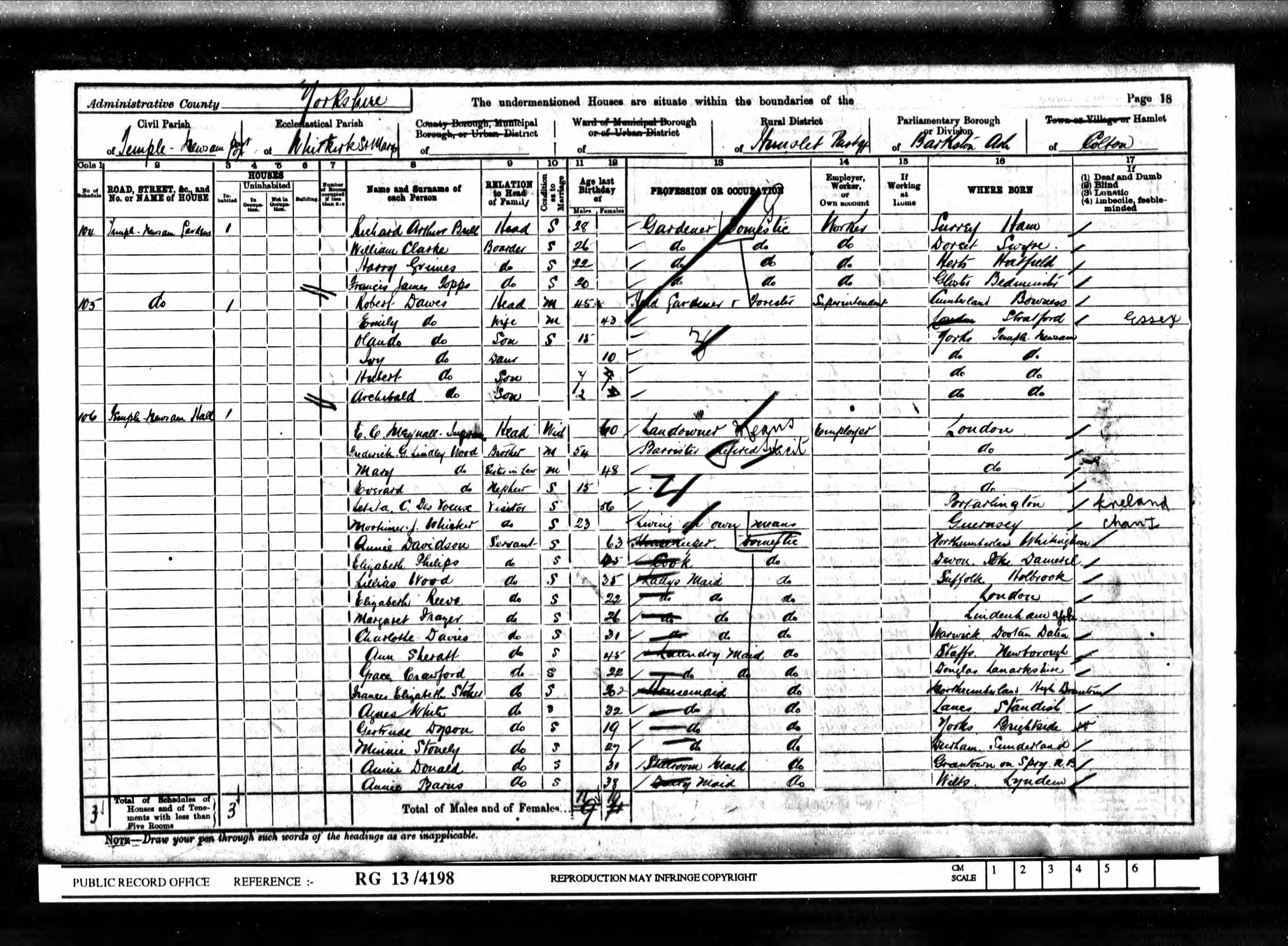
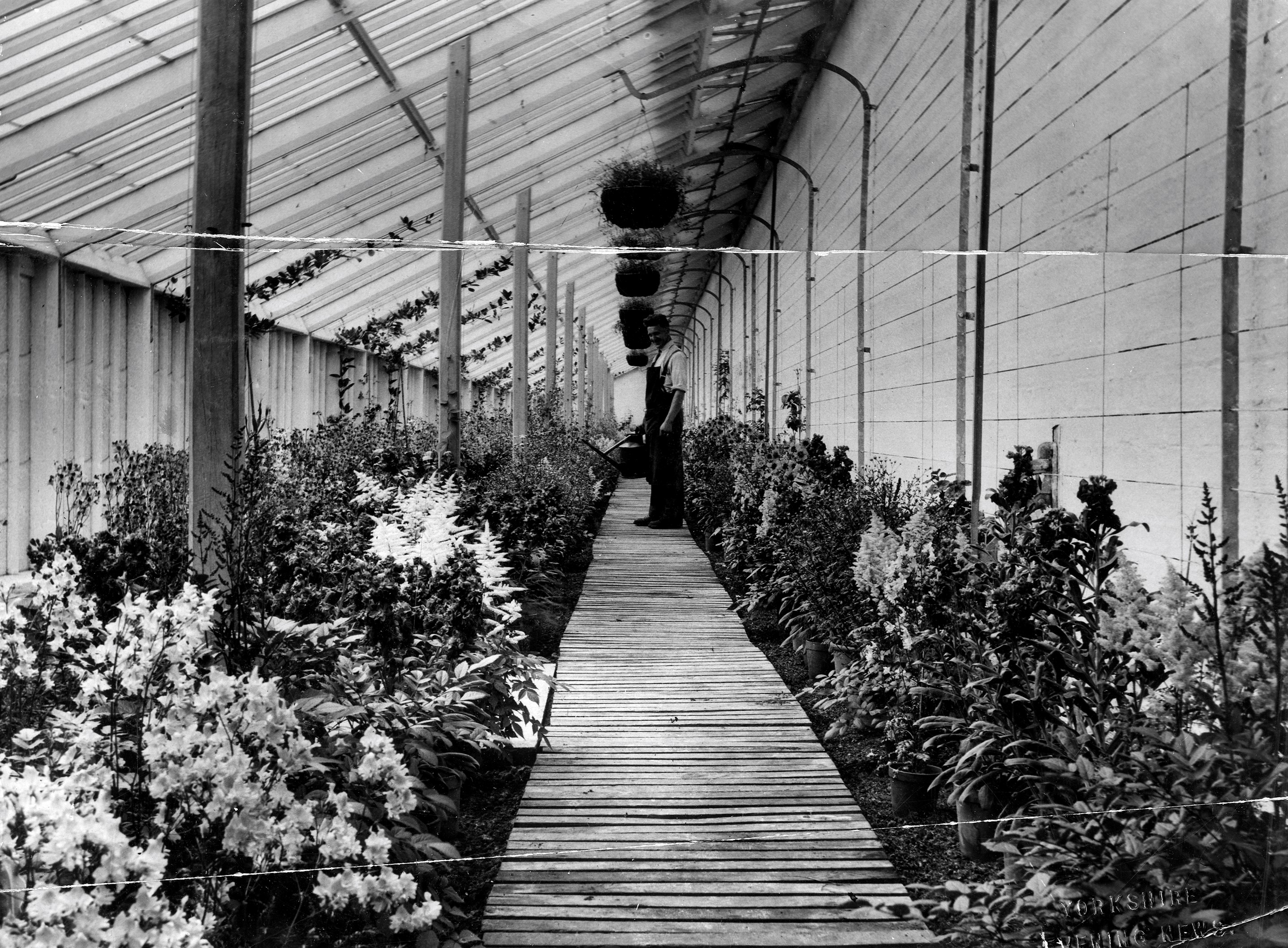
Jackpot! On the very same page, although not the same house, was head gardener and forester, Robert Dawes. I contacted Temple Newsam to find out if they had any more information, they kindly offered to supply me with some work they had done in 2007, which mentioned Robert Dawes. There was even a photo taken in 1910 that may include him. Encouraged, I set out to get back to the beginning.
Robert Dawes was born in Cumberland and baptised there on 29th July 1855. Five years old in 1861, according to the census of the same year, he lived with his parents John and Elizabeth (Smith, as was) at Penny Bridge, Cumberland. He had an older sister, Anne Agnes, two older brothers; Richard (who had been apprenticed to Elizabeth’s brother and had already left home) and William, and a younger brother, James. His father’s profession at the time was gentleman’s gardener; his mothers was laundress. Over time, John would variously describe himself as a gardener or domestic gardener. Of Robert’s siblings, Richard was a wooden hoop maker and subsequently a carter; James a gardener who emigrated to the Antipodes; and William variously a valet, agent and horse collar maker. Geographical mobility seems to be very much a part of the lives of this family – they feature on censuses from many parts of the country including Gloucester, London, Yorkshire, Lancashire and Lincolnshire. Elizabeth died in 1885, John in 1895.
Like James, Robert followed in his father’s footsteps and became a gardener. It is likely that as children, both boys would have helped their father. When John described himself as a gentleman’s gardener, the gentleman in question may have been John Penny Machell; Justice of the Peace and owner of Penny Bridge Hall. By the time of the 1871 census, John and Elizabeth had moved 5 miles away, to the centre of nearby Ulverston. It is likely that John had a new employer at this time and by this point, Robert had struck out on his own.
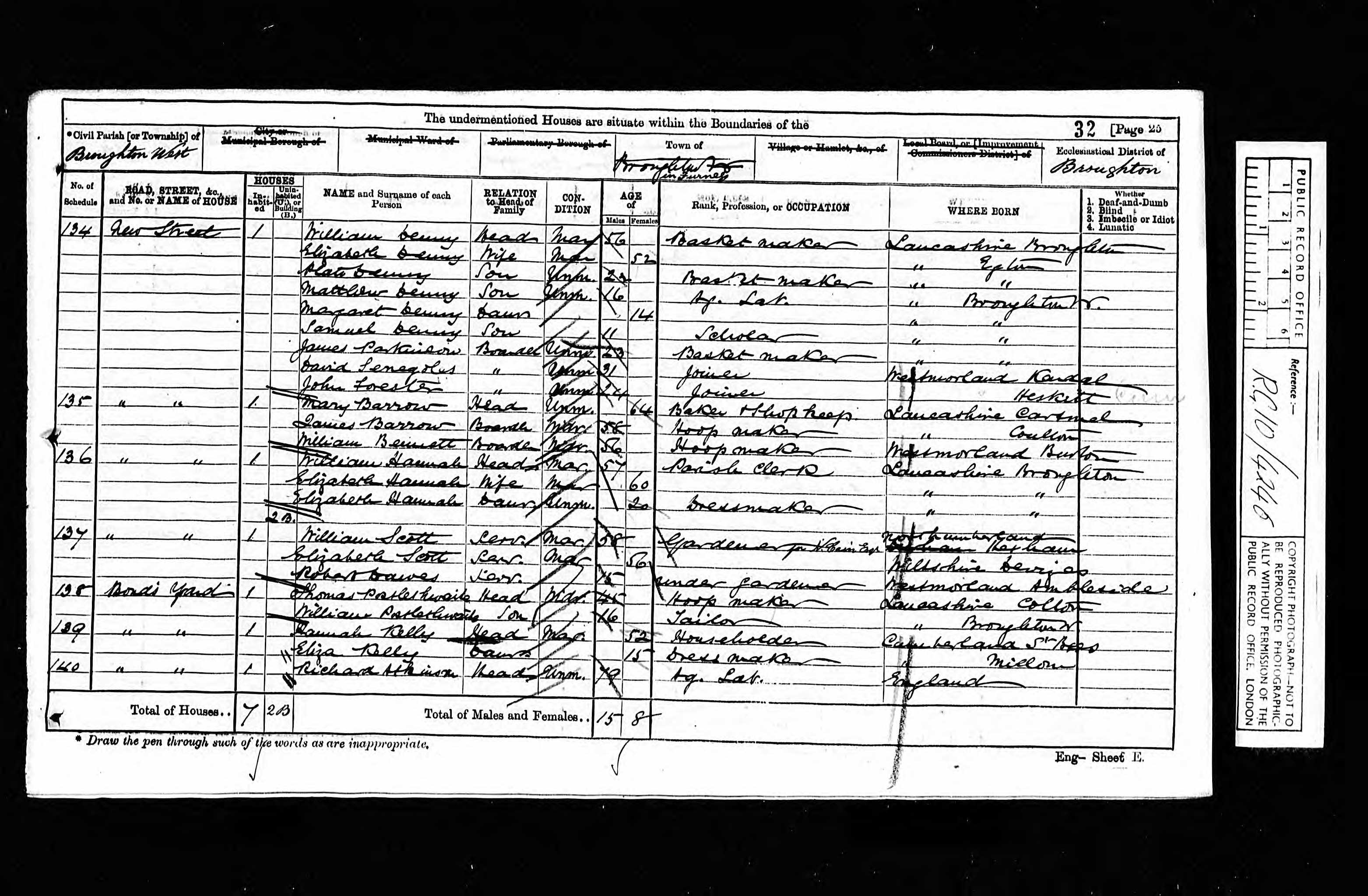
By the time of the 1871 census, 15-year-old Robert was an undergardener, living at Broughton in Furness, 10 miles north of Ulverston. He was part of the household of William Scott, whose profession is stated as gardener, though who for is frustratingly unclear. It could be N. Cain Esq; but there is no one of that name on the same census.
I’ve been unable to find Robert on the 1881 census. I can place him in Whitkirk by 1883, but he wasn’t there in 1881 – living at ‘the gardens’ at Temple Newsam on the 1881 census was the then head gardener, James S. J. Laurie, aged 33, originally of Scotland. Other men are listed as gardeners, but there is no mention of Robert Dawes.
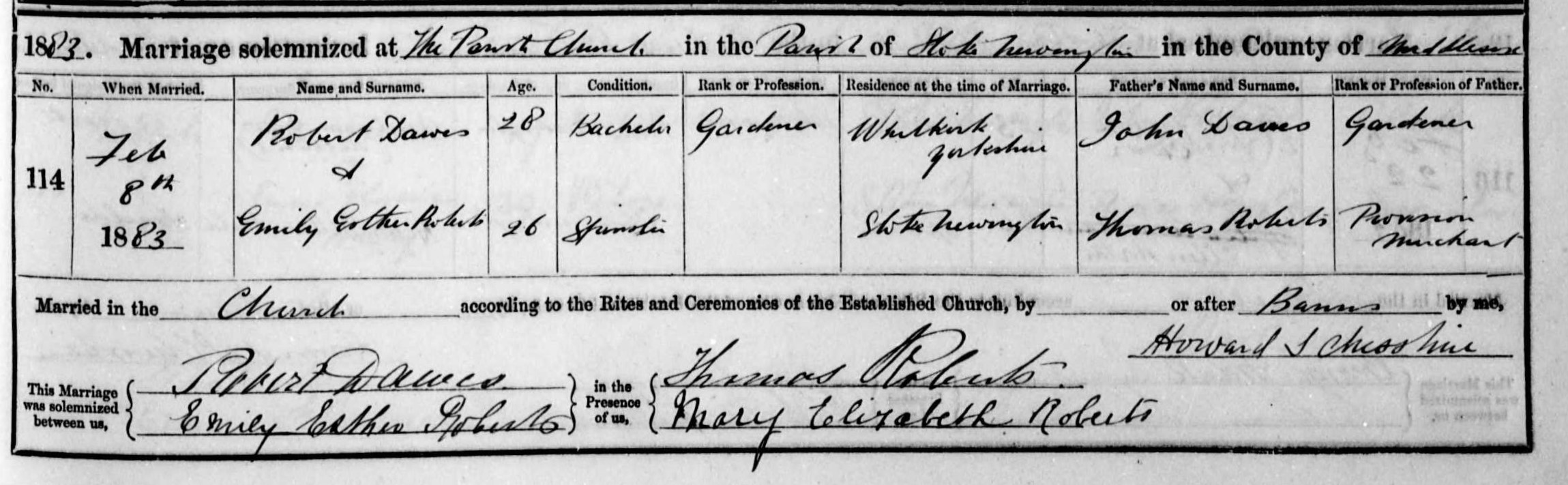
In January 1883, the banns were called for Robert’s marriage to Emily Esther Roberts of Stoke Newington at St Mary’s, Whitkirk on 3 occasions between 7th and 21st January. This means he must have been a resident there, even though the marriage took place at Emily’s home parish; also a St Mary’s, in Stoke Newington. The couple married 8th February 1883. Emily’s father was described as a provisions merchant, so the families were likely of similar social status, although Robert might have been marrying up a bit! Robert’s profession was recorded as gardener and his home as Whitkirk. Looking at maps of the time it does not look like there were many opportunities for a gardener in the area other than at Temple Newsam. So it’s a pretty solid assumption that Robert was working for the house at the time of his marriage.
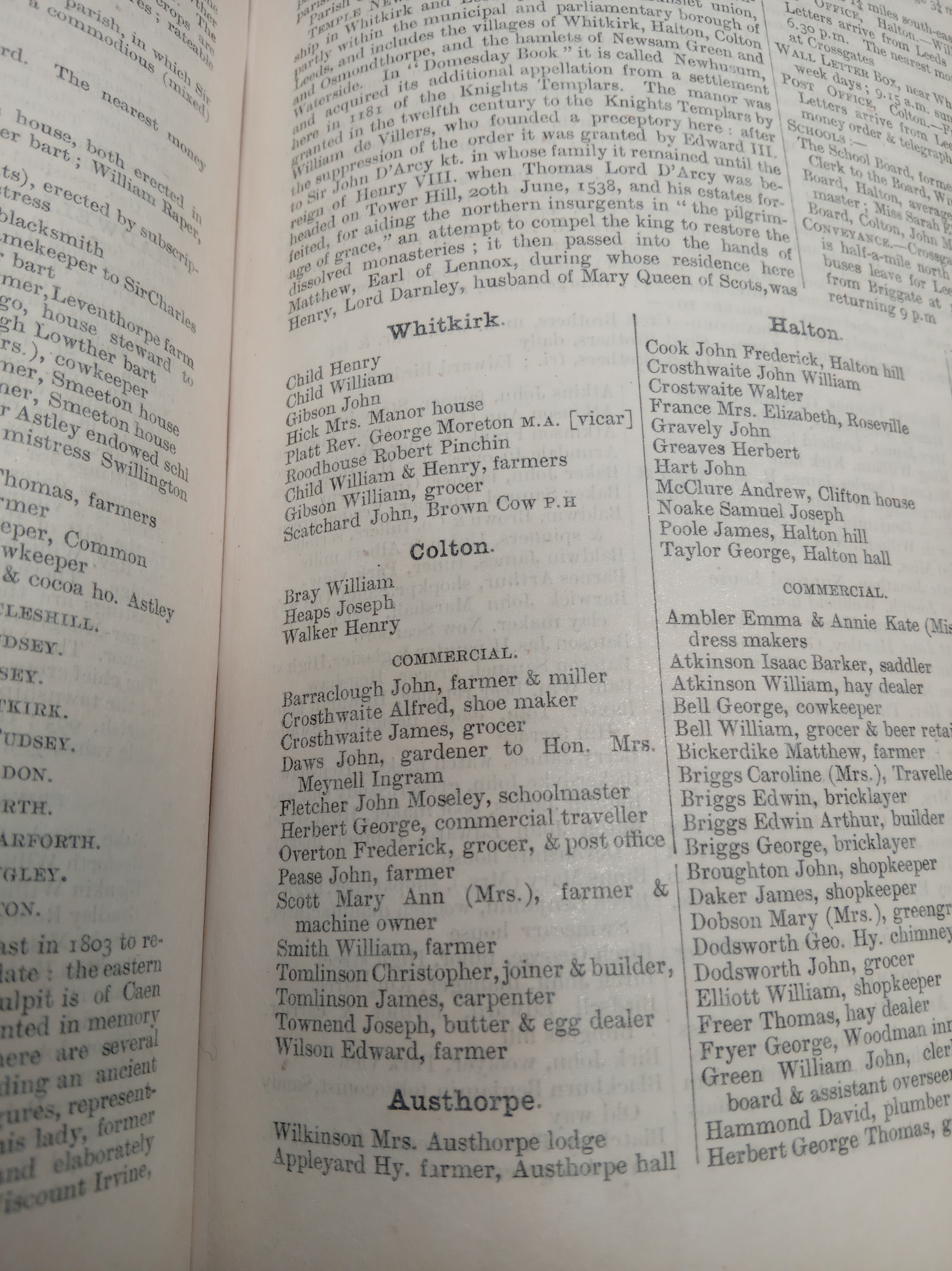
I’m unable to establish exactly when Robert started at Temple Newsam, and in what capacity. However, I can track his career to some extent using the holdings of Trade Directories available at the Local and Family History Library. However, based on the Slater’s Directory for West Yorkshire I can say that by 1887, he was the head man, having replaced his predecessor James Laurie. It may even have been a year earlier in 1886 – Kelly’s Directory lists a John Daws gardener to Hon. Mrs Meynell Ingram. Either way, it is at around this time that Robert starts appearing on the electoral register in Colton, meaning that he was earning enough money to rent a property that cost more than £10 per year.
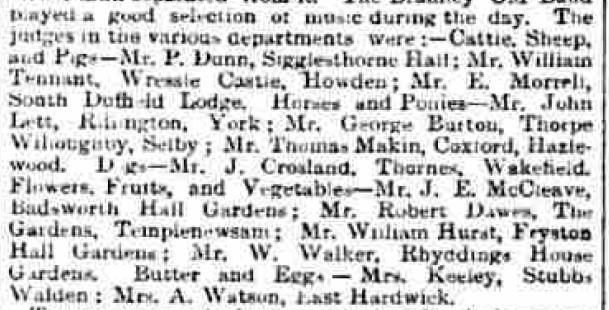
I think Robert must have been quite a modest man, because he isn’t described as head gardener anywhere else until the baptism record of their youngest child, Archibald in 1898. Even on the 1891 census, he is simply ‘gardener’. However, he clearly had the respect of his peers, as evidenced by this newspaper cutting from the Yorkshire Post & Leeds Intelligencer (YP&LI) 24th July 1890.
The 1891 census had Robert and Emily resident in Temple Newsam; the 1891 electoral register identified his dwelling as ‘The Gardens’. By the 1901 census, Robert and Emily’s address was specified as ‘Temple Newsam garden’, where they lived with Olando, Ivy, Hubert and Archibald. By this stage their eldest daughter Ruby had moved out. Robert’s occupation was head gardener and forester. Living next door at the same address, but a different household were 4 more gardeners, none of which are Leeds natives and may have been part of Robert’s staff. The 1893 map shows what looks like accommodation near the enclosed garden; by 1908 it seems to have been added to and converted into two.
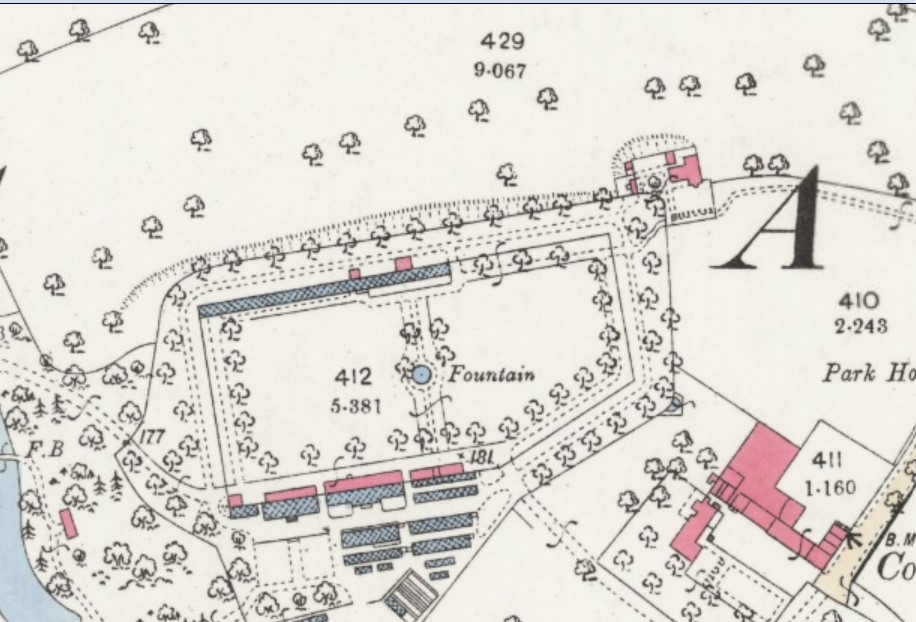
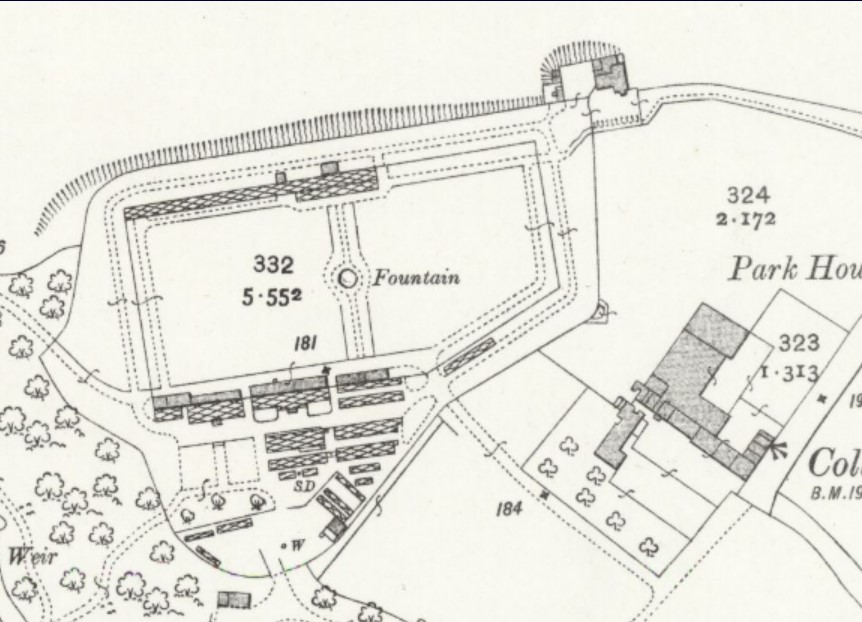
The house still stands today but looks to be privately owned.
The next big event in the lives of the Dawes family I can track was the death of Robert’s employer, the Honourable Mrs Emily Meynell Ingram in 1904. Mrs Ingram owned several properties and a yacht; but is widely accepted to have lived at Temple Newsam. She invested a great deal of time, money and energy into her home, living and working closely with her staff. Many of her employees were mentioned by name in her will, including Robert, as reported by the Yorkshire Evening Post (YEP) 12th January 1905. Listed as the head gardener of Templenewsam he received a legacy of £250, the same sum left to the coachman, William Herridge. In the same newspaper you could rent an 8 roomed house in nearby Woodlesford for £18 per year, so this was a significant sum. The same article mentions an additional bequest that Robert was included in – servants and gardeners who had been employed for five years also received a year’s wages and a suit of mourning. Does this mean Robert was out of a job? Probably not, because he continued at the same address, according to the electoral registers until at least 1912. However, this isn’t backed up by the census.
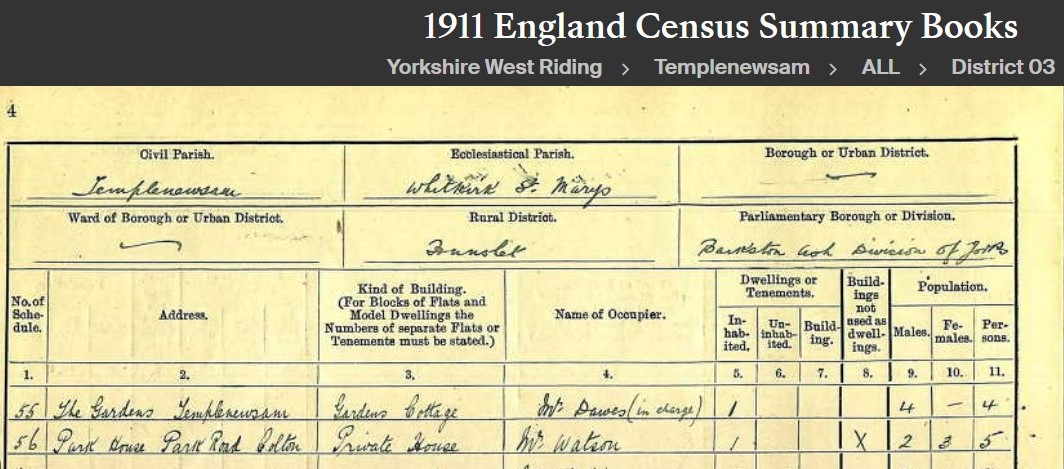
In the summary book for the 1911 census Mr Dawes is listed as the occupier of The Gardens with the caveat ‘in charge’. When I eventually found the actual census entry for the Gardens – spoiler alert, although the summary book lists it as Templenewsam, the actual census calls it Thorpe Stapleton and Templenewsam – Mr Dawes was not one of the occupants. Instead, living at the gardens were four young gardeners who presumably all worked on the estate. The next known address I had for Robert was 175 Roundhay Road, drawn from the address given on their son Archibald’s Great War service attestation form from 1916. When I checked that address on the 1911 census, I did not find the Dawes family.
January 1911 electoral register The Gardens
April 1911 census nowhere!
June 1911 Kelly’s Directory 175 Roundhay Road Mrs Jane Sheldon, Robert Dawes not listed at all
January 1912 electoral register The Gardens
June 1912 Kelly’s Directory Robert Dawes 175 Roundhay Road
1914-15 ward rolls Robert Dawes 175 Roundhay Road
1915 electoral register Robert Dawes 175 Roundhay Road
The only members of the Dawes family I have been able to find on the 1911 census are Ruby and Ivy. Both of them had moved to London and were living with two of their mother’s sisters. Of the rest of the family there is no trace. I’d like to think that they may have been off in Australia, visiting Robert’s brother James, but I have literally no justification for this assertion!
The 1914-1918 war was to have a strong impact on the Dawes family. Robert was too old, but all three of his sons served. Olando had already moved to London at this stage as a qualified architect. He used these skills in the Royal Engineers. The other two, Archibald and Hubert were both still in Leeds because both their names appeared on the Absent Voters List.
Interestingly, Emily also qualified to vote in 1918, in respect of her husband’s occupation. The Leeds electoral register for 1918 was published in October. Sadly, it was already out of date as far as the Dawes family were concerned – Hubert had died in Belgium in May that year, the recipient of a Military Medal.
Hubert was part of a group of men whose trench was overrun by a German assault near Voormezeele – the event is recorded on pp110-112 of The Green Howards in the Great War. His death was reported in the Skyrack Courier 7th June 1918 and in both the YEP and YP&LI a few days previously. The article from the YP&LI shows that this must have been a very difficult time for the Dawes family – Archibald, an RAF officer had been reported missing just a few days before Hubert’s death. Thankfully, he was a prisoner of war; and returned home at the end of the war.
Sometime between the Autumn 1920 register of electors and the 1921 census, Robert and Emily moved to Nether Edge near Sheffield. The 1921 census records Robert as a ‘retired horticulturalist’. It’s not clear what took them to Sheffield, however their son Olando was a 25-minute walk away in the same city on the same census.
Robert died 12th November 1923 aged 68. His death was registered at Kendal, and he was buried at the church of St Mary, Ambleside, where his parents were buried. Emily died in 1928 and is commemorated on Robert’s grave but actually buried at Watford, although exactly where I have been unable to determine.
Robert’s life indicates just how strong a force social mobility was in the Victorian/Edwardian period. The son of a gardener and a laundress, he rose to occupy a very senior position in what became a profession, and was the father of an architect and an RAF officer. Both his daughters married professional men. Gardening was truly transformative for the Dawes family.
 The Secret Library | Leeds Libraries Heritage Blog
A great article using local history sources to unearth the history of Robert Dawes at Temple Newsam. I think the horticultural press might be able to add details as, for instance, the RHS kept an annual list of head gardeners which might clarify when Robert gained the top job.
Yorkshire wide, there is an amazing charity Yorkshire Gardens Trust which researches historic gardens and has some information about the people, mostly men who worked there. There is a gazetteer for the old area of Yorkshire (historic boundary) which is available to search and this article, or a link to it would be a wonderful addition.
Such a good read, thank you for the research and the writing.