In this set of articles by Joey Talbot, Secret Library Leeds becomes Secret Library Morley, as we go in search of the many treasures that could once be found within the walls of the Morley Museum. This is part one of a three part series – keep an eye out for parts two and three in the coming weeks…
*****
This started off as a single blog piece, but eventually morphed into three, as the search bore fruit and my quest widened. And as for the museum collection itself, I used the word treasures for good reason, because there was quite an astonishing array of wonders to be in found in this museum, before it sadly closed its doors for the final time, in summer 1966.

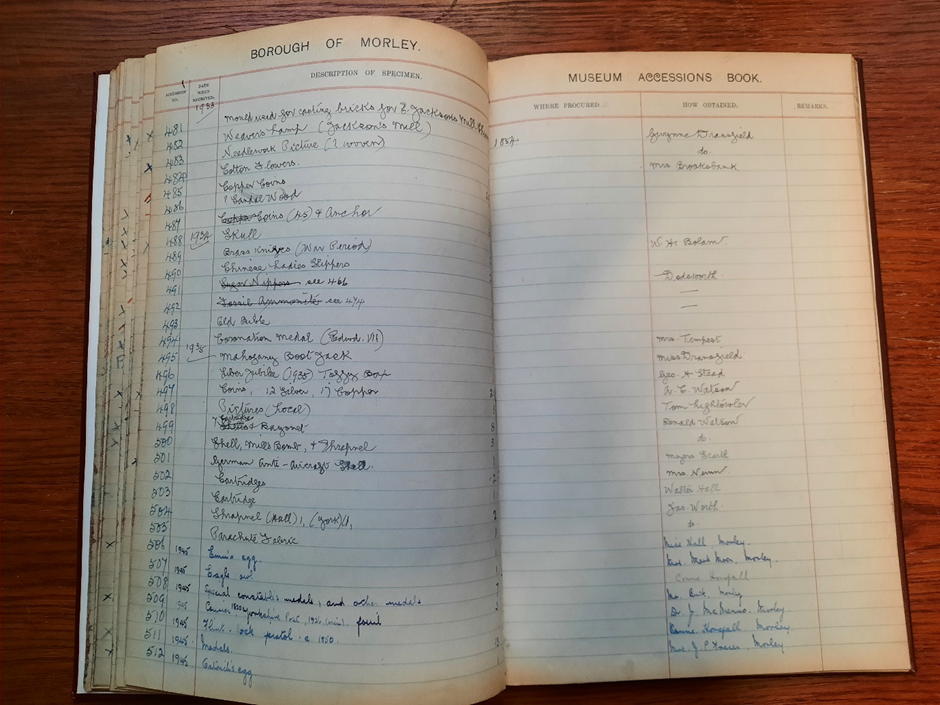
The museum was originally found on the first floor of the Morley Library building, and my journey into its world began when we had an email enquiry asking about an item that used to be part of the museum collection – the cradle that early twentieth century British Prime Minster Herbert Asquith, a Morley man, was rocked in as a baby. This reminded me of a hand-written volume I’d previously noticed on our shelves: the Morley Museum Accessions Book.

Looking through this book in detail, I can tell you that it’s an absolute gem! It covers the years from 1907 to 1960 (with a hiatus around 1935 – 1945), detailing the acquisitions made by the museum during this period. I could find no mention of Asquith’s cradle, but the book contained such a wealth of information relating to other museum exhibits that it was clearly worth studying further. Not only did it record the types of objects that people thought worth preserving, but it also revealed who donated them to the museum and what happened when loaned objects were recalled by the original owner. While I’m not sure exactly when the museum first opened, the accessions book dates back to just seven months after the official opening of the Morley Library building itself in October 1906.
You’ve got to hand it to the folk who ran the museum. They did an excellent job of recording the provenance of their exhibits, and there are all sorts of interesting trends to pick up on. In the initial pre-WWI years, the accession list is full of biological and geological pieces, including a few things that would today be highly illegal to collect. These lie alongside assorted cultural objects from around the world, royal memorabilia, and historical finds like old copper and silver coins.
Many of the biological donations, such as stuffed animals and birds’ eggs, are the kind of objects that used to be classic museum fare, but are now rather out of fashion, as people today often aren’t too keen to view arrangements of dead animals in glass cases. Yet the frequency of these donations also suggests a connection to nature that is perhaps more tenuous today, even if that connection was closely associated with killing, trapping and collecting.
From 1915 onwards we have an abundance of war relics – fragments of German shells, bayonets, rifles, and the like. Soldiers returning home on leave may have brought memorabilia with them, treasured finds from the trenches, but perhaps with painful memories attached, that meant they didn’t want to keep the objects at home.
As the years go by, the number of donations listed in the book diminishes, from an incredible 128 entries in 1908, to eight entries in 1920, then down to three entries during the whole of the 1950s. But across the years, the variety of objects is astounding, and they fill the range from the nondescript, to the bizarre, to the downright dangerous.
In this first article, I will go through the accessions book, picking out a smorgasbord of entries that caught my interest, with some light-hearted comments thrown in here and there. Then in the next two articles, we’ll take a deep dive into the subsequent quest to discover what happened to these objects after the museum closed in 1966, including the story of Asquith’s cradle itself.
To start you off, here are some of the accession book highlights:
THE HISTORICAL
Item 270: Town Crier’s Bell (Origin: Morley Corporation)
Morley gained a new Town Crier in July 2020. Steven Holt has performed with Morley Amateur Operatic Society for 50 years, and it was initially thought that he might be the first Town Crier Morley has ever had. But this bell proves otherwise. Donated to the museum in 1913 by Town Clerk Fred Thackray, the bell is inscribed with the words ‘Morley Corporation’, proving there must have been other Town Criers in Morley’s past.
Item 363: Old Morley handcuffs
Item 401: ‘Special orders of the day’ (Origin: Headquarters, Army, France)
These were also donated by the Town Clerk, and were given to the museum in late 1918, perhaps after the Armistice had been signed.
Stone Quern:
A quern is a round stone used for milling grain. This one was found at Dean Grange Farm near Horsforth, being used as a drinking trough for farm animals.
Item 516: Shetland whaling harpoon
THE BIZARRE
Item 24: Mummy’s hand
Is this a human hand? What happened to the rest of its body? Was it mummified in Egypt or Gildersome? Answers on a postcard please. [Note: We will be able to answer some of these questions in subsequent posts].

Item 52: Round ball of slag, used as a cricket ball against O. Scatcherd
Oliver Scatcherd was Mayor of Morley from 1898 to 1900, and husband of suffragist Alice Cliff Scatcherd, who was known for refusing to wear a wedding ring or use the word ‘obey’ in her marriage vows. And I guess he enjoyed a game of cricket.
But this wasn’t just any old cricket match. This ball was used in a game of ‘clown cricket’, against Casey’s renowned clown cricket team. According to this Lincolnshire blog Casey’s “were a far more powerful team than some imagine”, who regularly played cricket matches against more conventional teams, clad in grotesque costumes and indulging in “droll antics and gambols!”
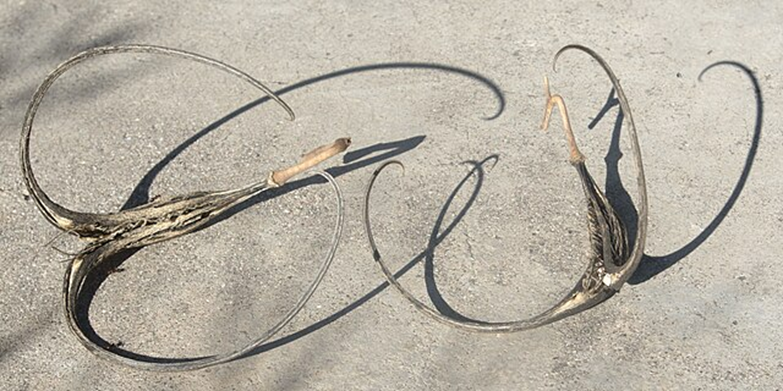
Item 239: Fruit of the unicorn plant
You learn something new every day. It turns out unicorns are real! They are plants from the genus Proboscidea, with edible fruits that ripen to become long hooked seed pods. But to keep you on your toes, they are also known as Devil’s Claw (image from Wikimedia Commons).
THE QUIRKY
Item 13: Jaw of an Ichthyosaurus
These marine reptiles, 1-26 m in length and broadly resembling modern fish or dolphins, were the subject of an incredible 1830 cartoon by Henry de la Beche, lampooning the geologist Charles Lyell. Lyell assumed that the Earth was eternal and one day ichthyosaurs could return, so de la Beche drew a sketch of a “Professor Ichthyosaurus” lecturing his students on the skull of an extinct human.

Item 23: Alligator
The first page of the accessions book was duplicated, so there are in fact two entries for this alligator. The first entry lists its origin as Horsforth, while according to the second, it comes from South America. Given that alligators are only native to the United States and China, this seems to be a remarkably well-travelled beast.
Item 57: Wood chain (cut with pocket-knife from one piece of wood)
The level of dedication in producing this chain is very impressive!
Item 62: Cricket ball (Note: on loan)
Morley’s Mayors clearly had a taste for cricket! William Middlebrook was the Mayor who, on September 28th 1905, laid the foundation stone of the Morley Library building. He also went on to become Lord Mayor of Leeds in 1910. Meanwhile, in January 1908, around a month before being elected MP for Leeds South, he donated this cricket ball to Morley Museum. Perhaps the donation was part of his election campaign?
The ball was, however, given as a loan, and I like to think that it was on loan only until the date of the next match, at which point he would return to the museum to demand his ball back. [Note: To find out whether the ball was ever returned, look out for the next blog post]
Item 192: Tortoise-shell framed spectacles
“Have you seen my glasses? I can’t find them anywhere.” “Don’t worry love, I donated them to the museum.”
THE INTENSELY BIOLOGICAL
Item 17: Hind and fore legs of fox-cub
Poor thing ☹ I feel truly sorry for this critter, I don’t think it had the best start to life.
Item 19: Stuffed badger
This is one of my favourite entries. The archivist has written “stuffed badger”, then they have crossed out the word stuffed. I would love to have been a fly on the wall when somebody realised that the animal they had been donated was not a taxidermy specimen, but was simply a dead (or possibly even live) badger.
To be fair though, there are several entries on this page in which the word stuffed has been crossed out, so this was probably just part of an exercise in tidying up their record-keeping.
Item 64: Fish (Origin: Hull trawler)
I hope they knew how to preserve this fish properly! Though personally I’d still rather have it with chips and mushy peas.

Item 109: Stone from a horse’s stomach (weight, 14 lbs)
Ouch! These mineral masses are known as enteroliths, and can build up around small pieces of foreign matter. Causing recurring colic symptoms, they can grow to the size of a cantaloupe melon. Eventually, they may lodge in the gut and cause life-threatening obstruction or rupture of the intestinal wall.
Item 173: One hundred and forty six British bird’s eggs
Egg collecting was once a popular pass-time, though today it is very much illegal. But the volume of this particular collection seems rather excessive!
Item 201: Sea gull
Probably came in search of the fish from the Hull trawler.
THE NONDESCRIPT
Item 44: Maize cob
Yes, it’s a corn on the cob. I suppose we’ve got to assume that in 1907, corn on the cob was rather more unusual than it is today. This cob was donated by Tom Smith of Morley, a prolific donator to the museum, who also gifted a cannon ball from the battlefield of Sebastopol, which now resides at the Bagshaw Museum in Batley.

Item 85: Nuts
To be fair, the origin of these nuts is listed as Queensland, Australia, so they probably weren’t just a few walnuts and almonds.
Item 176: Sea gravel (?) (Origin: Sunderland)
This sounds very much like a few small pebbles that somebody found on the beach in Sunderland.
Item 244: Two chicken’s eggs
Better than collecting wild birds’ eggs, although not quite as exciting.
THE GLOBAL
Item 178: Spears (7), Uganda
Item 242: Two Zulu assegais
An assegai is a type of African throwing spear or javelin, with a light wooden handle and an iron tip. Why do I pick these two entries out? On the wall at Morley Library, just inside the entranceway, are two spears that were discovered in the loft during refurbishment works in 2019. They are thought to be stabbing spears, known as Iklwa, a kind of spear that was particularly favoured by Shaka Zulu. They are almost certainly remnants of the former museum collection, but exactly which (if any) accession book entry they correspond with, it’s hard to say.

Item 398: Maori axes
Item 407: German spoon
One of the most apparently harmless of the numerous wartime relics listed in the accessions book, this was procured from a German dug-out in 1917 and donated to the museum in May 1919.
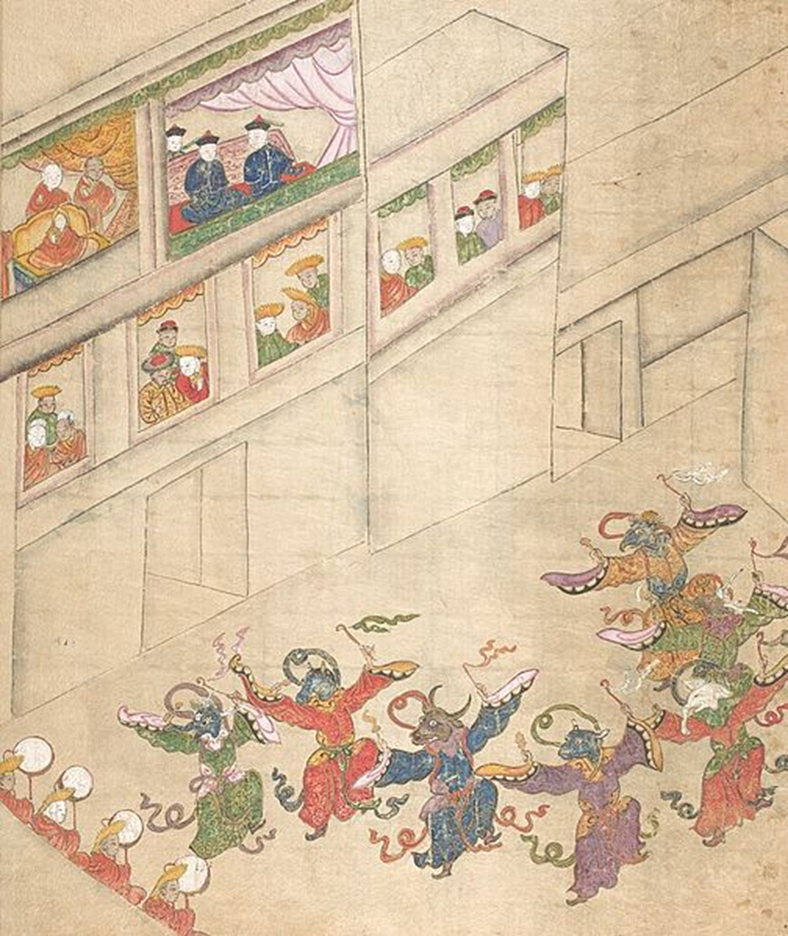
Item 448: Tibetan lama’s mask
The Cham Lama Dance was introduced to Tibet in the 8th Century as a means of subjugating demons that were obstructing the building of a monastery. Monks wearing wrathful masks and colourful costumes reach a meditative state as they dance to the rhythm of traditional drums and instruments.
Item 451: Eskimo reindeer skin gloves
Inuit winter clothing is both highly practical and an incredible artform. If these gloves are similar to the boots and outer jackets traditionally worn by the Even reindeer herders of northern Siberia, where temperatures reach as low as -60°C, they probably had double layer gloves: an inner layer with the hair facing inwards, from reindeers killed in June when the hair is short, dense and soft; and an outer layer with the hair facing outwards, from reindeers killed in November when the hair is long, wiry and supremely insulating.
THE INTRIGUING
Chinese money swords
Yes, these really are swords made of money. The blades are formed of rows of coins fastened to an iron rod with cord or string. These swords are not for combat of course, but are charms and feng-shui talismans to ward off evil spirits.

Item 65: Facsimile of an old document
Was this an important document? Or was it just a dentist’s bill?
Item 158: Grass dishes (Origin: West coast of Africa)
At first glance, the idea of grass dishes sounds highly impractical. But they were probably similar in design to this woven grass basket (image from Wikimedia Commons).

Item 174: Snakes
More information please!
Item 448: Skull
It would be nice to know what kind of skull this was. Human or animal? [Note: a little more information about this skull may be forthcoming in the next blog post]
THE DOWNRIGHT DANGEROUS
Item 146: Asbestos
Yes, somebody really donated a piece of asbestos to the museum! Though of course, the danger from this single piece would have been far less than from the Armley asbestos factory, which used to produce white ‘snow’ that local kids would play in, before the horrific dangers of asbestos became more widely understood.
Item 445: Collection of bombs
This listing has been crossed out, with a note attached stating that the bombs were destroyed as dangerous and were “emptied into old quarry in Scatcherd Lane before filling in.” If you live close to Scatcherd Lane, take note!
Item 464: Hornet’s nest
I hope there weren’t any hornets left in this nest.
THE TRULY VALUABLE
Item 87: Rubies, garnets, etc (several)
Now we’re talking!
Item 184: Cannon ball (Origin: Adwalton Moor)
Lying close to the village of Drighlington, Adwalton Moor is known as the site of a key battle during the English Civil War. The woollen towns of the West Riding were the heartland of Lord Fairfax’s Parliamentarian army, but in June 1643 this army was outnumbered and defeated at Adwalton Moor by the Earl of Newcastle’s Royalist forces. They retreated to Hull, temporarily losing control of most of Yorkshire. But this marked a turning point as it encouraged the Parliamentarians to forge an alliance with the Scottish Covenanters. Together they went on to achieve an important victory at Marston Moor near York in 1644, after which the Royalists effectively abandoned control of the North of England.
*****
With over 500 entries in the accessions book, there are still many tales left to tell, but we’ll have to stop here for now. But with such an abundance of unique objects, my curiosity was tingling. What happened to the collection after the museum closed in 1966? Can some of these items be traced today, or are they lost for evermore?
In the next blog post, I will continue the story to tell you what we discovered. Spoiler alert, the fate of the corn on the cob will remain a mystery, but there are special mentions for the cannon balls, the skull, the cricket ball, and of course Asquith’s cradle.
 The Secret Library | Leeds Libraries Heritage Blog
Totally love this! What happened to all the treasures?
Especially the Horsforth alligator!
Thank you and look forward to more
>
Hi Lucy,
Thanks so much for your comment! In the third article we’ll get to see some of the treasures that ended up at the Bagshaw Museum and Oakwell Hall.
As for the alligator, according to the documents we found from 1966, I can’t see an alligator in the listings, but they do include a crocodile. Perhaps if was actually a crocodile, that could explain the South American origin….
The crocodile is listed to be sent to Leeds, which I think means Leeds Museum. I don’t know whether they have any records of ever receiving it, but this seems to be the most likely possibility.
Best wishes,
Joey