This week’s article is the final part of Becky’s quest to discover the facts about Peaches Cottage in Middleton. Read parts one, two and three before starting this article.
Welcome back to the last part in our series of articles about family history fact checking, using Peaches Cottage Middleton as a starting point. Previously I have been researching people, but I will show here that you can search for buildings too.
The next assertions to check are those relating to who lived there after the Peacheys, namely, the Summers family from the 1950s before the cottage was demolished in the mid-1960s and replacement by 2 semi-detached houses. In other searches like this I have had great success in using trade directories, but they weren’t helpful here for a few reasons. Firstly, after the 1940s they become phone books; secondly because the house never seems to warrant a full address, and thirdly because Middleton is not always part of Leeds and is quite hard to find in the larger directories. Electoral registers are another route to try.
The format of the Leeds Electoral Registers changed in 1951, so this seemed like a good place to start. There was no trace of a Summers on Town Street Middleton at this date. Charles and Ellen Peachey were listed as living at an address on Town Street known as Rosedene though. Hopping forward, I eventually located the first mention of a Summers family on Town Street at 216 Town Street, The Cottage in 1954. Prior to them, the Bensons lived at the same address in 1952 and 1953, but Rosedene had disappeared. Neither 216, nor The Cottage appeared on the 1951 electoral register. 216 Town Street was known as ‘The Cottage’ as far as the 1968 electoral register. It then disappeared in 1969, and I thought that might be the demolition date – but it reappeared, stripped of its name in 1970, still inhabited by the Summers family. There is also a new address next door – 214A. The Summers family continued to inhabit this address – subject to a few lineup changes – as late as 2014. It is possible to keep going right up to the present day, but unauthorised reproduction of information from the electoral registers of the last 10 years carries a hefty fine and I am taking no chances. I can confirm that the address, 216 town Street, Middleton survives to the present day, and is indeed, 1 half of a pair of semi-detached houses. Could the Summers family have demolished their quaint old cottage and built a pair of semis on the same site?
The electoral registers had posed more questions than answers, so it was time to turn to the maps. Maybe that would help me to understand what was going on.
MAPS
If there’s one thing we are not short of in Local and Family History it is maps. Our oldest map dates from 1560 and we regularly receive updates to our Ordnance Survey stock. As well as traditional maps we have some more esoteric ones including ones that have been used as evidence in trials, land sale maps, some tithe maps and my personal favourites, these road maps from the 18th century.
I’m going to try and map the location of Peaches Cottage from it’s construction date to it’s demolition date – possibly in the 1960s, or possibly not.
One of my favourite resources in the department, isn’t even ours – it’s free for anyone to use. I probably recommend it at least twice a week and it’s very easy to lose yourself on. It’s the maps section of the National Library of Scotland.
There are many useful features on this website – the side by side tool is particularly fun if you can navigate your way to the right two maps. To keep it straightforward though, I’m going to use one of it’s most basic functions – searching for images by using a marker pin, just like you might drop a pin on a google map. The search function isn’t the same, so my tactic was to search for Middleton and drop the pin on Town Street myself. I used google maps to help me locate the modern location of 216 Town Street and crossing my fingers that it will be the same. The website has 22 maps that cover this location, dating from 1854 to 1973. You can see them all here.
By working through these maps I can establish that 216 Town Street was a single structure in 1970, but seems to have become something semi-detached by 1973. Checking our physical holdings of OS maps showed the single structure in 1967, but the semi-detached version in the next copy we had which was 1990. I can reproduce a section of the 1967 map here because it is out of copyright, but the 1990 one isn’t – you are very welcome to come and see it in the library though!
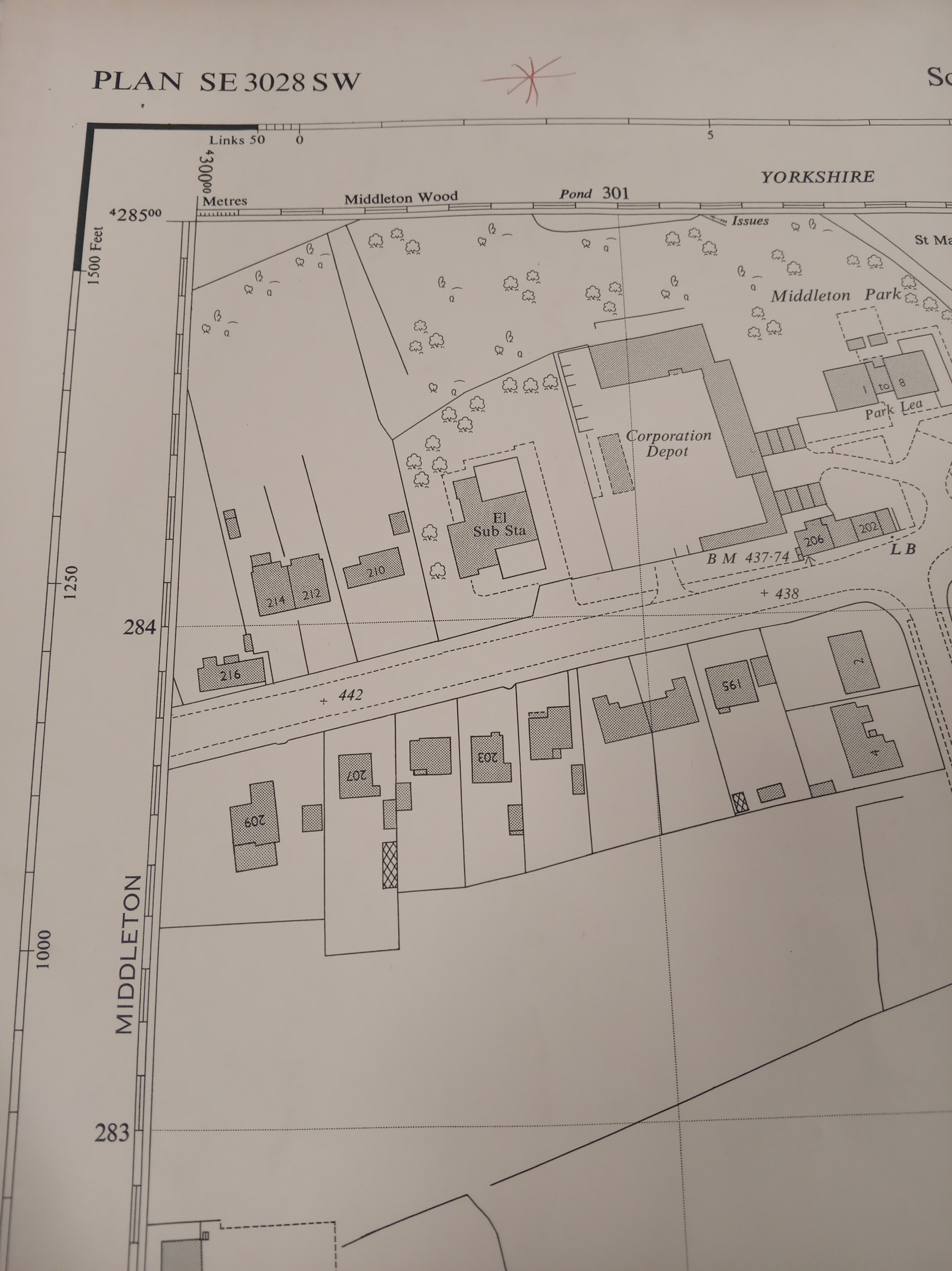
Using the maps on the NLS website I can work backwards through time and see if any of the other assertions about the location of Peaches Cottage hold up. I am singularly unlucky when it comes to maps, it always turns out the location I want is split across several, and Peaches Cottage is no exception – on modern OS maps the house is on 3028SW, but the grounds extend across 2928SE. They do look pretty extensive though, something which is very easy to see on OS 233 NW from 1950, where the grounds of the cottage are marked; as is a path leading through Middleton Woods to the tennis courts. The same map shows the entrance to the park itself to the left of the cottage. This validates the assertion from Bygone Middleton – ‘Below the park gates against Maud Walk, the private path to the park’. A similar assertion was made in Backward Glances (LQ MID 942 0694454X):
“Further east at the end of the wood was another large gate which led to a path known as Maude’s walk. Next to this was Peachey’s Cottage. Built of stone it had roses creeping round the door . . . she had a well in the back garden.”
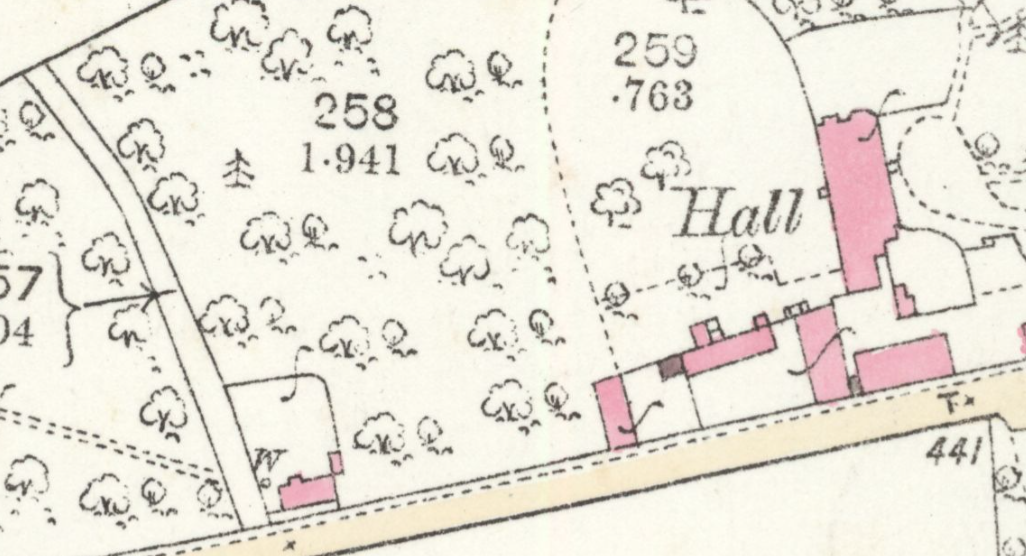
A well is clearly shown – marked W on Yorkshire 233.2 1894, reproduced here:
So much for the NLS, can we get back any further?
In our map holdings is ML 1853. This map was drawn up as part of the sale of the Middleton Colliery and it’s estates in the aftermath of the collapse of the finances of the Brandling family. It’s small, but Peaches cottage (as it will later be known) is definitely there:
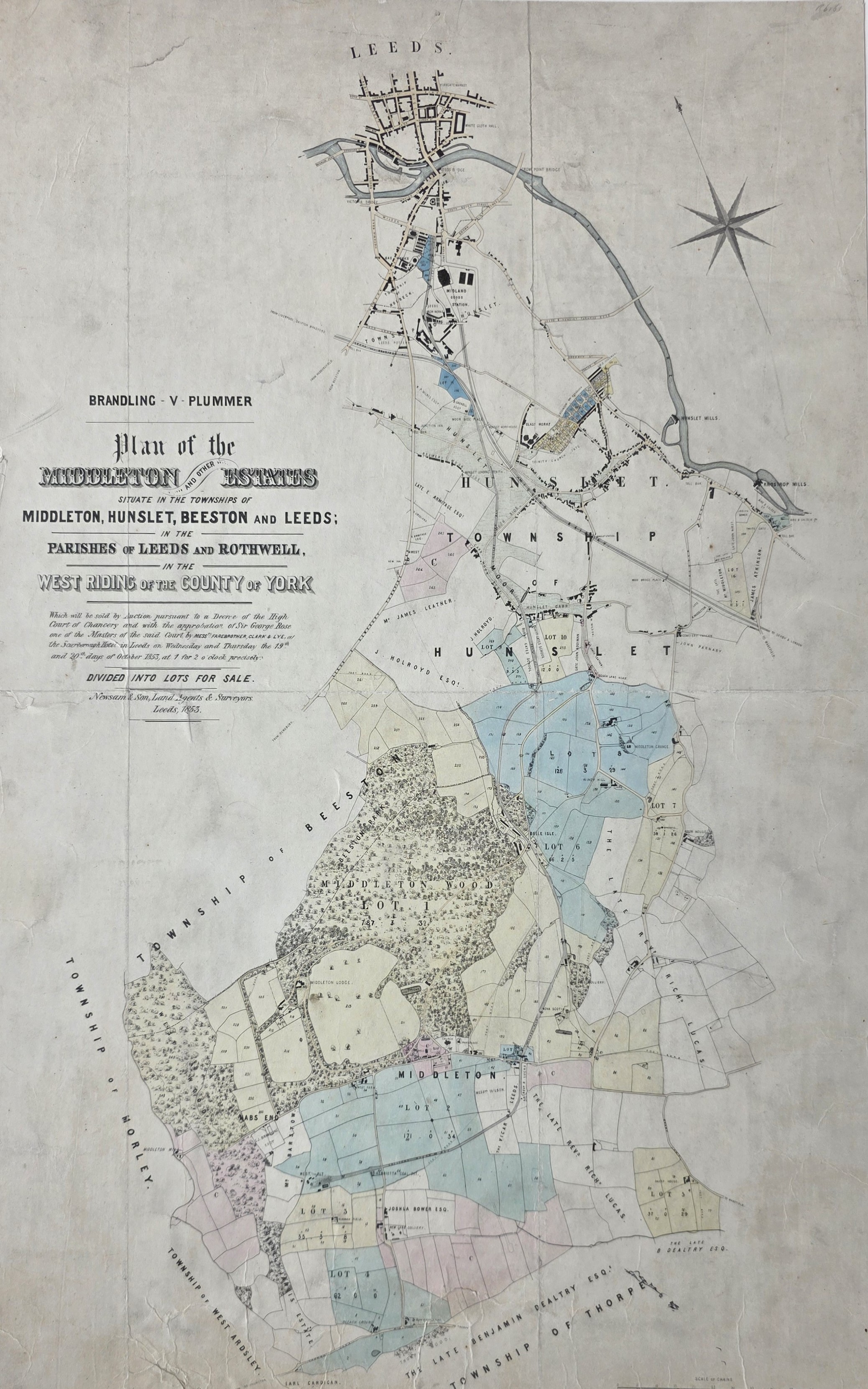
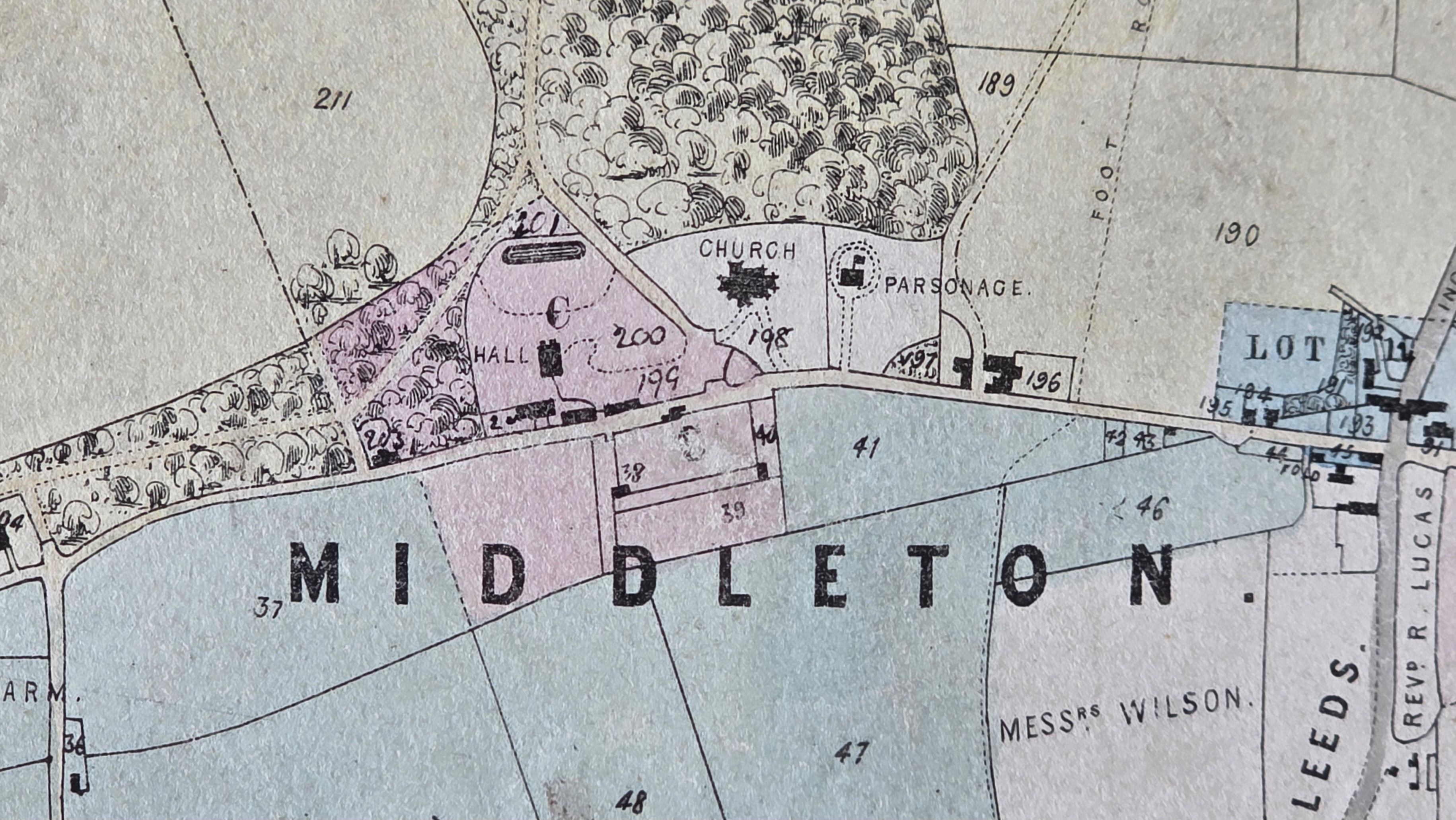
Alas, we have no earlier maps that cover the area so I have been unable to verify a construction date. All I can say is that it was definitely part of the Middleton Colliery Estate in 1853 so it was probably built as a colliers cottage. We do have some of the records of the Middleton colliery on microfilm, but with 4 reels to trawl through and them not being in date order, even I am going to admit defeat.
If I was prepared to take this research outside the Library, there are a number of places I could look for information. As already stated, to find out more about Annie Peachey’s teaching career I could look for the records of the schools mentioned at the West Yorkshire Archives. To find out more about the origins of the building as a colliery cottage, I could look for more records relating to the colliery. Other collections at the West Yorkshire Archive Service (WYAS) that might be useful would be the Goodchild collection. Additionally the WYAS actually have all the records relating to the Middleton Colliery, starting in 1760 (WYL899). This includes paybooks and rent books that would probably help to identify who was living at Peaches Cottage during the 1840s and 1850s, and even further back, if indeed it was a colliery cottage. The Thoresby Society have extensive holdings of sales particulars and maps, some of which could be useful. The Northumberland Archive have a collection relating to Middleton Colliery, thanks to the link forged by the Brandling family who took control of the estates in 1749.
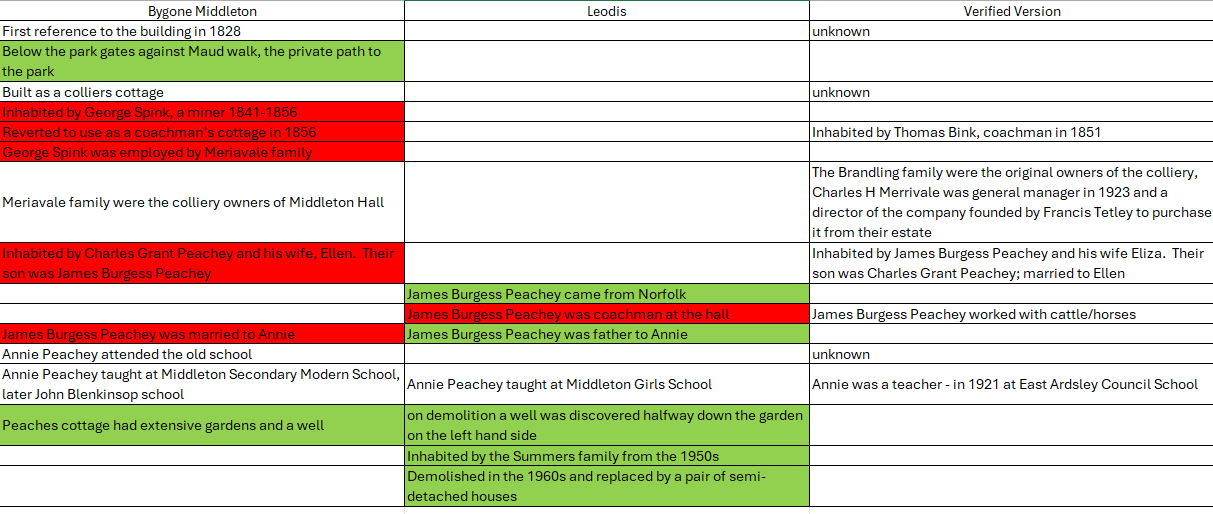
Still, of the 19 different assertions that had been made about Peaches Cottage, I have been able to verify or discount all but 3 of them, as well having had a huge adventure through some little known parts of the Local and Family History collections.
I hope you have found some of this journey useful, and if you have anything else to add to this story, please get in touch.
UPDATE – the customer contacted us some time later, very happy to share the picture they had found that was definitely the home their family had lived in. It categorically was not Peaches Cottage. Sometimes a rabbithole really is just a rabbithole . . . . . .
 The Secret Library | Leeds Libraries Heritage Blog