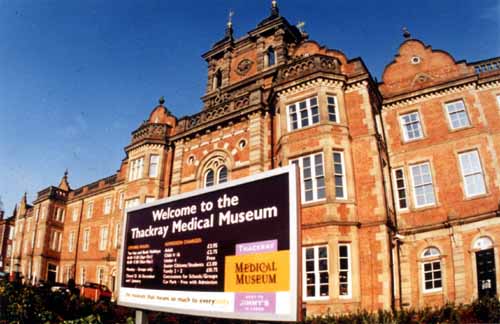
This week we welcome University of Leeds student Emily O’Riley. Having completed a yearlong research project alongside the Thackray Museum of Medicine, who provided 360 biographies of Workhouse inmates based on 1881 census data, Emily reflects on the Victorian Workhouse and what it can tell us about British society.
The first thing we learnt about the workhouse, was that we knew nothing about the workhouse.
It wasn’t the most encouraging sign, that at the beginning of a yearlong research project titled ‘Unlocking the Workhouse’, four second year students had little more to say other than parroting a film from 1968 in the trademark ‘Please sir…can I have some more’.
Our misled understanding underscores an interesting dynamic around the Victorian Workhouse. Talking between ourselves, with friends, even with university staff, it seemed that we all saw the workhouse as an integral, and telling, fact of Victorian society, yet knew little of it beyond that.
In contextualising the workhouse, what came before, and what came after, I hope to chart a more considered, yet necessarily brief, history of poverty in Britain. This tells us a lot about where we have come from, and most critically, where we still need to go.
*****
The legal origins of Poor Laws can be in the aftermath of the first bubonic plague outbreak in the 14th-century. This pandemic, the first major Black Death outbreak, was lethal in mediaeval Europe and killed an estimated third to half of the English population.[i] Following this crisis, it became important for King Edward III to structure the growing state bureaucracy to control the working population. The result was laws including the 1349 Ordinance of Labourers and the 1351 Statute of Labourers. These made it illegal for anyone under 60 to not work, froze wages at a pre-plague level and restricted the practice of begging which was increasingly seen as a social disturbance. This reflects an attitude shift. In pre-modern times poverty was not perceived as a moral failing.[ii]
However, poverty was increasingly thought of as ‘vagrancy’, a loaded label which associated the poor with negative ideas of laziness and criminality. The stigmatisation of the English peasantry increased as economic conditions worsened in the 15th and 16th-Centuries. The label of a ‘vagrant’ became a useful scapegoat, shifting blame from the decisions of the monarch to a supposedly idle, socially destructive poor. The distinction between ‘God’s Poor’ and ‘The Devil’s Poor’ highlights how peasantry became a contested moral idea.[iii] Some poor people were seen as down-on-their-luck, vulnerable and in need of alms, whereas others were characterised as lazy slackers stealing from the parish and the state. Centuries later, the 1834 New Poor Law codified this distinction between a ‘deserving poor’ and an ‘undeserving poor’. Indeed, finding echoes of this view is not difficult in contemporary Britain.
State control over peasantry grew as an unintended consequence of the Reformation, King Henry VIII’s decision to break from the Catholic church and found the Church of England. The dissolution of the monasteries weakened a significant provider of poor relief. To fill this gap in alms, the state was forced to step in. A surprising consequence of the Reformation was the rapid evolution of the modern benefits system, as poverty relief was now funded by taxes.[iv]

Despite holding strong cultural currency as a Victorian idea, workhouses existed before the 19th-century. Population growth and changes to the structure of labour, as more land was used for seasonal pasture land than crop land, lead to growing mobility of the peasantry. To regulate a growing, mobile poor in the late 1540s the first ‘workhouse’, the London House of Correction at Bridewell, was established.[v]
‘Indoor’, formalised relief, as opposed to ‘outdoor’ cash relief, grew in popularity. This had a punitive element demonstrated through frequent instances of beatings and harsh conditions.[vi] The early workhouse forms demonstrate how the workhouse approach to poverty centred criminalisation and punishment.
The scramble of legislation and diverse types of relief form the patchwork of the ‘Old Poor Law’. However, this system was a complicated mess and there was ever-growing concern, from the upper classes of society, of the social impacts of poverty in a rapidly urbanising Industrial nation. These concerns are reflected in the 1832 Royal Commission into the Operation of Poor Laws. The commission said that the state of poor relief was perpetuating poverty, as the able-bodied poor were given relief which put them off working.[vii] Again, the parallels between contemporary arguments that ‘generous benefits disincentivise work’ are striking.

To deter poor relief and encourage work, the 1834 New Poor Law radically changed how poor relief operated. The law grouped parishes into 600 poor unions with a Board of Guardians and a workhouse. The workhouses were governed by the ‘principle of less eligibility’, the idea that the workhouse conditions should be worse than the outside to deter applicants. The workhouse was a complicated institution which varied significantly based on location. Its role and living conditions form a larger part of later articles in this series.
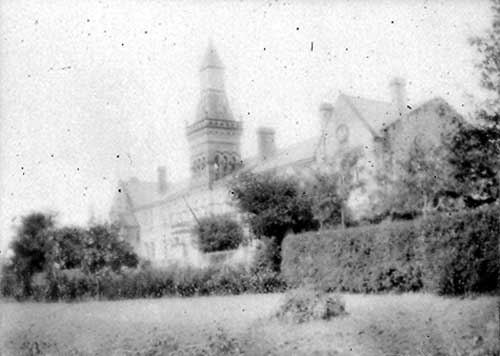
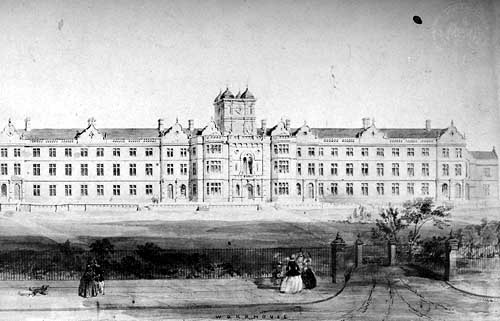
Despite its infamy, the workhouse system was relatively small and short-lived. The Leeds Union Workhouse could house 800 inmates in a growing urbanised city.[viii] The workhouse system as a whole was in decline by the late 19th-century. Most inmates were old and infirm. Many workhouse sites, like the Leeds Union Workhouse were repurposed: as war hospitals, and then as general hospitals. The decline of the workhouse system coincided with the development of the British Welfare State, notably the reforms of the Liberal government of 1906-1914: free school meals, pensions, unemployment insurance. Although abolished in 1930, it wasn’t until 1948, the same year that Attlee’s Labour government legislated for the establishment of a National Health Service, that the last workhouses fell out of use.[ix]
For a time in mid-late 20th-century Britain, mass poverty appeared to be a thing of the past. Old slum housing was demolished, making way for new, affordable council housing of the 1950s and 1960s. The politics of post-war consensus broadly supported taxes to fund benefits and NHS spending, with significant improvements to the material conditions of much of the British population.

But this age of relative affluence was not as stable, or as all-encompassing, as it seemed to a growing middle class and political class who claimed credit for it. Quickly, the conditions of the least well-off declined.
In 1979, child poverty was 13%.[x]In 1990 it was 22%.[xi] By 2021 it was 29%.[xii] Professor Patricia Thane has described this state of poverty in Britian at a “re-turning point”.[xiii]
The workhouse has come to symbolise an institutional embodiment of a low point in the treatment of the poor. The problem with this perception is that it treats the Victorians as an anomaly. Instances of cruelty and moral loathing of the poor; the desperate, the outliers, becomes an isolated episode, a stain in a history which is not glorified, in so much as it is overlooked. Poverty in contemporary Britain echoes the past in unsettling and unchanged ways. Wealth inequality is stark, as the wealthiest 10% of households hold 43% of wealth, whilst the least well-off 50% hold only 9%.[xiv]

Again, like between the 14th-and 19th-centuries, this existed beyond material conditions alone. As a child of the 2000s, I was familiar with the word ‘chav’, a term laden with prejudice and a demonisation of the British working class.[xv] The proliferation of this term reflects a nation locked in the archaic idea of the deserving and undeserving poor. Poverty continues to have a strongly moral aspect, imposed by those with least experience of it.
In this, contemporary perceptions of poverty are a culmination of a history which reached a symbolic peak with the workhouse system. But to focus on this alone neglects the gradual development of a class system, and with that a class mentality, which seeks to exclude and overlook poverty.
The workhouse might be the most powerful symbol of this, but the abolition of workhouses has not meant that the centuries-long attitudes underpinning it are gone too.
Browse our Library catalogue to find some further reading around the history of workhouses in England. You might also find our Health & Hospitals research guide of interest, and the Poverty and Riches section of our Discovering Leeds platform.
[i] Palmer, R.C. 1993. English law in the age of the black death, 1348-1381 : a transformation of governance and law. Chapel Hill ; The University of North Carolina Press, p.3.
[ii] Quigley, P.W. 2015. Five Hundred Years of English Poor Laws,1349-1834: Regulating the Working and Nonworking Poor. Akron Law Review, p.4.
[iii] Daly, C.T. 1986. Basilisks of the Commonwealth: Vagrants and Vagrancy in England, 1485-1553, p.20.
[iv] Daly, C.T. 1986. Basilisks of the Commonwealth: Vagrants and Vagrancy in England, 1485-1553, p.34.
[v] Eccles, A. 2016. Vagrancy in Law and Practice under the Old Poor Law. London: Routledge, p. 2.
[vi] Collinge, P., and Falcini, L. 2022. Providing for the Poor: The Old Poor Law 1750-1834. London: University of London Press, p. 3.
[vii] The Health Foundation, n.d. Workhouses and the Poor Law Amendment Act 1834. Avalable from: https://navigator.health.org.uk/theme/workhouses-and-poor-law-amendment-act-1834.
[viii] Historic England, n.d. Former Leeds New Workhouse, St James’ Hospital, Leeds. Available from: https://historicengland.org.uk/services-skills/education/educational-images/former-leeds-new-workhouse-st-james-hospital-leeds-4524
[ix] Ripon Museums, n.d. Workhouse History. Available from: https://riponmuseums.co.uk/workhouse_history/
[x] Thane, P. 2019. How Poverty in Modern Britian Echoes the Past. The British Academy. Available from: https://www.thebritishacademy.ac.uk/blog/how-poverty-modern-britain-echoes-past/#:~:text=Poverty%20then%20shot%20up%20under,1979%20and%2022%25%20in%201990.
[xi] Thane, P. 2019. Ibid.
[xii] Joseph Rowntree Foundation, 2024. UK Poverty 2024. Available from: https://www.jrf.org.uk/uk-poverty-2024-the-essential-guide-to-understanding-poverty-in-the-uk#:~:text=Poverty%20has%20increased%2C%20close%20to%20pre%2Dpandemic%20levels,-More%20than%201&text=This%20included%3A,nearly%203%20in%2010)%20children
[xiii] Thane, P. 2019. Ibid.
[xiv]Office for National Statistics. 2022. Household Total Wealth in Great Britian: April 2018 to March 2020. Available from: https://www.ons.gov.uk/peoplepopulationandcommunity/personalandhouseholdfinances/incomeandwealth/bulletins/totalwealthingreatbritain/april2018tomarch2020
[xv] Tyler, I. 2008. “Chav Mum Chav Scum”: Class Disgust in Contemporary Britain. Feminist Media Studies, pp. 17-34.
 The Secret Library | Leeds Libraries Heritage Blog
Having done some research into Yorkshire workhouses myself, one thing I found shocking was the amount of suicides by people either wanting to avoid the workhouse or by people already in the workhouse. Some people preferred prison. One lady in Edwardian Leeds even said she had loved prison and had put on weight during her last sentence.
I hope that Emily is reading this as I found her article really interesting.
If you have time Emily can you advise me on one or two matters.
My great great grandfather Jacob Thomas was an inmate at the Beckett Street Workhouse and died there in 1916. This despite his wife Elizabeth Ann ( nee Breary) living nearby in Arthur Street with her daughter and son in law! My own grandfather then 16 was in nearby Haymount Place with my great grandparents but no one seemed to have wanted the poor old fella…..
Anyhow it was my understanding that the Beckett Street Workhouse was taken over by the War Office in 1916 for use as the East Leeds Military Hospital. Were all the inmates transferred to the new Hunslet Workhouse which I think became St George’s Hospital? ( which is now closed.) If I’m correct the Workhouse was nowhere near Hunslet and nearer to Rothwell.
If this was the case did Jacob die there and was brought back to ” Newtown “?( as my father always called it).
I know he is buried in a *guinea grave* in the NE quadrant of the cemetery. .
He was born in Newchurch Place (circa 1847) which was
one of the slum houses backing on to St Mary’s church yard Mabgate. Margate was one of the meanest streets in a city of mean streets. Notorious for lewd and drunken acts. The very name hints at its dubious past. Jacob became a lamplighter going out each evening to open the glass canopy and ignite the gas onto a fragile mantle. In the morning he turned them all off again. He must have been well known in ” Newtown “.
I do hope you’re reading this comment Emily and if you can throw light on these matters ( no pun intended!) I would be most grateful.
Cheers
Bob