As we creep ever nearer to Halloween we thought it only right to regale you with a few spooky tales from a certain scrapbook in our collections. Known colloquially by staff as the ‘ghost scrapbook’ and more officially as ‘Ghost Stories and Weird Experiences, Life after Death etc.’, it forms Volume 37 of the Edwin Hick Collection. Hick was a devoted collector of stories of all sorts and created this scrapbook of ghostly tales from stories printed by local Yorkshire newspapers. Covering the 1920s – 1940s, this scrapbook has some wonderful tales to tell, from stately home ghosts, medieval monks and haunted sausages!
It has also served as inspiration to local illustrator, Simon Smith, who has created some gruesome illustrations to accompany some of these ghostly goings on. From 23rd October – 9th November you’ll be able to hunt down these images in the Local and Family History Library and use the accompanying QR code to link to the full story. Grab an activity sheet to tick off all you find. But in the meantime here’s a taster of some of these mysterious tales.
The Headless Steeds of Calverley Woods
Approaching ten of the clock on a brilliantly moon-lit night, a sturdy villager crossed the Aire by the stepping-stones at Apperley, and turned along the boulder-strewn path, through Calverley Woods to the village. The companionable murmuring of the river, and a gentle soughing in the trees alone broke the silence of the night.
The pedestrian was a stolid fellow whose mind was pleasurably anticipating a foaming tankard at the village ale-house. The beauty of the woods by night had no appeal, and the old-wives’ tales of fearsome apparitions were far from his thoughts.
Suddenly the clatter and jingle of horses broke upon his ear. He paused a moment to listen. The noise was no imagination. Instantly the stories of the phantom horsemen rushed into his brain, and, despite himself, his cheek blanched. From the heart of the woods, ahead and a little to the right-hand, came the sound of a madly riding cavalcade.
Nearer it came, and nearer. There was the ringing of iron-shod hoofs and the jingle and slap of leathern horse-gear; and, ever and anon, there burst forth cries and demoniacal laughter, which caused the echoes to resound far and wide.
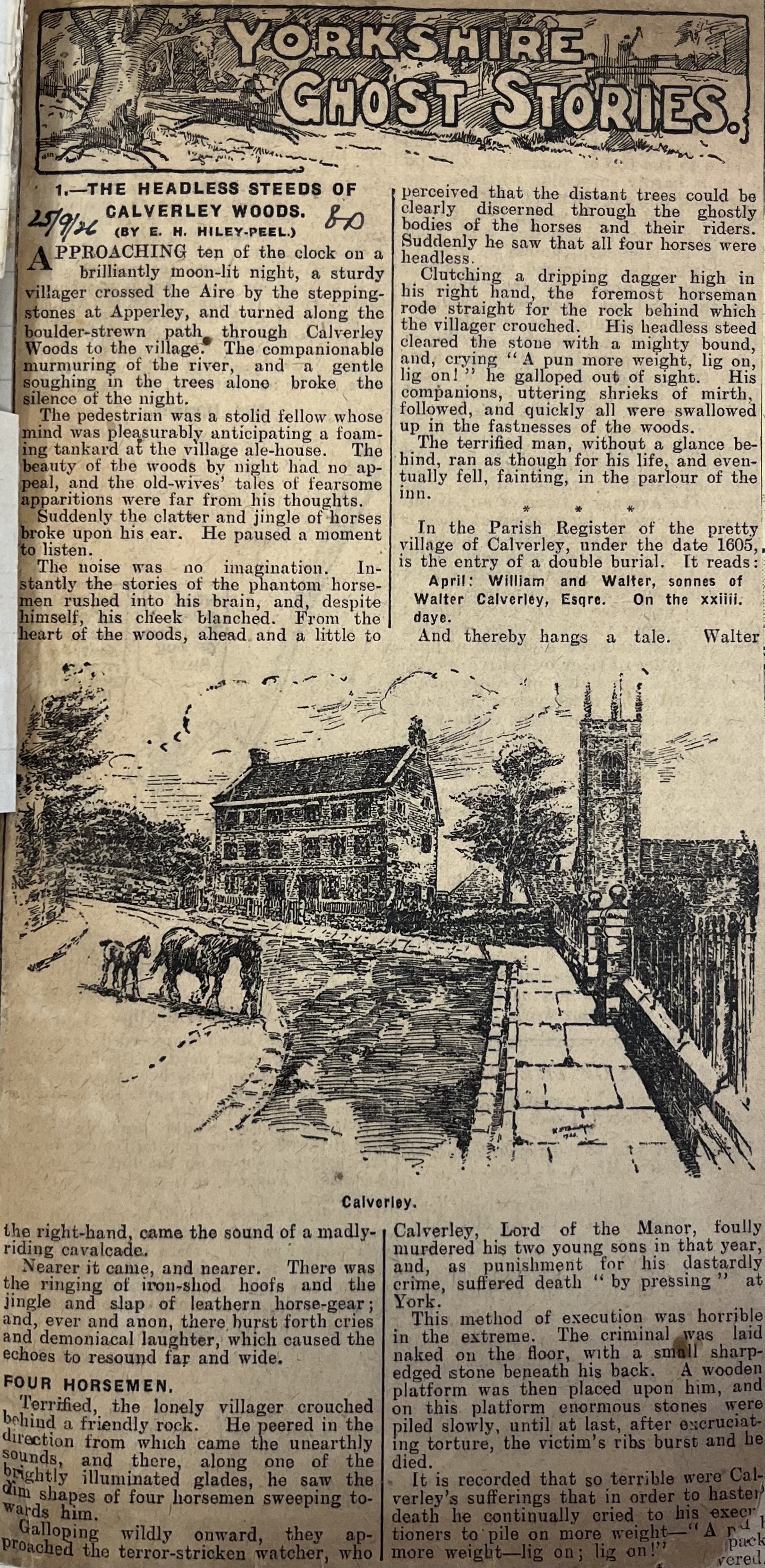
Terrified, the lonely villager crouched behind a friendly rock. He peered in the direction from which came the unearthly sounds, and there, along one of the brightly illuminated glades, he saw the dim shapes of four horsemen sweeping towards him.
Galloping wildly onward, they approached the terror-stricken watcher, who perceived that the distant trees could be clearly discerned through the ghostly bodies of the horses and their riders. Suddenly he saw that all four horses were headless.
Clutching a dripping dagger high in his right hand, the foremost horseman rode straight for the rock behind which the villager crouched. His headless steed cleared the stone with a mighty bound, and, crying “A pun more weight, lig on, lig on!” he galloped out of sight. His companions, uttering shrieks of mirth, followed, and quickly all were swallowed up in the fastnesses of the woods.
The terrified man, without a glance behind, ran as though for his life, and eventually fell, fainting, in the parlour of the inn.
In the Parish Register of the pretty village of Calverley, under the date 1605, is the entry of a double burial. It reads:
April: William and Walter, sonnes of Walter Calverley, Esqre. On the xxiiii daye.
And thereby hangs a tale. Walter Calverley, Lord of the Manor, foully murdered his two young sons in that year, and, as punishment for his dastardly crime, suffered death “by pressing” at York.
This method of execution was horrible in the extreme. The criminal was laid naked on the floor, with a small sharp-edged stone beneath his back. A wooden platform was then placed upon him, and on this platform enormous stones were piled slowly, until at last, after excruciating torture, the victim’s ribs burst and he died.
It is recorded that so terrible were Calverley’s sufferings that in order to hasten death he continually cried to his executioners to pile on more weight- “A pun more weight – lig on; lig on!”
When Evil Lives Ended
Grimmest, perhaps, of all the tales in this book of strange stories is one sent to Lord Halifax in 1880 by his uncle, the Rev the Hon. Francis R. Grey. This clergyman had a curate. F. Howson, who vouched for the truth of the following, narrative: –
A clergyman was attending the deathbed of a man who had led a very evil life. In company with the wife of the dying man, the clergyman was watching by the bed when a jet-black mouse crept on to the counterpane. They tried to frighten it away but there it remained; they tried to catch it, but it always evaded them. In spite of all they could do, the mouse stayed on the counterpane until the man died, when it disappeared as suddenly as it had come.
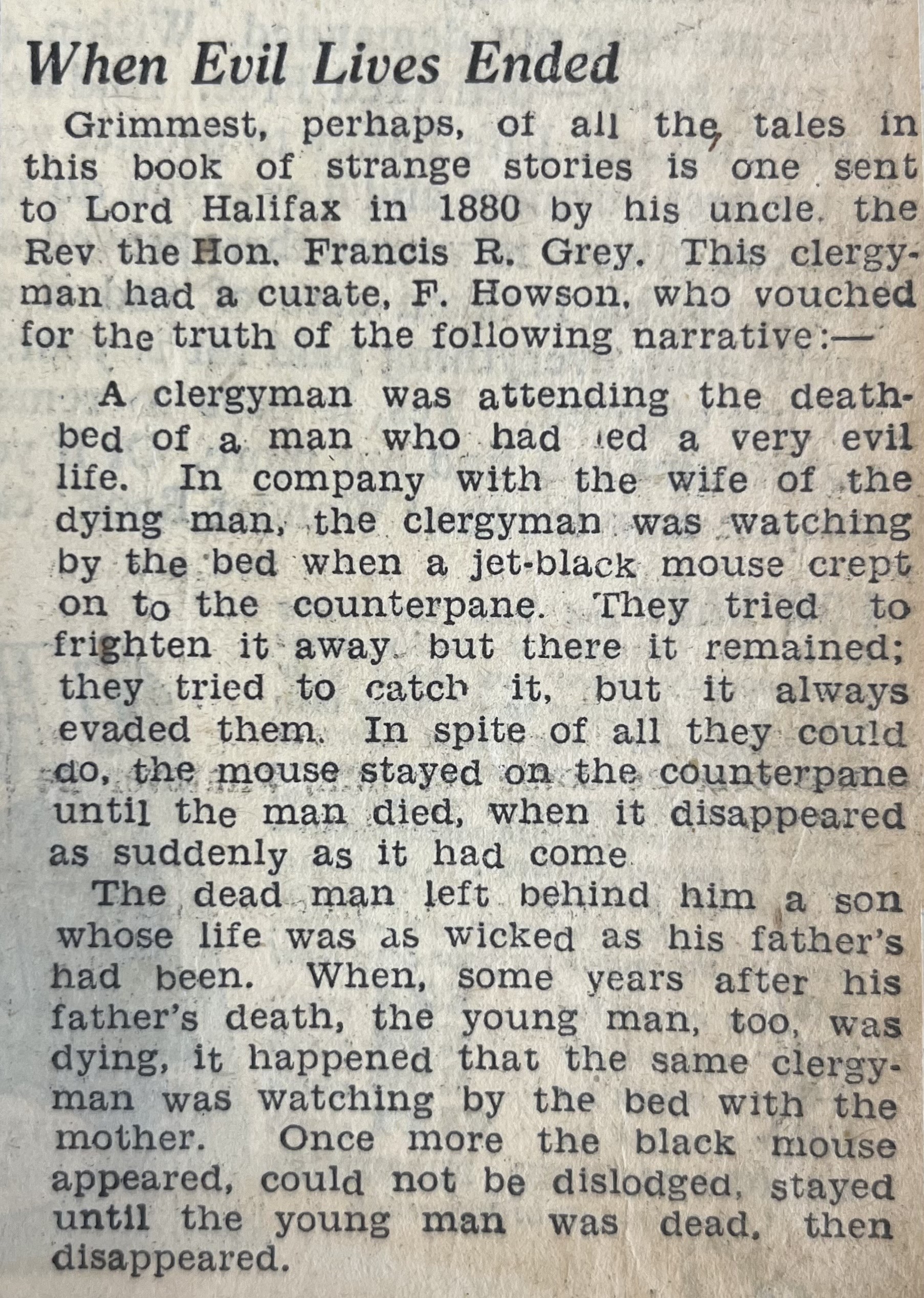
The dead man left behind him a son whose life was as wicked as his father’s had been. When, some years after his father’s death, the young man, too, was dying, it happened that the same clergyman was watching by the bed with the mother. Once more the black mouse appeared, could not be dislodged, stayed until the young man was dead then disappeared.
A Leeds Ghost
In “Candled Peel” — the life story of Mr. Kinsey Peile, the actor — I came across yesterday a very fully corroborated Leeds ghost story.
“While on tour,” says the author, “with George Alexander we visited Leeds. I had taken lodgings with a friend in the company. The house we were to spend the week in stood in a dark, dismal garden, surrounded by high walls.
“I woke one morning at about four o’clock. Suddenly to my surprise, a lady with fair hair, dressed in a claret coloured plush tea-gown, trimmed with coffee-coloured lace, appeared at the foot of my bed, gazed at me for a few moments with lack-lustre eyes, and glided away round my bed towards a deep cupboard in the corner of my room in which I had placed my dressing case with its silver fittings.
“The idea of anything spooky never entered my brain; I thought she was after my silver-topped bottles. I sprang out of bed, went to the cupboard, and found no one there. I felt puzzled, but tumbled back into bed and was soon fast asleep.

“At breakfast I told my friend what I had seen; he laughed and said it must have been indigestion or imagination. I never worried my head about it until the Sunday morning of our departure, when I awoke and again saw the fair-lady in the tea-gown. This time I made up my mind to get to the bottom of the mystery. I cross-questioned my friend, as it was he who had suggested our taking these rooms. As a matter, of fact, he said, ‘your bedroom is supposed to be haunted by the ghost of Miss —– (a famous light opera singer of that time) whose husband is believed to have poisoned her. She died in your room.2
“‘Really,’ I answered, ‘I think you might have told me beforehand.’
“He went on calmly, ‘I wanted to have further proof of the story, for I have seen her too; in fact I was with her in the room an hour before she died. She was lying on the sofa wearing the tea gown you describe.’
“I wasn’t sorry to leave those lodgings.”
Clothes and a Curse
Leeds Corporation has quite a number of ghosts among its invisible assets. There are at least a couple of municipally-owned spectres at Temple Newsam; there is one, which presumably comes under the Waterworks Department, at Swinsty Hall, alongside the reservoir in the Washburn Valley; there is the haunted Abbot’s bed in the Kirkstall Museum, and probably one or two others which have temporarily slipped my memory. But I must confess that until this week I did not know that we had a municipal Curse in Leeds.
The present bearer of the Curse is the lovely lady whom you see in the picture. She is one of the waxworks on which Mr. Kenneth Sanderson’s collection of old-time costumes are set out to their best advantage in the Leeds Art Gallery. On her head she wears a lace lappet, or head-dress, and it is with this that my story, which comes to me from Mr. Sanderson, is concerned.
The lappet belonged originally to Madame du Barry, having been given to her by Louis XV. Before her execution she is said to have placed a curse upon every item in her wardrobe, declaring that ill-luck would attend anyone who presumed to wear her possessions.

Her treasures were scattered during the Revolution, and ultimately this lappet turned up at a Paris saleroom, where it was bought by an English visitor for his wife. That was in 1794. The lady wore the lappet at the Waterloo Victory Ball, and when coming home she was thrown out of her carriage and killed. Later, her daughter wore it—and immediately met with serious injuries through falling from her horse.
Then the lappet was hidden for a time, no one daring to wear it. Eventually, however, it was rescued by one of the younger generation who wore it at a ball. Not long afterwards she was drowned at sea.
Gradually, the lappet’s evil reputations was forgotten, but was discovered afresh when tragedy befell its new owner in 1914. After that it was kept securely hidden, and only given to Mr Sanderson for his collection on condition that he would never allow it to be worn by anyone – except the waxen beauty in my picture. So far she is bearing up well, but if ever she suffers from mice, damp or any other evils to which wax is heir, you will know the reason why.
Hick’s ghost scrapbook is entitled ‘Ghost Stories and Weird Experiences, Life After Death etc.’ Full details can be found here.
Simon Smith’s illustrations can be seen in the Local and Family History Library from Wednesday 23rd October – Saturday 9th November during normal library opening hours. Follow him on Instagram @curmudgeonly_si
Please book an appointment if you wish to view any of the Hick Collection by contacting localandfamilyhistory@leeds.gov.uk or 0113 378 6982. ID will be required.
 The Secret Library | Leeds Libraries Heritage Blog
As well as these gruesome tales why not visit the more benevolent environs of Bolling Hall, Bradford. There you will find the ‘blue room’ with the door knob that turns by itself. Or alternatively marvel at the indoor riding horse (beloved by the landed gentry when they couldn’t get out).
What excellent stories!! I love this!
I like ghost stories. I think there should be a University set up to study pseudoscience sincerely.