This week we hear from Library and Digital Assistant Jan Pinder with another fascinating ramble around Horsforth, following on from last year’s Tales from the Horsforth Research Guide…
The Horsforth research guide was produced as a starting point for anyone wishing to use the Central Library stock to find out more about the history of Horsforth. This post will use materials from the guide to focus on some of Horsforth’s most notable buildings, some of which have been well preserved, others which have changed use, and a few that are unfortunately no longer here.
Some of the oldest buildings in Horsforth are its public houses, so this will be our starting point. In times gone by, public houses were at the heart of small communities and provided a centre for local gossip and business transactions. The Horsforth History Guide Number 2, The Inns, Taverns and Public Houses of Horsforth (L HOR 647) provides information and photographs of the many inns, taverns and beer houses that the town has seen over the years and forms the basis for the first part of this post.
The Old King’s Arms
The oldest license in Horsforth is held by the Old Kings Arms, which is located on the Green at the bottom of Town Street. The original part of the building started out as a farmhouse, with the imposing Victorian façade added later. The date stone above the main door (1879) is therefore misleading, as the pub was actually opened in 1749.
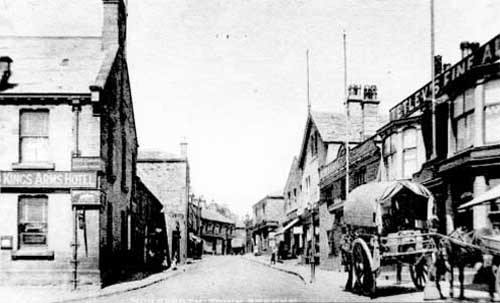
The grand Victorian addition was built directly in front of the old house and immediately in front of the garden wall was the site of the village stocks. This location is not surprising considering that by 1822 justice sessions were being held at the King’s. The stocks are shown on a town map of 1839, but had disappeared by 1878. The following account is given of the last occupier of the stocks:
The victim was a drunk – he lived not far from the Green. His wife, on hearing of the infliction, and under the cover of darkness, went to see him. By that time he fully realised his degraded position and spoke of having severe pain in the back, whereupon she immediately made from home, bringing back with her a cushion, and back to back she stayed with him through the night, bringing him great comfort and consolation. (Source: Dr Henry Bailey’s notes, 1948)
The Queens Arms
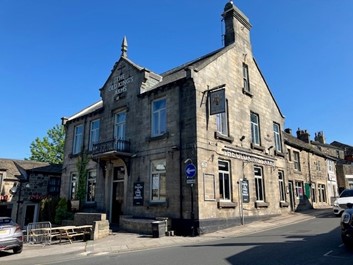
The Kings Arms, however, is not the oldest building in Horsforth currently used as a public house. This title goes to the Queens Arms on Long Row, formerly the Horse and Jockey, which was built originally as a house and weaving shop around the year 1630.
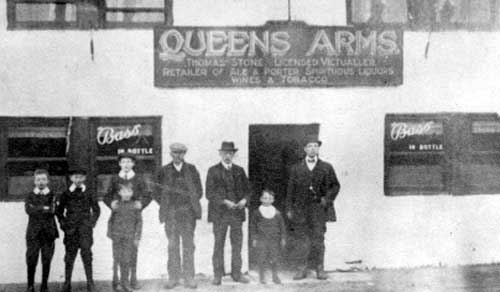
The building was purchased by John Longfellow, a cloth weaver in 1766. It is interesting to note that the famous American poet Henry Wadsworth Longfellow (1807 – 1882) was descended from the Horsforth Longfellows, although it is likely he was descended from a second group of Longfellows and not from John. The Longfellow family first occur in Horsforth records during the early 1600s (see Horsforth History Guide Number 8 – Horsforth History Tour (L HOR 942)). William Longfellow (1619- 1704), a clothmaker of Horsforth, had a son, also called William, who decided to sail to New England (now USA) during the 1670s. This younger William is known to be the great great great grandfather of the American poet.
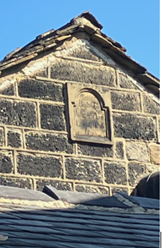
Back to the Longfellows of the Queens Arms. John Longfellow and his wife Ann began to add an extension to the original building in 1794. Tucked away on a gable end at the back of the building, we can still see the stone plaque that commemorates this work. It reads ‘Built by John and Ann Longfellow 1795.’
The pub still has it’s original beamed ceiling and other than the changed location of the main doorway, must still closely resemble the pub of centuries past.
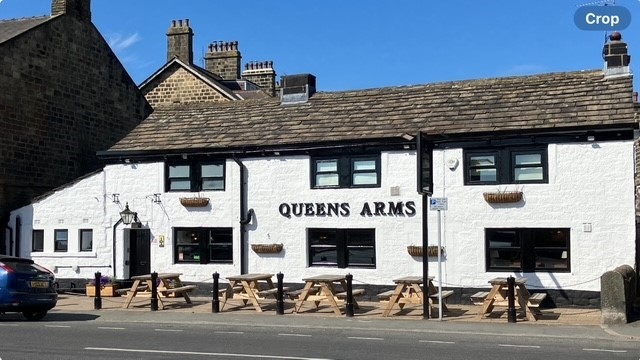
Queens Arms (above)
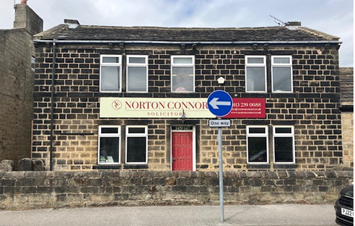
Many of Horsforth’s beerhouses have changed use over the years, one example being the Star and Garter on Town Street, which now houses Norton Connor solicitors. The Star and Garter brewed it’s own beer, and water for the brewing was obtained from the village water pump, which stood on the pavement almost in front of the inn. Please see The Horsforth History Guide Number 2, The Inns, Taverns and Public Houses of Horsforth (L HOR 647).
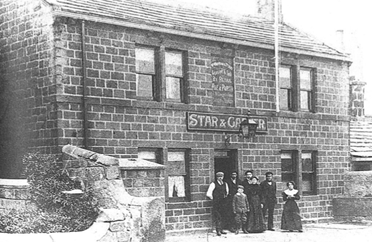
The photograph above shows the pub’s last landlord, William Marshall Tetley, his family and some of his regulars. The Star and Garter closed its doors to the public in 1927. It was then bought by a church group, with the ideal of attracting young people to use the premises for recreation, without alcohol. Apparently this wasn’t very popular! Prior to its current use as a solicitor’s practice, it was also used as a Jehovah’s Witness Meeting House.
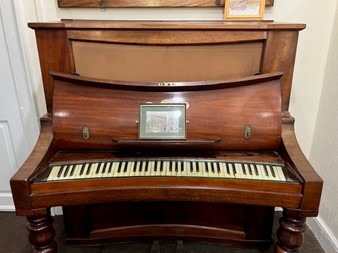
In the mid nineteenth century the Star and Garter was home to a distinctive piano with a curved keyboard. This is now on display in Horsforth Museum. It was left to Sarah Stables on the death of her father William, the pub landlord, in 1855 together with his sheet music. It moved to Cookridge with Sarah on her marriage and then returned with her to Town Street on the death of her husband. Sarah taught music at her Town Street home until she passed away in 1895.
Horsforth Hall
Probably the biggest loss to Horsforth in terms of buildings is that of Horsforth Hall in Hall Park, which was demolished in 1952. The hall was commissioned by the Stanhopes, a prominent Horsforth family, who came into possession of one fifth of the Manor of Horsforth when the estates of Kirkstall Abbey were sold off after the dissolution of the monasteries. They were the principal Horsforth family from 1630 until they left at the end of the eighteenth century
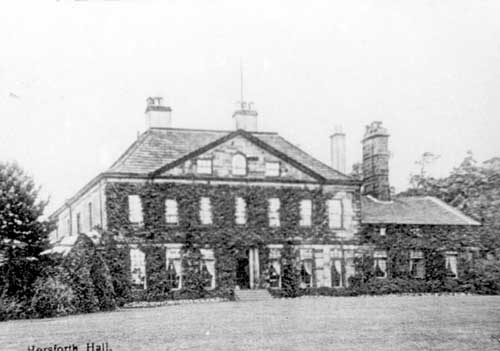
The hall was built by John Stanhope IV and was originally called New Hall. It was begun in 1699 and completed by 1707, when the family moved from their home at Low Hall (see later in article).
After the last Stanhope to inhabit the hall left around 1790, it was rented by various tenants. The first of these was Colonel Thomas Lloyd, owner of Armley Mills. In the 1880s a cricket field was set up in the park, which in 1896 was leased to the Horsforth Hall Park Cricket Club. Many famous cricketers including Hedley Verity, Herbert Sutcliffe, Bill Bowes and Len Hutton have played there. Please see Horsforth History Guide Number 7 – A History of Horsforth Hall Park: 1700 – 2000 (L HOR 942) for a full history of Horsforth Hall.
In 1930 the Hall and park were bought by a Scottish businessman, William Mathieson. He never lived in the hall, but it was he and his wife who donated the house and parkland to the people of Horsforth in May 1932.
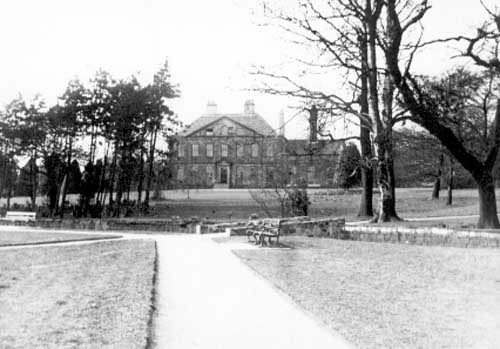
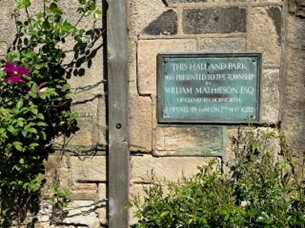
The hall was used as offices for Horsforth Urban District Council for some years. It had a café and was also a military communications centre and HQ of the ARP in the Second World War. After the war the structure of the hall was threatened by subsidence and rotting timbers. Rumour has it that the then Town Clerk, while sitting at his desk, suddenly disappeared through the floor as it collapsed beneath his weight! The council were unable to find the funds for the necessary repairs and so the hall was demolished. The site of Horsforth Hall is now occupied by a garden.
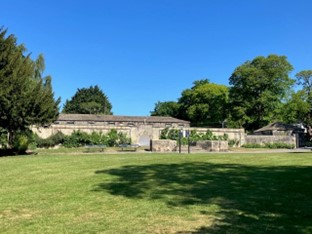
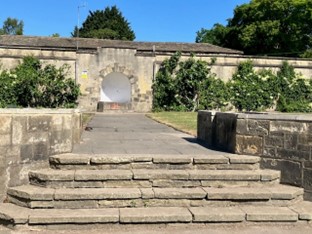
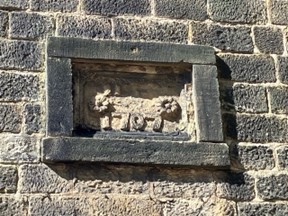
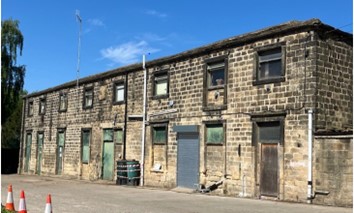
To the north of the hall was the stable block and coach house, which still stand today and are used as offices and a depot. The date of the building of the stables, 1707, can still be seen carved on a stone below the eves.
Low Hall
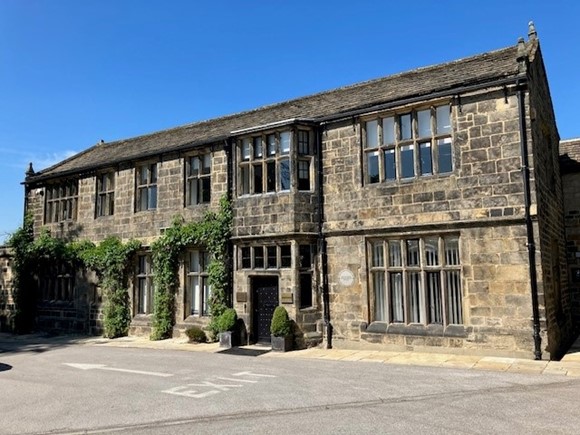
Low Hall, as mentioned above, was the original home of the Stanhope family, and is one of the oldest buildings in Horsforth. This Tudor house is 16th century in architecture and built from local stone. An information board inside the building tells us that the first recorded history of Low Hall is in 1565. It also tells an interesting story about Walter Stanhope, the second owner of Low Hall, who earned the wrath of King Charles I when he refused to attend his coronation and also refused a knighthood. On account of this he was fined £16 in 1630. Walter was asked to join the Royalist cause on many occasions, but chose to side with the Roundheads. Consequently, on 20 December 1642 Low Hall was invaded and plundered by Royalist Troops from Leeds, who stabled two hundred horses in the barn there.
In 1643 a warrant was issued against Walter Stanhope and his brother Richard for taking up arms against the King. It was only the timely intervention of his Cavalier son John, who had returned home from the Irish rebellion and appealed to Charles II to grant a pardon for his father’s past support of the rebels, that saved him. For more information on Walter Stanhope and the Stanhope family please see Walter Spencer Stanhope and the Stanhopes of Horsforth (LQ B STA).
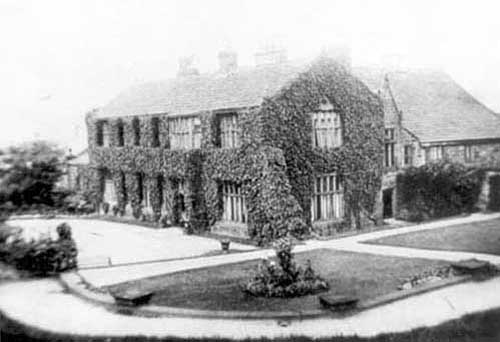
The Stanhopes remained in residence at Low Hall until 1699, when John Stanhope built Horsforth Hall. Low Hall continued to be occupied by relatives. Stanhope became a renowned lawyer and was instrumental in the creation of the Leeds Liverpool Canal, subscribing £5 500 towards it’s construction with his brother. He unfortunately died from gout in 1769, a year before work on the canal commenced. In the 1980s Low Hall was a popular restaurant and wedding venue, it is currently in use as offices.
The Silk Mill
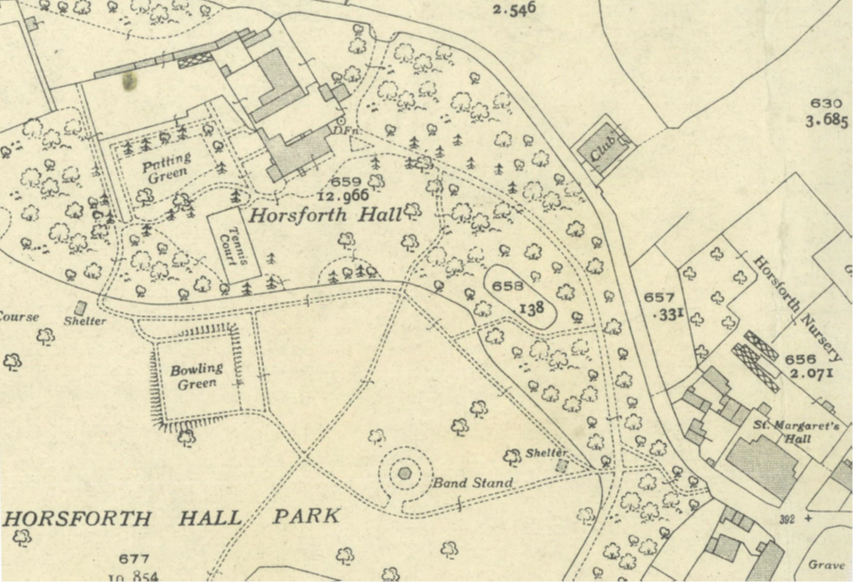
Horsforth was originally an agricultural community, before expanding rapidly during the Industrial Revolution. The home-based hand weaving of woollen cloth would have been the principal industry, but Horsforth saw the rise of many other industries, including textile production in the mills, tanning, quarrying, soap making, coal mining, silk spinning, corn grinding and dyeworks. The Woodside area of Horsforth was home to many of its mills, as is shown on the map below:
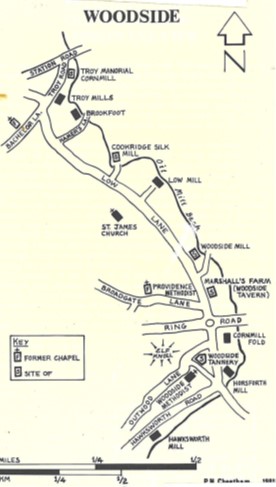
Perhaps the grandest of those mills was the Silk Mill, or Cookridge Mill. As most of the textile production in the area was woollen cloth, silk-spinning would have been unusual for the time. The highly specialised skilled labour for the spinning was originally obtained from Calderdale and during the late 1840s and early 1850s there had grown a ‘colony’ of silk-spinning families, all of whom came from the Halifax area.
Although silk production had begun here in the 1840s, most of the mill was built by John Charnley in 1884. He had bought the premises in 1879 for £7 000, but trade had become difficult. In July 1881 there were two suspicious fires just hours apart in different parts of the building, which almost destroyed it and allegedly put 200 people out of work. The insurance companies offered a reward for information, stating that ‘should there be more than one offender and the informant be connected with firing the mill, such informant shall be held harmless.’ Following this, a man called James Harling came forward to claim the reward, admitting that he and James Capstick started the fires on the orders of Charnley, who wanted to move to America. Although the insurance companies disputed the amount being claimed, they agreed to pay Charnley £20 296, but Harling and Capstick stood trial for arson. Capstick was found not guilty, but Harling guilty and sentenced to ten years of penal servitude. In 1883 John Charnley set about rebuilding the mill. The Wharfedale and Airedale Observer noted on 1 February 1884 that
Mr Charnley’s handsome and spacious silk mill is rapidly approaching completion, and before long we hope to see it filled with machinery, all in full employment and with plenty of orders at the back.
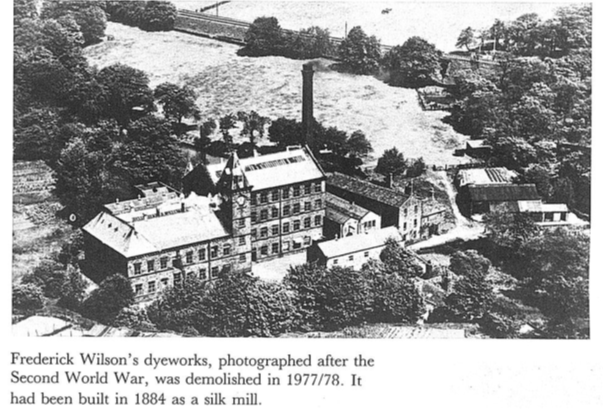
However, profitability was short lived and the mill was reorganised in 1891 to include worsted spinning. It changed hands a number of times before finally being demolished in 1977-78. John Charnley did get to America, he sailed from Liverpool in March 1904, where he was employed selling silk yarn. For more information on the silk mill and many other local mills please see Horsforth History Guide Number 3 – Woodside and it’s Industries (L HOR 338 ).
The Mechanics Institute
An article on Horsforth’s most notable buildings would not be complete without reference to the building that houses Horsforth’s library today, the Mechanics Institute. Mechanics’ Institutes were educational institutions, particularly popular in the 19th century, which were formed to provide means of self-help education for working people. Horsforth Mechanics Institute was built in 1882 of local millstone grit on land donated by Sir W.T.W. Spencer-Stanhope, and is one of the few listed buildings in Horsforth. It included a large meeting room, reading room and a library (see Leodis). The police station adjoined the building.
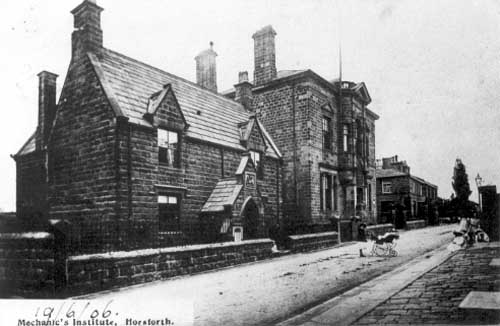
The Mechanics Institute now forms part of Horsforth Community Centre, which includes the library, along with the Brownlee Stone Centre shown on the left.
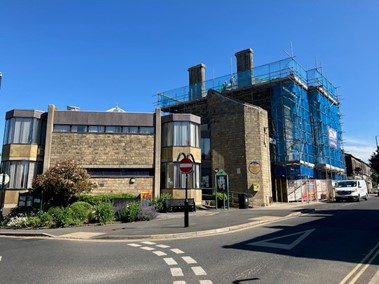
The police station was demolished to provide a site for a new library in the 1970s and a new police station was built on the Ring Road, which has also now been demolished. The library has since moved back into the Mechanics Institute.
Horsforth has a rich and full history, which is reflected in the tales that can be told about its many historic buildings. If you would like to find out more please see the Horsforth Research Guide for details of Leeds Central Library stock. Also visit www.leodis.net, which has hundreds of photographs of old Horsforth or visit Horsforth Museum.
Jan Pinder, June 2025
 The Secret Library | Leeds Libraries Heritage Blog
lovely post, thanks!