We welcome Library and Digital Assistant Becky Bavill back to the Secret Library this week, for a brilliantly-researched story to mark Armed Forces Day on June 29. This is the second part of a three part series that will run throughout June, alongside a full programme of Leeds Libraries events. You can find all three parts of this series here.
At the end of the last blog post on this subject, I left you on a cliffhanger, having tentatively identified the bride as Susan Smith of 81 Hillary Street.
It was time to turn to the census. Armed with an address and the names of Susan and her late father, I soon had the 1911 census in front of me. According to this document, Susan had 2 brothers living with her at Hillary Street in 1911. Even better, both of those brothers, and her father were compositors, working for newspapers, strengthening the link already established.
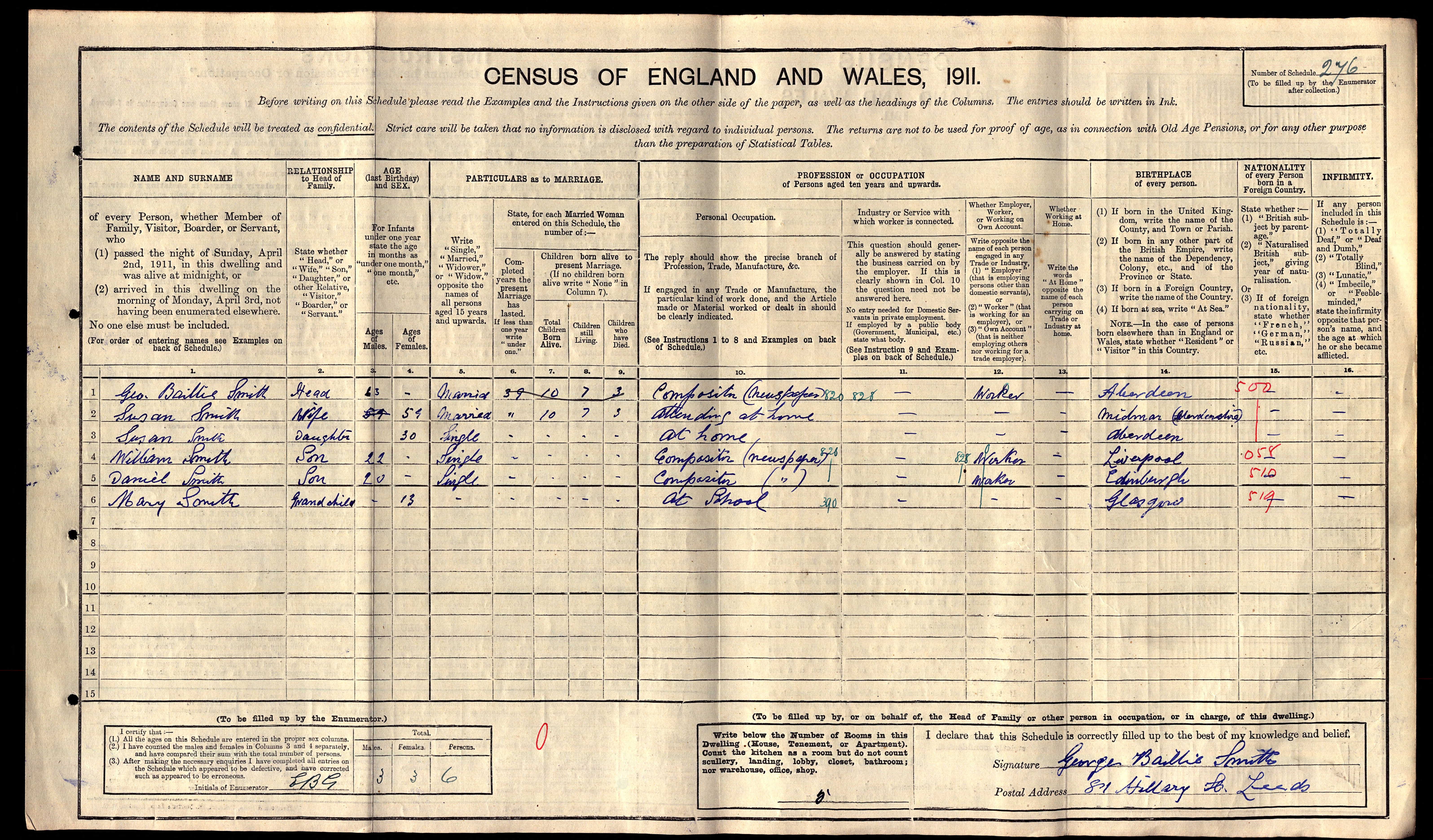
At this point, I have to admit, I fell face down into a rabbit hole. The 1911 census has a very useful piece of information on it, namely the details of how long a couple has been married, how many children they had, and how many have died. George and Susan senior had clocked up 39 years and 10 children. Although 3 of them had died before 1911 and couldn’t possibly be our diarist, I still needed to know who they all were in order to rule them out. Given that the family had lived in Edinburgh, Liverpool and Leeds at various times, this was not an easy task and took a lot of time.
Eventually I established what I thought was a definitive genealogy of the Smith family and concluded that my two strongest candidates were Daniel and William from the 1911 census. I needed to use another resource – the Absent Voters List. This records servicemen who were away from their place of residence and eligible to vote in the 1918 General Election. The list records the man’s regiment, service number, rank and address in Leeds where he was registered to vote. A name index is available to search online at:
https://libraries.leeds.gov.uk/what-you-can-do/local-and-family-history/absent-war-voters
Where I found both of them quite quickly:
3571C Daniel Smith 283997 GNR RFA
3556C William Smith 252547 DVR 666TH CO ASC

Both of these codes indicated the Hillary Street address. This identified Daniel as a Gunner in the Royal Field Artillery like Eric Stowell. On inspection of the marriage certificate, Daniel was actually a witness at his sister’s wedding, so he is very unlikely to have been writing a diary in a trench at the same time. William however, was a Driver in the Army Service Corps. Wait a minute, a driver? Of horses?
So it was now time for me to take a deep dive into the Army Service Corps, which became the Royal Army Service Corps at the end of the Great War. They had the mammoth task of transporting supplies, people, horses and material to and from trenches, headquarters, ammunition dumps and reserve locations. This sounds very much like what our diarist was doing; often referring to being ‘in convoy’ and describing some rather hair-raising supply runs. This is a fantastic summary of the work of the ASC:
Which also contained a gem of information, that drivers of horse drawn transport had their service numbers prefixed by a T. This allowed me to find this medal card, for William M Smith.
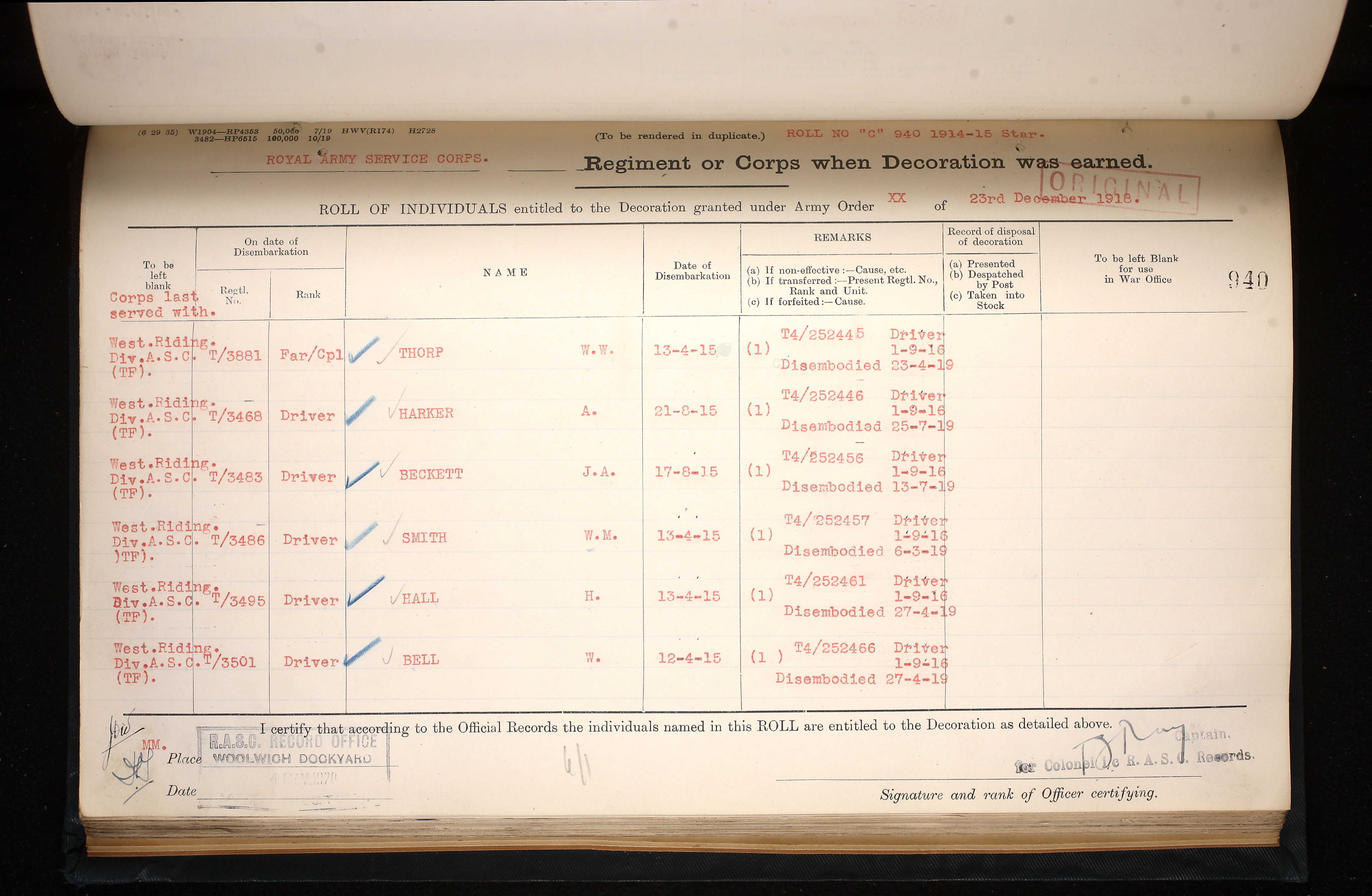
Which shows the same service number from the absent voters with a T prefix. It also shows that William joined as a territorial, just like the friends he named. A medal card isn’t that informative though, but it can lead to the information on the Medal Roll and . . . jackpot!

It looks like I’m getting closer to identifying our diarist, but I don’t think it’s quite ready to be set in stone. The information on the medal roll requires further investigation.
You can download extracts from the Leeds Mercury war diary to read this fascinating slice of local and international history for yourself.
 The Secret Library | Leeds Libraries Heritage Blog
How fascinating. Through research, I discovered that my own grandfather (Alfred Beckwith) was a member of the Territorial Army in Leeds (signing up in 1912) and it states on his enlistment that his own father (William Beckwith) had 35 years service in the force. The TA was an important organisation, I believe, at that time for keeping young men “out of trouble” and giving them skills and training they might not otherwise have received. His brother (also William Beckwith), too was in the TA (although I have less information on him) and I have a picture of all 3 of them in uniform probably at the start of WW1. The 2 brothers (probably destined for active service) both wear armbands that read “SB” (probably “stretcher bearer”) and I was told (and it says also on my grandfather’s enlistment papers that he was a “good musician”) that they were probably regimental musicians (as these acted, unarmed, as stretcher bearers on the battlefield). When war broke out, my grandfather was also with the Leeds Rifles (7th Bttn West Yorks), sent to Gainsborough for training then served in France (and, I am happy to say, both he and his brother returned alive). Reading this account, I have been able to picture perhaps something of what they might have experienced. (Coincidentally, my father’s brother also worked for the Yorkshire Evening post after the war!) My own father (himself Alfred Beckwith) himself then joined the TA in Leeds as soon as he was old enough (like his father, uncle and grandfather had done) before WW2 and developed enough skills and promotions to be able to train raw volunteer recruits in Scotland in 1939-41 (he was a trained PT instructor) instead of being sent immediately to a field of conflict. He then transferred to the RAF in 1941 and learnt to fly Spitfires. The TA was a very important organisation for generations of young men in Leeds, it seems. I am sure there are many families who will have some connection to the Territorial Army in Leeds and this will be fascinating to many of them. Thank you! I wonder what service the men in the Territorial Army (like my Great grandfather) from the 1870s saw?
Hi Jill, I’m so glad you liked it! If you would like to contact the library, I’m currently working with a photo album of the 7th and 8th battalion between 1900 and 1916. There are very few names in it, but it’s possible you might recognise some faces. localandfamilyhistory@leeds.gov.uk
Thank you, I will. I do have one photo of my grandfather and his brother in their (I assume) uniforms and I would definitely recognise their faces if I saw them (or I hope I would).