We welcome Library and Digital Assistant Becky Bavill back to the Secret Library this week, for a brilliantly-researched story to mark Armed Forces Day on June 29. This is the first part of a three part series that will run throughout June, alongside a full programme of Leeds Libraries events. You can find all three parts of this series here.
A long time ago in a library (not) far away, we received some interesting post from the Sheffield archives. It contained some printed columns of what turned out to be a WW1 diary from the front line, from the 16th of August to the 18th of October, year unspecified. Sheffield thought it might have been written by a Leeds resident, especially as it mentioned at least one other WW1 soldier known to be from Leeds. This is interesting in several respects:
- The keeping of diaries is generally against military regulations. There was too great a risk that they could fall into enemy hands the information contained could then be exploited – or so I had been led to believe.
- It has been typeset into newspaper columns. Does this mean it had been printed?
- Would it be possible to identify the diarist?
My first job was to read through and pick out anything that be helpful in identifying our diarist. Several names of other soldiers came up first. Here in the Local and Family History department we have 15 volumes of newspaper cuttings from the Great War and, helpfully for us, they have been indexed.
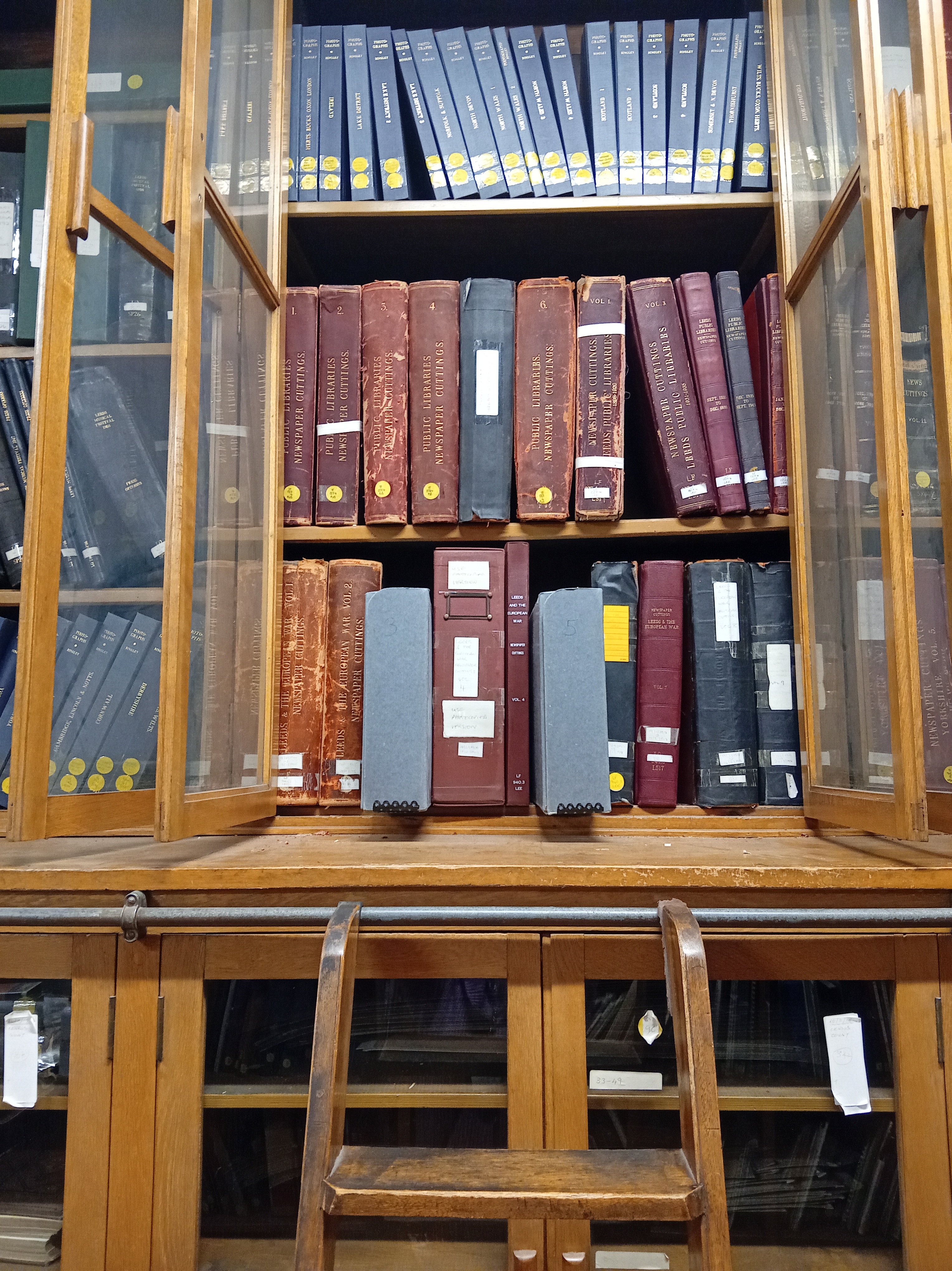
These are the soldiers who were most relevant. There will be a separate post about each of them, but these are the highlights:
Sergeant Frederick Albert Reginald Luff of the West Yorkshire Regiment (Prince of Wales’ Own) was awarded a Military Medal. Before the war he had been on the machine-room staff at the Leeds Mercury. He lived at Bayswater Road in Harehills with his wife and daughter.
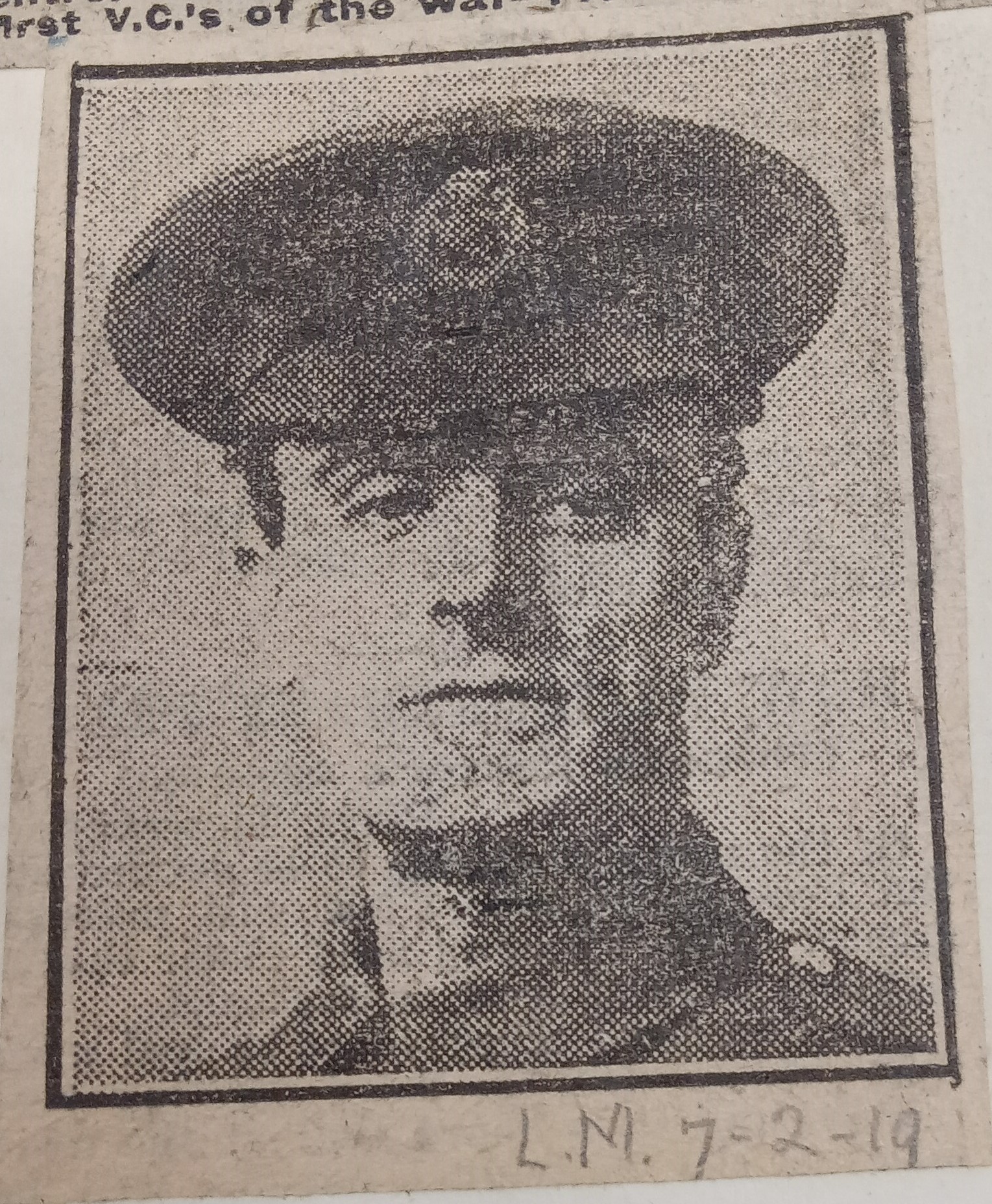
Second Lieutenant Eric Finlinson Stowell of the West Riding (Territorial) Field Artillery was decorated multiple times, including a Distinguished Conduct Medal and a Military Cross. Before the war he had been a journalist at the Leeds Mercury and the family lived at Reginald Terrace in Chapeltown.
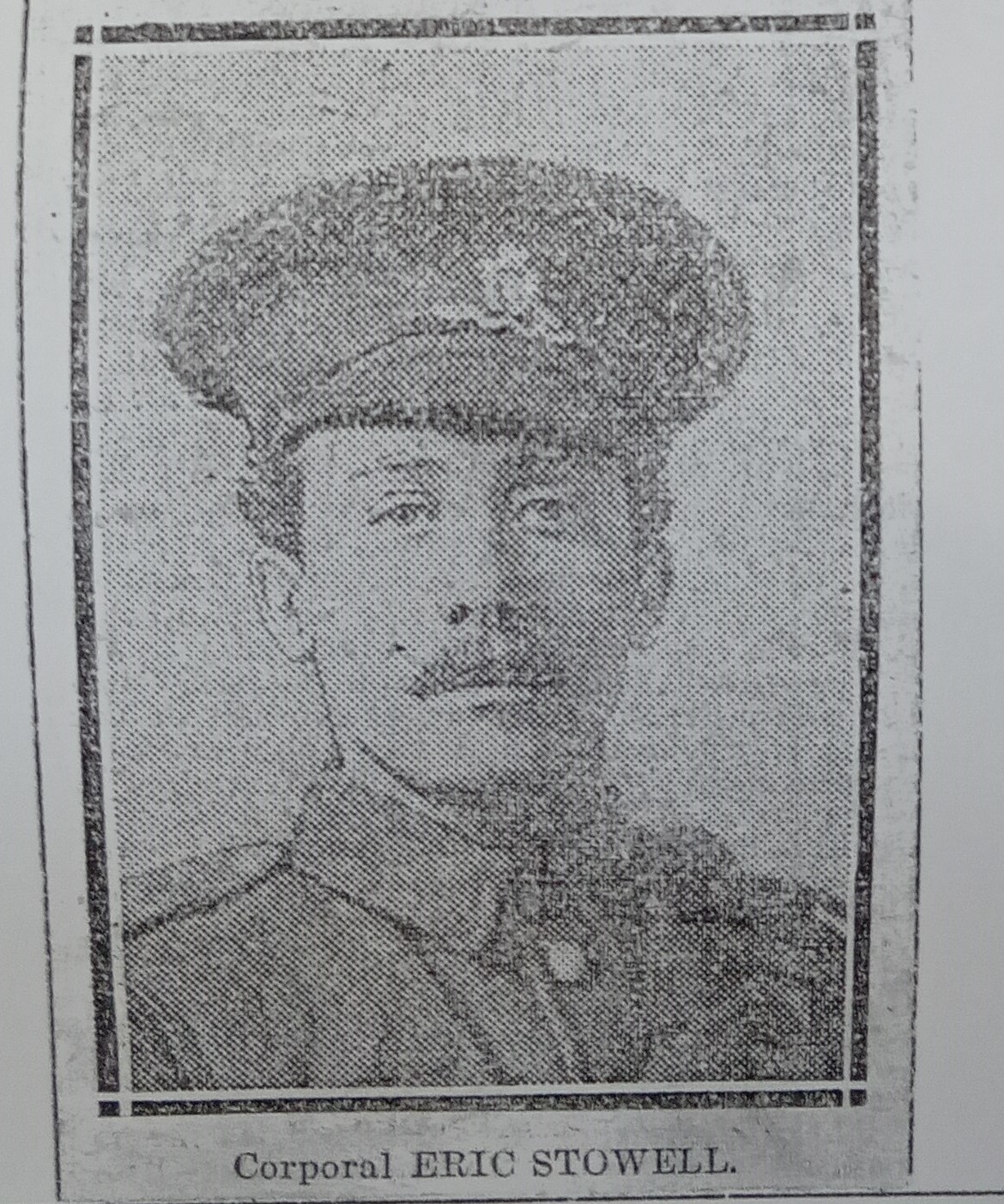
Sergeant Percy Longfield was in the 1/8th West Yorkshire (Territorial) Regiment (Prince of Wales’ Own). Also known as the Leeds Rifles. Before the war he was variously described as helping his father with his debt collection business or a clerk. The family lived at Blackman Lane in Woodhouse. He wasn’t in the cuttings books, I found him on Ancestry.com.
Two of the three worked for the Leeds Mercury which was a good connection to explore. Two of the three are clearly stated to have been part of the territorial regiment. This was an interesting lead. I tried to pull together the descriptions of their roles in the army, but it can get quite complicated with brigades, battalions and divisions. Here is my attempt to make sense of it.
Prior to 1908, people could volunteer to support the army in a number of ways. They could be members of a militia, the volunteer force, or the yeomanry. It was messy, and not very efficient. In 1907, Richard Haldane, the Liberal Secretary of State for War brought in the Territorial and Reserve Forces Act. This created a force that was financed centrally by the War Office “grouped into fourteen infantry divisions and fourteen mounted brigades. These formations were organised on the lines of the Regular Army but largely administrated by newly-to-be-formed county associations.”(1) This web page gives a breakdown of how the 49th was formed and the various descriptions of the soldiers above can be seen to be part of it.
49th (West Riding) Division – The Long, Long Trail (longlongtrail.co.uk)
And the link from this page to the one below brings the Royal Field Artillery under the same umbrella.
The 49th West Riding Territorial Regiment had a base at Fenton Street just prior to the war. Plenty of men signed up to be part of what we would later call the TA. There was an active social life, annual camps and recognition for skills like shooting. The important to thing to note – and this can be seen on attestation papers from the time – is that when you joined the Territorial Regiment you agreed to be called up to fight IN ENGLAND. According to Great War historian, Rob Martin, what happened at the start of the war was the application of peer pressure on a grand scale.
“They’d be called to a meeting and given a hard sell about doing their duty and going abroad. At the end they’d gee them up into a show of hands agreeing to be called up to go to France. When all your mates around you are going along with it, who’s going to say no?”
It is generally agreed that the Territorials played a vital role on the Western Front. After the near destruction of the British Expeditionary Force in 1914, conscription was eventually introduced in January 1916; but the Territorials had to fill the gaps until Kitchener’s New Army was ready to be deployed.
So far then, I had connected these three men as having either worked together or served together, possibly both. It was time to go back to the diary. Our diarist seemed to be living quite an independent life, spending a lot of time with horses and moving from place to place.
“On convoy again.”
“Reported at engineer’s place and went to trenches with them.”
“Called at Headquarters, bombers’(had to take some there!), dug-outs, then our sergeant and I set out on a trench-trip.”
Sometimes he was at the trenches, sometimes he was at HQ. Horses were used to move guns, but also considerable amounts of supplies. He doesn’t seem to be a regular Tommy as we might understand it. There were more clues about our diarist’s home life too:
Wishing to be ‘at the Fenton’
The mention of Phil and Charlie’s wedding at ‘dear old 81’ on September 25th.
Although no year was recorded on the pages supplied our diarist recorded both days and dates which could only make it 1915. The next step was to consult the marriages column of the Mercury and there it was: on Saturday 25th September 1915 the marriage of Charles Holdsworth to Susan Davidson Smith of 81 Hillary Street Leeds.
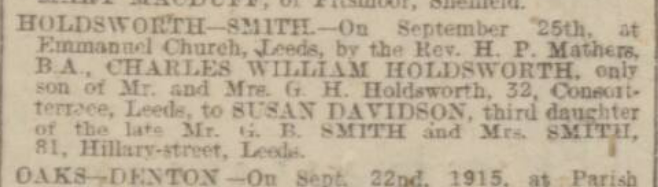
At this stage I must apologise to the other library customers who were disturbed when I actually screamed at finding this. Especially when I realised that Hillary Street is a 3 minute walk from the Fenton Street barracks and the Fenton Pub. Could our diarist be a relative of Susan’s? Why else would 81 be ‘dear’? And why did it have to be SMITH?! Stay tuned for more . . . . . .
(1) Addyman, Ronald, The Leeds Rifles, A Short Regimental History Part 1, Published September 1995. P. 8
You can download extracts from the Leeds Mercury war diary to read this fascinating slice of local and international history for yourself.


I am currently transcribing my Great Grandad’s World War One diary. He was from Stourton and served in the RAMC (Royal Army Medical Corps). The diary covers his shipping out to Gallipoli, the retreat to Egypt and then their shipping out to Northern France where it unfortunately ends. It’s very matter of fact, but full of details. I will gladly be able to send you a copy of it when I have completed it. I also hope to scan the diary in the future as it is in a poor state.
His name was Private John William McCullough, service number 408026. 89th Field Ambulance, 29th Division. He won a military medal for rescuing wounded soldiers under repeated machine gun fire and gas shell barrage. We even have part of a Red Cross Flag he brought back Gallipoli.
Hi Alan, that sounds fascinating! We have a great collection of autobiographies and diaries of Leeds people and we’d be honoured to add your Great Grandad’s. Let us know if we can help you with anything.