The third and final post in Library and Digital Assistant Becky Bavill’s series exploring the lives and careers of some Leeds soldiers during World War I. You can see all the articles in this series by clicking here, or read the original article that sparked this research here.
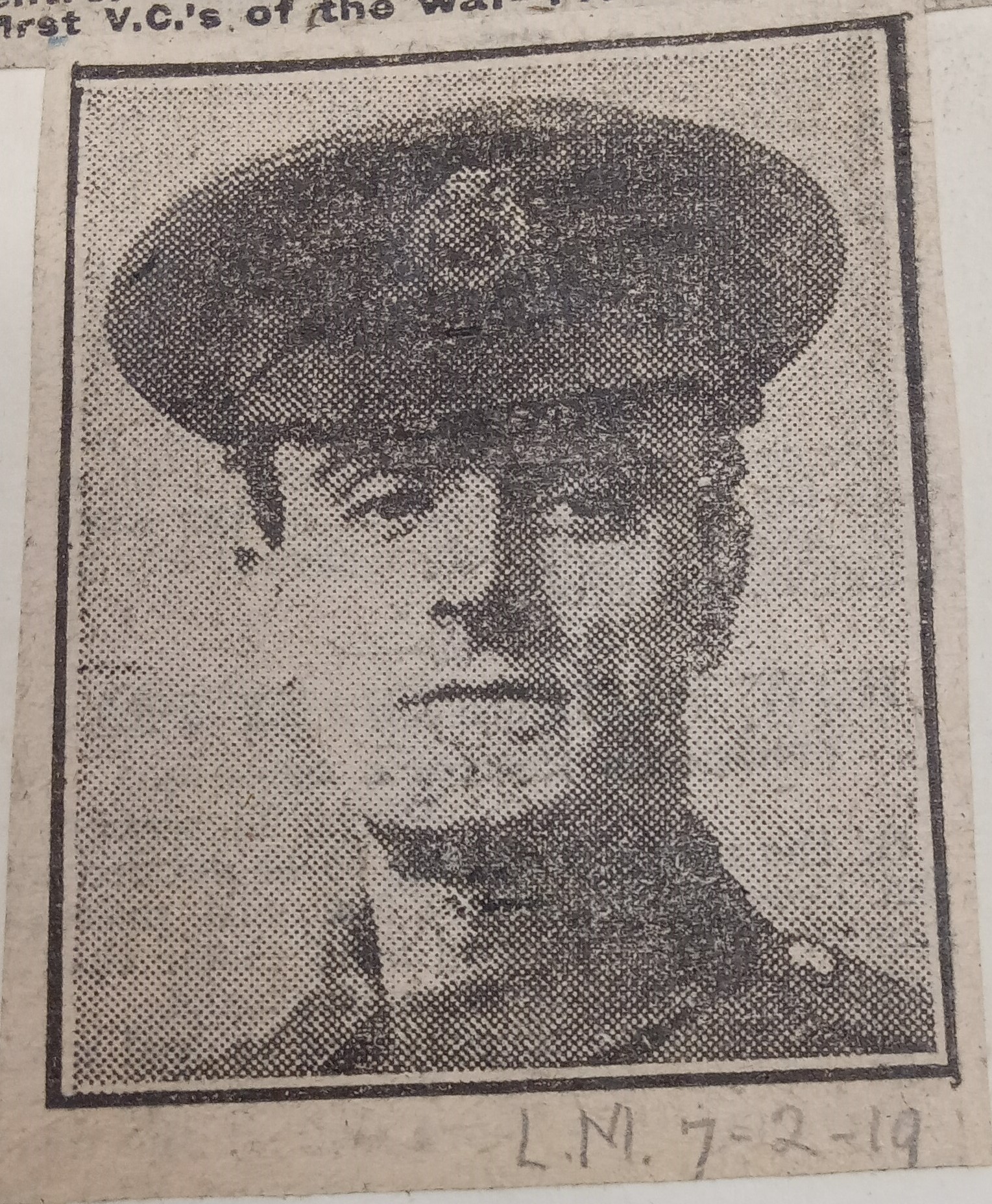
Fred Luff is mentioned in the diary of William Smith whose diary we have profiled in previous blog entries. I identified two links from William to Fred – they were both territorials, and both worked for the Leeds Mercury before the war. The 15 volumes of news-clippings from the Great War held here at Local and Family History offered three clues which added up to him having been in the West Yorkshire Regiment (Prince of Wales’ Own) when he was awarded a Military Medal. Before the war he had been on the machine-room staff at the Leeds Mercury. His wife, who lived at Golcar Street was notified that he was wounded sometime before 31/5/1918. What else can we find out to tell Fred’s story?
We don’t know the exact date of birth of Frederick Albert Reginald Luff (Fred) as it was recorded slightly differently in different sources; but he was baptised in Cardiff 30/12/1887 and his birth registered in Jan/Feb/Mar 1888. His parents were Frederick Henry and Alice Ann. Frederick was a marine engineer at the time of his son’s birth. Fred was one of five – his siblings were Ivy Grace, Blanche, Archibald William and Samuel Percival. Sometime between 1901 and 1910 the whole family moved to Leeds which may have something to do with the change in jobs for Frederick senior – who on the 1911 census was a linotype operator, as his son would later become. The family lived at Ashley Road on the census, which was the address that Fred gave on his marriage certificate.
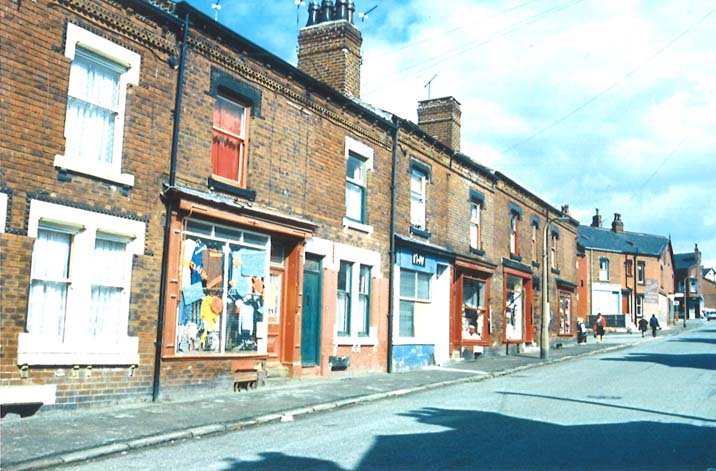
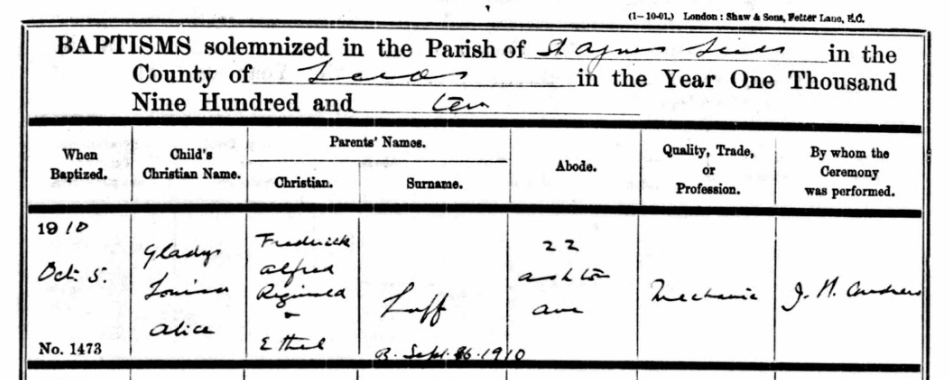
On 26/2/1910 Fred Luff, aged 21 and a mechanic married Ethel Myers at St Clements in Sheepscar. One of the witnesses was his sister, Ivy Grace. Based on the information from the BMD index, they had 7 children, but only 4 survived infancy. They were Gladys, Dorothy, Joseph Frederick and Ethel J. Gladys Louisa Alice was baptised 5/10/1910 in Leeds. The family were at 22 Ashton Avenue, and her father’s profession was listed as mechanic. The next baptism record I found was Joseph whose date of birth was 29/8/1915. This record listed Fred as a mechanic and the family address as Golcar Street – where they had moved to sometime since 1912.
The details of the children they lost also help to fill in the family history. John was buried at Leeds General 30/9/1911 aged 2 days. The family address was 29 Bayswater Street. Frederick was buried at Leeds General 30/9/1912, aged 10 hours which seems like a horrible coincidence of dates. The family address was 39 Bayswater Street. Possibly one of these is an error, but families did move within the same street if they were renting and more suitable rooms came up.
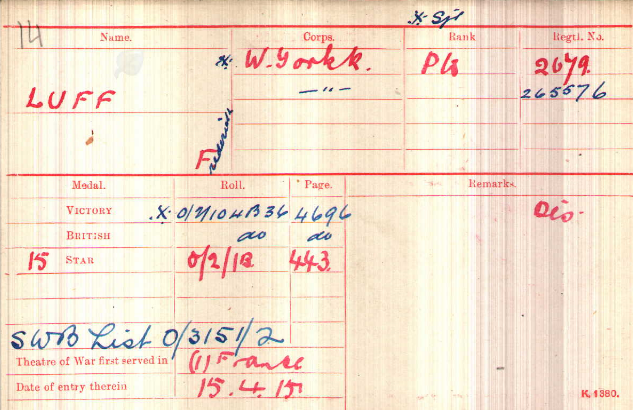
According to the Leeds Mercury, Fred enlisted in the West Yorkshires 7/9/1914. This almost certainly makes him a territorial soldier. His medal card indicates that he was initially part of the 1/7 West Yorkshires with a number of 2679, and then subsequently a sergeant in the 2/7 West Yorkshires, number 265576. He first arrived in France 15/4/1915.
William’s diary makes reference to an injury that Fred was recovering from on 18/9/1915. He was wounded again as reported in the Leeds Mercury 31/5/1918. The article describes him as Sergeant Luff so he had gained a promotion at that stage. At this time, Ethel would have been heavily pregnant with Harry – who was born in June and died in July 1918. I hope that Fred was home by that time to be with his family at what must have been a very stressful period. His citation for a military medal appears in the London Gazette 7/10/1918; and on 7/2/1919 he is described by the Leeds Mercury as having been presented with the Military Medal at a ceremony in Beckett’s Park. This website gives more information about the Military Medal and how to research it:
How to research an award of the Military Medal (MM) – The Long, Long Trail (longlongtrail.co.uk)
He was discharged 18/2/1919 – and awarded the Silver War Badge on discharge. The same website provides more information about this medal too:
Records of the Silver War Badge – The Long, Long Trail (longlongtrail.co.uk)
This suggests that he might have been wounded a third time in whatever it was that led to his citation – his records show that he was discharged as unfit for service; and by the 1921 census he seemed to be retraining to become a self-employed hairdresser. Ethel died of heart failure in 1923; when her youngest child and namesake was just 2 years old. She was buried in Leeds General Cemetery and the notifiers were her mother and father. After 1923, Fred disappeared from Golcar Street in the electoral register, and from the Leeds trade directories entirely.
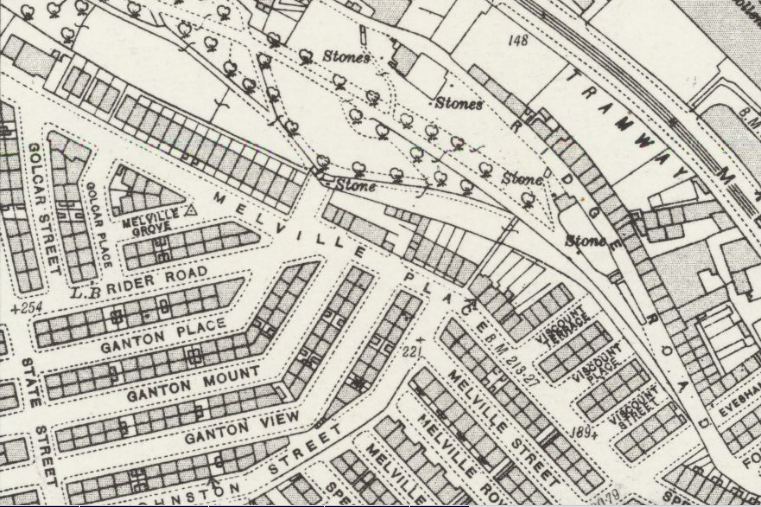
The 1939 register showed him living in Lambeth with Norah, born 8/11/1911 and there are 4 redacted entries in the same household. Norah calls herself Luff, but the only marriage record I can find that fits them is the 1941 marriage of Frederick A R Luff to Norah Kinch in Lambeth. A search for children with the surname Luff and the mother’s maiden name Kinch throws up these records:
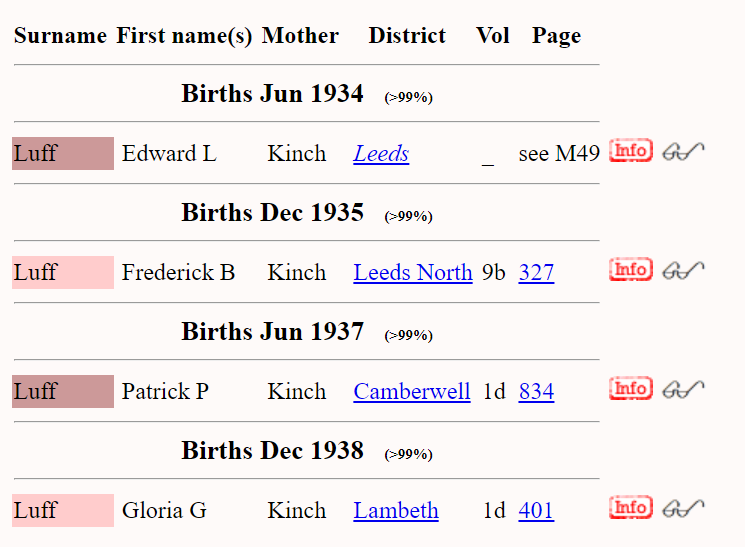
Which would fit the redactions in the 1939 register quite nicely. According to the GRO there was a Nora Kinch born in Hunslet Oct/Nov/Dec 1911. At the time of the birth of the first child, young Ethel would have been 13 so I would have expected her to be living with her father, but by the time of the 1939 register she would have been 18 and likely to be independent – in any case, I lost her in the records. Fred appeared on the electoral register with Norah and their grownup children at the same address in Lambeth throughout the 1950s. His death was registered in Wandsworth 1963.
You can download extracts from the Leeds Mercury war diary to read this fascinating slice of local and international history for yourself.
 The Secret Library | Leeds Libraries Heritage Blog
it’s great to read about the people of Leeds in this period of time. It’s interesting as we can relate it to our own family members and have an idea what their lives might have been like.