This week on the Secret Library we mark the 400th anniversary of the Leeds Charter of 1626 with a new research guide covering resources at our Central Library for exploring this important century…
On July 13 Leeds will celebrate 400 years since the signing of the town’s first Charter in 1626 – a historically significant document granting the newly incorporated Council significant powers of local governance.
The original Charter was lost sometime in the twenty years after it’s signing, though a reissued edition of 1646 survives in the Leeds branch of the West Yorkshire Archive Service (WYAS). You can read more about this fascinating document on the WYAS website.
While the Central Library no longer holds the Charter itself (though it once did, before the Archives split from the Library in the 1960s and moved to their new home in Sheepscar), we do have many other books and other printed resources that can help you to understand this important century in Leeds’ history. We’ve brought many of those together into a new research guide, which you can access on our research guide page, or by clicking the image below.
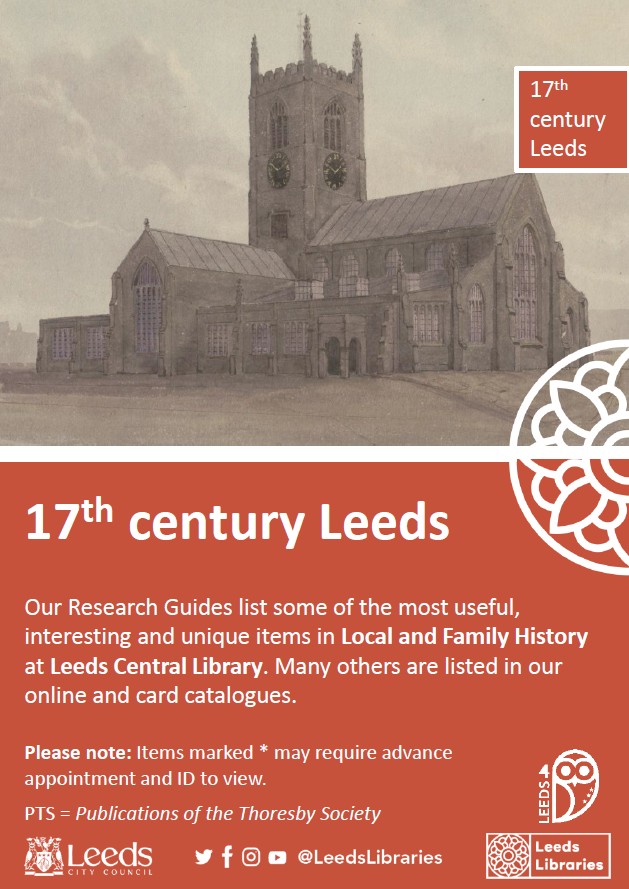
As you’ll see, the guide defines the ‘seventeenth century’ rather broadly in the Leeds context, bookended by two maps: the 1560 plan of Leeds (the first map of the town) at the earliest point and John Cossins’ famous, and by now very familiar, survey dated around 1726. The 1560 plan reflects the rapid growth in the town’s population during a period of expanding trade in textiles across the whole West Riding region, while the Cossins plan reveals something of the gains in wealth, power, and social standing for the leading merchant class since the signing of the Charter.
The intervening years were sometimes tumultuous, shaped by figures such as Alexander Cooke, John Metcalfe, and John Harrison, who presided over an increasingly vibrant intellectual culture. During this period, Leeds secured its place within the broader Republic of Letters through the correspondence and wider exchanges between local scholars like Ralph Thoresby and national luminaries such as Hans Sloane.
While the merchant class utilised the powers granted by the Charter to secure their own status in the town – including the grand homes seen in the margins of Cossins’ 1726 plan – poorer members of Leeds society may have wondered if anything had really changed at all. Peter Salmon’s wonderful 1960s study of seventeenth century worker’s cottages in Little Woodhouse starkly reveals the contrast between the opulence of the town’s elites, and the hard difficulty of everyday life for the majority.
Keep an eye out for a workshop coming later this year, where you can learn more about Leeds in the seventeenth century and get hands on with our treasures. This will form part of our public events programme for Leeds400, and will accompany an exhibition showcasing 400 years of Leeds history as seen through the Leeds Libraries collections. Sign up to our newsletter to find out more.

