This week Jan returns to the blog with a fascinating look into the long history of the Stanhope family of Horsforth.
Horsforth can trace its existence back to the Domesday Book of 1086, when the land was held by three Saxon thanes. Following the Dissolution of the monasteries the estates of Kirkstall Abbey, of which Horsforth formed part, were sold off to five families, one of these being the Stanhope family. So began their connection with Horsforth, a connection which would see them reside in the village as its principal family for more than two hundred years and leave a lasting legacy. This post will focus on the Stanhopes who lived in Horsforth, from the first generation in the mid sixteenth century to the last Stanhopes to live there in the late eighteenth century.
Evidence of the Stanhopes long association with Horsforth can still be seen today in the street names of Stanhope Avenue and Stanhope Drive ( see previous article Tales from the Horsforth Research Guide ).
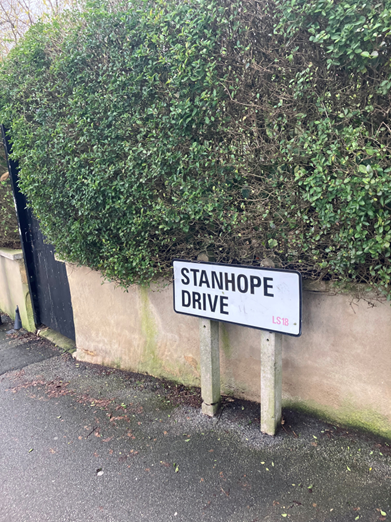
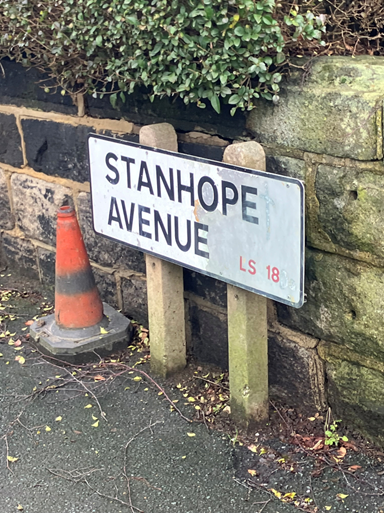
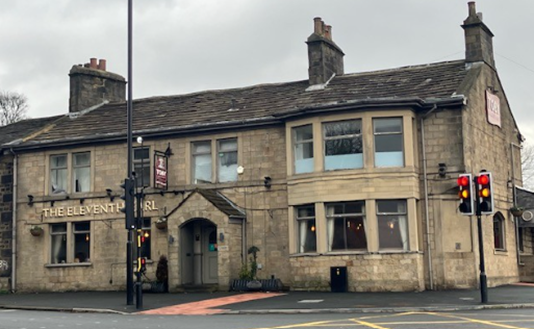
In addition, two public houses, one now demolished and one renamed as The Eleventh Earl, were given the name The Stanhope Arms, the latter being renamed in 1970 to avoid confusion with the former.
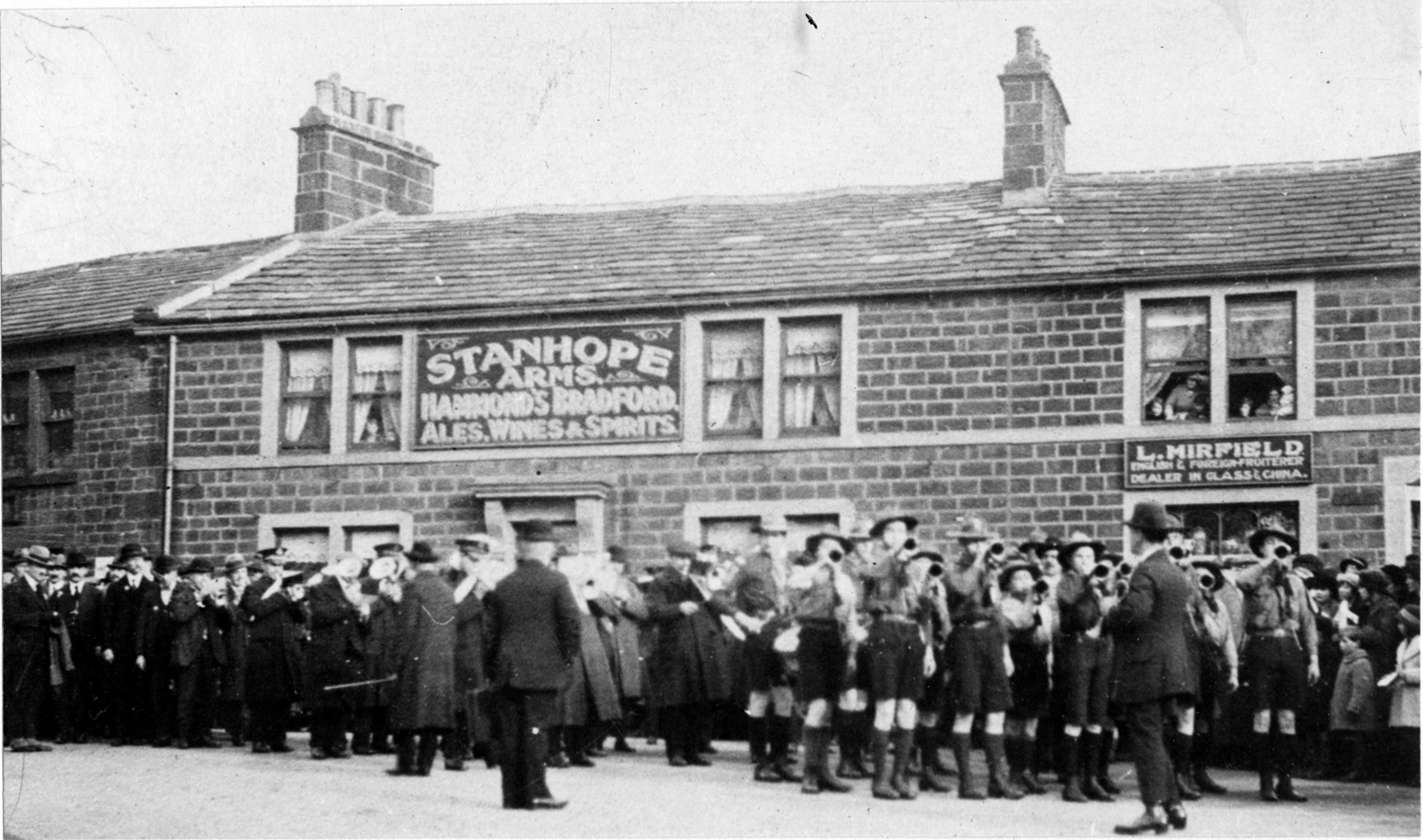
Stanhope Arms (Eleventh – Leodis)
We are fortunate that many letters and records have survived that provide detailed information about the Stanhopes of Horsforth. These include family papers in the central libraries at Bradford and Sheffield and also the book Annals of a Yorkshire House: from the papers of a macaroni & his kindred by Anna Maria Wilhelmina Stirling ( 1911 ), who was a descendent of the Spencer-Stanhope family.
A browse of the library catalogue at Central Library revealed a number of items of stock relating to the Stanhope family in addition to the above. A good starting point proved to be Stanhope, Atkinson, Haddon and Shaw: Four North Country Families by Hugh Owen ( 1985 ) L Q 920 OWE. This book provides a comprehensive history of the Stanhope family ( with detailed family trees ) and will form the basis of much of this post. As the eldest Stanhope son was named John for several generations, this post will adopt the book’s strategy of naming the Johns I, II, III, IV and V to try and avoid confusion.
John Stanhope I ( c1522 – 1593 )
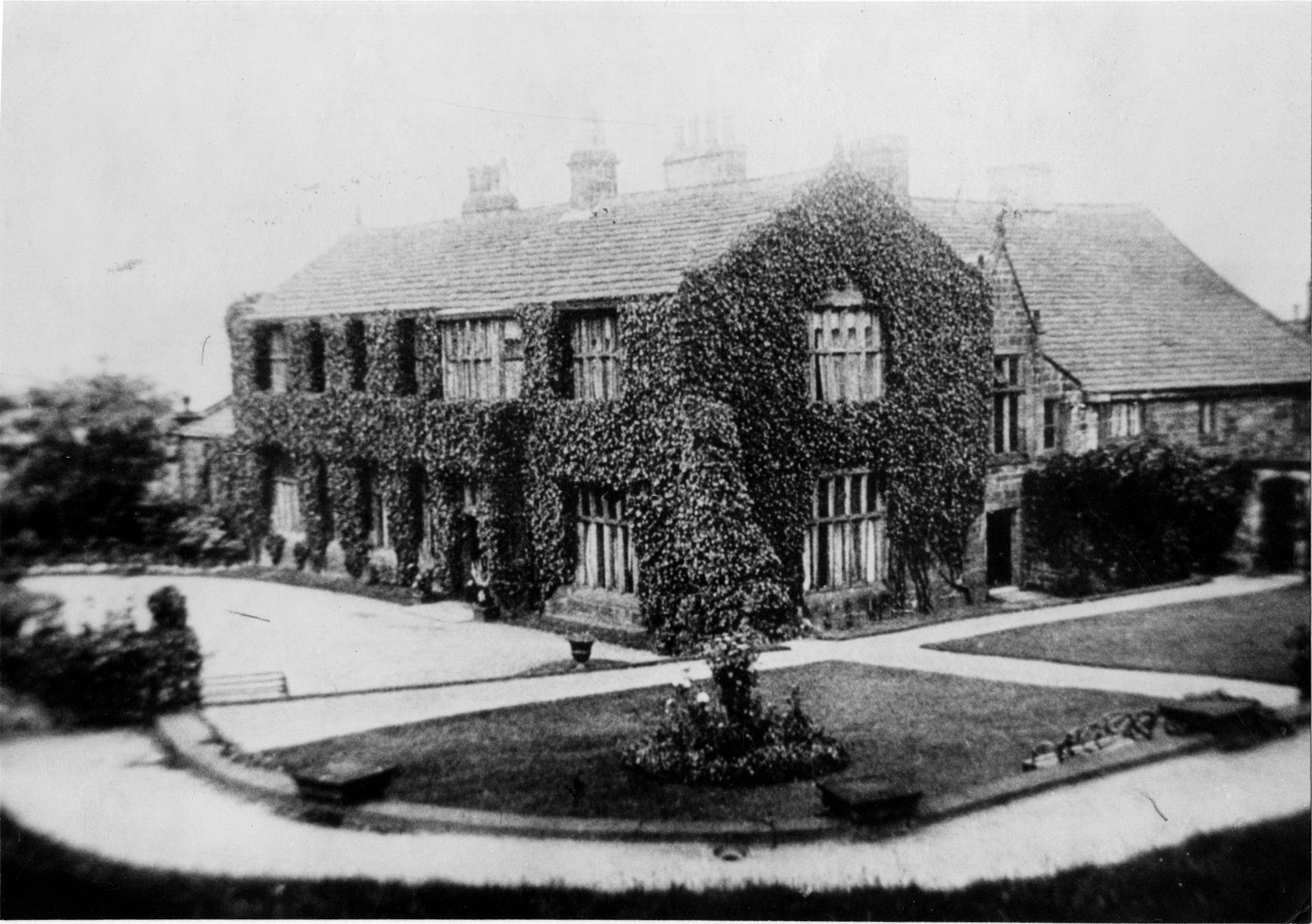
John Stanhope, Yeoman of Manchester, was living in Eccleshill Bradford when he purchased one fifth of the Manor of Horsforth in 1566. John would likely have belonged to the rural class of ‘yeoman,’ one grade lower in the social scale than a ‘gentleman.’ The yeoman would have owned or owned the lease of his land and worked it himself as opposed to the gentleman who would have employed others to work it for him. John and his family initially remained in Eccleshill after purchasing the Horsforth land and he became constable of Eccleshill in 1568 and 1576. The Stanhopes eventually made the Elizabethan Low Hall in Horsforth their home ( see previous article More Tales from the Horsforth Research Guide for more information on Low Hall ) which became the main Stanhope residence for the next hundred years. It remained in the possession of the Stanhope and then the Spencer-Stanhope family until the 1970s.
Walter Stanhope ( 1574 – 1660 )
John was succeeded by his eldest surviving son, Walter. After settling into Low Hall he soon made his name in the neighbourhood, being energetic in local affairs, the development of mineral wealth in the area, the building of bridges and roads and in parish affairs. In 1613 he was the largest contributor in Horsforth towards the cost of extending the Chapel and in 1618 became a High Constable. It is likely that his status had now extended to that of gentleman, as he was now a man of some standing and wealth. Walter was to incur royal displeasure at the time of Charles I’s coronation, which he refused to attend. He also refused the order of knighthood and in 1630 a fine of £16 was imposed for this offence. On 20 December 1642, a few months after the start of the Civil War, Walter Stanhope and his wife received an unwelcome visit from Royalist troops from Leeds, when items with a total value of £76 were plundered from the hall.
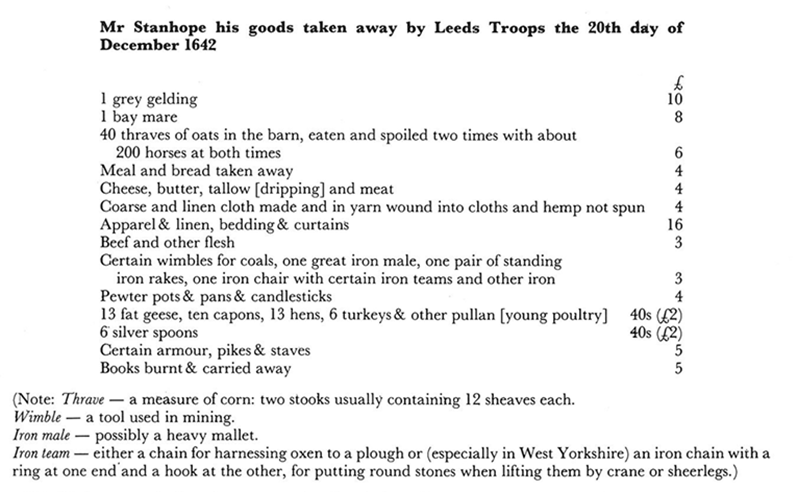
As Owen notes, with Christmas only five days away, the plundering of six turkeys was an unkind act!
The land-owning interests of the Stanhopes had by now increased greatly since their initial purchase of one fifth of the manor of Horsforth. The original purchase had given them lands scattered throughout the manor but through marriages, piece-meal purchases and careful managing of their estates they came to be recognised as Lords of the Manor by 1650. The family fortunes also prospered due to their involvement in business and law, with many, such as Walter’s successor John Stanhope II, going into the legal profession.
John Stanhope II ( 1608 – 1675 )
John II was the first of the family to be educated at University and go on to read at an Inn of Court. After the death of his first wife he became Steward of a Manor near Belfast, where he went on to remarry. Unfortunately his second wife also died and Walter was forced to flee Ireland and return home due to the Irish Rebellion of 1641. After marrying his third wife John embarked on a life of public service, filling a number of important offices in Yorkshire, including Justice of the Peace for the West Riding and Steward for a number of Manors. John does not appear to have taken an active part in the Civil War, he is not named in the warrant calling for the arrest of his father and brothers in July 1643 but it seems likely that his sympathies were with Parliament. He seems to have earned respect for his abilities as a lawyer, magistrate and administrator, and built on his father’s legal legacy, displaying professional competence. His descendants were to follow the same vocation for three generations.
John Stanhope III ( 1629 – 1694 )
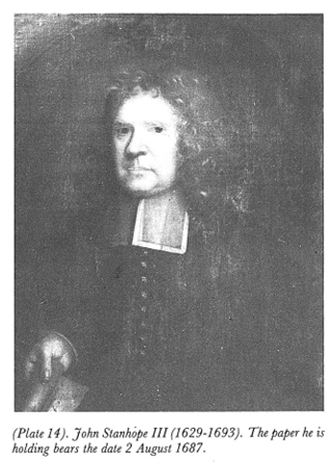
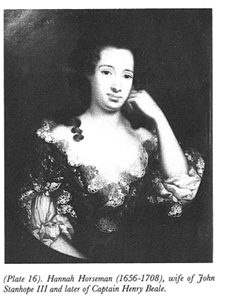
Like his father John III was a student at Gray’s Inn and on completion of his legal training remained there practising as a lawyer. He went on to transfer his legal practice to Horsforth and moved to Low Hall on the death of his father in June 1675. On 20 September 1677 he married Hannah Horseman at Ripon Cathedral. She was said to have had an uncontrollable temper and it is said that on one occasion, growing tired of her temper tantrums, he threatened to ‘clap her in prison.’ Mrs Stirling in her Annals of a Yorkshire House goes so far as to say that he invented some clever pretext for clapping the lady into jail and thus secured for himself the peace which he had been unable to enjoy in her society,’
John Stanhope IV ( 1678 – 1736 )
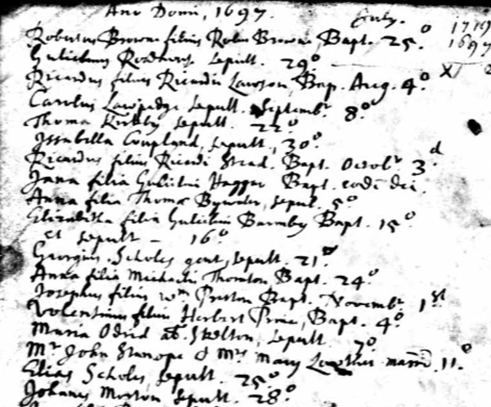
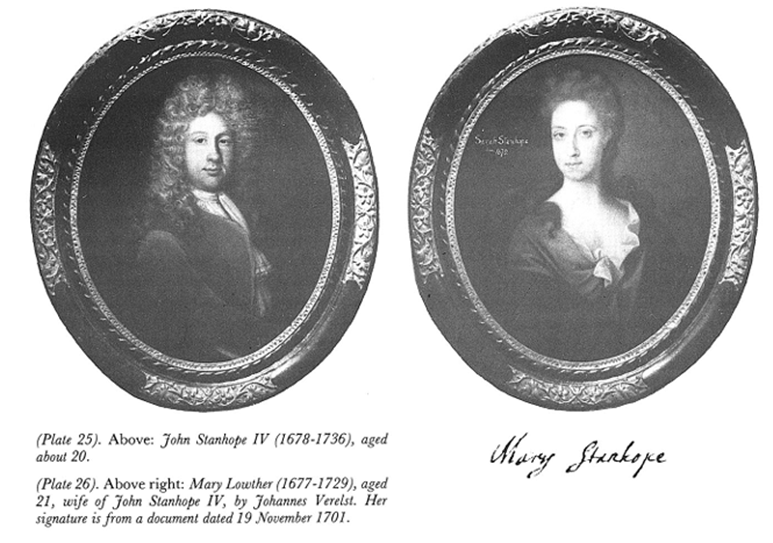
John III’seldest son and heir, John IV was born at Low Hall in June 1678. He attended Prince Henry Grammar School in Otley, then went on to Gray’s Inn and Oxford University, again going on to become a lawyer. On 11 November 1697 he married Mary Lowther of Swillington Hall at St Cuthbert’s Church, Hunslet Moor.
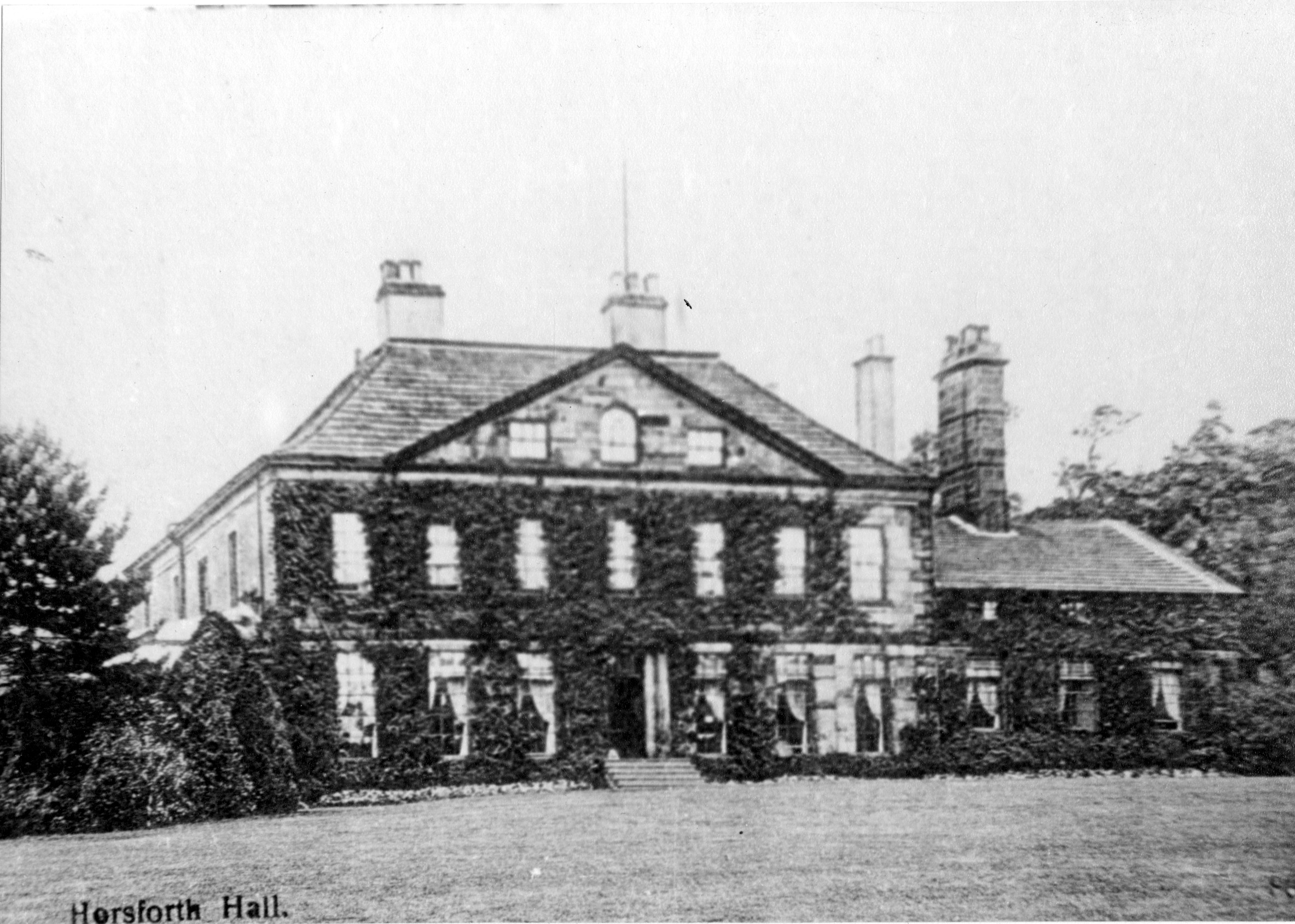
By the end of the seventeenth century John Stanhope IV was finding his existing oak panelled home old fashioned and gloomy, so he built a larger and more modern home on higher ground closer to the chapel, in what today is Hall Park.
Horsforth New Hall, as it became known, faced south east and gardens and parkland were created in front of it in a style befitting a family wishing to establish itself as landed gentry and Lords of the Manor. For more information please see A History of Hall Park 1700 – 2000, Horsforth History Guide Number 7 by Horsforth Village Publications L HOR 942.
In 1710 John and his cousin Walter Calverley built the bridge at Calverley Mill, thought to be the location of the original horse ford which gave Horsforth its name.
John Stanhope V (1702-1769)
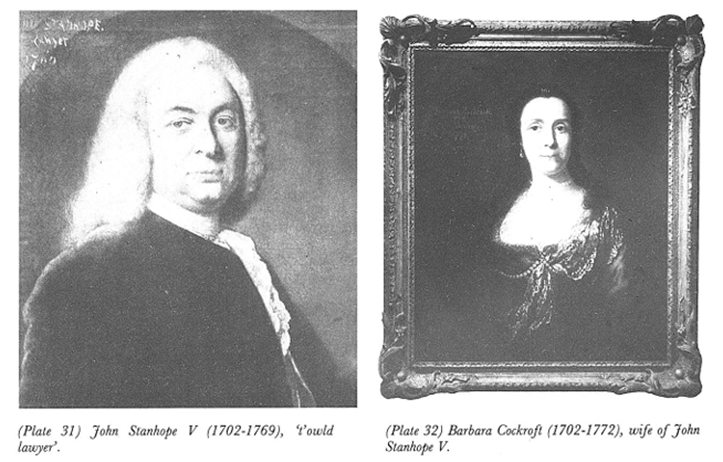
In 1736 John was succeeded by his eldest son John Stanhope V. He was the first child to be born at the new hall and after being educated at Bradford Grammar School was the fourth generation of Stanhopes to study law at Gray’s Inn. John chose to live a quiet life in Yorkshire but still conducted an active legal practice from Horsforth. He had a reputation for being a formidable barrister however, having a wide reputation in the north and being known with respect and affection throughout Yorkshire as t’owld lawyer.
In 1758 John paid £1020 for the building of the new chapel in Horsforth called the Bell Chapel. The Stanhope Memorial in St Margaret’s Church describes him as:
Learned, eloquent, powerful as an advocate. Upright, friendly, beneficent as a man. The boast of his Family. The blessing of his neighbourhood. This Chapel itself may be reckoned a monument of him. Much at whose expense and more by whose exertions in the years 1757 and 1758 it was rebuilt and greatly enlarged.
The same memorial plaque describes his widow Barbara as Childless herself, she considered as her children the poor.
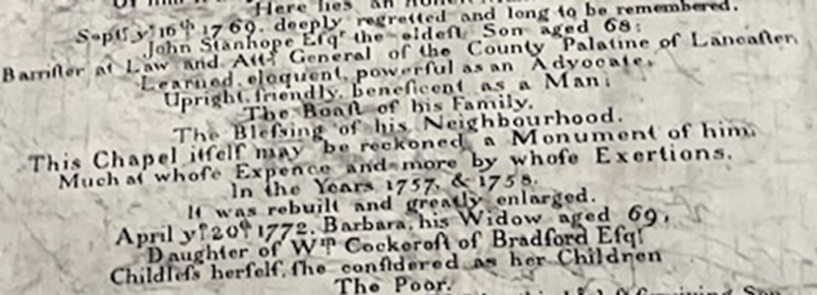
The plaque also mentions John’s brother William, who is again described in favourable terms. Unmarried and living at Brownberries, a mile from Horsforth Hall, his good age is seen as a pleasing proof that cheerfulness of temper and an unreproaching heart bring ease, respect and comfort to sooth the infirmities of old age!
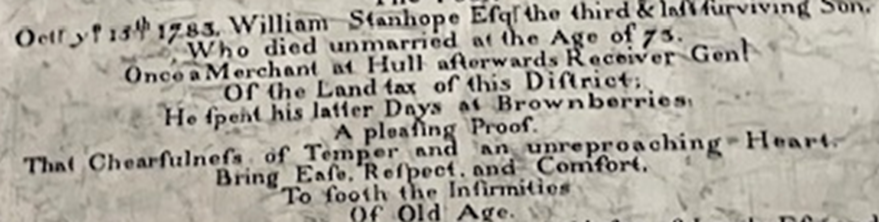
Besides financing the building of the Bell Chapel, John also had a major involvement in the building of the Leeds Liverpool Canal, along with his father and his merchant brother Walter.
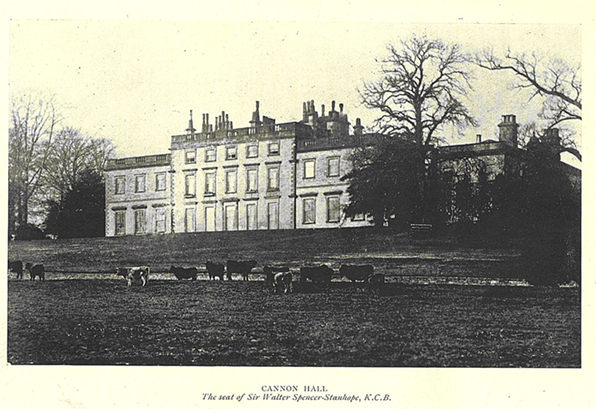
Walter’s second wife Ann was the sister of John Spencer of Cannon Hall Farm at Cawthorne near Barnsley, a more affluent estate than that at Horsforth. Because neither John Spencer nor John Stanhope V of Horsforth had surviving sons, their nephew Walter Spencer Stanhope, also known as Watty, became heir to both estates.
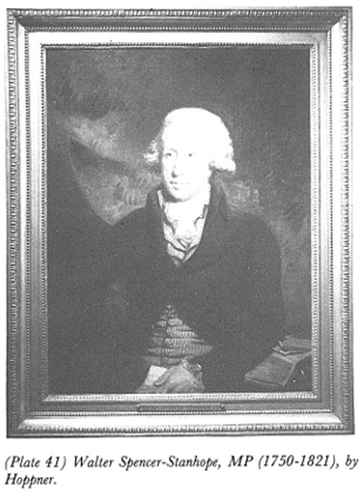
Walter ( Watty ) Spencer Stanhope ( 1749 – 1821 )
John Stanhope and John Spencer, the two uncles of the young Walter became close friends and were nominated as guardians for Watty in his father’s will. They played a large part in his upbringing, teaching him the sports of hunting, shooting and cock fighting, which they both enjoyed. After 3 years at Oxford and travels in Europe Watty became at the age of 26 the MP for Carlisle and later for other constituencies. He had an annual income from the two estates and his various business investments in the West Riding of over £9 000, a considerable sum in those days. This enabled him to make many improvements to his two estates as well as rebuilding the bell chapel and the bridge to Calverley created by his grandfather.
He was the last member of the Stanhope family to live in Horsforth Hall after he inherited it in 1769. However, after the death of his uncle John Spencer in 1775 he resided mainly at the much grander Cannon Hall, this being a more suitable seat for an MP and aspiring aristocrat. Walter also took the name of Spencer-Stanhope on inheriting the estates of his mother’s family. Until his marriage in 1783 Walter’s life was divided between politics and entertainment. He was a member of a group of young men known as Macaronis noted for their elaborate and exquisite dress and fondness for foreign speech and behaviour.
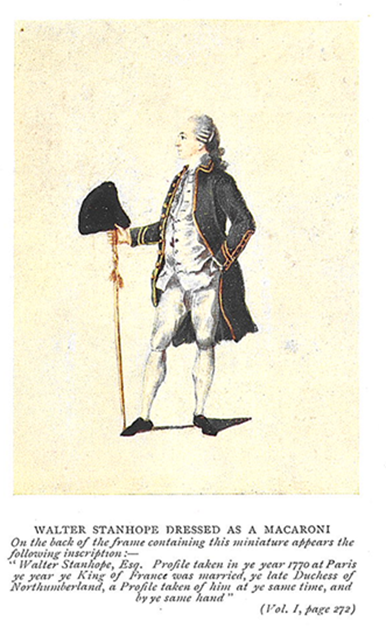
After his death in 1821 his son wrote that Walter had passed a happy life and that by his friends and acquaintances, and more especially by his poorer neighbours, he was universally beloved.
Walter was responsible for the Stanhope Memorial Plaque in St Margaret’s church which was referred to earlier and which he dedicated in memory of that part of the family of Stanhope, who have dwelt at Horsforth or Eccleshill since the reign of Queen Mary.
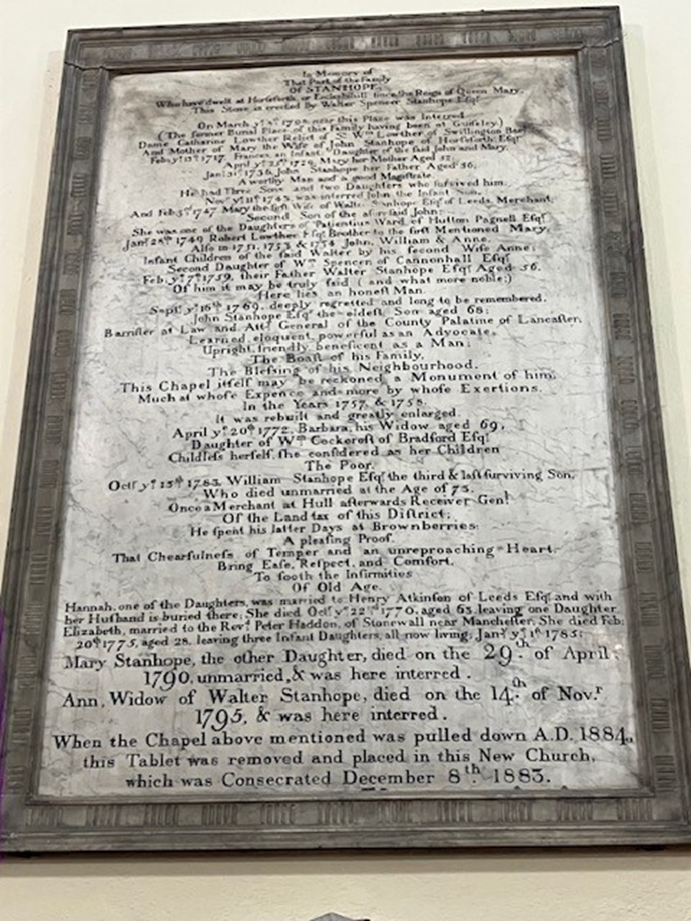
When Walter commissioned this plaque it would have hung in the Bell Chapel on the Green, but the congregation had outgrown this by the late 1800s and a larger place of worship was needed. Although now residing at Cannon Hall, the Stanhopes still had land in Horsforth and donated a field at the top of the hill for a new church to be built that could be seen from far away. They also financed the building of the new St Margaret’s Church, which began in 1876. Their association with Horsforth continued long after the last Stanhope had left Horsforth Hall and can still be seen today.
For further information on the Stanhope family and their association with Horsforth please see Stanhope, Atkinson, Haddon and Shaw: Four North Country Families by Hugh Owen ( 1985 ) L Q 920 OWE. and Annals of a Yorkshire House: from the papers of a macaroni & his kindred by Anna Wilhemina Stirling ( 1911 ) Y B STA.

