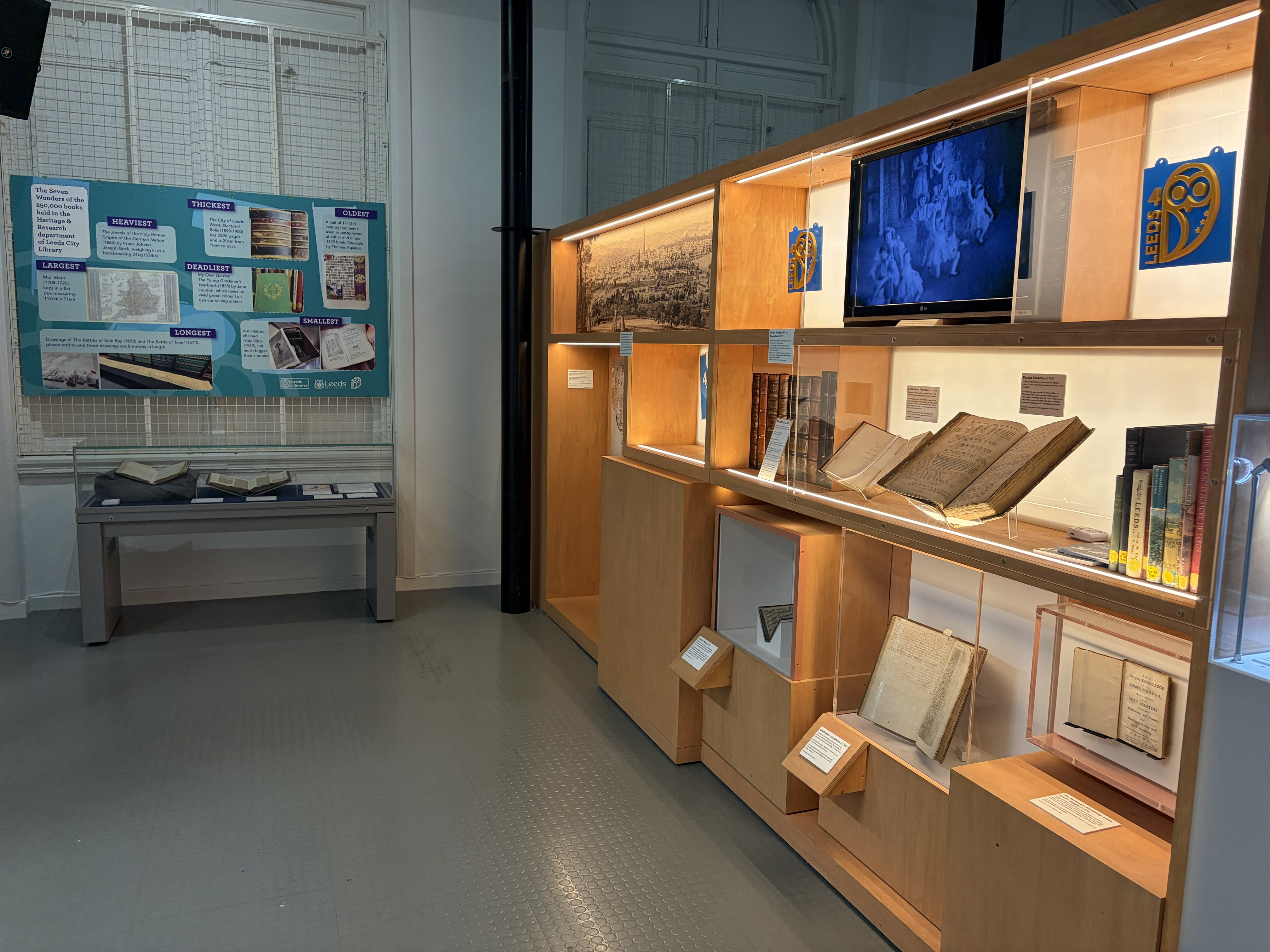
Over the next few weeks we’ll be posting a few more articles than usual, all tied to our exhibition Leodis: 400 Years of Leeds in the Leeds Libraries Collections. The exhibition can be seen in our City Library until November 11. This week, our focus is on early written histories of the town and later city…..
Cistercian Missal (1516)
A Missal is a liturgical book for the use of the Cistercian order of monks – effectively a prayer book. Kirkstall Abbey was a Cistercian monastery until its closure in 1539.
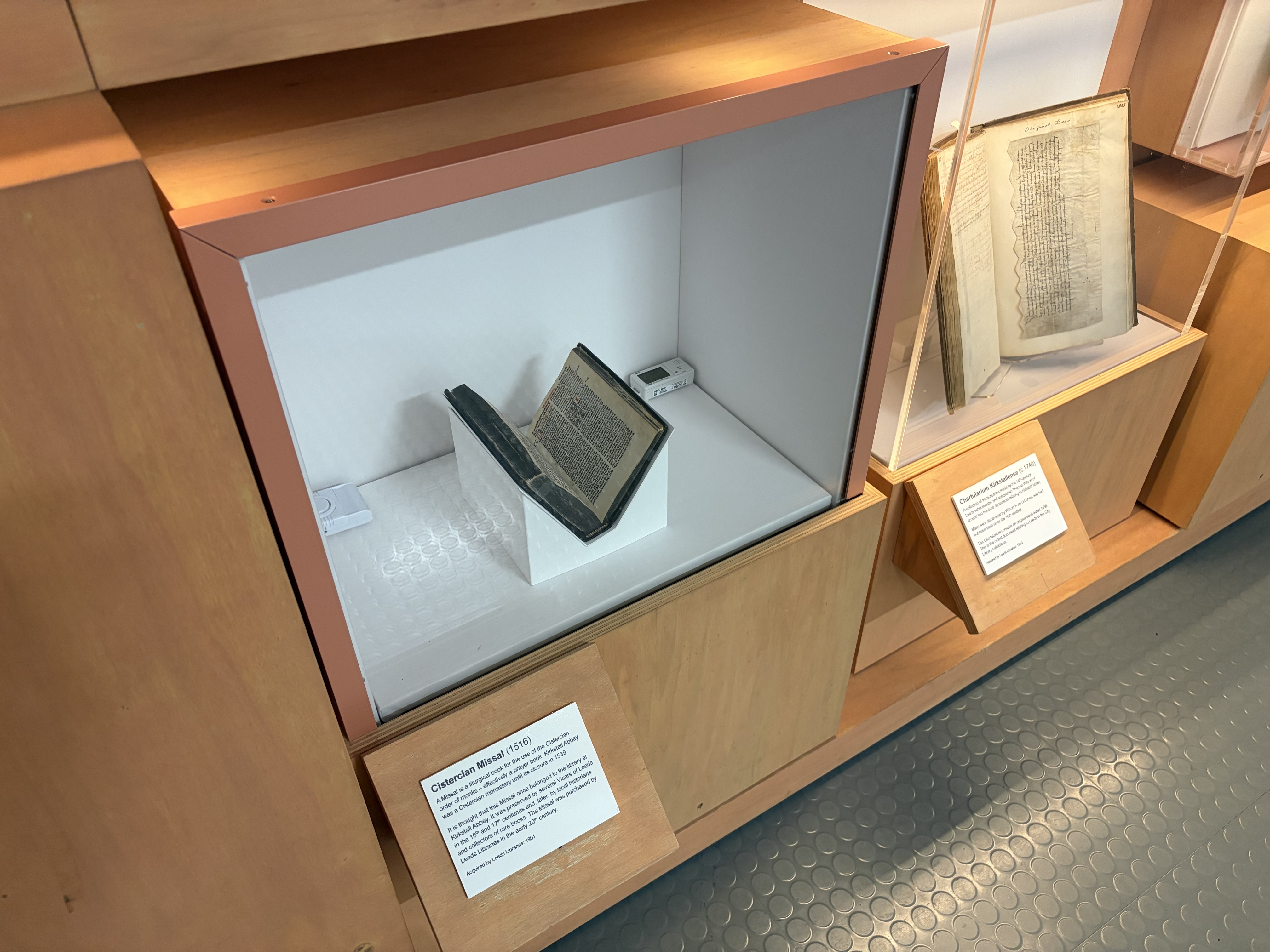
It is thought that our Missal once belonged to the library at Kirkstall Abbey. It was preserved by several Vicars of Leeds in the 16th and 17th centuries and, later, by local historians and collectors of rare books. The Missal was purchased by Leeds Libraries in the early 20th century.
Not strictly a history at all, of course – but this book was annotated by the 18th century Leeds schoolmaster and antiquarian, Thomas Wilson, an important figure in the historiography of Leeds, collecting and preserving many important manuscripts.
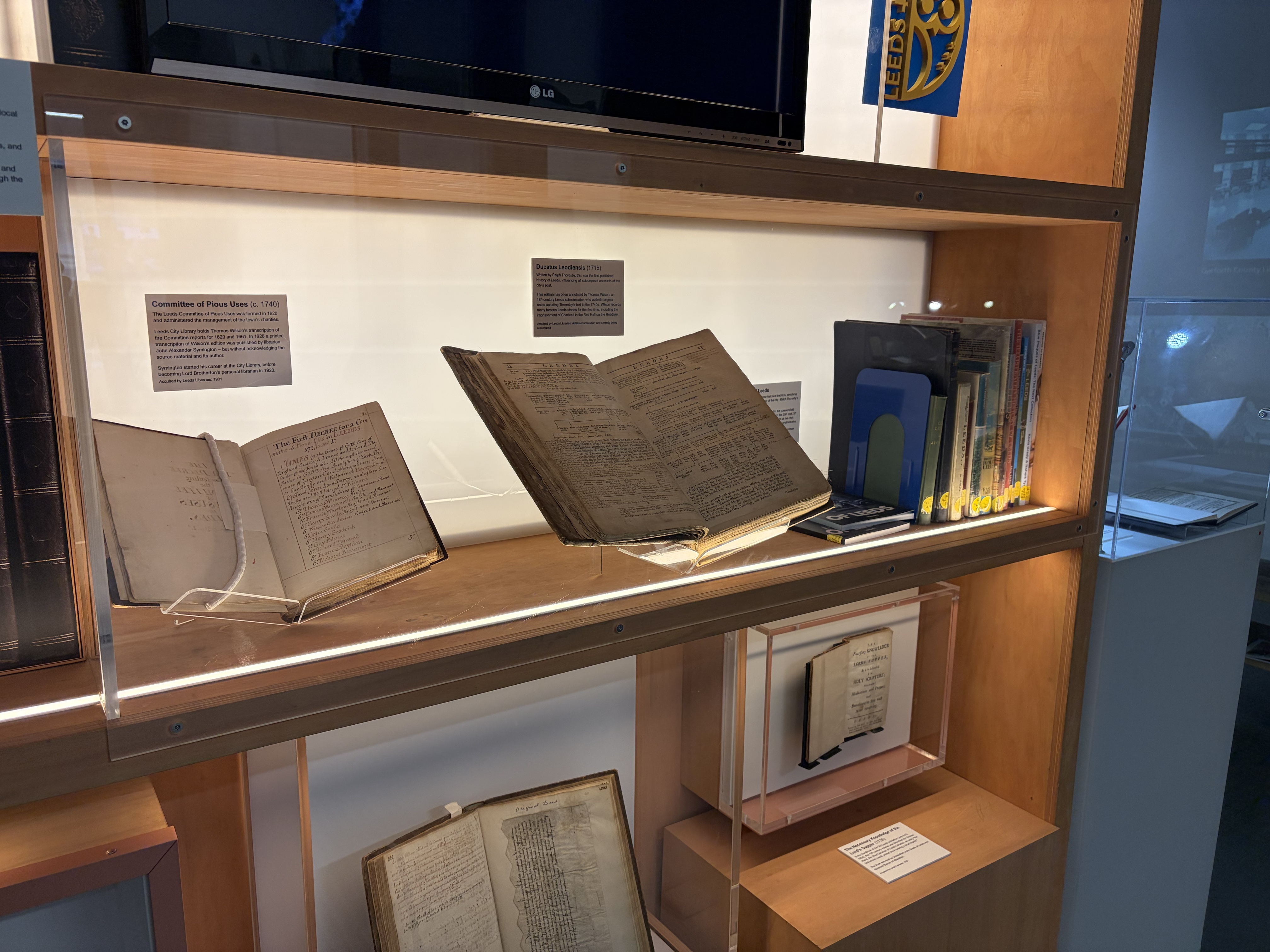
Ducatus Leodiensis (1715)
Written by Ralph Thoresby, this was the first published history of Leeds, influencing all subsequent accounts of the city’s past.
This edition has been annotated by Thomas Wilson, who added marginal notes updating Thoresby’s text to the 1740s. Wilson records many famous Leeds stories for the first time, including the imprisonment of Charles I in the Red Hall on the Headrow.
Chartularium Kirkstallense (c.1740)
A collection of transcriptions made by the 18th-century Leeds schoolmaster and antiquarian Thomas Wilson of around two hundred documents relating to Kirkstall Abbey.
Many were discovered by Wilson in an old chest and had not been seen since the 16th century.
The Chartularium contains an original deed dated 1460. This is the oldest document relating to Leeds in the City Library collections.
Committee of Pious Uses (c. 1740)
The Leeds Committee of Pious Uses was formed in 1620 and administered the management of the town’s charities.
Leeds City Library holds Thomas Wilson’s transcription of the Committee reports for 1620 and 1661. In 1926 a printed transcription of Wilson’s edition was published by librarian John Alexander Symington – but without acknowledging the source material and its author.
Symington started his career at the City Library, before becoming Lord Brotherton’s personal librarian in 1923.
The Necessary Knowledge of the Lord’s Supper (1726)
In the handbook of the Old Leeds exhibition (July 8-23, 1926), this 18th-century volume was described by Thomas Hand, the Chief Librarian of Leeds Libraries, as being “the first known Leeds printed book bearing a local imprint.”
The book was sold by booksellers John Swale of Leeds and Abraham Barber of Wakefield. Again, this is not strictly a historical work at all – but rather representative of the printing revolution that allowed antiquarians and local historians to publish their works in Leeds.
Histories of Leeds
Leeds has a rich and diverse historical tradition, stretching back to the first written history of the city – Ralph Thoresby’s Ducatus Leodiensis (1715).
Most subsequent historians followed in the contours laid down by Thoresby. Others, particularly in the 20th and 21st centuries, have looked to document aspects of the city’s past not covered by those earlier, more traditional histories.
The City Library aims to preserve a copy of every written history of Leeds.