This week on the blog we hear from guest author Struan Yallup, who brings us the tale of how a tragic accident shines a light on remarriage in Victorian Leeds – and on why you were born.
This story isn’t actually about a cat. The story only happened because of a cat. This story is about life in Victorian Leeds, particularly the experience of being widowed and remarrying.
I’ll level with you. This story is really about you. And me. And all of us. If you go back 50, 100, 200, 500,1000 years, every one of us has widows and widowers as ancestors. It’s not a pleasant thing to think about, but people died young so that I could exist. People died young so that you could exist.
Even worse, sometimes they died young in the most tragic, heartbreaking ways.
Imagine, for a moment, you are a lifelong Methodist living in Leeds in 1856. You have a keen interest in the latest scientific breakthroughs and theories. Your faith in God is beginning to be tested. On Saturday the 1st of November, you purchase a copy of the Leeds Times and take it home to read. (Click to see full list of the Central Library’s newspaper holdings for Leeds)
It is when you reach page five that you clench your fists and exclaim, “Have you no mercy, Lord? There can be no God!”
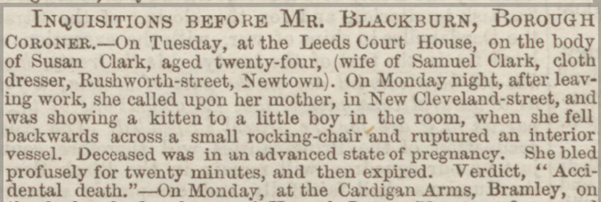
Surely, there are few things sweeter or more innocent in this world than showing a kitten to a small boy? For this woman to die in such an unfortunate way seems so unfair, particularly as she was soon to give birth. A just God would not permit this.
Susan’s tragic accident shows how fragile life was in the Victorian era, and how fragile it remains. I doubt an ambulance would have reached Susan in time if this had happened today. Her injury sounds fatal anyway.
I stumbled on this story by accident. I found it so moving, I was compelled to discover what happened next. So, I started looking into the full Clark family tree.
Susan was herself a non-conformist, born to Jacob and Hannah Teale on 19 December 1831, and christened in March the following year. Not only was she pregnant at her death, she and Samuel had a two-year-old child, William. He had been born on 12 August 1854. I wonder if William was the little boy. Had she gone to her mother’s house to collect him after work?
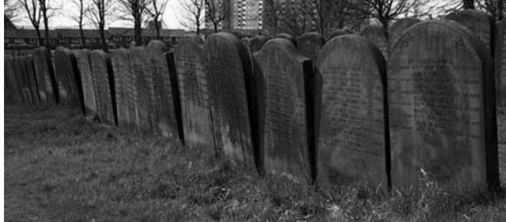
Susan was buried on 31 October 1856, in the non-conformist section of Beckett Street Cemetery. As for Samuel? It was common for widowers with young children to seek a new wife as soon as possible in Victorian times. It was not easy being a single mum or dad.
Only on 7 Aug 1859 did Samuel remarry, nearly three years on from Susan’s death. Jane Hawkins was childless and 12 years older than Samuel (he was 28). She had been widowed since 1847, when her first husband George Kirkaldy died. It is possible she and Samuel were living together before the marriage, of course.
Young William had lost his mother at two. He would lose his stepmother at 12 years of age. Jane was the second of Samuel’s wives to lie in rest at Beckett Street. She was buried in an Anglian grave on 5 Feb 1867.
Samuel was a little quicker in finding a third wife. Suspiciously quicker.
On 20 Apr 1867, just over two months after burying his wife, he married another widow, Eliza Bell. Two years Samuel’s junior, Eliza had three children with Thomas Williams before he died in 1862.
The suddenness of this wedding raises a question. Had Samuel been cheating on his older wife? I think we can see the answer on their first daughter’s baptism record. Annis was christened on 25 June 1868. But her birth is recorded as 18 November 1867.
There’s some simple maths involved here. 11 minus nine equals two. Annis was conceived in February, perhaps March 1867. Samuel’s wife had only been in the ground a matter of weeks. It’s not proof their relationship began earlier, but he was a fast mover otherwise.
Another four children followed. Frances, Samuel, Ada and George, the final birth, in 1878.
George was just six when he lost his mother Eliza on 24 June 1885. Samuel was widowed for a third time. A hat trick of wives in Beckett graves. In the 1891 census, he was listed as an iron moulder, with Samuel, Annis and George still living with him.
There are 57 family trees on Ancestry.com that have Samuel down as dying in the summer of 1904. I think they’ve all got the wrong guy (a wheelwright from Hunslet). Our Samuel is not to be found on the 1901 Census. I believe it’s far more likely that he died on 6 February 1900. (You can access Ancestry.com for free in all Leeds Libraries via our Digital Library).
I think you can guess where the 1900 death Samuel was buried. He joined his three wives in Beckett Cemetery. It was almost fifty years on from the kitten accident that claimed Susan.
And what of his first son William, who may have been the small boy? He married Esther Bickerdike on 10 July 1876 at Leeds, St Peter. Like his father, William was an iron moulder. Unlike his father, he was not widowed young.
Esther and William had 10 children together. She died in 1913 and William followed in 1920. They had many grandchildren and have many living descendants. Samuel’s children with Eliza Bell have many descendants too, all alive today because of a cat-linked accident.
The story of Samuel Clark is in no way unusual, except for the manner of his first wife’s death. But it’s certainly illustrative of how widows and widowers got on with life in Victorian Leeds.
It is also illuminating to hear from a widow at the other end of the social scale. The Earl of Cardigan, then Lady Cardigan, owned vast swathes of Leeds and West Yorkshire during Samuel Clark’s life. Her scandalous “My Recollections” was published in 1909, and is packed with barbs, gossip and warts and all stories.
As a young lady, Adeline de Horsey dismissed the protestations of her maid and visited a fortune teller on a seedy street near Westminster Bridge. The wrinkled old woman took puffs from a clay pipe, then made her prediction. Adeline would marry a widower of high position, then be widowed herself and remarry. This is how Adeline felt on her way home.
“I was quite impressed by my “fortune,” but I was a little disappointed, for like most girls I had my daydreams of a young husband, and the prospect of a widower was thus rather depressing. Strangely enough, the prediction came true, for Lord Cardigan was a widower”
Adeline was widowed in March 1868 after Cardigan was thrown from his horse. The Earl was returning home from comforting the sister of a young gamekeeper who had accidentally shot himself in the face (bad day, that one). Adeline described her experience of post-bereavement courtship thus,
“Nearly all the men who proposed to me were widowers! I was asked in marriage by Lord Sherborne, a widower with ten children, by the Duke of Leeds, who was a widower with eleven children, by Christopher Mansell Talbot, once Father of the House of Commons, also a widower with four children. Prince Soltykoff, the Duke of St. Albans, Harry Howard, and Disraeli were other widowers who proposed to me, so I suppose I must have had some unaccountable fascination for bereaved husbands.
Perhaps it was your late husband’s “fortune” they had the fascination for, M’lady? Let’s finish up by returning to the woman who inspired this blog. Susan Teale’s fate is a poignant reminder that we all owe our existence to the early deaths.
George Yallup, my paternal great-great-grandfather lost his first wife in childbirth in October 1865. Without his mother Harriet to nurture him, their newborn son died six months later. George was left with four kids to raise. He married Emma Woodrow in October 1866, a year after Harriet died, Emma bore him 10 kids, including my grandfather’s father, Ted.
My maternal grandma’s first husband, Stanley, never came back from the war. He was cut down by a sniper’s bullet in Burma, 1944. My mother was born because of that bullet.
Harriet and Stanley are not in my ancestral line. I didn’t inherit their DNA. In a strange way, though, they feel like family – almost like blood relations. They are part of who I am.
I don’t know who died young so you could exist. I pay my respects to them all the same.


I’m new to this blog and found it whilst researching The Silent Traveller in the Yorkshire Dales, by Chiang Yee. I loved the piece on that little volume! “The Kitten …” piece on how we all owe our existence to early deaths and remarriages in our family lines took me on a wondering trip through my own. Looking forward to new posts!