To mark Leeds 400 this summer, one of the activities taking place across Leeds has been a city-wide game of Trivial Pursuit with questions all about Leeds. Drawing inspiration from this, we held a series of treasures showcase events themed around the six Trivial Pursuit categories. This week, Joey talks us through items he highlighted on the themes of sports, leisure, science and nature.
Each event corresponded to two Trivial Pursuit categories – for mine these were Sports & Leisure and Science & Nature. So I dug around in our special collections to find items that could best showcase the sporting and scientific history of Leeds. There were many interesting items I couldn’t quite fit in, such as a proposal for an elevated railway to Roundhay Park and Henry Baines’ The Flora of Yorkshire, with its contributions from a young Richard Spruce. But here’s what I chose.
Sport and Leisure
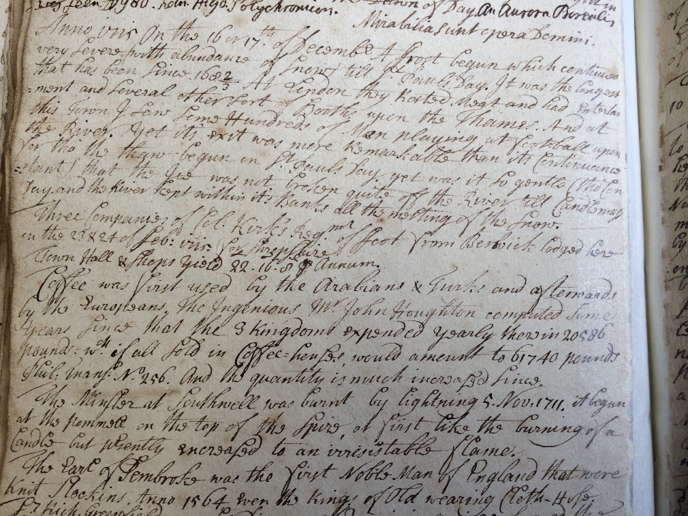
John Lucas Memoranda Book [1712 – 1750]
This 18th century diary – or ‘memoranda book’ – was compiled by John Lucas, Master of the Leeds Charity School, and friend of renowned Leeds antiquarian Ralph Thoresby. John Lucas was born in 1684 in Warton, Lancashire, and he worked for thirty years on a detailed History of Warton Parish which touches on everything from local wedding traditions to the fish of Morecambe Bay. When Lucas moved to Leeds he worked as a schoolmaster, first at Leeds Grammar School, then at St John’s Charity School, where he was closely associated with Thomas Wilson, another Leeds antiquarian and schoolmaster.
Lucas used his memoranda book to note interesting occurrences, both nationally and locally. I chose it for the treasures showcase because it contains the first report of a game of football in Leeds. This is from December 1715, when he writes that groups of men are playing ‘foot-ball’ on the ice of the frozen River Aire. He also mentions horse racing at Chapeltown and Temple Newsam, and gives the first report of a person of African descent in Leeds (Thomas Mawson). The memoranda book can be viewed in our main Leeds 400 exhibition. For a more legible version of Leeds-related sections of the book, we have copies of a transcript created by the Thoresby Society.
Cecil Slingsby – Norway, the northern playground: sketches of climbing and mountain exploration in Norway between 1872 and 1903. (1904)
This year marks the 150th anniversary of Wm Cecil Slingsby’s ascent of Store Skagastølstind, Norway’s third highest and most highly-sought peak. Slingsby first sighted the peak in 1872, returning repeatedly to the area until he made his successful ascent in 1876. Slingsby had approached the mountain together with Norwegian climber Emanuel Mohn and reindeer-hunter Knut Lykken, passing fresh bear tracks crossing a glacier along the way. When they reached a high pass before the final intimidating wall, Mohn and Lykken both refused to continue, leaving Slingsby to complete the ascent alone. He was subsequently given the epithet “father of Norwegian mountaineering,” and celebrations took place in Norway this year to mark the anniversary.
Slingsby lived at Carleton-in-Craven near Skipton. He came from a wealthy cotton mill-owning family. In his youth during the American Civil War, when cotton exports from the southern states were blockaded, he identified new cotton sources from India that could replace the blockaded America cotton.
Many years later, Slingsby was President of the Leeds-based Yorkshire Ramblers’ Club from 1893 to 1903. He gifted a copy of his book Norway, the Northern Playground to the Yorkshire Ramblers’ Club, which we now hold as one of a number of mountaineering-related items inherited from the club. We also have a modestly-named notebook of newspaper cuttings taken by Slingsby, Little Adventures on Low Mountains, and a copy of Baedecker’s guide to Norway and Sweden, based in part on information contributed by Slingsby, which contains a letter from Karl Baedecker to Slingsby.
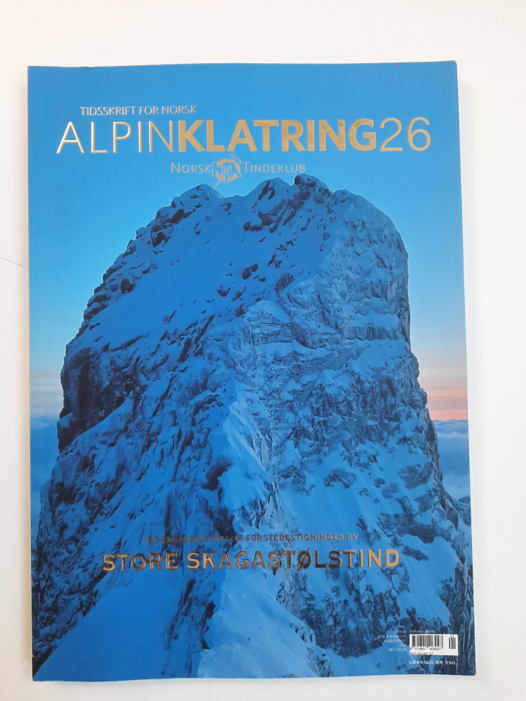
Norwegian mountaineering journal Alpinklatring celebrates the 150th anniversary of Slingsby’s Store Skagastølstind ascent.
Scrapbook of Harry Croft (secretary of Leeds St Marks Harriers athletics club) [1930s-1950s]
Harry Croft was Secretary of the Leeds St Mark’s Harriers for around 30 years from the mid-1920s to the mid-1950s. He ran for the club and in 1957 was elected President of Yorkshire Cross Country Association. Croft collected an incredible array of newspaper cuttings relating to club members and other sporting activity, as detailed in Karen Downham’s article on Secret Library Leeds.
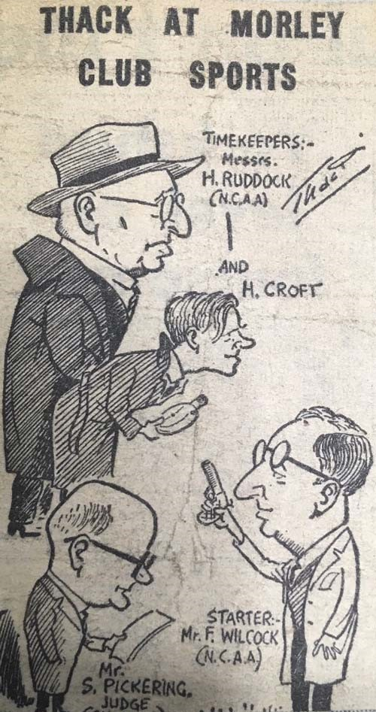
A 1949 cartoon shows Harry Croft officiating as a timekeeper at a meet alongside other race officials.
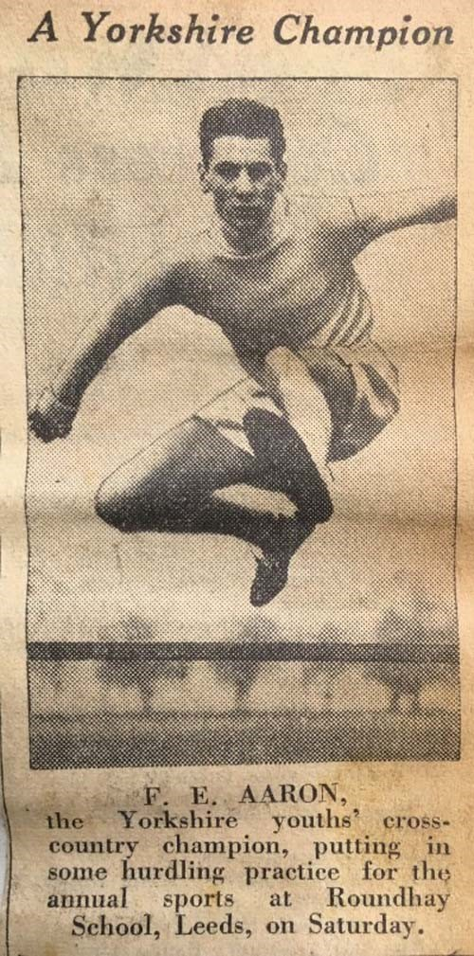
Club members represented in the scrapbook include Joseph Fozard, the ‘oldest member’ of the club, who ran for St Mark’s Harriers for over 50 years, until his death age 72 in 1940. Also prominent in the scrapbook are the Aaron family. Benjamin Aaron became club President in 1949, having been active in the club for over 35 years. His son Frank ran for Roundhay School from the age of 11, won the Leeds Youth Championship aged 15, 16 and 17, and in 1954 was given the honour of opening the new athletics track at Temple Newsam. Frank’s brother Arthur is well known as the only Leeds recipient of the Victoria Cross during WWII, and is the subject of a sculpture by Graham Ibbeson which can be seen on the roundabout at the bottom of Eastgate.
1948 Test Match map for Leeds car parking
This map was produced by the Leeds City Police to show access routes for car parking for the Fourth Test between England and Australia in 1948. In winning the match at Headingley, Australia set a world record for the highest victorious runchase in Test history, chasing 404 runs to gain an unbeatable 3-0 lead in the 1948 Ashes series.
The attendance of 158,000 was the highest of any UK test match. Yorkshire batsman Len Hutton opened the batting for England, after he had been controversially omitted from the team in the previous Test. But it was Australia who stepped up on the final day of the match, eventually winning by seven wickets with 15 minutes remaining.
One thing I particularly like about the map is the North arrow, which is shaped like a cricket bat. And as anyone who has been in the vicinity of Headingley on a match day knows, parking in the area can still be difficult.
Marching Altogether / The Square Ball / The Hanging Sheep
Independent from the clubs’ official materials and produced by fans in a DIY fashion, football fanzines took off in the 1970s and became a breeding ground for popular culture. With their unsanctioned viewpoints, fanzines were full of articles like The Square Ball’s ’10 Alternative Ways To Get To See Leeds At Home, If You Can’t Afford A Season Ticket.’ Irvine Welsh even wrote for the Hibs Monthly fanzine while creating Trainspotting.
The first ever zines were made by sci-fi fans in the 1930s, but in the 70s the ethos of the punk era lead football fanzines to flourish, along with all sorts of zines connected to the underground music scene. Leeds United fans have created everything from the longstanding The Square Ball to obscure projects like Tomato Soup and Lentils, the ‘Official Leeds and Arbroath Football Fanzine’, of which only one edition was ever made. For the treasures showcase we collated a bunch of editions of Marching Altogether, The Square Ball, and The Hanging Sheep.
Science and Nature
Joseph Priestley – The History and Present State of Discoveries relating to Vision, Light, and Colours (1772)
Scientist, radical preacher and political theorist, Priestley was born in Birstall and had close links to Leeds, moving here in 1767 to become Minister to the dissenting congregation of Mill Hill Chapel. Priestley converted the chapel to a Unitarian theology, which was at the time considered dangerously radical.
Priestley has a particular importance to the history of libraries in Leeds. He was the first secretary of the Leeds Library and the likely driving force behind its establishment. Founded in 1768, in an era long before the 1850 Public Libraries Act, this is the oldest surviving subscription library of its kind in the UK, and has existed in its Commercial Street premises since 1808.
Our showcased book, Vision, Light and Colours was published by Priestley in 1772. This was a follow-up to his 1767 book History and Present State of Electricity. Originally these two volumes were planned to mark the start of a series of works encompassing all branches of experimental philosophy, but Priestley abandoned the project due to poor sales. Instead, he left Leeds in 1773, becoming tutor to the children of William Petty, a future Prime Minister. The following year he made his celebrated discovery of “dephlogisticated air”, or as we now call it, oxygen. Among his other scientific breakthroughs he is credited with developing the process that led to carbonated water. Eventually, with his support for the French revolution, Priestley was forced to leave the UK and move to America.
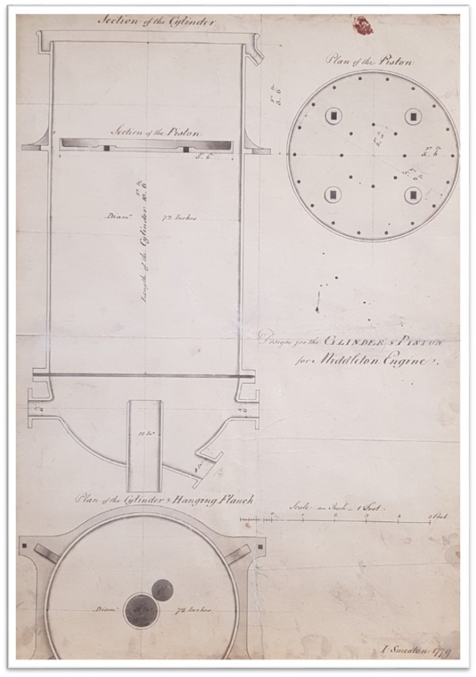
John Smeaton – plans for the Middleton engine. (1791)
Born at Austhorpe near Leeds, John Smeaton became known as England’s first civil engineer, famed for his design of the Eddystone Lighthouse in Cornwall among many other projects. He made this set of plans for a stationary steam engine in a pumping house at Middleton Colliery. There are six technical drawings covering different aspects of the engine and pumping house. Five of these bear Smeaton’s signature and appear to be genuine originals from his studio, although it’s possible the inking may have been done by one of his assistants. The final drawing is in a different style and may be an original by Matthew Murray.
Matthew Murray was another prominent Leeds engineer. In 1812 he built Salamanca, the world’s first commercially successful locomotive, which also served the Middleton Colliery. A slightly lesser known fact about Murray is that he built Holbeck Lodge, also known as ‘Steam Hall’ due to its innovative heating system. The is the house with a beautiful garden full of purple irises that a 1915 YEP reporter was so happy to discover on a rail journey through Holbeck.
Rebecca Hey – Sylvan Musings: or, The spirit of the woods (1849)
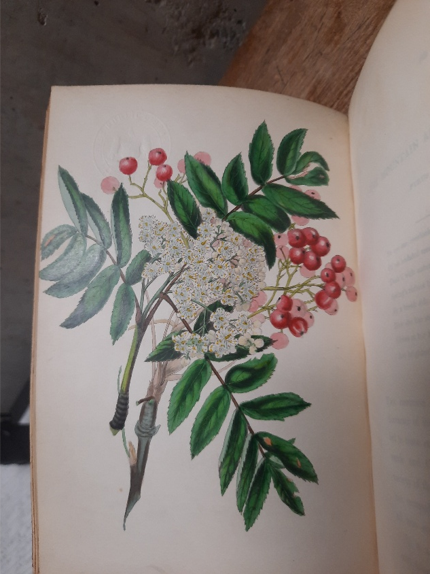
Artist, poet and naturalist Rebecca Hey (née Roberts) was born in Leeds in 1797, baptised at St Peter’s. Her second book, Sylvan Musings, is perhaps the world’s first encyclopaedia of trees, written at a time when it was rare for women to publish on scientific topics under their own name. Each chapter starts with a painting, followed by botanical notes and poetry concerning a particular tree species, in which she encourages us “partake the enthusiasm of the writer towards the whole leafy race.”
Another of her books, The Moral of Flowers, is part of our Gott Bequest, a collection of some 600 botanical works donated to Leeds Libraries by benefactor Beryl Gott. Unlike in Sylvan Musings, the paintings in this book are by William Clark.
Photographs of Unhealthy areas: Vol. 1 (1901)
You might think it unlikely for there to be any personal link between a book of botanical artworks and an urban regeneration scheme, but look closely and the links are there. Hey’s husband William was principal surgeon at the LGI and set up Leeds School of Medicine in 1831. His name appears at the top of a list of surgeons in an 1833 board of health report by Robert Baker, in which they argue that lack of drainage, sewerage and paving are key attributing factors in a recent cholera outbreak. This was before John Snow’s famous 1854 map of Soho which aided his discovery that cholera is spread by contaminated water supplies.
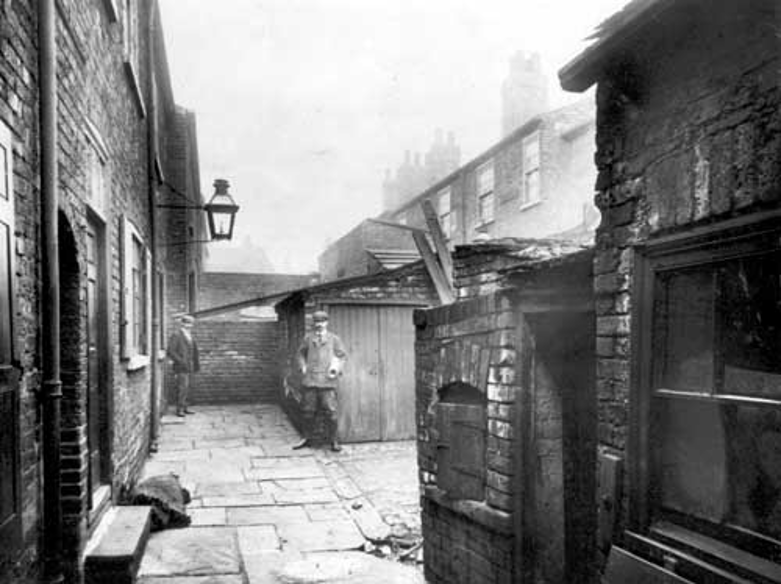
Some decades later, arguments for urban improvement were still gaining ground, and in 1890 the Housing of the Working Classes Act empowered local authorities to condemn unsanitary ‘slum’ housing, purchase the land and finance new housing. ‘Unhealthy areas’ were classified, including the Quarry Hill area in Leeds. A set of photographs were taken in 1901 of the properties of petitioners within these areas. These give us a unique snapshot of Leeds urban fabric.
Over the next few years, the Leeds Corporation Sanitary Committee resolved to demolish many of these properties, starting a process of urban renewal which would eventually lead to the construction of the Quarry Hill flats.
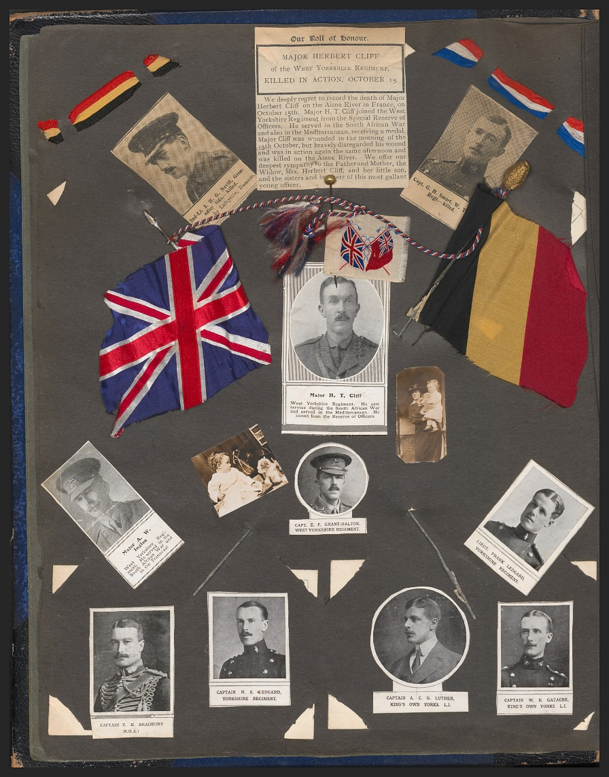
Gledhow Hall Hospital, 1915-1919, Lady Nussey
In keeping with the medical theme, our last item is a scrapbook from Gledhow Hall Hospital, which is packed full of letters, photographs and other assorted ephemera from the First World War years.
Edith Maud Cliff, also known as Lady Nussey, was Commandant of Gledhow Hall Hospital during the Great War. She began training as a Voluntary Aid Detachment Nurse in 1911; this was an organisation set up by the British Red Cross Society and the Order of St John, composed of ladies of independent means who cared for ill and wounded soldiers. Her cousin, Lord Airedale, offered the family estate at Gledhow Hall to be used as a military hospital during the war and Miss Cliff was appointed as Commandant.
During 1915-1919 she collected a scrapbook of photographs, letters, and articles relating to life at the hospital, giving us a tantalising snapshot of life during the First World War. She later married Sir Thomas Willans Nussey, whose sister Hilda had been a nurse at Gledhow Hall.